
 Application Data
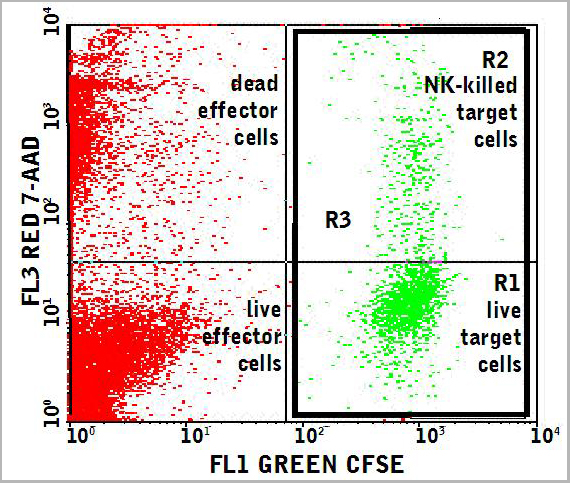
(As all target cellswere initiallystained green, theentire populationcan be counted inR3=R2+R1. After theeffector cells andred live/dead stainwere added, all thedead target cellswere stained red, shifting them up the Y-axis (R2), clearly distinguishing themfrom the live target cells (R1). (Live effector cells are at lower left, dead effectorcells are in upper left). Using the Basic Cytotoxicity Test, the analysis would becomplete (and R2 would be the maroon line above). However, ICT's TotalCytotoxicity Kit includes an additional caspase reagent to concurrently assessapoptosis (which is the blue line above). To complete the analysis using theTotal Cytotoxicity Test, further analyze R1 and R2 to isolate apoptotic cells.)
Application Data
(As all target cellswere initiallystained green, theentire populationcan be counted inR3=R2+R1. After theeffector cells andred live/dead stainwere added, all thedead target cellswere stained red, shifting them up the Y-axis (R2), clearly distinguishing themfrom the live target cells (R1). (Live effector cells are at lower left, dead effectorcells are in upper left). Using the Basic Cytotoxicity Test, the analysis would becomplete (and R2 would be the maroon line above). However, ICT's TotalCytotoxicity Kit includes an additional caspase reagent to concurrently assessapoptosis (which is the blue line above). To complete the analysis using theTotal Cytotoxicity Test, further analyze R1 and R2 to isolate apoptotic cells.)
Cytotoxicity Assay Kit
Total Cytotoxicity Test Assay Kit
Other Kit Components at 2 - 8 degree C
Application Data
(As all target cellswere initiallystained green, theentire populationcan be counted inR3=R2+R1. After theeffector cells andred live/dead stainwere added, all thedead target cellswere stained red, shifting them up the Y-axis (R2), clearly distinguishing themfrom the live target cells (R1). (Live effector cells are at lower left, dead effectorcells are in upper left). Using the Basic Cytotoxicity Test, the analysis would becomplete (and R2 would be the maroon line above). However, ICT's TotalCytotoxicity Kit includes an additional caspase reagent to concurrently assessapoptosis (which is the blue line above). To complete the analysis using theTotal Cytotoxicity Test, further analyze R1 and R2 to isolate apoptotic cells.)
Application Data
(As all target cellswere initiallystained green, theentire populationcan be counted inR3=R2+R1. After theeffector cells andred live/dead stainwere added, all thedead target cellswere stained red, shifting them up the Y-axis (R2), clearly distinguishing themfrom the live target cells (R1). (Live effector cells are at lower left, dead effectorcells are in upper left). Using the Basic Cytotoxicity Test, the analysis would becomplete (and R2 would be the maroon line above). However, ICT's TotalCytotoxicity Kit includes an additional caspase reagent to concurrently assessapoptosis (which is the blue line above). To complete the analysis using theTotal Cytotoxicity Test, further analyze R1 and R2 to isolate apoptotic cells.)
Application Data
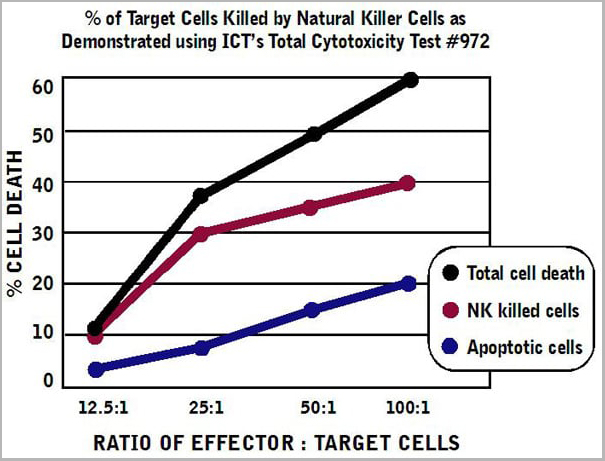
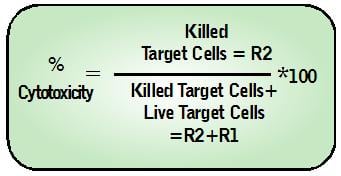
(ICT's TotalCytotoxicity Testcan be usedto easily analyzethe activity ofnatural killer(NK) cells. Basedon flowcytometric data,the formula[R2/(R2+R1)] X 100 was used tocalculate cytotoxicity. NK-killed necrotic cells are shown in the maroon line, andapoptotic cells are shown as the blue line. When added together, the total levelof cell death is calculated as the black line. In this example, cytotoxicityincreased as more NK effector cells were combined with target cells. As the ratioof Effector:Target-cells increased from 12.5:1 to 100:1 the percentage of targetcells dying increased from 11% to 60%.)
Application Data
(ICT's TotalCytotoxicity Testcan be usedto easily analyzethe activity ofnatural killer(NK) cells. Basedon flowcytometric data,the formula[R2/(R2+R1)] X 100 was used tocalculate cytotoxicity. NK-killed necrotic cells are shown in the maroon line, andapoptotic cells are shown as the blue line. When added together, the total levelof cell death is calculated as the black line. In this example, cytotoxicityincreased as more NK effector cells were combined with target cells. As the ratioof Effector:Target-cells increased from 12.5:1 to 100:1 the percentage of targetcells dying increased from 11% to 60%.)
Customer Reviews
Loading reviews...
Share Your Experience
Similar Products
Product Notes
The Cytotoxicity (Catalog #AAA12387) is an Assay Kit and is intended for research purposes only. The product is available for immediate purchase. It is sometimes possible for the material contained within the vial of "Cytotoxicity, Assay Kit" to become dispersed throughout the inside of the vial, particularly around the seal of said vial, during shipment and storage. We always suggest centrifuging these vials to consolidate all of the liquid away from the lid and to the bottom of the vial prior to opening. Please be advised that certain products may require dry ice for shipping and that, if this is the case, an additional dry ice fee may also be required.Precautions
All products in the AAA Biotech catalog are strictly for research-use only, and are absolutely not suitable for use in any sort of medical, therapeutic, prophylactic, in-vivo, or diagnostic capacity. By purchasing a product from AAA Biotech, you are explicitly certifying that said products will be properly tested and used in line with industry standard. AAA Biotech and its authorized distribution partners reserve the right to refuse to fulfill any order if we have any indication that a purchaser may be intending to use a product outside of our accepted criteria.Disclaimer
Though we do strive to guarantee the information represented in this datasheet, AAA Biotech cannot be held responsible for any oversights or imprecisions. AAA Biotech reserves the right to adjust any aspect of this datasheet at any time and without notice. It is the responsibility of the customer to inform AAA Biotech of any product performance issues observed or experienced within 30 days of receipt of said product. To see additional details on this or any of our other policies, please see our Terms & Conditions page.Frequently Asked Questions
What is the best assay for cytotoxicity?
LDH (lactate dehydrogenase) release assays are among the most reliable methods for measuring cytotoxicity. They detect enzyme leakage from damaged cells, providing quantitative, non-radioactive results. Other methods include MTT, trypan blue exclusion, and flow cytometry, each with specific advantages depending on experimental requirements.
What does this cytotoxicity kit measure?
LDH cytotoxicity kits measure lactate dehydrogenase enzyme released from damaged or lysed cells into culture supernatant. The enzyme catalyzes NADH oxidation, creating measurable optical signals. Kit readings correlate directly with cell membrane integrity and cell death rates.
What types of samples or treatments can be tested?
LDH assays accommodate diverse samples, including drug-treated cells, immunotoxicity models, chemotherapy screening, viral infection studies, and biomaterial biocompatibility testing. Applications span cancer research, pharmaceutical development, vaccine safety assessment, and nanomaterial toxicology evaluations.
What detection method does the kit use?
Most LDH cytotoxicity kits use colorimetric detection with absorbance measurement at 490-560 nm wavelengths. The assay measures NADH consumption via enzymatic reaction, producing colored formazan products. Results correlate with LDH enzyme concentration and cell damage magnitude.
What are the typical components of an LDH cytotoxicity assay kit?
Standard kits include reaction buffer, LDH substrate, catalyst enzyme (NAD⁺ or similar), and positive control (cell lysis solution). Some formulations include a stop reagent for endpoint assays. Components are pre-calibrated for 96-well plate format compatibility with standard plate readers.
How long does the assay take to complete?
Typical LDH cytotoxicity assays require 2-4 hours total time: 18-24 hours cell culture/treatment, 15-30 minutes sample preparation, and 30-60 minutes enzymatic reaction with absorbance reading. Express assay protocols reduce reaction time to 10-15 minutes for rapid screening applications.
What storage conditions are required for the kit?
LDH cytotoxicity kit components are typically stored at 2-8°C in original, sealed packaging. Most kits remain stable for 12-24 months under proper conditions. Some formulations may contain components requiring frozen storage at -20°C. Verify specific storage requirements on product packaging.
Item has been added to Shopping Cart
If you are ready to order, navigate to Shopping Cart and get ready to checkout.