Native Protein Characterization: Techniques, Applications, and Best Practices for Researchers
 Cynthia
14 min read
Cynthia
14 min read
In this Article
- What Is Native Protein Characterization?
- What Information Can Native Characterization Reveal?
- What Native Characterization Cannot Tell You VS The Alternatives
- Which Techniques Are Used for Native Protein Characterization?
- How Do Researchers Choose the Right Technique?
- Native vs Denaturing Protein Characterization
- Common Challenges and How to Overcome Them
- Need Support With Native Protein Characterization?


All of the products listed in AAA Biotech’s catalog are strictly for research-use only (RUO).
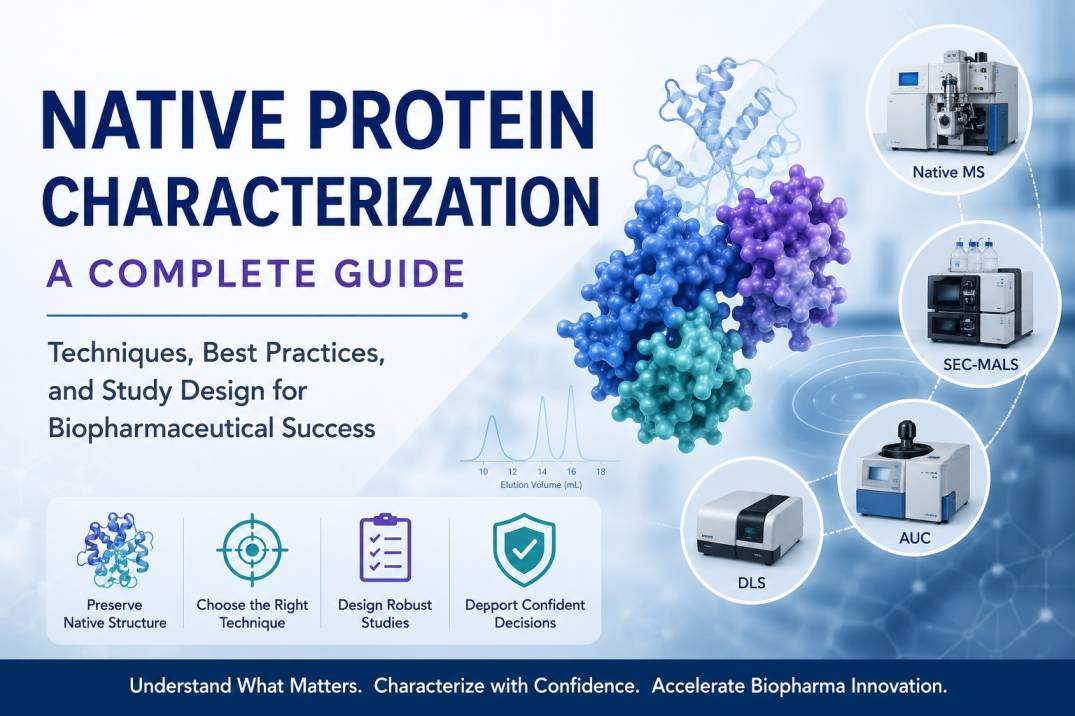
Native Protein Characterization at a Glance
Native protein characterization is the study of proteins under conditions that preserve their natural structure, interactions, and function. Unlike denaturing approaches, native methods keep proteins intact, allowing researchers to observe how they behave in a biological context.
Commonly used techniques include native mass spectrometry (native MS), size-exclusion chromatography coupled to multi-angle light scattering (SEC-MALS), analytical ultracentrifugation (AUC), dynamic light scattering (DLS), native PAGE, and circular dichroism (CD). The most appropriate method depends on the scientific question being addressed, the characteristics of the sample, and whether regulatory-grade data is required.
How do you study a protein without changing the very thing you're trying to understand?
It is a question many researchers come across sooner or later. After all, proteins are sensitive molecules.
The conditions used during analysis can sometimes cause them to unfold, lose important interactions, or behave differently from how they would naturally.
What Is Native Protein Characterization?
Native protein characterization refers to a suite of analytical approaches designed to study proteins while preserving their natural, folded state.
Rather than disrupting the protein's architecture before measurement, native methods maintain the structural and biochemical conditions that allow the protein to retain its higher-order organization, non-covalent interactions, and biological activity.
This is distinct from classical analytical workflows that intentionally denature proteins, such as SDS-PAGE, which unfolds polypeptides to separate them purely by mass.
Native characterization instead prioritizes the question: what does this protein actually look like and how does it behave under biologically relevant conditions?
Understanding Native Conditions
Native conditions typically mean maintaining physiological or near-physiological pH, ionic strength, and temperature.
For most proteins, this means working in aqueous buffer at pH values between 6.5 and 8.0, in the presence of appropriate salts, and avoiding denaturing additives such as urea, guanidine hydrochloride, or detergents that would disrupt hydrophobic cores or strip away binding partners.
The goal is to preserve the protein in a state that is as close as possible to how it exists in the cell or in a formulated biopharmaceutical product.
What Makes Native Characterization Different?
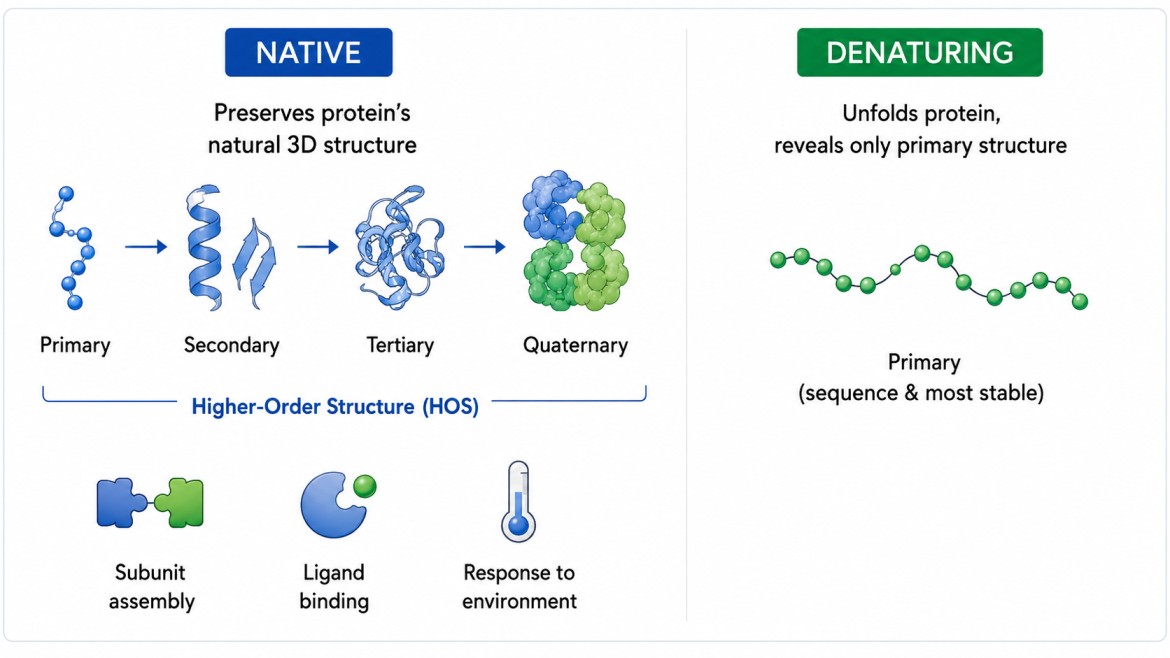
The defining difference is that native characterization respects the hierarchy of protein structure. Proteins are not simply linear sequences of amino acids. They fold into specific three-dimensional shapes governed by secondary structures such as:
- Alpha-helices and beta-sheets,
- Tertiary folds that define the overall shape of the polypeptide chain, and
- Quaternary arrangements where multiple subunits assemble into functional complexes.
Denaturing methods typically access only primary structure information, such as sequence identity and modification sites.
Native methods, by contrast, allow researchers to probe higher-order structure (HOS): the collective term for a protein's secondary, tertiary, and quaternary organization, including how subunits assemble, how ligands bind, and how the overall architecture responds to environmental changes.
For a deeper exploration of this topic, check out this higher-order structure characterization guide.
Why Is Native Characterization Important?
Native characterization is important because protein function depends entirely on structure. A therapeutic antibody that loses its dimeric architecture, an enzyme that cannot bind its cofactor, or a receptor that aggregates during formulation may all appear intact by sequence analysis while being functionally compromised.
Understanding the native state is therefore not optional; it is foundational.
Applications in Drug Development
Biopharmaceutical development is one of the most demanding contexts for native characterization. Regulatory agencies, including the FDA and EMA, require comprehensive structural characterization of biologic drug candidates under guidelines such as ICH Q6B.
This guidance specifically calls for the characterization of higher-order structure, oligomeric state, aggregation propensity, and protein-ligand interactions, all of which require native analytical conditions.
Applications in Academic Research
Structural biologists use native mass spectrometry to interrogate transient protein complexes that cannot be crystallized. Biochemists apply AUC and SEC-MALS to study enzyme oligomerization as a function of pH, salt concentration, or ligand binding. Cell biologists use DLS and native PAGE to monitor the behavior of signaling proteins under physiological conditions.
What Information Can Native Characterization Reveal?
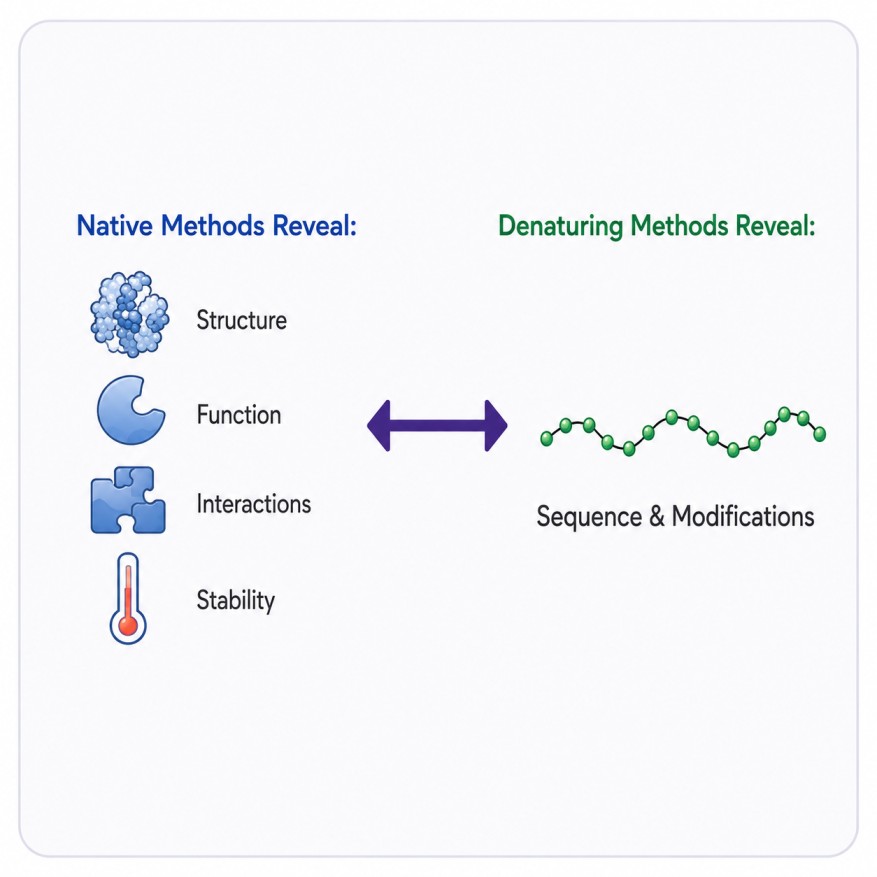
Native analyses provide insights that are simply unavailable through denaturing approaches. Once a protein is unfolded, the information encoded in its three-dimensional architecture is irretrievably lost. Native methods are therefore the only route to understanding how a protein's structure connects to its function, stability, and behavior.
Questions Researchers Can Answer
Well-designed native characterization studies can address a wide range of biological and analytical questions:
- Oligomeric state: Is the protein a monomer, dimer, or higher-order assembly? Does the oligomeric state change with concentration or environmental conditions?
- Protein-protein and protein-ligand interactions: What binding partners does the protein associate with? What is the stoichiometry of those interactions? How do small molecule candidates affect binding?
- Conformational stability: How does the protein's folded state respond to changes in temperature, pH, or formulation excipients?
- Aggregation behavior: Are aggregates present? What is their size distribution and quantity? Are they reversible or irreversible?
- Structural integrity: Does the protein retain its secondary and tertiary structural elements after purification, storage, or processing?
For a closer look at how expression system choice affects protein quality upstream of characterization, see our guide to protein expression systems.
What Native Characterization Cannot Tell You VS The Alternatives
| What Native Characterization Cannot Tell You | Recommended Alternative |
|---|---|
| Primary amino acid sequence or site-specific modifications | Bottom-up LC-MS/MS (denaturing) |
| Disulfide bond connectivity | Peptide mapping under non-reducing conditions |
| Precise atomic-resolution structure | X-ray crystallography or cryo-EM |
| Absolute protein concentration | UV absorbance (A280) or BCA/Bradford assay |
| Presence of host cell protein impurities | ELISA-based HCP assay or denaturing LC-MS |
Which Techniques Are Used for Native Protein Characterization?
 Orthogonal methods are independent analytical techniques that measure the same property through different physical principles, so that the limitations of one are compensated by the strengths of another.
No single technique provides complete native characterization. Each method has a distinct detection principle, analytical strengths, and limitations that make it more or less suited to specific research questions. Understanding the landscape of available tools is the first step toward designing a robust study.
Table 1: Native Protein Characterization Technique Overview
| Technique | Information Obtained | Strengths | Limitations | Typical Applications |
|---|---|---|---|---|
| Native MS | Intact mass, stoichiometry, ligand binding, oligomeric state | High sensitivity; reveals non-covalent interactions; minimal sample volume | Requires volatile buffers; limited for some membrane proteins; high instrument cost | Antibody characterization; drug-protein binding; complex stoichiometry |
| SEC-MALS | Absolute molecular weight; oligomeric state; hydrodynamic radius | Column-independent MW; distinguishes monomer, dimer, and higher oligomers with precision | Cannot separate same-size species; flow rate and column choice affect results | Recombinant protein characterization; aggregation profiling; formulation studies |
| AUC | Sedimentation coefficient; molecular weight; shape; aggregation content | Absolute, column-free measurement; high resolution for aggregate quantification; works in native solution | Time-consuming; requires high protein concentration; specialist equipment and data analysis | Regulatory submissions; biopharmaceutical lot release; detailed oligomeric characterization |
| DLS | Hydrodynamic diameter; particle size distribution; aggregation onset | Rapid; non-destructive; detects large aggregates with high sensitivity; suitable for stability screening | Qualitative rather than quantitative; large aggregates can mask smaller species | Formulation development; stability monitoring; batch comparison |
| Native PAGE | Relative molecular weight; charge-dependent migration; oligomeric banding patterns | Simple; preserves quaternary structure; allows downstream activity staining | Migration depends on charge and shape, not size alone; limited quantitative accuracy | Initial oligomeric state screening; activity-linked gel staining; protein purity assessment |
| Circular Dichroism | Secondary structure content (alpha-helix, beta-sheet); folding state; thermal stability | Non-destructive; sensitive to conformational changes; suitable for thermal unfolding studies | Low spatial resolution; requires transparent buffers; cannot resolve complex mixtures | Biopharmaceutical comparability; formulation stability; secondary structure validation |
Native Mass Spectrometry (Native MS)
Native mass spectrometry (native MS) allows researchers to analyze intact proteins and protein complexes while preserving important non-covalent interactions. This makes it useful for determining molecular weight, identifying oligomeric states, and studying protein-ligand interactions.
Because it requires only small sample volumes and provides rapid results, native MS is widely used in biopharmaceutical research. One important consideration is that samples often need to be exchanged into volatile buffers, such as ammonium acetate, before analysis.
SEC-MALS
Size-exclusion chromatography coupled with multi-angle light scattering (SEC-MALS) separates proteins by size and measures their absolute molecular weight. It is commonly used to distinguish monomers from oligomers, detect aggregates, and characterize complex proteins that may behave unpredictably in conventional SEC analyses.
Since SEC-MALS does not rely on calibration standards, it provides highly accurate molecular weight measurements across a range of applications.
Analytical Ultracentrifugation (AUC)
Analytical ultracentrifugation (AUC) studies proteins in solution by separating them under centrifugal force based on their size, shape, and mass. Researchers often use AUC to investigate oligomerization, assess sample heterogeneity, and quantify aggregates without the need for chromatography columns.
Although the technique requires specialized expertise, it provides detailed insights under near-native conditions and is frequently used alongside other characterization methods.
Dynamic Light Scattering (DLS)
Dynamic light scattering (DLS) measures the movement of particles in solution to estimate their size distribution. It is a fast, non-destructive technique commonly used for aggregation screening, formulation development, and stability studies.
While DLS requires minimal sample preparation, it is particularly sensitive to larger particles, meaning a small number of aggregates can strongly influence the results.
Native PAGE
Native polyacrylamide gel electrophoresis (native PAGE) separates proteins under non-denaturing conditions, preserving their native structure and interactions. It is often used for assessing protein purity, investigating oligomeric states, and performing downstream functional assays such as enzyme activity staining.
Because it is relatively simple and cost-effective, native PAGE remains a valuable tool, particularly for preliminary analyses and academic research settings.
Circular Dichroism (CD)
Circular dichroism (CD) spectroscopy examines how proteins interact with polarized light to provide information about their secondary and tertiary structure. Researchers commonly use CD to monitor structural changes, compare protein conformations, and assess thermal stability during formulation studies.
Although CD cannot provide detailed structural resolution, it serves as a valuable complementary technique for understanding protein folding and stability.
How Do Researchers Choose the Right Technique?
Method selection depends on the scientific question being asked. There is no universally best technique for native characterization. A method that provides definitive answers for one project may be entirely unsuitable for another, depending on the protein, the buffer system, the sample volume available, and the level of regulatory stringency required.
Table 2: Decision Framework for Native Characterization Technique Selection
| Research Goal | Recommended Technique(s) |
|---|---|
| Determine absolute molecular weight | SEC-MALS (primary); AUC sedimentation equilibrium (orthogonal confirmation) |
| Characterize oligomeric state and stoichiometry | Native MS; AUC sedimentation velocity; SEC-MALS |
| Detect and quantify protein aggregation | DLS (rapid screening); SEC-MALS (quantitative); AUC (regulatory-grade quantification) |
| Assess secondary structure and folding | Circular dichroism (CD); FTIR as orthogonal confirmation |
| Study protein-ligand or protein-protein interactions | Native MS (stoichiometry and affinity); AUC (binding thermodynamics) |
| Monitor conformational stability under stress | CD thermal unfolding; DLS size monitoring; DSC as complementary tool |
| Characterize membrane proteins in native-like conditions | Native MS with appropriate detergent or nanodisc systems; AUC in detergent solution |
| Support regulatory submissions (ICH Q6B) | AUC + SEC-MALS (orthogonal aggregate quantification); CD (secondary structure comparability) |
Researchers looking to strengthen their understanding of reagent validation before beginning characterization studies may also find our guide to antibody validation strategies useful.
Factors That Influence Method Selection
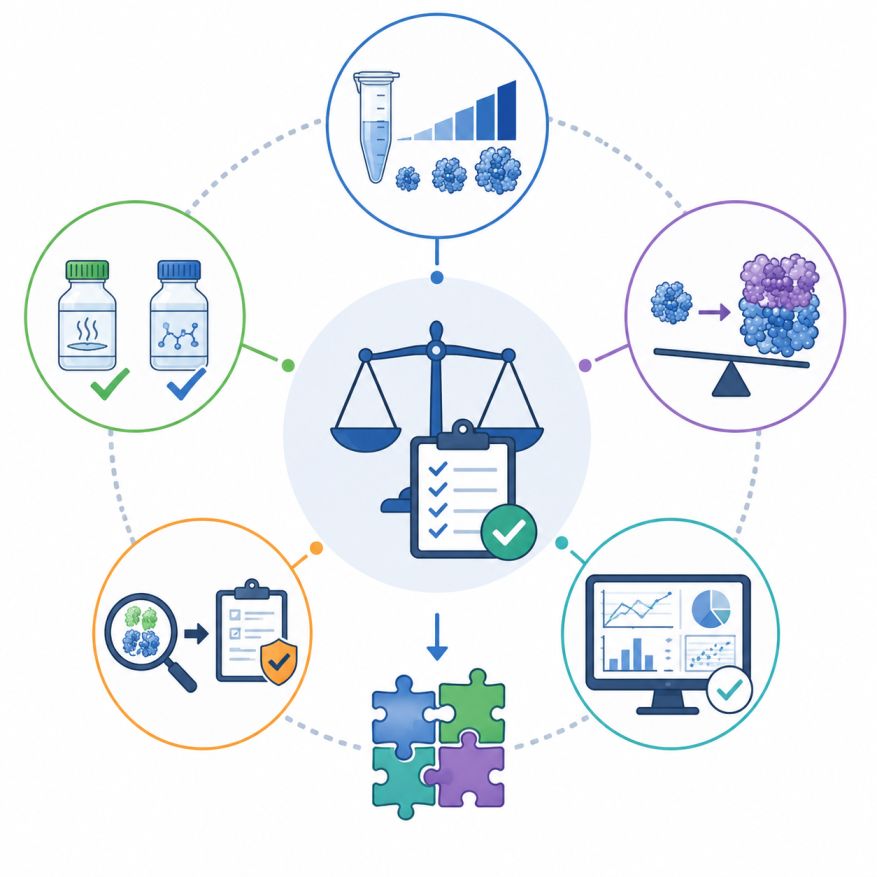
Choosing the right technique depends on more than just the research question. Key factors include:
- Sample concentration: Some techniques, such as native MS, work well with limited sample amounts, while others, like AUC, often require higher concentrations.
- Buffer compatibility: Native MS requires volatile buffers, whereas SEC-MALS, DLS, and CD are generally more flexible.
- Protein size: Very large protein complexes may be difficult to analyze using native MS but can often be studied using AUC.
- Study objectives: Early-stage research may only require screening methods, while regulatory studies often demand orthogonal approaches using multiple techniques.
- Data requirements: The level of detail and confidence needed can influence whether a single method or a combination of methods is most appropriate.
In many cases, combining complementary techniques provides the most comprehensive understanding of protein behavior.
Why Orthogonal Approaches Matter
No single analytical method is infallible. Each has assumptions built into its measurement principle, and each is susceptible to different types of artifacts.
SEC-MALS assumes that the protein does not interact with the column matrix; if it does, the elution profile and therefore the molecular weight calculation may be skewed. AUC assumes accurate knowledge of solvent density and protein partial specific volume. Native MS assumes that the ionization process does not perturb the complex stoichiometry.
When two independent techniques based on different physical principles agree, the confidence in the result increases substantially. When they disagree, that discrepancy itself is scientifically informative and warrants further investigation.
Designing studies to include orthogonal measurements from the outset, rather than adding them reactively when results are questioned, saves time and produces more defensible data.
Native vs Denaturing Protein Characterization
The appropriate approach depends on whether preserving native structure is essential to the research question. Native and denaturing methods are not competing strategies. They are complementary analytical toolkits, each suited to different questions, and both are typically required across a complete protein characterization program.
When Native Methods Are Preferred
Native methods are the appropriate choice whenever the research question involves the protein's three-dimensional organization, its biological interactions, or its behavior under conditions relevant to function or storage.
This includes determining oligomeric state, characterizing protein-ligand or protein-protein complexes, monitoring aggregation under physiologically relevant conditions, and assessing conformational stability as part of formulation development.
In biopharmaceutical characterization, native methods are essential for demonstrating that a biologic retains its higher-order structure across manufacturing campaigns, after process changes, and throughout its intended shelf life. Regulatory agencies specifically require this evidence for BLA, MAA, and biosimilar submissions.
When Denaturing Methods Are Appropriate
Denaturing methods are the right choice when the scientific question concerns primary structure, sequence identity, post-translational modification mapping, or the presence of impurities at the peptide level.
Bottom-up proteomics, which relies on enzymatic digestion and LC-MS/MS analysis of peptides, is a denaturing workflow that provides rich sequence-level data unavailable by native approaches.
Common Challenges and How to Overcome Them
Native characterization presents unique analytical challenges that require careful planning. Because the goal is to preserve the protein's natural state throughout analysis, any deviation in handling, buffer composition, or experimental conditions carries more consequence than in denaturing workflows where the protein's structure is intentionally disrupted.
Protein Aggregation
Solution: Aggregation detected by one technique should be confirmed using an orthogonal method. Combining DLS with SEC-MALS or AUC can help distinguish true aggregation from experimental artifacts.
Sample Instability
Solution: To preserve protein integrity, use freshly prepared samples whenever possible, minimize freeze-thaw cycles, avoid vigorous mixing, and handle samples gently before analysis.
Buffer Incompatibility
Solution: Native MS requires volatile buffers, as common buffers such as phosphate, Tris, and high-salt formulations can interfere with measurements. Buffer exchange into ammonium acetate is a common approach.
Low-Abundance Proteins
Solution: When sample availability is limited, native MS is often preferred due to its high sensitivity. DLS can also work with small sample volumes, while techniques requiring larger amounts may need prior concentration steps.
Table 4: Troubleshooting Guide for Common Native Characterization Challenges
| Challenge | Potential Cause | Recommended Action |
|---|---|---|
| Unexpected aggregation detected | Protein instability during handling; freeze-thaw damage; suboptimal pH or ionic strength | Optimize storage conditions; use fresh samples; confirm with a second orthogonal technique such as AUC or DLS |
| Inconsistent molecular weight readings | Column carryover in SEC-MALS; incorrect dn/dc value; sample heterogeneity | Equilibrate column thoroughly; verify dn/dc for modified proteins; cross-validate with native MS or AUC |
| Poor signal quality in native MS | Non-volatile buffer components (phosphate, Tris, NaCl); sample concentration too low | Exchange to ammonium acetate or compatible volatile buffer by gel filtration or dialysis; increase protein concentration |
| Unexpected protein unfolding during CD analysis | Buffer UV absorption interfering at low wavelengths; temperature fluctuations during run | Switch to transparent low-UV buffer (e.g., phosphate at low concentration); recalibrate temperature control |
| Low sensitivity for dilute samples | Protein concentration below detection threshold of chosen technique | Consider native MS for its low sample consumption; concentrate protein if stability permits; evaluate DLS as a preliminary screen |
| Ambiguous oligomeric state results | Single technique insufficient; concentration-dependent equilibria; technique-specific bias | Apply orthogonal methods (e.g., AUC and SEC-MALS); vary protein concentration to probe equilibrium; consult experienced analytical team |
Need Support With Native Protein Characterization?
Successful native characterization begins long before an analytical technique is selected. Protein quality, biological activity, reagent consistency, and experimental design can all influence the reliability of downstream results.
AAA Biotech supports researchers by providing high-quality recombinant proteins, native proteins, antibodies, and other research reagents designed to advance protein studies across a wide range of applications. And selecting well-validated reagents is an important first step.
Explore AAA Biotech's catalog to find the proteins and research tools that best align with your scientific goals.
Faq's
How much sample is typically needed for native characterization studies?
Sample requirements depend on the technique used. Native MS requires the least material, often working with sub-microgram quantities, while DLS needs only small volumes at moderate concentrations. SEC-MALS typically requires 10–100 μg of protein, whereas AUC generally needs the largest amount, ranging from hundreds of micrograms to several milligrams.
Can frozen protein samples be analyzed under native conditions?
Yes. Frozen samples can be used if they are stored properly, ideally in small aliquots at ultra-low temperatures to minimize freeze-thaw cycles. Samples should be thawed gently on ice and checked for any visible precipitation before analysis.
What buffers are commonly incompatible with native mass spectrometry workflows?
Buffers containing non-volatile components, such as phosphate, Tris, HEPES, imidazole, or high salt concentrations, can interfere with native MS analysis. Samples are commonly exchanged into volatile buffers like ammonium acetate before measurement.
Should researchers use multiple characterization techniques within the same study?
In most cases, yes. Using orthogonal techniques provides more reliable results and is often expected for regulatory studies. Combining methods that measure different properties of a protein can improve confidence in the findings.
Which native characterization methods are most suitable for membrane proteins?
The best approach depends on the protein and the research objective. Native MS, AUC, DLS, and CD can all be applied to membrane proteins when appropriate detergents or membrane mimetics are used.
How long does a comprehensive characterization project usually take?
Timelines vary based on project complexity. Single-technique studies may be completed within days, while multi-technique characterization programs can take several weeks or longer.
When should native protein characterization be outsourced?
Outsourcing may be beneficial when specialized instrumentation, technical expertise, or regulatory-grade documentation is required, or when internal resources and timelines are limited.
What information should researchers provide before initiating a characterization study?
Researchers should share details such as the protein identity, concentration, buffer composition, available sample volume, study objectives, and any specific handling requirements. This information helps ensure the most appropriate analytical strategy is selected.
Lead Clinical Research Coordinator (LCRC)
Cynthia Lee is the President of AAA Biotech and specializes in understanding highly validated and characterized monoclonal/polyclonal antibodies, recombinant proteins, and ELISA kits.
Related Posts