
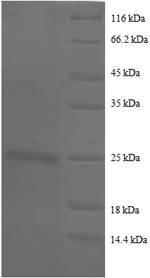
 SDS-PAGE
Basigin Recombinant Protein | BSG recombinant protein
Recombinant Human Basigin
Gene Names
BSG; M6; OK; 5F7; TCSF; CD147; EMMPRIN
Purity
Greater or equal to 85% purity as determined by SDS-PAGE.
Synonyms
Basigin; N/A; Recombinant Human Basigin; 5F7; Collagenase stimulatory factor; Extracellular matrix metalloproteinase inducer; EMMPRIN; Leukocyte activation antigen M6OK blood group antigen; Tumor cell-derived collagenase stimulatory factor; TCSF; CD147; BSG recombinant protein
Host
E Coli or Yeast or Baculovirus or Mammalian Cell
Purity/Purification
Greater or equal to 85% purity as determined by SDS-PAGE.
Form/Format
Lyophilized or liquid (Format to be determined during the manufacturing process)
Sequence Positions
138-321aa; partial
Sequence
EPGTVFTTVEDLGSKILLTCSLNDSATEVTGHRWLKGGVVLKEDALPGQKTEFKVDSDDQWGEYSCVFLPEPMGTANIQLHGPPRVKAVKSSEHINEGETAMLVCKSESVPPVTDWAWYKITDSEDKALMNGSESRFFVSSSQGRSELHIENLNMEADPGQYRCNGTSSKGSDQAIITLRVRSH
Preparation and Storage
Store at -20 degree C, for extended storage, conserve at -20 degree C or -80 degree C.
SDS-PAGE
SDS-PAGE
Related Product Information for BSG recombinant protein
Plays an important role in targeting the monocarboxylate transporters SLC16A1, SLC16A3 and SLC16A8 to the plasma membrane. Plays pivotal roles in spermatogenesis, embryo implantation, neural network formation and tumor progression. Stimulates adjacent fibroblasts to produce matrix metalloproteinases (MMPS). Ses to be a receptor for oligomannosidic glycans. In vitro, promotes outgrowth of astrocytic processes.
Product Categories/Family for BSG recombinant protein
References
Human leukocyte activation antigen M6, a member of the Ig superfamily, is the species homologue of rat OX-47, mouse basigin, and chicken HT7 molecule.Kasinrerk W., Fiebiger E., Stefanova I., Baumruker T., Knapp W., Stockinger H.J. Immunol. 149:847-854(1992) The basigin group of the immunoglobulin superfamily complete conservation of a segment in and around transmembrane domains of human and mouse basigin and chicken HT7 antigen.Miyauchi T., Masuzawa Y., Muramatsu T.J. Biochem. 110:770-774(1991) The human tumor cell-derived collagenase stimulatory factor (renamed EMMPRIN) is a member of the immunoglobulin superfamily.Biswas C., Zhang Y., Decastro R., Guo H., Nakamura T., Kataoka H., Nabeshima K.Cancer Res. 55:434-439(1995) Wakasugi H., Scamps C., Yang G., Vancong N., Bernheim A., Tursz T., Harada N.Decastro R., Zhang Y., Kataoka H., Coon J., Biswas C.Characterization of the gene for human EMMPRIN, a tumor cell surface inducer of matrix metalloproteinases.Guo H., Majmudar G., Jensen T.C., Biswas C., Toole B.P., Gordon M.K.Gene 220:99-108(1998) Regulation of EMMPRIN/CD147 expression and its function of controlling matrix metalloproteinases production and cell-surface localization in co-culture of human uterine cervical carcinoma SKG-II cells and human uterine cervical fibroblasts.Sato T., Takita M., Noguchi Y., Hirata M., Sakai T., Ito A.Kim D., Kanai Y., Choi H., Shin H., Kim J., Teraoka H., Shigeta Y., Chairoungdua A., Babu E., Anzai N., Iribe Y., Endou H.Retina-specific expression of 5A11/Basigin-2, a member of the immunoglobulin gene superfamily.Ochrietor J.D., Moroz T.P., van Ekeris L., Clamp M.F., Jefferson S.C., deCarvalho A.C., Fadool J.M., Wistow G., Muramatsu T., Linser P.J.Invest. Ophthalmol. Vis. Sci. 44:4086-4096(2003) Characterization of basigin isoforms and the inhibitory function of basigin-3 in human hepatocellular carcinoma proliferation and invasion.Liao C.G., Kong L.M., Song F., Xing J.L., Wang L.X., Sun Z.J., Tang H., Yao H., Zhang Y., Wang L., Wang Y., Yang X.M., Li Y., Chen Z.N.Mol. Cell. Biol. 31:2591-2604(2011) The secreted protein discovery initiative (SPDI) , a large-scale effort to identify novel human secreted and transmembrane proteins a bioinformatics assessment.Clark H.F., Gurney A.L., Abaya E., Baker K., Baldwin D.T., Brush J., Chen J., Chow B., Chui C., Crowley C., Currell B., Deuel B., Dowd P., Eaton D., Foster J.S., Grimaldi C., Gu Q., Hass P.E., Heldens S., Huang A., Kim H.S., Klimowski L., Jin Y., Johnson S., Lee J., Lewis L., Liao D., Mark M.R., Robbie E., Sanchez C., Schoenfeld J., Seshagiri S., Simmons L., Singh J., Smith V., Stinson J., Vagts A., Vandlen R.L., Watanabe C., Wieand D., Woods K., Xie M.-H., Yansura D.G., Yi S., Yu G., Yuan J., Zhang M., Zhang Z., Goddard A.D., Wood W.I., Godowski P.J., Gray A.M.Genome Res. 13:2265-2270(2003) SeattleSNPs variation discovery resourceThe DNA sequence and biology of human chromosome 19.Grimwood J., Gordon L.A., Olsen A.S., Terry A., Schmutz J., Lamerdin J.E., Hellsten U., Goodstein D., Couronne O., Tran-Gyamfi M., Aerts A., Altherr M., Ashworth L., Bajorek E., Black S., Branscomb E., Caenepeel S., Carrano A.V., Caoile C., Chan Y.M., Christensen M., Cleland C.A., Copeland A., Dalin E., Dehal P., Denys M., Detter J.C., Escobar J., Flowers D., Fotopulos D., Garcia C., Georgescu A.M., Glavina T., Gomez M., Gonzales E., Groza M., Hammon N., Hawkins T., Haydu L., Ho I., Huang W., Israni S., Jett J., Kadner K., Kimball H., Kobayashi A., Larionov V., Leem S.-H., Lopez F., Lou Y., Lowry S., Malfatti S., Martinez D., McCready P.M., Medina C., Morgan J., Nelson K., Nolan M., Ovcharenko I., Pitluck S., Pollard M., Popkie A.P., Predki P., Quan G., Ramirez L., Rash S., Retterer J., Rodriguez A., Rogers S., Salamov A., Salazar A., She X., Smith D., Slezak T., Solovyev V., Thayer N., Tice H., Tsai M., Ustaszewska A., Vo N., Wagner M., Wheeler J., Wu K., Xie G., Yang J., Dubchak I., Furey T.S., DeJong P., Dickson M., Gordon D., Eichler E.E., Pennacchio L.A., Richardson P., Stubbs L., Rokhsar D.S., Myers R.M., Rubin E.M., Lucas S.M.Nature 428:529-535(2004) Mural R.J., Istrail S., Sutton G., Florea L., Halpern A.L., Mobarry C.M., Lippert R., Walenz B., Shatkay H., Dew I., Miller J.R., Flanigan M.J., Edwards N.J., Bolanos R., Fasulo D., Halldorsson B.V., Hannenhalli S., Turner R., Yooseph S., Lu F., Nusskern D.R., Shue B.C., Zheng X.H., Zhong F., Delcher A.L., Huson D.H., Kravitz S.A., Mouchard L., Reinert K., Remington K.A., Clark A.G., Waterman M.S., Eichler E.E., Adams M.D., Hunkapiller M.W., Myers E.W., Venter J.C. Signal peptide prediction based on analysis of experimentally verified cleavage sites.Zhang Z., Henzel W.J.Protein Sci. 13:2819-2824(2004) Partial sequencing and characterization of the tumor cell-derived collagenase stimulatory factor.Nabeshima K., Lane W.S., Biswas C.Arch. Biochem. Biophys. 285:90-96(1991) Basigin (CD147) a multifunctional transmembrane protein involved in reproduction, neural function, inflammation and tumor invasion.Muramatsu T., Miyauchi T.Histol. Histopathol. 18:981-987(2003) Identification and quantification of N-linked glycoproteins using hydrazide chemistry, stable isotope labeling and mass spectrometry.Zhang H., Li X.-J., Martin D.B., Aebersold R.Nat. Biotechnol. 21:660-666(2003) Cell surface expression of CD147/EMMPRIN is regulated by cyclophilin 60.Pushkarsky T., Yurchenko V., Vanpouille C., Brichacek B., Vaisman I., Hatakeyama S., Nakayama K.I., Sherry B., Bukrinsky M.I.J. Biol. Chem. 280:27866-27871(2005) Global, in vivo, and site-specific phosphorylation dynamics in signaling networks.Olsen J.V., Blagoev B., Gnad F., Macek B., Kumar C., Mortensen P., Mann M.Cell 127:635-648(2006) Proteomic and bioinformatic characterization of the biogenesis and function of melanosomes.Chi A., Valencia J.C., Hu Z.-Z., Watabe H., Yamaguchi H., Mangini N.J., Huang H., Canfield V.A., Cheng K.C., Yang F., Abe R., Yamagishi S., Shabanowitz J., Hearing V.J., Wu C., Appella E., Hunt D.F.J. Proteome Res. 5:3135-3144(2006) The role of charged residues in the transmembrane helices of monocarboxylate transporter 1 and its ancillary protein basigin in determining plasma membrane expression and catalytic activity.Manoharan C., Wilson M.C., Sessions R.B., Halestrap A.P.Mol. Membr. Biol. 23:486-498(2006) junction protein shrew-1 influences cell invasion and interacts with invasion-promoting protein CD147.Schreiner A., Ruonala M., Jakob V., Suthaus J., Boles E., Wouters F., Starzinski-Powitz A.Mol. Biol. Cell 18:1272-1281(2007) Lys-N and trypsin cover complementary parts of the phosphoproteome in a refined SCX-based approach.Gauci S., Helbig A.O., Slijper M., Krijgsveld J., Heck A.J., Mohammed S.Anal. Chem. 81:4493-4501(2009) Glycoproteomics analysis of human liver tissue by combination of multiple enzyme digestion and hydrazide chemistry.Chen R., Jiang X., Sun D., Han G., Wang F., Ye M., Wang L., Zou H.J. Proteome Res. 8:651-661(2009) Mass-spectrometric identification and relative quantification of N-linked cell surface glycoproteins.Wollscheid B., Bausch-Fluck D., Henderson C., O'Brien R., Bibel M., Schiess R., Aebersold R., Watts J.D.Nat. Biotechnol. 27:378-386(2009) Quantitative phosphoproteomics reveals widespread full phosphorylation site occupancy during mitosis.Olsen J.V., Vermeulen M., Santamaria A., Kumar C., Miller M.L., Jensen L.J., Gnad F., Cox J., Jensen T.S., Nigg E.A., Brunak S., Mann M.Sci. Signal. 3:RA3-RA3(2010) Initial characterization of the human central proteome.Burkard T.R., Planyavsky M., Kaupe I., Breitwieser F.P., Buerckstuemmer T., Bennett K.L., Superti-Furga G., Colinge J.BMC Syst. Biol. 5:17-17(2011) System-wide temporal characterization of the proteome and phosphoproteome of human embryonic stem cell differentiation.Rigbolt K.T., Prokhorova T.A., Akimov V., Henningsen J., Johansen P.T., Kratchmarova I., Kassem M., Mann M., Olsen J.V., Blagoev B.Sci. Signal. 4:RS3-RS3(2011) An enzyme assisted RP-RPLC approach for in-depth analysis of human liver phosphoproteome.Bian Y., Song C., Cheng K., Dong M., Wang F., Huang J., Sun D., Wang L., Ye M., Zou H.J. Proteomics 96:253-262(2014) Crystal structure of HAb18G/CD147 implications for immunoglobulin superfamily homophilic adhesion.Yu X.-L., Hu T., Du J.-M., Ding J.-P., Yang X.-M., Zhang J., Yang B., Shen X., Zhang Z., Zhong W.-D., Wen N., Jiang H., Zhu P., Chen Z.-N.J. Biol. Chem. 283:18056-18065(2008) Structure of the EMMPRIN N-terminal domain 1 dimerization via beta-strand swapping.Luo J., Teplyakov A., Obmolova G., Malia T., Wu S.-J., Beil E., Baker A., Swencki-Underwood B., Zhao Y., Sprenkle J., Dixon K., Sweet R., Gilliland G.L.Proteins 77:1009-1014(2009) The Ok(a) blood group antigen is a marker for the M6 leukocyte activation antigen, the human homolog of OX-47 antigen, basigin and neurothelin, an immunoglobulin superfamily molecule that is widely expressed in human cells and tissues.Spring F.A., Holmes C.H., Simpson K.L., Mawby W.J., Mattes M.J., Okubo Y., Parsons S.F.Eur. J. Immunol. 27:891-897(1997) +Additional computationally mapped references.<p>Provides general information on the entry.
NCBI and Uniprot Product Information
NCBI GI #
NCBI GeneID
NCBI Accession #
NCBI GenBank Nucleotide #
Molecular Weight
24.2 kDa
NCBI Official Full Name
basigin isoform 1
NCBI Official Synonym Full Names
basigin (Ok blood group)
NCBI Official Symbol
BSG
NCBI Official Synonym Symbols
M6; OK; 5F7; TCSF; CD147; EMMPRIN
NCBI Protein Information
basigin
UniProt Protein Name
Basigin
UniProt Gene Name
BSG
UniProt Synonym Gene Names
EMMPRIN; TCSF
UniProt Entry Name
BASI_HUMAN
Customer Reviews
Loading reviews...
Share Your Experience
Similar Products

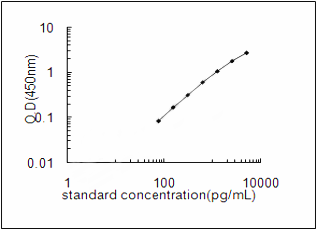
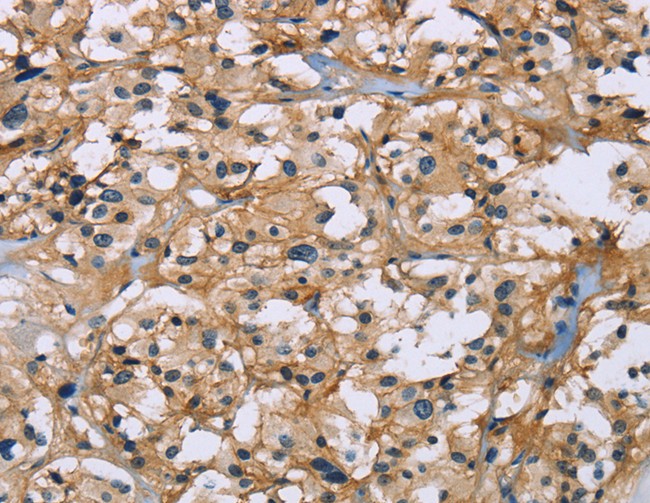
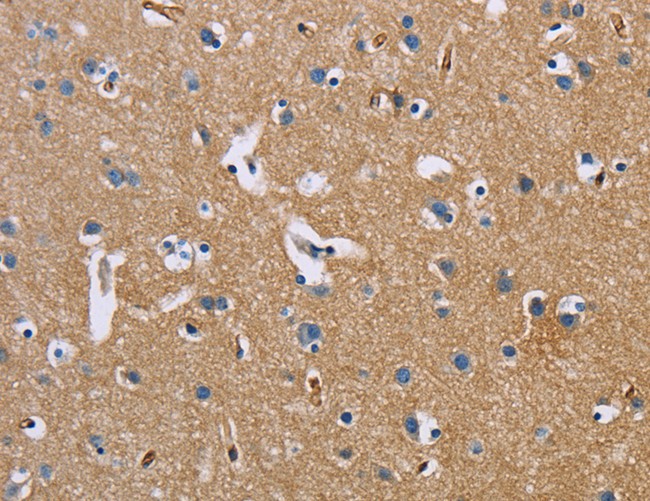

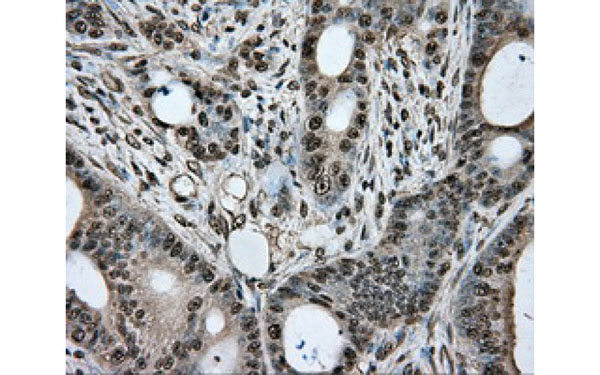


Product Notes
The BSG bsg (Catalog #AAA113431) is a Recombinant Protein produced from E Coli or Yeast or Baculovirus or Mammalian Cell and is intended for research purposes only. The product is available for immediate purchase. The immunogen sequence is 138-321aa; partial. The amino acid sequence is listed below: EPGTVFTTVE DLGSKILLTC SLNDSATEVT GHRWLKGGVV LKEDALPGQK TEFKVDSDDQ WGEYSCVFLP EPMGTANIQL HGPPRVKAVK SSEHINEGET AMLVCKSESV PPVTDWAWYK ITDSEDKALM NGSESRFFVS SSQGRSELHI ENLNMEADPG QYRCNGTSSK GSDQAIITLR VRSH. It is sometimes possible for the material contained within the vial of "Basigin, Recombinant Protein" to become dispersed throughout the inside of the vial, particularly around the seal of said vial, during shipment and storage. We always suggest centrifuging these vials to consolidate all of the liquid away from the lid and to the bottom of the vial prior to opening. Please be advised that certain products may require dry ice for shipping and that, if this is the case, an additional dry ice fee may also be required.Precautions
All products in the AAA Biotech catalog are strictly for research-use only, and are absolutely not suitable for use in any sort of medical, therapeutic, prophylactic, in-vivo, or diagnostic capacity. By purchasing a product from AAA Biotech, you are explicitly certifying that said products will be properly tested and used in line with industry standard. AAA Biotech and its authorized distribution partners reserve the right to refuse to fulfill any order if we have any indication that a purchaser may be intending to use a product outside of our accepted criteria.Disclaimer
Though we do strive to guarantee the information represented in this datasheet, AAA Biotech cannot be held responsible for any oversights or imprecisions. AAA Biotech reserves the right to adjust any aspect of this datasheet at any time and without notice. It is the responsibility of the customer to inform AAA Biotech of any product performance issues observed or experienced within 30 days of receipt of said product. To see additional details on this or any of our other policies, please see our Terms & Conditions page.Item has been added to Shopping Cart
If you are ready to order, navigate to Shopping Cart and get ready to checkout.