
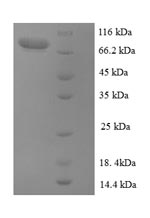
 SDS-PAGE
Extracellular calcium-sensing receptor Recombinant Protein | CASR recombinant protein
Recombinant Human Extracellular calcium-sensing receptor
Gene Names
CASR; CAR; FHH; FIH; HHC; EIG8; HHC1; NSHPT; PCAR1; GPRC2A; HYPOC1
Purity
Greater or equal to 85% purity as determined by SDS-PAGE.
Synonyms
Extracellular calcium-sensing receptor; N/A; Recombinant Human Extracellular calcium-sensing receptor; Parathyroid cell calcium-sensing receptor 1; PCaR1; CASR recombinant protein
Host
E Coli or Yeast or Baculovirus or Mammalian Cell
Purity/Purification
Greater or equal to 85% purity as determined by SDS-PAGE.
Form/Format
Lyophilized or liquid (Format to be determined during the manufacturing process)
Sequence Positions
20-612aa; Extracellular Domain
Sequence
YGPDQRAQKK GDIILGGLFP IHFGVAAKDQ DLKSRPESVE CIRYNFRGFR WLQAMIFAIE EINSSPALLP NLTLGYRIFD TCNTVSKALE ATLSFVAQNK IDSLNLDEFC NCSEHIPSTI AVVGATGSGV STAVANLLGL FYIPQVSYAS SSRLLSNKNQ FKSFLRTIPN DEHQATAMAD IIEYFRWNWV GTIAADDDYG RPGIEKFREE AEERDICIDF SELISQYSDE EEIQHVVEVI QNSTAKVIVV FSSGPDLEPL IKEIVRRNIT GKIWLASEAW ASSSLIAMPQ YFHVVGGTIG FALKAGQIPG FREFLKKVHP RKSVHNGFAK EFWEETFNCH LQEGAKGPLP VDTFLRGHEE SGDRFSNSST AFRPLCTGDE NISSVETPYI DYTHLRISYN VYLAVYSIAH ALQDIYTCLP GRGLFTNGSC ADIKKVEAWQ VLKHLRHLNF TNNMGEQVTF DECGDLVGNY SIINWHLSPE DGSIVFKEVG YYNVYAKKGE RLFINEEKIL WSGFSREVPF SNCSRDCLAG TRKGIIEGEP TCCFECVECP DGEYSDETDA SACNKCPDDF WSNENHTSCI AKEIEFLSWT EPF
Preparation and Storage
Store at -20 degree C, for extended storage, conserve at -20 degree C or -80 degree C.
SDS-PAGE
SDS-PAGE
Related Product Information for CASR recombinant protein
Senses changes in the extracellular concentration of calcium ions. The activity of this receptor is mediated by a G-protein that activates a phosphatidylinositol-calcium second messenger system.
Product Categories/Family for CASR recombinant protein
References
Pearce S.H.S., Thakker R.V.Molecular cloning and functional expression of human parathyroid calcium receptor cDNAs.Garrett J.E., Capuano I.V., Hammerland L.G., Hung B.C., Brown E.M., Hebert S.C., Nemeth E.F., Fuller F.J. Biol. Chem. 270:12919-12925(1995) Molecular cloning of a putative Ca(2+) -sensing receptor cDNA from human kidney.Aida K., Koishi S., Tawata M., Onaya T.Biochem. Biophys. Res. Commun. 214:524-529(1995) Expression of a calcium-sensing receptor in a human medullary thyroid carcinoma cell line and its contribution to calcitonin secretion.Freichel M., Zink-Lorenz A., Holloschi A., Hafner M., Flockerzi V., Raue F.Endocrinology 137:3842-3848(1996) SeattleSNPs variation discovery resource Familial hypocalciuric hypercalcemia associated with mutation in the human Ca(2+) -sensing receptor gene.Aida K., Koishi S., Inoue M., Nakazato M., Tawata M., Onaya T.J. Clin. Endocrinol. Metab. 80:2594-2598(1995) Changes in calcium responsiveness and handling during keratinocyte differentiation. Potential role of the calcium receptor.Bikle D.D., Ratnam A., Mauro T., Harris J., Pillai S.J. Clin. Invest. 97:1085-1093(1996) Calcium-sensing receptor ubiquitination and degradation mediated by the E3 ubiquitin ligase dorfin.Huang Y., Niwa J., Sobue G., Breitwieser G.E.J. Biol. Chem. 281:11610-11617(2006) Rab1 small GTP-binding protein regulates cell surface trafficking of the human calcium-sensing receptor.Zhuang X., Adipietro K.A., Datta S., Northup J.K., Ray K.Endocrinology 151:5114-5123(2010) Mutations in the human Ca(2+) -sensing receptor gene cause familial hypocalciuric hypercalcemia and neonatal severe hyperparathyroidism.Pollak M.R., Brown E.M., Chou Y.-H.W., Hebert S.C., Marx S.J., Steinmann B., Levi T., Seidman C.E., Seidman J.G.Cell 75:1297-1303(1993) Autosomal dominant hypocalcaemia caused by a Ca(2+) -sensing receptor gene mutation.Pollak M.R., Brown E.M., Estep H.L., McLaine P.N., Kifor O., Park J., Hebert S.C., Seidman C.E., Seidman J.G.Nat. Genet. 8:303-307(1994) Mutations in the human Ca(2+) -sensing-receptor gene that cause familial hypocalciuric hypercalcemia.Chou Y.-H.W., Pollak M.R., Brandi M.L., Toss G., Arnqvist H., Atkinson A.B., Papapoulos S.E., Marx S., Brown E.M., Seidman J.G., Seidman C.E.Am. J. Hum. Genet. 56:1075-1079(1995) Calcium-sensing receptor mutations in familial benign hypercalcemia and neonatal hyperparathyroidism.Pearce S.H.S., Trump D., Wooding C., Besser G.M., Chew S.L., Grant D.B., Heath D.A., Hughes I.A., Paterson C.R., Whyte M.P., Thakker R.V.J. Clin. Invest. 96:2683-2692(1995) The Ca(2+) -sensing receptor gene (PCAR1) mutation T151M in isolated autosomal dominant hypoparathyroidism.Lovlie R., Eiken H.G., Sorheim J.I., Boman H.Hum. Genet. 98:129-133(1996) Mutations in the Ca(2+) -sensing receptor gene cause autosomal dominant and sporadic hypoparathyroidism.Baron J., Winer K.K., Yanovski J.A., Cunningham A.W., Laue L., Zimmerman D., Cutler G.B. Jr.Hum. Mol. Genet. 5:601-606(1996) A familial syndrome of hypocalcemia with hypercalciuria due to mutations in the calcium-sensing receptor.Pearce S.H.S., Williamson C., Kifor O., Bai M., Coulthard M.G., Davies M., Lewis-Barned N., McCredie D., Powell H., Kendall-Taylor P., Brown E.M., Thakker R.V.N. Engl. J. Med. 335:1115-1122(1996) A novel mutation (L174R) in the Ca2+-sensing receptor gene associated with familial hypocalciuric hypercalcemia.Ward B.K., Stuckey B.G.A., Gutteridge D.H., Laing N.G., Pullan P.T., Ratajczak T.3.3.CO;2-G>Hum. Mutat. 10:233-235(1997) Sporadic hypoparathyroidism caused by de Novo gain-of-function mutations of the Ca(2+) -sensing receptor.De Luca F., Ray K., Mancilla E.E., Fan G.-F., Winer K.K., Gore P., Spiegel A.M., Baron J.J. Clin. Endocrinol. Metab. 82:2710-2715(1997) Two novel missense mutations in calcium-sensing receptor gene associated with neonatal severe hyperparathyroidism.Kobayashi M., Tanaka H., Tsuzuki K., Tsuyuki M., Igaki H., Ichinose Y., Aya K., Nishioka N., Seino Y.J. Clin. Endocrinol. Metab. 82:2716-2719(1997) Familial hypoparathyroidism identification of a novel gain of function mutation in transmembrane domain 5 of the calcium-sensing receptor.Watanabe T., Bai M., Lane C.R., Matsumoto S., Minamitani K., Minagawa M., Niimi H., Brown E.M., Yasuda T.J. Clin. Endocrinol. Metab. 83:2497-2502(1998) An adult patient with severe hypercalcaemia and hypocalciuria due to a novel homozygous inactivating mutation of calcium-sensing receptor.Chikatsu N., Fukumoto S., Suzawa M., Tanaka Y., Takeuchi Y., Takeda S., Tamura Y., Matsumoto T., Fujita T.Clin. Endocrinol. (Oxf.) 50:537-543(1999) A novel activating mutation in calcium-sensing receptor gene associated with a family of autosomal dominant hypocalcemia.Okazaki R., Chikatsu N., Nakatsu M., Takeuchi Y., Ajima M., Miki J., Fujita T., Arai M., Totsuka Y., Tanaka K., Fukumoto S.J. Clin. Endocrinol. Metab. 84:363-366(1999) Autosomal dominant hypoparathyroidism associated with short stature and premature osteoarthritis.Stock J.L., Brown R.S., Baron J., Coderre J.A., Mancilla E., De Luca F., Ray K., Mericq M.V.J. Clin. Endocrinol. Metab. 84:3036-3040(1999) A986S polymorphism of the calcium-sensing receptor and circulating calcium concentrations.Cole D.E.C., Peltekova V.D., Rubin L.A., Hawker G.A., Vieth R., Liew C.C., Hwang D.M., Evrovski J., Hendy G.N.Lancet 353:112-115(1999) Familial hypercalcemia and hypercalciuria caused by a novel mutation in the cytoplasmic tail of the calcium receptor.Carling T., Szabo E., Bai M., Ridefelt P., Westin G., Gustavsson P., Trivedi S., Hellman P., Brown E.M., Dahl N., Rastad J.J. Clin. Endocrinol. Metab. 85:2042-2047(2000) A novel mutation in Ca2+-sensing receptor gene in familial hypocalciuric hypercalcemia.Nakayama T., Minato M., Nakagawa M., Soma M., Tobe H., Aoi N., Kosuge K., Sato M., Ozawa Y., Kanmatsuse K., Kokubun S.Endocrine 15:277-282(2001) Association between total serum calcium and the A986S polymorphism of the calcium-sensing receptor gene.Cole D.E.C., Vieth R., Trang H.M., Wong B.Y.-L., Hendy G.N., Rubin L.A.Mol. Genet. Metab. 72:168-174(2001) A family of autosomal dominant hypocalcemia with a positive correlation between serum calcium and magnesium identification of a novel gain of function mutation (Ser(820) Phe) in the calcium-sensing receptor.Nagase T., Murakami T., Tsukada T., Kitamura R., Chikatsu N., Takeo H., Takata N., Yasuda H., Fukumoto S., Tanaka Y., Nagata N., Yamaguchi K., Akatsu T., Yamamoto M.J. Clin. Endocrinol. Metab. 87:2681-2687(2002) Hydrochlorothiazide effectively reduces urinary calcium excretion in two Japanese patients with gain-of-function mutations of the calcium-sensing receptor gene.Sato K., Hasegawa Y., Nakae J., Nanao K., Takahashi I., Tajima T., Shinohara N., Fujieda K.J. Clin. Endocrinol. Metab. 87:3068-3073(2002) Association between activating mutations of calcium-sensing receptor and Bartter's syndrome.Watanabe S., Fukumoto S., Chang H., Takeuchi Y., Hasegawa Y., Okazaki R., Chikatsu N., Fujita T.Lancet 360:692-694(2002) Autosomal dominant hypocalcemia a novel activating mutation (E604K) in the cysteine-rich domain of the calcium-sensing receptor.Tan Y.M., Cardinal J., Franks A.H., Mun H.-C., Lewis N., Harris L.B., Prins J.B., Conigrave A.D.J. Clin. Endocrinol. Metab. 88:605-610(2003) Recurrent familial hypocalcemia due to germline mosaicism for an activating mutation of the calcium-sensing receptor gene.Hendy G.N., Minutti C., Canaff L., Pidasheva S., Yang B., Nouhi Z., Zimmerman D., Wei C., Cole D.E.C.J. Clin. Endocrinol. Metab. 88:3674-3681(2003) Blood ionized calcium is associated with clustered polymorphisms in the carboxyl-terminal tail of the calcium-sensing receptor.Scillitani A., Guarnieri V., De Geronimo S., Muscarella L.A., Battista C., D'Agruma L., Bertoldo F., Florio C., Minisola S., Hendy G.N., Cole D.E.C.J. Clin. Endocrinol. Metab. 89:5634-5638(2004) Severe hypercalcemia in a 9-year-old Brazilian girl due to a novel inactivating mutation of the calcium-sensing receptor.Miyashiro K., Kunii I., Manna T.D., de Menezes Filho H.C., Damiani D., Setian N., Hauache O.M.J. Clin. Endocrinol. Metab. 89:5936-5941(2004) Genetic testing in familial isolated hyperparathyroidism unexpected results and their implications.Warner J., Epstein M., Sweet A., Singh D., Burgess J., Stranks S., Hill P., Perry-Keene D., Learoyd D., Robinson B., Birdsey P., Mackenzie E., Teh B.T., Prins J.B., Cardinal J.J. Med. Genet. 41:155-160(2004) A novel mutation (E767K) in the second extracellular loop of the calcium sensing receptor in a family with autosomal dominant hypocalcemia.Uckun-Kitapci A., Underwood L.E., Zhang J., Moats-Staats B.Am. J. Med. Genet. A 132:125-129(2005) Impaired cotranslational processing of the calcium-sensing receptor due to signal peptide missense mutations in familial hypocalciuric hypercalcemia.Pidasheva S., Canaff L., Simonds W.F., Marx S.J., Hendy G.N.Hum. Mol. Genet. 14:1679-1690(2005) Functional characterization of calcium-sensing receptor codon 227 mutations presenting as either familial (benign) hypocalciuric hypercalcemia or neonatal hyperparathyroidism.Wystrychowski A., Pidasheva S., Canaff L., Chudek J., Kokot F., Wiecek A., Hendy G.N.J. Clin. Endocrinol. Metab. 90:864-870(2005) Identification of a novel inactivating R465Q mutation of the calcium-sensing receptor.Leech C., Lohse P., Stanojevic V., Lechner A., Goeke B., Spitzweg C.Biochem. Biophys. Res. Commun. 342:996-1002(2006) A hypocalcemic child with a novel activating mutation of the calcium-sensing receptor gene successful treatment with recombinant human parathyroid hormone.Mittelman S.D., Hendy G.N., Fefferman R.A., Canaff L., Mosesova I., Cole D.E., Burkett L., Geffner M.E.J. Clin. Endocrinol. Metab. 91:2474-2479(2006) Identification and functional characterization of a novel mutation in the calcium-sensing receptor gene in familial hypocalciuric hypercalcemia modulation of clinical severity by vitamin D status.Zajickova K., Vrbikova J., Canaff L., Pawelek P.D., Goltzman D., Hendy G.N.J. Clin. Endocrinol. Metab. 92:2616-2623(2007) Molecular genetic analysis of the calcium sensing receptor gene in patients clinically suspected to have familial hypocalciuric hypercalcemia phenotypic variation and mutation spectrum in a Danish population.Nissen P.H., Christensen S.E., Heickendorff L., Brixen K., Mosekilde L.J. Clin. Endocrinol. Metab. 92:4373-4379(2007) An idiopathic epilepsy syndrome linked to 3q13.3-q21 and missense mutations in the extracellular calcium sensing receptor gene.Kapoor A., Satishchandra P., Ratnapriya R., Reddy R., Kadandale J., Shankar S.K., Anand A.Ann. Neurol. 64:158-167(2008) A homozygous inactivating calcium-sensing receptor mutation, Pro339Thr, is associated with isolated primary hyperparathyroidism correlation between location of mutations and severity of hypercalcaemia.Hannan F.M., Nesbit M.A., Christie P.T., Lissens W., Van der Schueren B., Bex M., Bouillon R., Thakker R.V.Clin. Endocrinol. (Oxf.) 73:715-722(2010) Familial hypocalciuric hypercalcemia new mutation in the CASR gene converting valine 697 to methionine.Aparicio Lopez C., Anton-Martin P., Gil-Fournier B., Ramiro-Leon S., Perez-Nanclares G., Perez de Nanclares G., Martinez Menendez B., Castano L.Eur. J. Pediatr. 171:147-150(2012) +Additional computationally mapped references.<p>Provides general information on the entry.
NCBI and Uniprot Product Information
NCBI GI #
NCBI GeneID
NCBI Accession #
NCBI GenBank Nucleotide #
Molecular Weight
68.6 kDa
NCBI Official Full Name
extracellular calcium-sensing receptor isoform 2
NCBI Official Synonym Full Names
calcium sensing receptor
NCBI Official Symbol
CASR
NCBI Official Synonym Symbols
CAR; FHH; FIH; HHC; EIG8; HHC1; NSHPT; PCAR1; GPRC2A; HYPOC1
NCBI Protein Information
extracellular calcium-sensing receptor
UniProt Protein Name
Extracellular calcium-sensing receptor
UniProt Gene Name
CASR
UniProt Synonym Gene Names
GPRC2A; PCAR1; CaSR; PCaR1
UniProt Entry Name
CASR_HUMAN
Customer Reviews
Loading reviews...
Share Your Experience
Similar Products
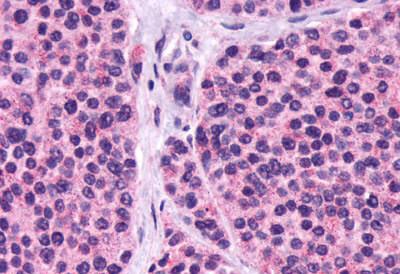
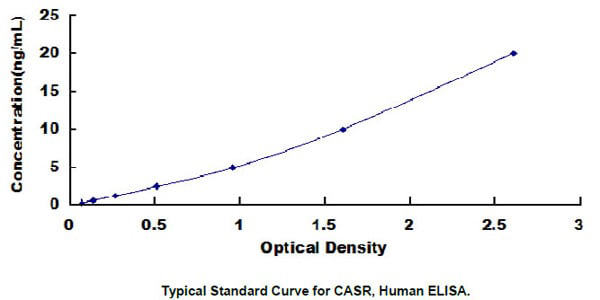
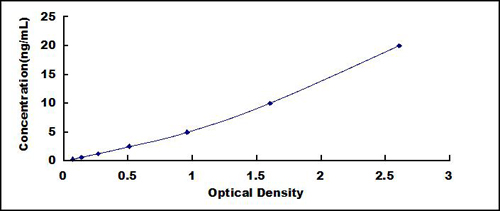
Product Notes
The CASR casr (Catalog #AAA113503) is a Recombinant Protein produced from E Coli or Yeast or Baculovirus or Mammalian Cell and is intended for research purposes only. The product is available for immediate purchase. The immunogen sequence is 20-612aa; Extracellular Domain. The amino acid sequence is listed below: YGPDQRAQKK GDIILGGLFP IHFGVAAKDQ DLKSRPESVE CIRYNFRGFR WLQAMIFAIE EINSSPALLP NLTLGYRIFD TCNTVSKALE ATLSFVAQNK IDSLNLDEFC NCSEHIPSTI AVVGATGSGV STAVANLLGL FYIPQVSYAS SSRLLSNKNQ FKSFLRTIPN DEHQATAMAD IIEYFRWNWV GTIAADDDYG RPGIEKFREE AEERDICIDF SELISQYSDE EEIQHVVEVI QNSTAKVIVV FSSGPDLEPL IKEIVRRNIT GKIWLASEAW ASSSLIAMPQ YFHVVGGTIG FALKAGQIPG FREFLKKVHP RKSVHNGFAK EFWEETFNCH LQEGAKGPLP VDTFLRGHEE SGDRFSNSST AFRPLCTGDE NISSVETPYI DYTHLRISYN VYLAVYSIAH ALQDIYTCLP GRGLFTNGSC ADIKKVEAWQ VLKHLRHLNF TNNMGEQVTF DECGDLVGNY SIINWHLSPE DGSIVFKEVG YYNVYAKKGE RLFINEEKIL WSGFSREVPF SNCSRDCLAG TRKGIIEGEP TCCFECVECP DGEYSDETDA SACNKCPDDF WSNENHTSCI AKEIEFLSWT EPF. It is sometimes possible for the material contained within the vial of "Extracellular calcium-sensing receptor, Recombinant Protein" to become dispersed throughout the inside of the vial, particularly around the seal of said vial, during shipment and storage. We always suggest centrifuging these vials to consolidate all of the liquid away from the lid and to the bottom of the vial prior to opening. Please be advised that certain products may require dry ice for shipping and that, if this is the case, an additional dry ice fee may also be required.Precautions
All products in the AAA Biotech catalog are strictly for research-use only, and are absolutely not suitable for use in any sort of medical, therapeutic, prophylactic, in-vivo, or diagnostic capacity. By purchasing a product from AAA Biotech, you are explicitly certifying that said products will be properly tested and used in line with industry standard. AAA Biotech and its authorized distribution partners reserve the right to refuse to fulfill any order if we have any indication that a purchaser may be intending to use a product outside of our accepted criteria.Disclaimer
Though we do strive to guarantee the information represented in this datasheet, AAA Biotech cannot be held responsible for any oversights or imprecisions. AAA Biotech reserves the right to adjust any aspect of this datasheet at any time and without notice. It is the responsibility of the customer to inform AAA Biotech of any product performance issues observed or experienced within 30 days of receipt of said product. To see additional details on this or any of our other policies, please see our Terms & Conditions page.Item has been added to Shopping Cart
If you are ready to order, navigate to Shopping Cart and get ready to checkout.