
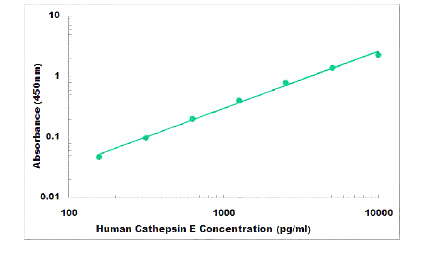
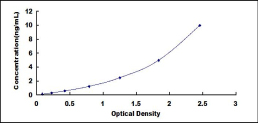
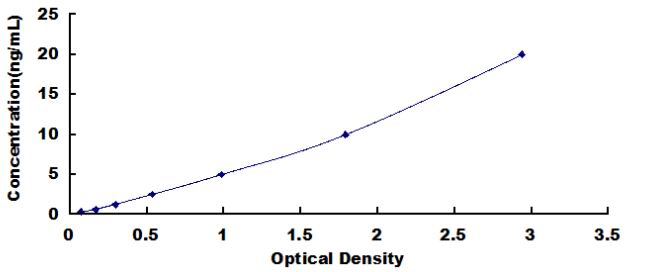
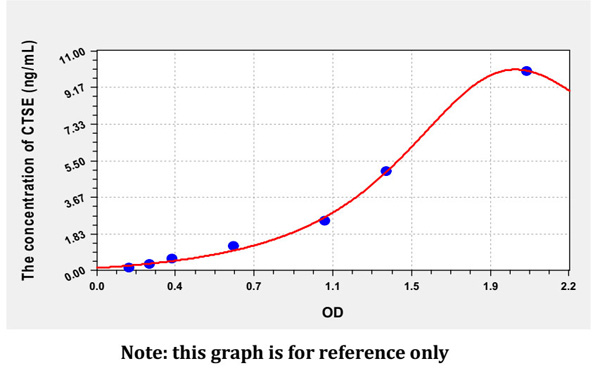
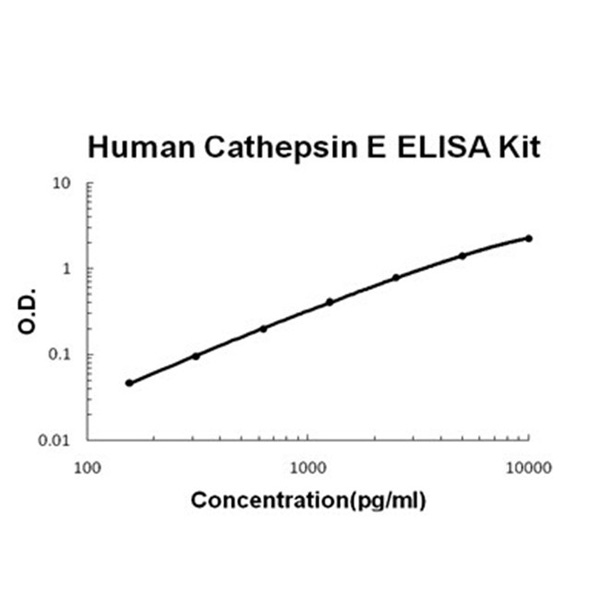
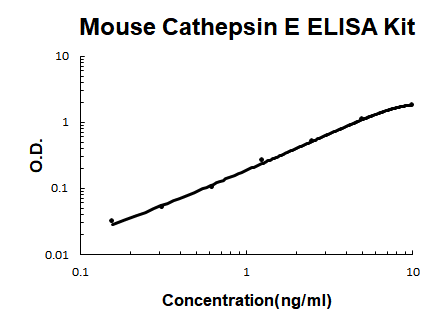
 Standard Curve (Sample)
Human Cathepsin E ELISA Kit | CTSE elisa kit
Human Cathepsin E ELISA Kit
Gene Names
CTSE; CATE
Reactivity
Human
Applications
ELISA
Synonyms
Cathepsin E; N/A; Human Cathepsin E ELISA Kit; CTSE elisa kit
Reactivity
Human
Specificity
The Human Cathepsin E ELISA Kit allows for the detection and quantification of endogenous levels of natural and/or recombinant Human Cathepsin E proteins within the range of 156 pg/ml - 10000 pg/ml.
Sequence Length
401
Samples
Cell Culture Supernatants, Serum, Plasma.
Sensitivity
10 pg/ml.
Applicable Applications for CTSE elisa kit
ELISA (Sandwich ELISA)
Preparation and Storage
Shipped and store at 4 degree C for 6 months, store at -20 degree C for one year. Avoid freeze/thaw cycles.
Standard Curve (Sample)
Standard Curve (Sample)
Related Product Information for CTSE elisa kit
Principle of the Assay||The Human Cathepsin E ELISA (Enzyme-Linked Immunosorbent Assay) kit is an in vitro enzyme-linked immunosorbent assay for the quantitative measurement of Human Cathepsin E in Cell Culture Supernatants, Serum, Plasma. This assay employs an antibody specific for Human Cathepsin E coated on a 96-well plate. Standards and samples are pipetted into the wells and Cathepsin E present in a sample is bound to the wells by the immobilized antibody. The wells are washed and biotinylated anti-Human Cathepsin E antibody is added. After washing away unbound biotinylated antibody, HRP-conjugated streptavidin is pipetted to the wells. The wells are again washed, a TMB substrate solution is added to the wells and color develops in proportion to the amount of Cathepsin E bound. The Stop Solution changes the color from blue to yellow, and the intensity of the color is measured at 450 nm.
Background/Introduction: Cathepsin E is a protein that in humans is encoded by the CTSE gene. It is mapped to 1q32.1. The protein encoded by this gene is a gastric aspartyl protease that functions as a disulfide-linked homodimer. This protease, which is a member of the peptidase C1 family, has a specificity similar to that of pepsin A and cathepsin D. It is an intracellular proteinase that does not appear to be involved in the digestion of dietary protein and is found in highest concentration in the surface of epithelial mucus-producing cells of the stomach. Cathepsin E is the first aspartic proteinase expressed in the fetal stomach and is found in more than half of gastric cancers. It appears, therefore, to be an oncofetal antigen, and it also has an important role in immune responses.
Background/Introduction: Cathepsin E is a protein that in humans is encoded by the CTSE gene. It is mapped to 1q32.1. The protein encoded by this gene is a gastric aspartyl protease that functions as a disulfide-linked homodimer. This protease, which is a member of the peptidase C1 family, has a specificity similar to that of pepsin A and cathepsin D. It is an intracellular proteinase that does not appear to be involved in the digestion of dietary protein and is found in highest concentration in the surface of epithelial mucus-producing cells of the stomach. Cathepsin E is the first aspartic proteinase expressed in the fetal stomach and is found in more than half of gastric cancers. It appears, therefore, to be an oncofetal antigen, and it also has an important role in immune responses.
NCBI and Uniprot Product Information
NCBI GI #
NCBI GeneID
Molecular Weight
39,553 Da
NCBI Official Full Name
Cathepsin E
NCBI Official Synonym Full Names
cathepsin E
NCBI Official Symbol
CTSE
NCBI Official Synonym Symbols
CATE
NCBI Protein Information
cathepsin E
UniProt Protein Name
Cathepsin E
UniProt Gene Name
CTSE
UniProt Entry Name
CATE_HUMAN
Customer Reviews
Loading reviews...
Share Your Experience
Similar Products


Product Notes
The Human CTSE ctse (Catalog #AAA261718) is an ELISA Kit and is intended for research purposes only. The product is available for immediate purchase. The AAA261718 ELISA Kit recognizes Human CTSE. AAA Biotech's Cathepsin E can be used in a range of immunoassay formats including, but not limited to, ELISA (Sandwich ELISA). Researchers should empirically determine the suitability of the CTSE ctse for an application not listed in the data sheet. Researchers commonly develop new applications and it is an integral, important part of the investigative research process. It is sometimes possible for the material contained within the vial of "Cathepsin E, ELISA Kit" to become dispersed throughout the inside of the vial, particularly around the seal of said vial, during shipment and storage. We always suggest centrifuging these vials to consolidate all of the liquid away from the lid and to the bottom of the vial prior to opening. Please be advised that certain products may require dry ice for shipping and that, if this is the case, an additional dry ice fee may also be required.Precautions
All products in the AAA Biotech catalog are strictly for research-use only, and are absolutely not suitable for use in any sort of medical, therapeutic, prophylactic, in-vivo, or diagnostic capacity. By purchasing a product from AAA Biotech, you are explicitly certifying that said products will be properly tested and used in line with industry standard. AAA Biotech and its authorized distribution partners reserve the right to refuse to fulfill any order if we have any indication that a purchaser may be intending to use a product outside of our accepted criteria.Disclaimer
Though we do strive to guarantee the information represented in this datasheet, AAA Biotech cannot be held responsible for any oversights or imprecisions. AAA Biotech reserves the right to adjust any aspect of this datasheet at any time and without notice. It is the responsibility of the customer to inform AAA Biotech of any product performance issues observed or experienced within 30 days of receipt of said product. To see additional details on this or any of our other policies, please see our Terms & Conditions page.Item has been added to Shopping Cart
If you are ready to order, navigate to Shopping Cart and get ready to checkout.