

 Application Data
(Effects of ACM from Olig2PC-Astros and NPC-Astros on neurons.(h and i) RT-PCR analysis of the expression of the antioxidant defense-related genes, GCLC and NFE2L2 (n=3), and the neurotrophic growth factor genes, BDNF, GDNF and NT-3 (n=3).)
Application Data
(Effects of ACM from Olig2PC-Astros and NPC-Astros on neurons.(h and i) RT-PCR analysis of the expression of the antioxidant defense-related genes, GCLC and NFE2L2 (n=3), and the neurotrophic growth factor genes, BDNF, GDNF and NT-3 (n=3).)
Glial-Derived Neurotrophic Factor Active Protein | Gdnf active protein
Mouse Glial-Derived Neurotrophic Factor Recombinant
FGF was removed and NP media supplemented with 20 ng/ml BDNF, 20 ng/ml GDNF and 0.5 mM dibutyryl cAMP (N6,2?-O-Dibutyryladenosine 3?,5?-cyclic monophosphate sodium salt).
Medium was exchanged every 2-3 days.Monolayer neuronal differentiationiPSC cultures were dissociated with Accutase to generate single-cell suspensions, then differentially plated on gelatin-coated plasticware for 1 h in medium'>hESC medium in the presence of ROCK inhibitor (Y27632, Ascent) to remove SNL feeders.
The nonattached cells were resuspended in MEF-CM (&systems) with 10 ng ml-1 FGF2 and plated on growth-factor reduced Matrigel (B) at a density of 25,000 cells cm-2 and allowed to propagate in self-renewal conditions for 72 h or until 70-90% confluent, whereupon media was changed to KS medium containing 50 ng ml-1 Noggin, 10 uM -1 SHH C24II and 50 ng ml-1 Wnt1 for the second day onwards.
kk1 blocking antibody (100 ng ml-1&) was also added for the second day only.
After 5 days, medium'>medium'>KSR medium'>medium containing these ligands was cross-tapered with medium'>N2B27 medium'>medium (Cells) containing the same ligands over 7 days (75% medium'>medium'>KSR and 25% medium'>N2B27 first day, 50% of each third day, and 25% medium'>medium'>KSR with 75% medium'>N2B27 fifth day).
Once established in N2B27 conditions, Wnt1, Noggin, SB431542 and -1 BDNF, 0.2 mM ascorbic acid and 100 ng ml-1 FGF8 were added.
Three days later, cells were dissociated with Hank's buffered saline solution for 1 h at room temperature, and lifted mechanically, then replated en bloc on to poly-l-ornithine/laminin-coated plasticware.
Neuronal maturation ensued with BDNF and ascorbic acid as before, supplemented with 10 ng ml-1 GDNF, 1 ng ml-1 TGFbeta3 and 0.5 mM dibutyryl-cAMP for the next 7 days.
After a total of 23-31 days, the resulting neuronal cultures were analysed by immunocytochemistry, qPCR and western blot.Differentiation of smNPCsFor generation of more ventral CNS neurons, including mDANs, medium'>smNPC expansion medium was changed 2 days after splitting to N2B27 medium with 100 ng/mL FGF8, 1 uM PMA, and 200 uM AA.
After 8 days in this medium, maturation medium-N2B27 with 10 ng/mL BDNF, 10 ng/mL GDNF, 1 ng/mL TGF-b3, 200 uM AA, and 500 uM dbcAMP-was used for the maturation of neurons.
0.5 uM PMA was added to this medium for 2 more days.
One day after changing to maturation medium, the cultures were split at a 1?3 ratio as small clumps, or single cells after Accutase treatment, or earlier when cultures became over-confluent.
Cultures were analyzed after 2 weeks in maturation conditions unless otherwise indicated.Neural differentiation of hiPSCsSchematic diagram in -1).NPCs in the form of rosettes developed for another 1 week (week 2).
Next, rosettes were manually isolated from surrounding cells and expanded as neurospheres in a suspension culture for 1 week (week 3) in NPC medium, composed of DMEM/F12, 1 × N2, 1 × B27-RA and 20?ng?ml-1 FGF2.
For neuronal differentiation, neurosphere at week 3 were plated again on growth factor reduced Matrigel-coated plates in medium'>neural medium'>induction medium for 1 week.
At week 4, only the clusters from which neurons migrated out were picked (-1) pre-coated plates in medium'>neuronal medium'>differentiation medium consisting of DMEM/F12, 1 × N2, 1 × B27-RA, 20?ng?ml-1 BDNF, 20?ng?ml-1 GDNF, 1?mM dibutyryl-cyclic AMP, 200?nM ascorbic acid.
Within another week of culture in the neuronal differentiation medium, the majority of the cells showed neuronal processes.Under this differentiation condition, ~85% of the total cells were betaIII-tubulin+ neurons at 6-week time point (-1) in the chemically defined and xeno-free astroglia medium containing DMEM/F12, 1 × N2, 1 × B27, BMP4 (10?ng?ml-1) and FGF2 (20?ng?ml-1) for directed astroglia differentiation-1) in medium consisting of DMEM/F12, 1 × N2, 1 × B27-RA for spontaneous differentiation.
Medium was changed every other day.
Cells were passaged at least 6-8 times during directed astroglia differentiation.
Neuronal differentiation of human embryonic stem cells by dual SMAD inhibition.2) Neuronal induction (days 10-20), by incubating cells with brain-derived neurotrophic factor, glia-derived neurotrophic factor, ascorbic acid, dibutyryl-cyclic-AMP (dbcAMP) and the NOTCH1-inhibitor DAPT; 3) Neuronal differentiation (days 20-37), by dissociating cells and re-plating them on poly-lysine/laminin-coated glass coverslips in the presence of BDNF, GDNF and neurotrophin 3 (NT3).Human embryonic and neural stem cell culture and differentiationFor neural differentiation, TrypLE Select dissociated single cells were plated onto CELLstart coated Lab-Tek Permanox chamber slides in XF-NSM.
24 h after attachment, the media was changed to differentiation media (DM) consisting of X-Vivo 15, 10 ng/mL BDNF, 10 ng/mL GDNF, 1× N2, 1× B27, 2 ng/mL Heparin (; St. Louis,), 63 ug/mL NAC, 0.1 ng/mL bFGF, and 10 ug/mL Ciprofloxacin.
The media was changed every 3 days with half being removed and replaced with fresh DM.
Differentiation was carried out for a total of 2-4 weeks before cells were permeabilized and immunostained.
Application Data
(Effects of ACM from Olig2PC-Astros and NPC-Astros on neurons.(h and i) RT-PCR analysis of the expression of the antioxidant defense-related genes, GCLC and NFE2L2 (n=3), and the neurotrophic growth factor genes, BDNF, GDNF and NT-3 (n=3).)
Application Data
(Effects of ACM from Olig2PC-Astros and NPC-Astros on neurons.(h and i) RT-PCR analysis of the expression of the antioxidant defense-related genes, GCLC and NFE2L2 (n=3), and the neurotrophic growth factor genes, BDNF, GDNF and NT-3 (n=3).)
Application Data
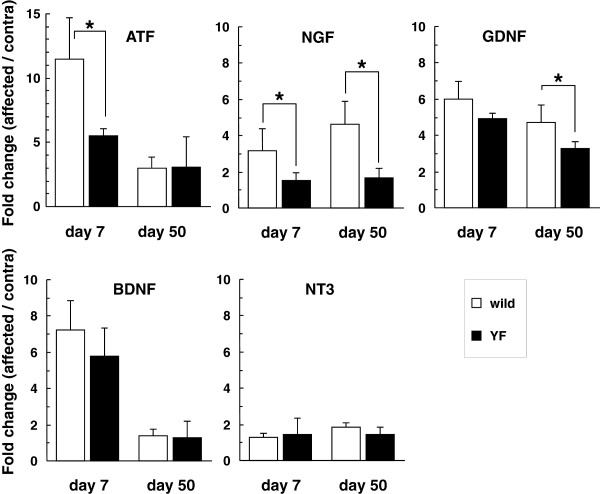
(Alterations of gene expression of neurotrophins in the DRG after HSV-1 infection.Gene expression levels of ATF3 and neurotrophins (NGF, GDNF, BDNF, and NT3) were normalized to the GAPDH level, and are presented as the fold change in the ratio of the affected side to the contralateral one.)
Application Data
(Alterations of gene expression of neurotrophins in the DRG after HSV-1 infection.Gene expression levels of ATF3 and neurotrophins (NGF, GDNF, BDNF, and NT3) were normalized to the GAPDH level, and are presented as the fold change in the ratio of the affected side to the contralateral one.)
Application Data
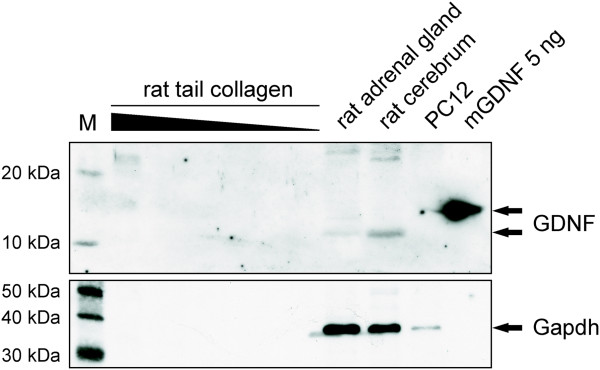
(The SCG SC development assay is free of GDNF.Western Blot for GDNF with different dilutions of rat-tail collagen (20?l, 10?l, 5?l, 2.5?l, 1.25?l and 0.6125?l collagen) were analyzed using anti-GDNF antibody specific for human and rat GDNF.)
Application Data
(The SCG SC development assay is free of GDNF.Western Blot for GDNF with different dilutions of rat-tail collagen (20?l, 10?l, 5?l, 2.5?l, 1.25?l and 0.6125?l collagen) were analyzed using anti-GDNF antibody specific for human and rat GDNF.)
NCBI and Uniprot Product Information
Customer Reviews
Loading reviews...
Share Your Experience
Similar Products




Product Notes
The Gdnf gdnf (Catalog #AAA76397) is an Active Protein produced from E coli (Note: Host protein expression may be lot-specific and can be subject to change during production, including bulk orders.) and is intended for research purposes only. The product is available for immediate purchase. The amino acid sequence is listed below: MKLWDVVAVC LVLLHTASAF PLPAGKRLLE APAEDHSLGH RRVPFALTSD SNMPEDYPDQ FDDVMDFIQA TIKRLKRSPD KQAAALPRRE RNRQAAAASP ENSRGKGRRG QRGKNRGCVL TAIHLNVTDL GLGYETKEEL IFRYCSGSCE SAETMYDKIL KNLSRSRRLT SDKVGQACCR PVAFDDDLSF LDDNLVYHIL RKHSAKRCGC I. It is sometimes possible for the material contained within the vial of "Glial-Derived Neurotrophic Factor, Active Protein" to become dispersed throughout the inside of the vial, particularly around the seal of said vial, during shipment and storage. We always suggest centrifuging these vials to consolidate all of the liquid away from the lid and to the bottom of the vial prior to opening. Please be advised that certain products may require dry ice for shipping and that, if this is the case, an additional dry ice fee may also be required.Precautions
All products in the AAA Biotech catalog are strictly for research-use only, and are absolutely not suitable for use in any sort of medical, therapeutic, prophylactic, in-vivo, or diagnostic capacity. By purchasing a product from AAA Biotech, you are explicitly certifying that said products will be properly tested and used in line with industry standard. AAA Biotech and its authorized distribution partners reserve the right to refuse to fulfill any order if we have any indication that a purchaser may be intending to use a product outside of our accepted criteria.Disclaimer
Though we do strive to guarantee the information represented in this datasheet, AAA Biotech cannot be held responsible for any oversights or imprecisions. AAA Biotech reserves the right to adjust any aspect of this datasheet at any time and without notice. It is the responsibility of the customer to inform AAA Biotech of any product performance issues observed or experienced within 30 days of receipt of said product. To see additional details on this or any of our other policies, please see our Terms & Conditions page.Item has been added to Shopping Cart
If you are ready to order, navigate to Shopping Cart and get ready to checkout.