
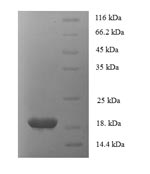
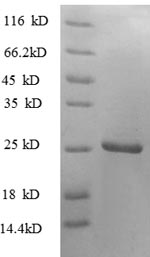
 SDS-PAGE
Tumor necrosis factor ligand superfamily member 6 Recombinant Protein | FASLG recombinant protein
Recombinant Human Tumor necrosis factor ligand superfamily member 6
Gene Names
FASLG; APTL; FASL; CD178; CD95L; ALPS1B; CD95-L; TNFSF6; TNLG1A; APT1LG1
Purity
Greater or equal to 85% purity as determined by SDS-PAGE.
Synonyms
Tumor necrosis factor ligand superfamily member 6; N/A; Recombinant Human Tumor necrosis factor ligand superfamily member 6; Apoptosis antigen ligand; APTLCD95 ligand; CD95-LFas antigen ligand; Fas ligand; FasL; CD178; FASLG recombinant protein
Host
E Coli or Yeast or Baculovirus or Mammalian Cell
Purity/Purification
Greater or equal to 85% purity as determined by SDS-PAGE.
Form/Format
Lyophilized or liquid (Format to be determined during the manufacturing process)
Sequence Positions
130-281aa; Full Length of Mature Protein
Sequence
QIGHPSPPPE KKELRKVAHL TGKSNSRSMP LEWEDTYGIV LLSGVKYKKG GLVINETGLY FVYSKVYFRG QSCNNLPLSH KVYMRNSKYP QDLVMMEGKM MSYCTTGQMW ARSSYLGAVF NLTSADHLYV NVSELSLVNF EESQTFFGLY KL
Preparation and Storage
Store at -20 degree C, for extended storage, conserve at -20 degree C or -80 degree C.
SDS-PAGE
SDS-PAGE
Related Product Information for FASLG recombinant protein
Cytokine that binds to TNFRSF6/FAS, a receptor that transduces the apoptotic signal into cells. May be involved in cytotoxic T-cell mediated apoptosis and in T-cell development. TNFRSF6/FAS-mediated apoptosis may have a role in the induction of peripheral tolerance, in the antigen-stimulated suicide of mature T-cells, or both. Binding to the decoy receptor TNFRSF6B/DcR3 modulates its effects.
Product Categories/Family for FASLG recombinant protein
References
Fas ligand mediates activation-induced cell death in human T lymphocytes.Alderson M.J. Exp. Med. 181:71-77(1995) Human Fas ligand gene structure, chromosomal location and species specificity.Takahashi T., Tanaka M., Inazawa J., Abe T., Suda T., Nagata S.Int. Immunol. 6:1567-1574(1994) Schaetzlein C.E., Poehlmann R., Philippsen P., Eibel H.Role of Fas ligand in apoptosis induced by hepatitis C virus infection.Mita E., Hayashi N., Iio S., Takehara T., Hijioka T., Kasahara A., Fusamoto H., Kamada T.Biochem. Biophys. Res. Commun. 204:468-474(1994) Isolation and characterization of a new naturally occurring variant of human Fas ligand that is expressed only in membrane bound form.Zeytun A., Nagarkatti M., Nagarkatti P.S. The DNA sequence and biological annotation of human chromosome 1.Gregory S.G., Barlow K.F., McLay K.E., Kaul R., Swarbreck D., Dunham A., Scott C.E., Howe K.L., Woodfine K., Spencer C.C.A., Jones M.C., Gillson C., Searle S., Zhou Y., Kokocinski F., McDonald L., Evans R., Phillips K., Atkinson A., Cooper R., Jones C., Hall R.E., Andrews T.D., Lloyd C., Ainscough R., Almeida J.P., Ambrose K.D., Anderson F., Andrew R.W., Ashwell R.I.S., Aubin K., Babbage A.K., Bagguley C.L., Bailey J., Beasley H., Bethel G., Bird C.P., Bray-Allen S., Brown J.Y., Brown A.J., Buckley D., Burton J., Bye J., Carder C., Chapman J.C., Clark S.Y., Clarke G., Clee C., Cobley V., Collier R.E., Corby N., Coville G.J., Davies J., Deadman R., Dunn M., Earthrowl M., Ellington A.G., Errington H., Frankish A., Frankland J., French L., Garner P., Garnett J., Gay L., Ghori M.R.J., Gibson R., Gilby L.M., Gillett W., Glithero R.J., Grafham D.V., Griffiths C., Griffiths-Jones S., Grocock R., Hammond S., Harrison E.S.I., Hart E., Haugen E., Heath P.D., Holmes S., Holt K., Howden P.J., Hunt A.R., Hunt S.E., Hunter G., Isherwood J., James R., Johnson C., Johnson D., Joy A., Kay M., Kershaw J.K., Kibukawa M., Kimberley A.M., King A., Knights A.J., Lad H., Laird G., Lawlor S., Leongamornlert D.A., Lloyd D.M., Loveland J., Lovell J., Lush M.J., Lyne R., Martin S., Mashreghi-Mohammadi M., Matthews L., Matthews N.S.W., McLaren S., Milne S., Mistry S., Moore M.J.F., Nickerson T., O'Dell C.N., Oliver K., Palmeiri A., Palmer S.A., Parker A., Patel D., Pearce A.V., Peck A.I., Pelan S., Phelps K., Phillimore B.J., Plumb R., Rajan J., Raymond C., Rouse G., Saenphimmachak C., Sehra H.K., Sheridan E., Shownkeen R., Sims S., Skuce C.D., Smith M., Steward C., Subramanian S., Sycamore N., Tracey A., Tromans A., Van Helmond Z., Wall M., Wallis J.M., White S., Whitehead S.L., Wilkinson J.E., Willey D.L., Williams H., Wilming L., Wray P.W., Wu Z., Coulson A., Vaudin M., Sulston J.E., Durbin R.M., Hubbard T., Wooster R., Dunham I., Carter N.P., McVean G., Ross M.T., Harrow J., Olson M.V., Beck S., Rogers J., Bentley D.R.Nature 441:315-321(2006) Matsumura M., Nakanishi Y., Ohba Y. Fas ligand mutation in a patient with systemic lupus erythematosus and lymphoproliferative disease.Wu J., Wilson J., He J., Xiang L., Schur P.H., Mountz J.D.J. Clin. Invest. 98:1107-1113(1996) Characterization of Fas (Apo-1, CD95) -Fas ligand interaction.Schneider P., Bodmer J.-L., Holler N., Mattmann C., Scuderi P., Terskikh A., Peitsch M.C., Tschopp J.J. Biol. Chem. 272:18827-18833(1997) Downregulation of Fas ligand by shedding.Tanaka M., Itai T., Adachi M., Nagata S.Nat. Med. 4:31-36(1998) The Fas ligand intracellular domain is released by ADAM10 and SPPL2a cleavage in T-cells.Kirkin V., Cahuzac N., Guardiola-Serrano F., Huault S., Luckerath K., Friedmann E., Novac N., Wels W.S., Martoglio B., Hueber A.O., Zornig M.Cell Death Differ. 14:1678-1687(2007) Sorting of Fas ligand to secretory lysosomes is regulated by mono-ubiquitylation and phosphorylation.Zuccato E., Blott E.J., Holt O., Sigismund S., Shaw M., Bossi G., Griffiths G.M.J. Cell Sci. 120:191-199(2007) Identification of SH3 domain interaction partners of human FasL (CD178) by phage display screening.Voss M., Lettau M., Janssen O.BMC Immunol. 10:53-53(2009)
NCBI and Uniprot Product Information
NCBI GI #
NCBI GeneID
NCBI Accession #
NCBI GenBank Nucleotide #
Molecular Weight
19.3 kDa
NCBI Official Full Name
tumor necrosis factor ligand superfamily member 6 isoform 1
NCBI Official Synonym Full Names
Fas ligand
NCBI Official Symbol
FASLG
NCBI Official Synonym Symbols
APTL; FASL; CD178; CD95L; ALPS1B; CD95-L; TNFSF6; TNLG1A; APT1LG1
NCBI Protein Information
tumor necrosis factor ligand superfamily member 6
UniProt Protein Name
Tumor necrosis factor ligand superfamily member 6
UniProt Gene Name
FASLG
UniProt Synonym Gene Names
APT1LG1; CD95L; FASL; TNFSF6; APTL; CD95-L; Fas ligand; FasL; sFasL; APL; FasL ICD; SPA
UniProt Entry Name
TNFL6_HUMAN
Customer Reviews
Loading reviews...
Share Your Experience
Similar Products




Product Notes
The FASLG faslg (Catalog #AAA114094) is a Recombinant Protein produced from E Coli or Yeast or Baculovirus or Mammalian Cell and is intended for research purposes only. The product is available for immediate purchase. The immunogen sequence is 130-281aa; Full Length of Mature Protein. The amino acid sequence is listed below: QIGHPSPPPE KKELRKVAHL TGKSNSRSMP LEWEDTYGIV LLSGVKYKKG GLVINETGLY FVYSKVYFRG QSCNNLPLSH KVYMRNSKYP QDLVMMEGKM MSYCTTGQMW ARSSYLGAVF NLTSADHLYV NVSELSLVNF EESQTFFGLY KL. It is sometimes possible for the material contained within the vial of "Tumor necrosis factor ligand superfamily member 6, Recombinant Protein" to become dispersed throughout the inside of the vial, particularly around the seal of said vial, during shipment and storage. We always suggest centrifuging these vials to consolidate all of the liquid away from the lid and to the bottom of the vial prior to opening. Please be advised that certain products may require dry ice for shipping and that, if this is the case, an additional dry ice fee may also be required.Precautions
All products in the AAA Biotech catalog are strictly for research-use only, and are absolutely not suitable for use in any sort of medical, therapeutic, prophylactic, in-vivo, or diagnostic capacity. By purchasing a product from AAA Biotech, you are explicitly certifying that said products will be properly tested and used in line with industry standard. AAA Biotech and its authorized distribution partners reserve the right to refuse to fulfill any order if we have any indication that a purchaser may be intending to use a product outside of our accepted criteria.Disclaimer
Though we do strive to guarantee the information represented in this datasheet, AAA Biotech cannot be held responsible for any oversights or imprecisions. AAA Biotech reserves the right to adjust any aspect of this datasheet at any time and without notice. It is the responsibility of the customer to inform AAA Biotech of any product performance issues observed or experienced within 30 days of receipt of said product. To see additional details on this or any of our other policies, please see our Terms & Conditions page.Item has been added to Shopping Cart
If you are ready to order, navigate to Shopping Cart and get ready to checkout.