
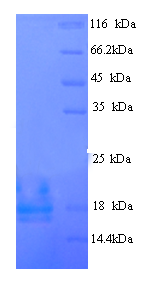
 SDS-PAGE
Envelope glycoprotein Recombinant Protein | GP recombinant protein
Recombinant Zaire ebolavirus Envelope glycoprotein
Purity
Greater or equal to 85% purity as determined by SDS-PAGE.
Synonyms
Envelope glycoprotein; N/A; Recombinant Zaire ebolavirus Envelope glycoprotein; GP1,2; GP; GP recombinant protein
Host
E Coli or Yeast or Baculovirus or Mammalian Cell
Purity/Purification
Greater or equal to 85% purity as determined by SDS-PAGE.
Form/Format
Lyophilized or liquid (Format to be determined during the manufacturing process)
Sequence Positions
502-637
Sequence
EAIVNAQPKC NPNLHYWTTQ DEGAAIGLAW IPYFGPAAEG IYTEGLMHNQ NGLICGLRQL ANETTQALQL FLRATTELRT FSILNRKAID FLLQRWGGTC HILGPDCCIE PHDWTKNITD KIDQIIHDFV DKTLPD
Sequence Length
676
Preparation and Storage
Store at -20 degree C, for extended storage, conserve at -20 degree C or -80 degree C.
SDS-PAGE
SDS-PAGE
Related Product Information for GP recombinant protein
GP1 is responsible for binding to the receptor(s) on target cells. Interacts with CD209/DC-SIGN and CLEC4M/DC-SIGNR which act as cofactors for virus entry into the host cell. Binding to CD209 and CLEC4M, which are respectively found on dendritic cells (DCs), and on endothelial cells of liver sinusoids and lymph node sinuses, facilitate infection of macrophages and endothelial cells. These interactions not only facilitate virus cell entry, but also allow capture of viral particles by DCs and subsequent transmission to susceptible cells without DCs infection (trans infection). Binding to the macrophage specific lectin CLEC10A also ses to enhance virus infectivity. Interaction with FOLR1/folate receptor alpha may be a cofactor for virus entry in some cell types, although results are contradictory. Mbers of the Tyro3 receptor tyrosine kinase family also se to be cell entry factors in filovirus infection. Once attached, the virions are internalized through clathrin-dependent endocytosis and/or macropinocytosis. After internalization of the virus into the endosomes of the host cell, proteolysis of GP1 by two cysteine proteases, CTSB/cathepsin B and CTSL/cathepsin L presumably induces a conformational change of GP2, unmasking its fusion peptide and initiating membranes fusion. GP2 acts as a class I viral fusion protein. Under the current model, the protein has at least 3 conformational states: pre-fusion native state, pre-hairpin intermediate state, and post-fusion hairpin state. During viral and target cell membrane fusion, the coiled coil regions (heptad repeats) assume a trimer-of-hairpins structure, positioning the fusion peptide in close proximity to the C-terminal region of the ectodomain. The formation of this structure appears to drive apposition and subsequent fusion of viral and target cell membranes. Responsible for penetration of the virus into the cell cytoplasm by mediating the fusion of the membrane of the endocytosed virus particle with the endosomal membrane. Low pH in endosomes induces an irreversible conformational change in GP2, releasing the fusion hydrophobic peptide. GP1,2 mediates endothelial cell activation and decreases endothelial barrier function. Mediates activation of primary macrophages. At terminal stages of the viral infection, when its expression is high, GP1,2 down-modulates the expression of various host cell surface molecules that are essential for immune surveillance and cell adhesion. Down-modulates integrins ITGA1, ITGA2, ITGA3, ITGA4, ITGA5, ITGA6, ITGAV and ITGB1. GP1,2 alters the cellular recycling of the dimer alpha-V/beta-3 via a dynamin-dependent pathway. Decrease in the host cell surface expression of various adhesion molecules may lead to cell detachment, contributing to the disruption of blood vessel integrity and horrhages developed during Ebola virus infection (cytotoxicity). This cytotoxicity appears late in the infection, only after the massive release of viral particles by infected cells. Down-modulation of host MHC-I, leading to altered recognition by immune cells, may explain the immune suppression and inflammatory dysfunction linked to Ebola infection. Also down-modulates EGFR surface expression. GP2delta is part of the complex GP1,2delta released by host ADAM17 metalloprotease. This secreted complex may play a role in the pathogenesis of the virus by efficiently blocking the neutralizing antibodies that would otherwise neutralize the virus surface glycoproteins GP1,2. Might therefore contribute to the lack of inflammatory reaction seen during infection in spite the of extensive necrosis and massive virus production. GP1,2delta does not se to be involved in activation of primary macrophages.
References
Emergence of subtype Zaire Ebola virus in Gabon.Volchkov V., Volchkova V., Eckel C., Klenk H.-D., Bouloy M., Leguenno B., Feldmann H.Virology 232:139-144(1997)
NCBI and Uniprot Product Information
Customer Reviews
Loading reviews...
Share Your Experience
Similar Products
Product Notes
The GP gp (Catalog #AAA115668) is a Recombinant Protein produced from E Coli or Yeast or Baculovirus or Mammalian Cell and is intended for research purposes only. The product is available for immediate purchase. The immunogen sequence is 502-637. The amino acid sequence is listed below: EAIVNAQPKC NPNLHYWTTQ DEGAAIGLAW IPYFGPAAEG IYTEGLMHNQ NGLICGLRQL ANETTQALQL FLRATTELRT FSILNRKAID FLLQRWGGTC HILGPDCCIE PHDWTKNITD KIDQIIHDFV DKTLPD. It is sometimes possible for the material contained within the vial of "Envelope glycoprotein, Recombinant Protein" to become dispersed throughout the inside of the vial, particularly around the seal of said vial, during shipment and storage. We always suggest centrifuging these vials to consolidate all of the liquid away from the lid and to the bottom of the vial prior to opening. Please be advised that certain products may require dry ice for shipping and that, if this is the case, an additional dry ice fee may also be required.Precautions
All products in the AAA Biotech catalog are strictly for research-use only, and are absolutely not suitable for use in any sort of medical, therapeutic, prophylactic, in-vivo, or diagnostic capacity. By purchasing a product from AAA Biotech, you are explicitly certifying that said products will be properly tested and used in line with industry standard. AAA Biotech and its authorized distribution partners reserve the right to refuse to fulfill any order if we have any indication that a purchaser may be intending to use a product outside of our accepted criteria.Disclaimer
Though we do strive to guarantee the information represented in this datasheet, AAA Biotech cannot be held responsible for any oversights or imprecisions. AAA Biotech reserves the right to adjust any aspect of this datasheet at any time and without notice. It is the responsibility of the customer to inform AAA Biotech of any product performance issues observed or experienced within 30 days of receipt of said product. To see additional details on this or any of our other policies, please see our Terms & Conditions page.Item has been added to Shopping Cart
If you are ready to order, navigate to Shopping Cart and get ready to checkout.