
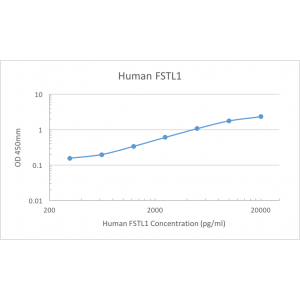
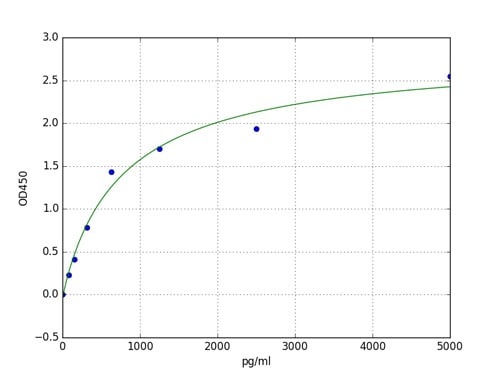
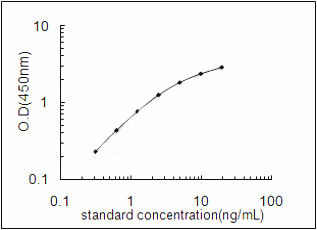
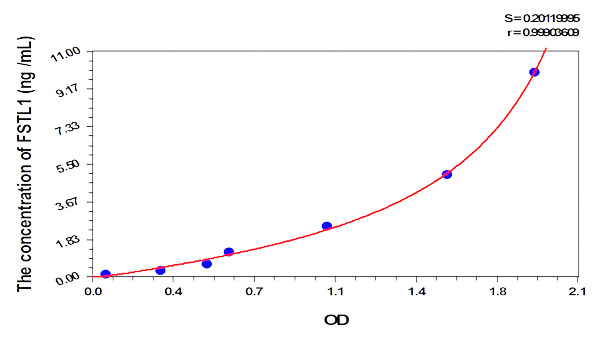
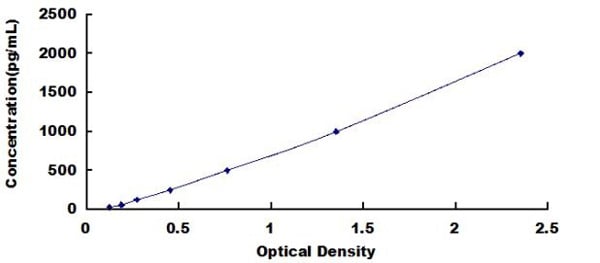
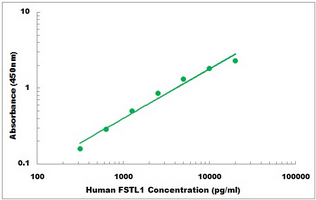
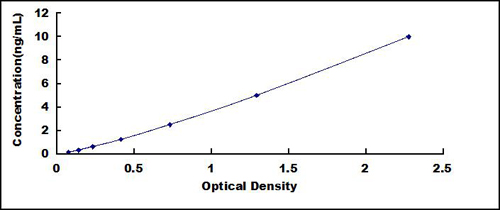
 Standard Curve (Sample)
Human FSTL1 ELISA Kit | FSTL1 elisa kit
Human FSTLPre-Coated ELISA Kit
Gene Names
FSTL1; FRP; FSL1; MIR198
Reactivity
Human
Synonyms
FSTL1; N/A; Human FSTLPre-Coated ELISA Kit; FSTL1 elisa kit
Reactivity
Human
Specificity
Natural and recombinant Human FSTL1
Assay Type
Solid Phase Sandwich ELISA: 96-Well Strip Plate
Detection Range
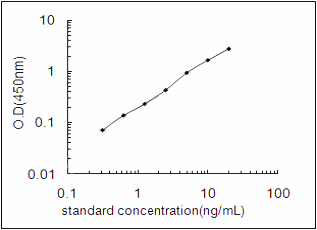
312pg/ml-20,000pg/ml
Sensitivity
<10pg/ml
Components
Anti-Human FSTL1 Pre-coated 96-well strip microplate
Human FSTL1 Standard
Human FSTL1 Biotinylated antibody (100x)
Avidin-Biotin-Peroxidase Complex (100x)
Sample Diluent
Antibody Diluent
Avidin-Biotin-Peroxidase Diluent
Wash Buffer Concentrate (Powder for 1000mL)
Color Developing Reagent
Stop Solution
Plate Sealers.
Human FSTL1 Standard
Human FSTL1 Biotinylated antibody (100x)
Avidin-Biotin-Peroxidase Complex (100x)
Sample Diluent
Antibody Diluent
Avidin-Biotin-Peroxidase Diluent
Wash Buffer Concentrate (Powder for 1000mL)
Color Developing Reagent
Stop Solution
Plate Sealers.
Interference
No detectable cross-reactivity with other relevant proteins
Preparation and Storage
Store the unopened product at 2-8 degree C.
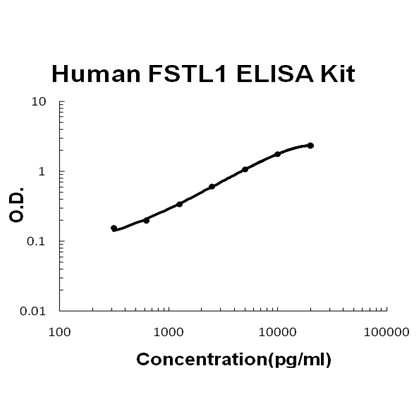
Standard Curve (Sample)
Standard Curve (Sample)
Related Product Information for FSTL1 elisa kit
Follistatin-like protein 1 (FSTL1) is a widely-expressed, extracellular glycoprotein that is homologously grouped into the osteonectin (BM-40/SPARC) family of secreted proteins based on its possession of both a follistatin-like and extracellular calcium-binding domain. Initially identified as a TGF-beta-inducible protein in a cloned mouse osteoblast cell line, FSTL1 has since been implicated in an array of cell-type-specific functions, such as the regulation of proliferation, differentiation, apoptosis and migration, as well as a number of biological processes, including embryonic development, inflammatory response, angiogenesis, tumorigenesis, and immune disease pathogenesis. Highly conserved across mammalian species and widely expressed in human tissues, FSTL1 can be upregulated through signaling mediators of the innate immune system,such as TLR4 agonists and the arthritogenic cytokine IL-1beta via NFkappaB pathways, to stimulate the expression and secretion of pro-inflammatory cytokines, including TNF-alpha, IL-1beta, IL-6 and IL-8. While cells of mesenchymal lineage are capable of FSTL1 production, FSTL1 expression is notably absent from cells of hematopoietic lineage under normal physiological conditions. Macrophages and monocytes are, however, capable of taking up FSTL1 at sites of inflammation where FSTL1 stimulation can cause the expression of caspase-1 and its resultant enzymatic cleavage of active IL-1beta from pro-IL-1beta. Whereas the overexpression of FSTL1 has been noted as a substantial contributor to the progression of immune diseases like rheumatoid arthritis (RA) and osteoarthritis (OA), diminished FSTL1 serum levels have been identified as playing a significant part in both ovarian and endometrial carcinogenesis, where it directly affects cell proliferation, migration and invasion.
Human FSTL1 Pre-Coated ELISA (Enzyme-Linked Immunosorbent Assay) kit is a solid phase immunoassay specially designed to measure FSTL1 with a 96-well strip plate that is pre-coated with mouse monoclonal antibody specific for FSTL1. It contains NS0-expressed recombinant FSTL1. The detection antibody is a biotinylated goat polyclonal antibody specific for FSTL1. The kit is analytically validated with ready to use reagents.
Human FSTL1 Pre-Coated ELISA (Enzyme-Linked Immunosorbent Assay) kit is a solid phase immunoassay specially designed to measure FSTL1 with a 96-well strip plate that is pre-coated with mouse monoclonal antibody specific for FSTL1. It contains NS0-expressed recombinant FSTL1. The detection antibody is a biotinylated goat polyclonal antibody specific for FSTL1. The kit is analytically validated with ready to use reagents.
NCBI and Uniprot Product Information
NCBI GI #
NCBI GeneID
NCBI Accession #
NCBI GenBank Nucleotide #
Molecular Weight
31,228 Da
NCBI Official Full Name
follistatin-related protein 1
NCBI Official Synonym Full Names
follistatin-like 1
NCBI Official Symbol
FSTL1
NCBI Official Synonym Symbols
FRP; FSL1; MIR198
NCBI Protein Information
follistatin-related protein 1; follistatin-like protein 1
UniProt Protein Name
Follistatin-related protein 1
UniProt Gene Name
FSTL1
UniProt Synonym Gene Names
FRP
UniProt Entry Name
FSTL1_HUMAN
Customer Reviews
Loading reviews...
Share Your Experience
Similar Products




Product Notes
The Human FSTL1 fstl1 (Catalog #AAA79383) is an ELISA Kit and is intended for research purposes only. The product is available for immediate purchase. The AAA79383 ELISA Kit recognizes Human FSTL1. It is sometimes possible for the material contained within the vial of "FSTL1, ELISA Kit" to become dispersed throughout the inside of the vial, particularly around the seal of said vial, during shipment and storage. We always suggest centrifuging these vials to consolidate all of the liquid away from the lid and to the bottom of the vial prior to opening. Please be advised that certain products may require dry ice for shipping and that, if this is the case, an additional dry ice fee may also be required.Precautions
All products in the AAA Biotech catalog are strictly for research-use only, and are absolutely not suitable for use in any sort of medical, therapeutic, prophylactic, in-vivo, or diagnostic capacity. By purchasing a product from AAA Biotech, you are explicitly certifying that said products will be properly tested and used in line with industry standard. AAA Biotech and its authorized distribution partners reserve the right to refuse to fulfill any order if we have any indication that a purchaser may be intending to use a product outside of our accepted criteria.Disclaimer
Though we do strive to guarantee the information represented in this datasheet, AAA Biotech cannot be held responsible for any oversights or imprecisions. AAA Biotech reserves the right to adjust any aspect of this datasheet at any time and without notice. It is the responsibility of the customer to inform AAA Biotech of any product performance issues observed or experienced within 30 days of receipt of said product. To see additional details on this or any of our other policies, please see our Terms & Conditions page.Item has been added to Shopping Cart
If you are ready to order, navigate to Shopping Cart and get ready to checkout.