
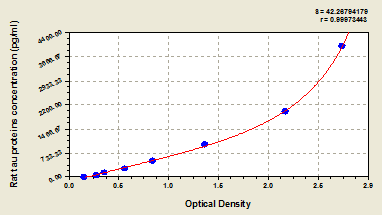
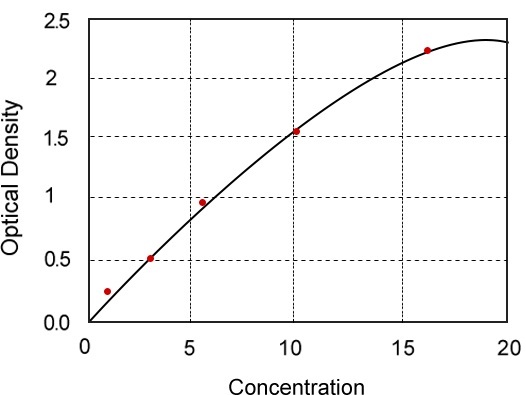
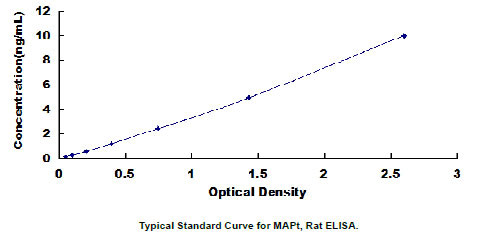
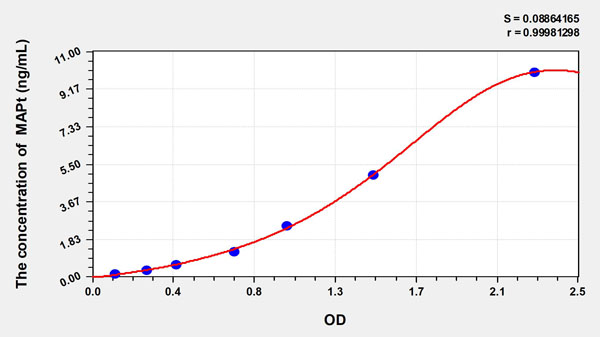
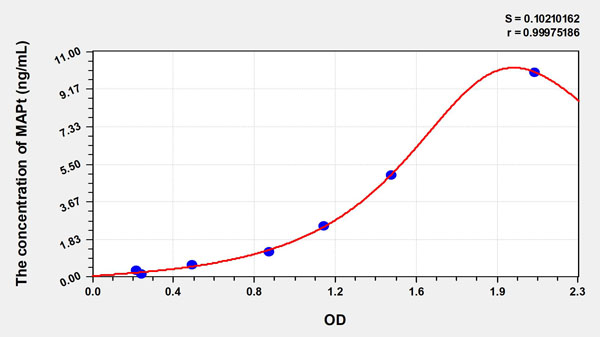
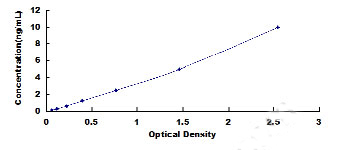
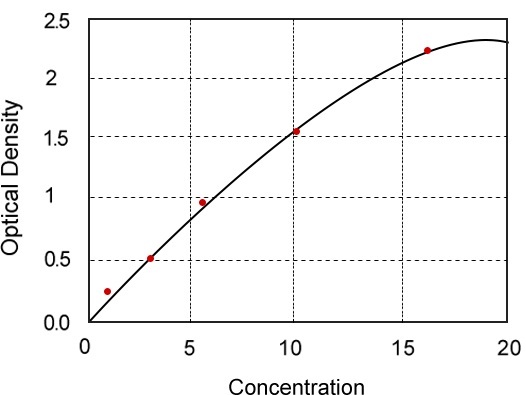
 Standard Curve (Sample)
Rat microtubule-associated protein tau ELISA Kit | MAPT elisa kit
Rat Tau Proteins ELISA Kit
Gene Names
Mapt; pTau; Mtapt; RNPTAU
Reactivity
Rat
Synonyms
microtubule-associated protein tau; N/A; Rat Tau Proteins ELISA Kit; Rat Tau Proteins ELISA kit; DDPAC; FLJ31424; FTDP-17; MAPTL; MGC138549; MSTD; MTBT1; MTBT2; PPND; TAU; G protein beta1/gamma2 subunit-interacting factor 1; isoform 4; MAPT elisa kit
Reactivity
Rat
Specificity
This assay has high sensitivity and excellent specificity for detection of Rat MAPT. No significant cross-reactivity or interference between Rat MAPT and analogues was observed.
Sequence Length
752
Samples
Serum, plasma, cerebrospinal fluid (CSF)
Detection Range
62.5 pg/ml-4000 pg/ml
Sensitivity
15.6 pg/ml
Intra-assay Precision
Intra-assay Precision (Precision within an assay): CV% is less than 8%
Three samples of known concentration were tested twenty times on one plate to assess.
Inter-assay Precision (Precision between assays): CV% is less than 10%
Three samples of known concentration were tested in twenty assays to assess.
Three samples of known concentration were tested twenty times on one plate to assess.
Inter-assay Precision (Precision between assays): CV% is less than 10%
Three samples of known concentration were tested in twenty assays to assess.
Detection Wavelength
450 nm
Sample Volume
50-100ul
Preparation and Storage
Unopened test kits should be stored at 2 to 8 degree C upon receipt. Please refer to pdf manual for further storage instructions.
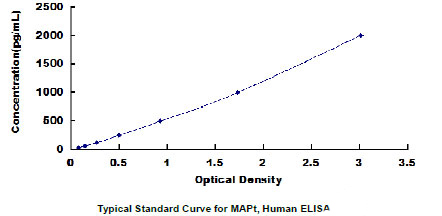
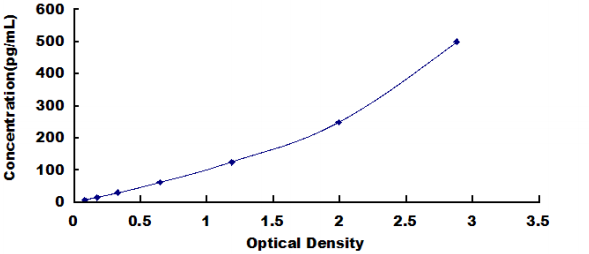
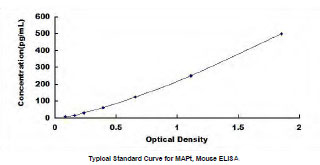
Standard Curve (Sample)
Standard Curve (Sample)
Related Product Information for MAPT elisa kit
Introduction: Tau proteins are microtubule-associated proteins that are abundant in neurons in the central nervous system and are less common elsewhere. They were discovered in 1975 in Marc Kirschner's laboratory at Princeton University. Tau proteins interact with tubulin to stabilize microtubules and promote tubulin assembly into microtubules. Tau has two ways of controlling microtubule stability: isoforms and phosphorylation. Six tau isoforms exist in brain tissue, and they are distinguished by their number of binding domains. Three isoforms have three binding domains and the other three have four binding domains. The binding domains are located in the carboxy-terminus of the protein and are positively-charged (allowing it to bind to the negatively-charged microtubule). The isoforms with four binding domains are better at stabilizing microtubules than those with three binding domains. The isoforms are a result of alternative splicing in exons 2,3, and 10 of the tau gene. Phosphorylation of tau is regulated by a host of kinases. For example, PKN, a serine/threonine kinase. When PKN is activated, it phosphorylates tau, resulting in disruption of microtubule organization. Hyperphosphorylation of the tau protein (tau inclusions), however, can result in the self-assembly of tangles of paired helical filaments and straight filaments, which are involved in the pathogenesis of Alzheimer's disease and other tauopathies. Tau protein is a highly soluble microtubule-associated protein (MAP). These proteins are mostly found in neurons compared to non-neuronal cells. One of tau's main functions is to modulate the stability of axonal microtubules. Tau is not present in dendrites and is active primarily in the distal portions of axons where it provides microtubule stabilization but also flexibility as needed. This contrasts with STOP proteins in the proximal portions of axons which essentially lock down the microtubules and MAP2 that stabilizes microtubules in dendrites. The tau gene locates on chromosome 17q21, containing 16 exons. All of the six tau isoforms are present in an often hyperphosphorylated state in paired helical filaments from Alzheimer's Disease brain. In other neurodegenerative diseases, the deposition of aggregates enriched in certain tau isoforms has been reported. When misfolded this otherwise very soluble protein can form extremely insoluble aggregates that contribute to a number of neurodegenerative diseases.
Principle of the Assay: The microtiter plate provided in this kit has been pre-coated with an antibody specific to Tau Proteins. Standards or samples are then added to the appropriate microtiter plate wells with abiotin-conjugated antibody preparation specific for Tau Proteins and Avidin conjugated to Horseradish Peroxidase (HRP) is added to each microplate well and incubated. Then a TMB (3,3',5,5' tetramethyl-benzidine) substrate solution is added to each well. Only those wells that contain Tau Proteins, biotin-conjugated antibody and enzyme-conjugated Avidin will exhibit a change in color. The enzyme-substrate reaction is terminated by the addition of a sulphuric acid solution and the color change is measured spectrophotometrically at a wavelength of 450 nm +/- 2 nm. The concentration of Tau Proteins in the samples is then determined by comparing the O.D. of the samples to the standard curve.
Principle of the Assay: The microtiter plate provided in this kit has been pre-coated with an antibody specific to Tau Proteins. Standards or samples are then added to the appropriate microtiter plate wells with abiotin-conjugated antibody preparation specific for Tau Proteins and Avidin conjugated to Horseradish Peroxidase (HRP) is added to each microplate well and incubated. Then a TMB (3,3',5,5' tetramethyl-benzidine) substrate solution is added to each well. Only those wells that contain Tau Proteins, biotin-conjugated antibody and enzyme-conjugated Avidin will exhibit a change in color. The enzyme-substrate reaction is terminated by the addition of a sulphuric acid solution and the color change is measured spectrophotometrically at a wavelength of 450 nm +/- 2 nm. The concentration of Tau Proteins in the samples is then determined by comparing the O.D. of the samples to the standard curve.
NCBI and Uniprot Product Information
NCBI GI #
NCBI GeneID
Molecular Weight
78,564 Da
NCBI Official Full Name
Microtubule-associated protein tau
NCBI Official Synonym Full Names
microtubule-associated protein tau
NCBI Official Symbol
Mapt
NCBI Official Synonym Symbols
pTau; Mtapt; RNPTAU
NCBI Protein Information
microtubule-associated protein tau; PHF-tau; paired helical filament-tau; neurofibrillary tangle protein; Tau microtubule-associated protein
UniProt Protein Name
Microtubule-associated protein tau
UniProt Gene Name
Mapt
UniProt Synonym Gene Names
Mtapt; Tau; PHF-tau
UniProt Entry Name
TAU_RAT
Customer Reviews
Loading reviews...
Share Your Experience
Similar Products

Product Notes
The Rat MAPT mapt (Catalog #AAA79758) is an ELISA Kit and is intended for research purposes only. The product is available for immediate purchase. The AAA79758 ELISA Kit recognizes Rat MAPT. It is sometimes possible for the material contained within the vial of "microtubule-associated protein tau, ELISA Kit" to become dispersed throughout the inside of the vial, particularly around the seal of said vial, during shipment and storage. We always suggest centrifuging these vials to consolidate all of the liquid away from the lid and to the bottom of the vial prior to opening. Please be advised that certain products may require dry ice for shipping and that, if this is the case, an additional dry ice fee may also be required.Precautions
All products in the AAA Biotech catalog are strictly for research-use only, and are absolutely not suitable for use in any sort of medical, therapeutic, prophylactic, in-vivo, or diagnostic capacity. By purchasing a product from AAA Biotech, you are explicitly certifying that said products will be properly tested and used in line with industry standard. AAA Biotech and its authorized distribution partners reserve the right to refuse to fulfill any order if we have any indication that a purchaser may be intending to use a product outside of our accepted criteria.Disclaimer
Though we do strive to guarantee the information represented in this datasheet, AAA Biotech cannot be held responsible for any oversights or imprecisions. AAA Biotech reserves the right to adjust any aspect of this datasheet at any time and without notice. It is the responsibility of the customer to inform AAA Biotech of any product performance issues observed or experienced within 30 days of receipt of said product. To see additional details on this or any of our other policies, please see our Terms & Conditions page.Item has been added to Shopping Cart
If you are ready to order, navigate to Shopping Cart and get ready to checkout.