
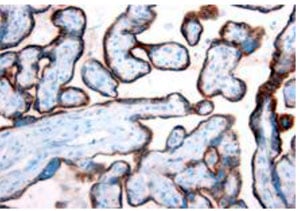
 IHC (Immunohiostchemistry)
(Immunohistochemistry on paraffin-embedded sections of human placenta.)
IHC (Immunohiostchemistry)
(Immunohistochemistry on paraffin-embedded sections of human placenta.)
anti-Human alpha-Glucosidase Monoclonal Antibody | anti-Trad_1739 antibody
Mouse anti alpha-Glucosidase
Reactivity
Human
Applications
Immunoblot, Western Blot, Immunohistochemistry
Synonyms
alpha-Glucosidase, Antibody; Mouse anti alpha-Glucosidase; anti-Trad_1739 antibody
Host
Mouse (Balb/c)
Reactivity
Human
Clonality
Monoclonal
Isotype
IgG2a
Clone Number
43G7
Specificity
Reacts with the two major bands with apparent molecular weights of 76 000 and 70 000, the band with a molecular weight of about 94000 and minor bands with apparent molecular weights of less than 67 000, when analyzing a-glucosidase isolated from placenta by polyacrylamide gel electrophoresis in the presence of SDS and a reducing agent.
Form/Format
Each vial contains 100 ul 1 mg/ml purified monoclonal antibody in PBS containing 0.09% sodium azide.
Applicable Applications for anti-Trad_1739 antibody
IB (Immunoblot), IHC (Immunohistochemistry)
Source Note
43G7 is a Mouse monoclonal IgG1 antibody derived by fusion of Mouse myeloma cells with spleen cells from a Balb/cHeA Mouse hyperimmunized with purified acid alpha-glucosidase from Human placenta.
Preparation and Storage
Store at 4 degree C, or in small aliquots at -20 degree C.
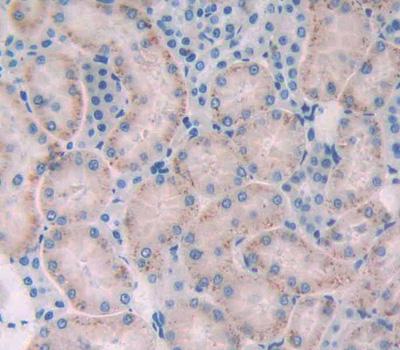
IHC (Immunohiostchemistry)
(Immunohistochemistry on paraffin-embedded sections of human placenta.)
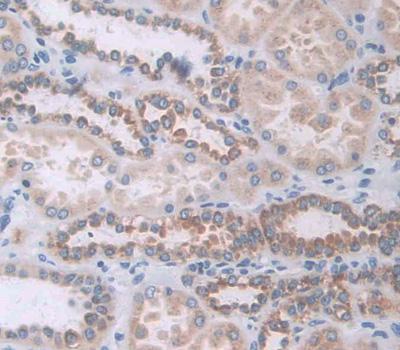
IHC (Immunohiostchemistry)
(Immunohistochemistry on paraffin-embedded sections of human placenta.)
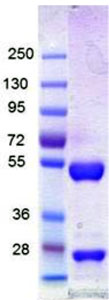
SDS-PAGE
(SDS-polyacrylamide gel electrophoresis)
SDS-PAGE
(SDS-polyacrylamide gel electrophoresis)
Related Product Information for anti-Trad_1739 antibody
Lysosomal alpha -glucosidase, like all other lysosomal enzymes of which the 'life-cycle' has been studied, is synthesized as a large precursor that is processed to mature forms of lower molecular mass. Acid alpha -glucosidase Catalyzes the hydrolysis of the alpha1 -> 4 and alpha1 -> 6 glucosidic linkages in glycogen and the alpha1 -> 4 glucosidic linkage in maltose and artificial substRates likep-nitrophenyl- alpha -glucoside. The enzyme is deficient in patients with Glycogenosis Type II (Pompe's disease). Pompe disease (also called Glycogen storage disease type II (GSD II) or acid maltase deficiency) is an autosomal recessive metabolic disorder which damages muscle and nerve cells throughout the body. It is caused by an accumulation of glycogen in the lysosome due to deficiency of the lysosomal acid alpha-glucosidase enzyme. It is the only glycogen storage disease with a defect in lysosomal metabolism. The build-up of glycogen causes progressive muscle weakness (myopathy) throughout the body and affects various body tissues, particularly in the heart, skeletal muscles, liver and nervous system. There are exceptions but levels of alpha-glucosidase determines the type of GSD II an individual may have. More alpha glucosidase present in the individuals muscles means symptoms occur later in life and progress more slowly. GSD II is broadly divided into two onset forms based on the age symptoms occur: Infantile-onset form is usually identified at 4-8 months; muscles appear normal but are limp and weak preventing them from lifting their head or rolling over. As the disease progresses heart muscles thicken and progressively fail. Without treatment death usually occurs due to heart failure and respiRatory weakness.Late/later onset form occurs later than one to two years and progresses more slowly than Infantile-onset form. One of the first symptoms is a progressive decrease in muscle strength starting with the legs and moving to smaller muscles in the trunk and arms, such as the diaphragm and other muscles required for breathing. RespiRatory failure is the most common cause of death. Enlargement of the heart muscles and rhythm disturbances are not significant features but do occur in some casesThe disease is caused by a mutation in a gene (acid alpha-glucosidase: also known as acid maltase) on long arm of chromosome 17 at 17q25.2-q25.3 (base pair 75,689,876 to 75,708,272). The number of mutations described is currently (in 2010) 289 with 67 being non-pathogenic mutations and 197 pathogenic mutations. The remainder are still being evaluated for their association with disease.
Product Categories/Family for anti-Trad_1739 antibody
References
John Hilkens, Joseph M. Tager, Femke Buijs, Betty Brouwer-Kelder, Gerda M. Van Thienen, Frans P.W. Tegelaers and Jo Hilgers (1981): Monoclonal antibodies anti Human acid t~-glucosidase, Biochimica et Biophysica Acta, 678 (1981) 7-11.
NCBI and Uniprot Product Information
NCBI GI #
NCBI GeneID
NCBI Accession #
NCBI GenBank Nucleotide #
NCBI Official Full Name
alpha-glucosidase
NCBI Official Symbol
Trad_1739
NCBI Protein Information
alpha-glucosidase
Customer Reviews
Loading reviews...
Share Your Experience
Similar Products


Product Notes
The Trad_1739 (Catalog #AAA77501) is an Antibody produced from Mouse (Balb/c) and is intended for research purposes only. The product is available for immediate purchase. The Mouse anti alpha-Glucosidase reacts with Human and may cross-react with other species as described in the data sheet. AAA Biotech's alpha-Glucosidase can be used in a range of immunoassay formats including, but not limited to, IB (Immunoblot), IHC (Immunohistochemistry). Researchers should empirically determine the suitability of the Trad_1739 for an application not listed in the data sheet. Researchers commonly develop new applications and it is an integral, important part of the investigative research process. It is sometimes possible for the material contained within the vial of "alpha-Glucosidase, Monoclonal Antibody" to become dispersed throughout the inside of the vial, particularly around the seal of said vial, during shipment and storage. We always suggest centrifuging these vials to consolidate all of the liquid away from the lid and to the bottom of the vial prior to opening. Please be advised that certain products may require dry ice for shipping and that, if this is the case, an additional dry ice fee may also be required.Precautions
All products in the AAA Biotech catalog are strictly for research-use only, and are absolutely not suitable for use in any sort of medical, therapeutic, prophylactic, in-vivo, or diagnostic capacity. By purchasing a product from AAA Biotech, you are explicitly certifying that said products will be properly tested and used in line with industry standard. AAA Biotech and its authorized distribution partners reserve the right to refuse to fulfill any order if we have any indication that a purchaser may be intending to use a product outside of our accepted criteria.Disclaimer
Though we do strive to guarantee the information represented in this datasheet, AAA Biotech cannot be held responsible for any oversights or imprecisions. AAA Biotech reserves the right to adjust any aspect of this datasheet at any time and without notice. It is the responsibility of the customer to inform AAA Biotech of any product performance issues observed or experienced within 30 days of receipt of said product. To see additional details on this or any of our other policies, please see our Terms & Conditions page.Item has been added to Shopping Cart
If you are ready to order, navigate to Shopping Cart and get ready to checkout.