
 FCM/FACS (Flow Cytometry)
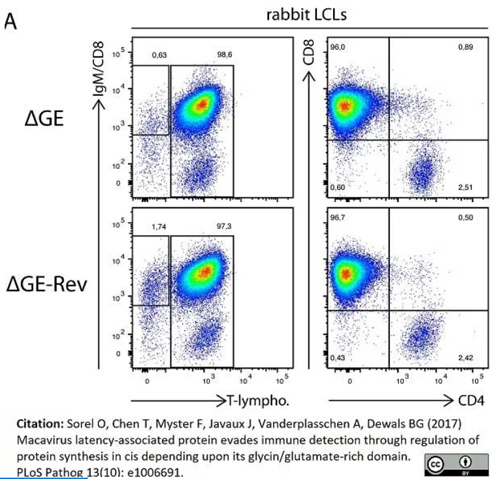
(Published customer image:Mouse anti Rabbit CD4 antibody, clone KEN-4 (AAA50241) used for the evaluation of rabbit lymphoblastoid phenotype by flow cytometry.Image caption:Lymphoblastoid cell lines (LCLs) phenotypic analysis.LCLs were propagated from peripheral blood mononuclear cells of rabbits developing MCF after infection with Delta-GE or Delta-GE-rev viruses in Iscove’s modified Dulbecco’s medium (IMDM) containing 10% FCS and supplemented with recombinant human interleukin 2 (Roche, 10 IU/mL). Cells were maintained in medium replaced every 3–4 days and analyzed by flow cytometry for IgM+ B cells, CD8+ T cells and CD4+ T cells after 3 weeks culture (A).)
FCM/FACS (Flow Cytometry)
(Published customer image:Mouse anti Rabbit CD4 antibody, clone KEN-4 (AAA50241) used for the evaluation of rabbit lymphoblastoid phenotype by flow cytometry.Image caption:Lymphoblastoid cell lines (LCLs) phenotypic analysis.LCLs were propagated from peripheral blood mononuclear cells of rabbits developing MCF after infection with Delta-GE or Delta-GE-rev viruses in Iscove’s modified Dulbecco’s medium (IMDM) containing 10% FCS and supplemented with recombinant human interleukin 2 (Roche, 10 IU/mL). Cells were maintained in medium replaced every 3–4 days and analyzed by flow cytometry for IgM+ B cells, CD8+ T cells and CD4+ T cells after 3 weeks culture (A).)
CD4 Monoclonal Antibody | anti-CD4 antibody
MOUSE ANTI RABBIT CD4
This product should be stored undiluted. Avoid repeated freezing and thawing as this may denature the antibody. Should this product contain a precipitate we recommend microcentrifugation before use.
FCM/FACS (Flow Cytometry)
(Published customer image:Mouse anti Rabbit CD4 antibody, clone KEN-4 (AAA50241) used for the evaluation of rabbit lymphoblastoid phenotype by flow cytometry.Image caption:Lymphoblastoid cell lines (LCLs) phenotypic analysis.LCLs were propagated from peripheral blood mononuclear cells of rabbits developing MCF after infection with Delta-GE or Delta-GE-rev viruses in Iscove’s modified Dulbecco’s medium (IMDM) containing 10% FCS and supplemented with recombinant human interleukin 2 (Roche, 10 IU/mL). Cells were maintained in medium replaced every 3–4 days and analyzed by flow cytometry for IgM+ B cells, CD8+ T cells and CD4+ T cells after 3 weeks culture (A).)
FCM/FACS (Flow Cytometry)
(Published customer image:Mouse anti Rabbit CD4 antibody, clone KEN-4 (AAA50241) used for the evaluation of rabbit lymphoblastoid phenotype by flow cytometry.Image caption:Lymphoblastoid cell lines (LCLs) phenotypic analysis.LCLs were propagated from peripheral blood mononuclear cells of rabbits developing MCF after infection with Delta-GE or Delta-GE-rev viruses in Iscove’s modified Dulbecco’s medium (IMDM) containing 10% FCS and supplemented with recombinant human interleukin 2 (Roche, 10 IU/mL). Cells were maintained in medium replaced every 3–4 days and analyzed by flow cytometry for IgM+ B cells, CD8+ T cells and CD4+ T cells after 3 weeks culture (A).)
FCM/FACS (Flow Cytometry)
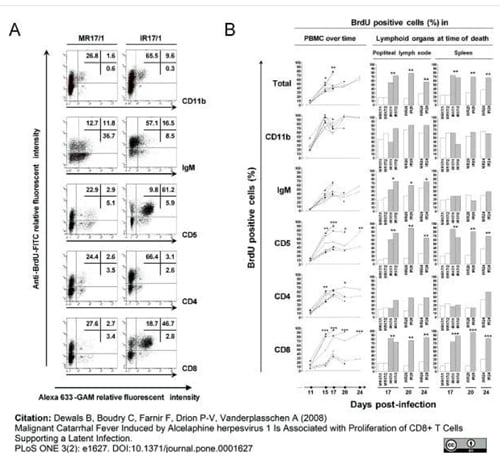
(Published researcher image:Mouse anti Rabbit CD4 antibody, clone KEN-4 (AAA50241) used to assess CD4 expression levels on rabbit mononuclear cells by flow cytometry.Image caption:Analysis of in vivo BrdU incorporation.Rabbits were treated as described in Fig. 1. PBMCs were collected at days 11, 15, 17, 20 and 24 post-inoculation, while mononuclear cells were isolated from popliteal lymph node and spleen at the time of death. Cells were labelled with anti-CD11b, IgM, CD5, CD4 and CD8 mAbs as the primary antibodies. Alexa 633-GAM was used as the secondary antibody. In vivo BrdU incorporation was revealed by immunofluorescent staining as described in Methods. After staining, cells were analysed by flow cytometry.A. Representative flow cytometry dot plots are shown for each double staining, they illustrate the data obtained at day 17 post-infection for the PBMC of rabbits MR17/1 and IR17/1. The data represent the percentages of BrdU positive cells (y-axis) calculated based on the acquisition of 10,000 cells expressing the indicated cell marker (x-axis).B. The percentage of BrdU positive cells amongst the indicated cellular subset was determined and compared between AlHV-1 infected (left column: bold lines; middle and right columns: hatched bars) and mock infected (left column: dotted lines; middle and right columns: open bars) groups (* P)
FCM/FACS (Flow Cytometry)
(Published researcher image:Mouse anti Rabbit CD4 antibody, clone KEN-4 (AAA50241) used to assess CD4 expression levels on rabbit mononuclear cells by flow cytometry.Image caption:Analysis of in vivo BrdU incorporation.Rabbits were treated as described in Fig. 1. PBMCs were collected at days 11, 15, 17, 20 and 24 post-inoculation, while mononuclear cells were isolated from popliteal lymph node and spleen at the time of death. Cells were labelled with anti-CD11b, IgM, CD5, CD4 and CD8 mAbs as the primary antibodies. Alexa 633-GAM was used as the secondary antibody. In vivo BrdU incorporation was revealed by immunofluorescent staining as described in Methods. After staining, cells were analysed by flow cytometry.A. Representative flow cytometry dot plots are shown for each double staining, they illustrate the data obtained at day 17 post-infection for the PBMC of rabbits MR17/1 and IR17/1. The data represent the percentages of BrdU positive cells (y-axis) calculated based on the acquisition of 10,000 cells expressing the indicated cell marker (x-axis).B. The percentage of BrdU positive cells amongst the indicated cellular subset was determined and compared between AlHV-1 infected (left column: bold lines; middle and right columns: hatched bars) and mock infected (left column: dotted lines; middle and right columns: open bars) groups (* P)
Application Data
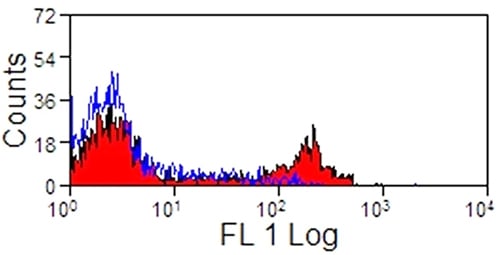
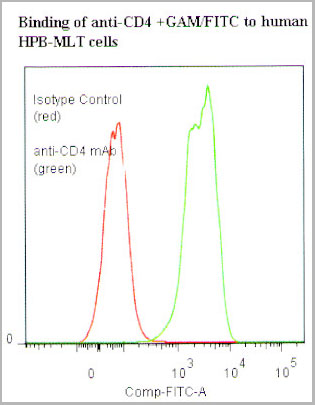
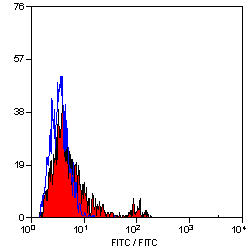
(Staining of rabbit peripheral blood lymphocytes with purified Mouse anti Rabbit CD4 antibody, clone KEN-4 (AAA50241) followed by FITC conjugated Rabbit F(ab')2 anti Mouse IgG antibody)
Application Data
(Staining of rabbit peripheral blood lymphocytes with purified Mouse anti Rabbit CD4 antibody, clone KEN-4 (AAA50241) followed by FITC conjugated Rabbit F(ab')2 anti Mouse IgG antibody)
FITC (Fluorescein Isothiocyanate)
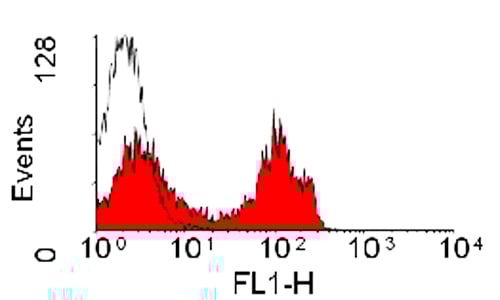
(Staining of rabbit peripheral blood lymphocytes with FITC conjugated Mouse anti Rabbit CD4 antibody, clone KEN-4)
FITC (Fluorescein Isothiocyanate)
(Staining of rabbit peripheral blood lymphocytes with FITC conjugated Mouse anti Rabbit CD4 antibody, clone KEN-4)
Mouse anti Rabbit CD4 antibody, clone KEN-4 blocks the allogeneic mixed lymphocyte reaction response.
NCBI and Uniprot Product Information
Customer Reviews
Loading reviews...
Share Your Experience
Similar Products





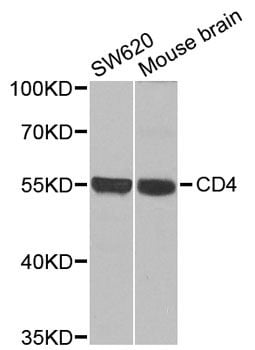
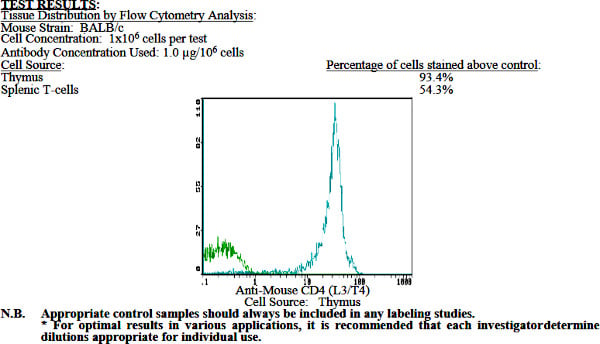
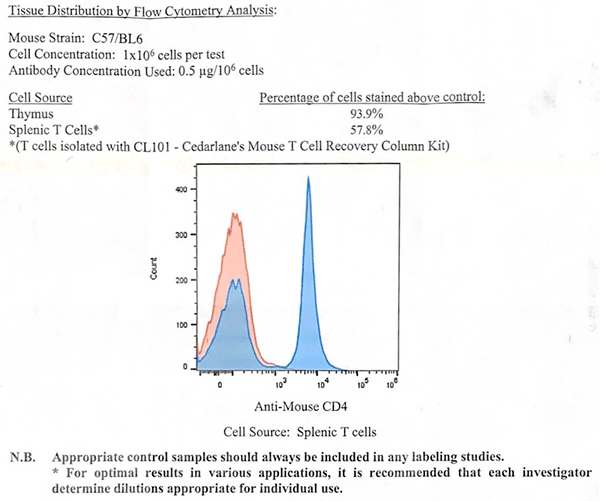
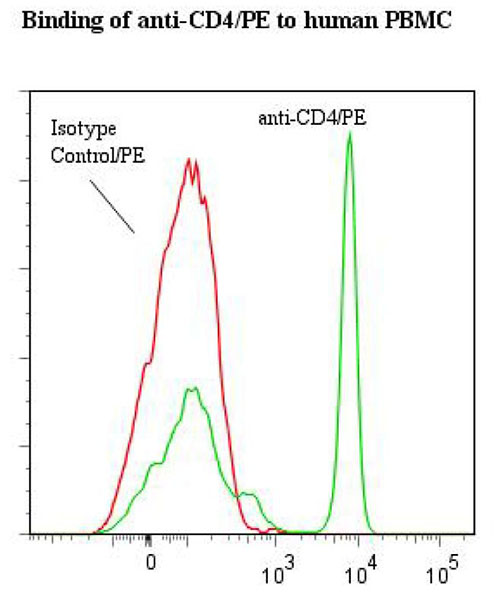
Product Notes
The CD4 cd4 (Catalog #AAA50241) is an Antibody and is intended for research purposes only. The product is available for immediate purchase. The MOUSE ANTI RABBIT CD4 reacts with Brown Hare (Lepus europeus) and may cross-react with other species as described in the data sheet. AAA Biotech's CD4 can be used in a range of immunoassay formats including, but not limited to, IP (Immunoprecipitation), IHC (Immunohistochemistry), FCM/FACS (Flow Cytometry). Researchers should empirically determine the suitability of the CD4 cd4 for an application not listed in the data sheet. Researchers commonly develop new applications and it is an integral, important part of the investigative research process. It is sometimes possible for the material contained within the vial of "CD4, Monoclonal Antibody" to become dispersed throughout the inside of the vial, particularly around the seal of said vial, during shipment and storage. We always suggest centrifuging these vials to consolidate all of the liquid away from the lid and to the bottom of the vial prior to opening. Please be advised that certain products may require dry ice for shipping and that, if this is the case, an additional dry ice fee may also be required.Precautions
All products in the AAA Biotech catalog are strictly for research-use only, and are absolutely not suitable for use in any sort of medical, therapeutic, prophylactic, in-vivo, or diagnostic capacity. By purchasing a product from AAA Biotech, you are explicitly certifying that said products will be properly tested and used in line with industry standard. AAA Biotech and its authorized distribution partners reserve the right to refuse to fulfill any order if we have any indication that a purchaser may be intending to use a product outside of our accepted criteria.Disclaimer
Though we do strive to guarantee the information represented in this datasheet, AAA Biotech cannot be held responsible for any oversights or imprecisions. AAA Biotech reserves the right to adjust any aspect of this datasheet at any time and without notice. It is the responsibility of the customer to inform AAA Biotech of any product performance issues observed or experienced within 30 days of receipt of said product. To see additional details on this or any of our other policies, please see our Terms & Conditions page.Item has been added to Shopping Cart
If you are ready to order, navigate to Shopping Cart and get ready to checkout.