


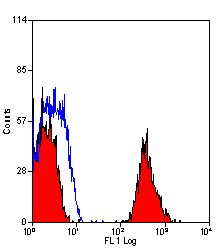
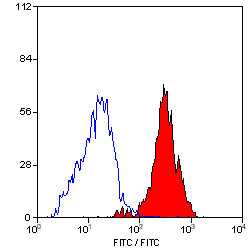
 Application Data
(Staining of mouse peripheral blood platelets with Hamster anti Mouse CD61:FITC)
Application Data
(Staining of mouse peripheral blood platelets with Hamster anti Mouse CD61:FITC)
Hamster CD61 Monoclonal Antibody | anti-CD61 antibody
HAMSTER ANTI MOUSE CD61:FITC
Purified IgG conjugated to Fluorescein Isothiocyanate Isomer 1 (FITC) - liquid
Flow Cytometry: Minimum Dilution: Neat; Maximum Dilution: 1/10
1% Bovine Serum Albumin
Preparation
Fusion Partners
Shelf Life: 18 months from date of despatch.
Application Data
(Staining of mouse peripheral blood platelets with Hamster anti Mouse CD61:FITC)
Application Data
(Staining of mouse peripheral blood platelets with Hamster anti Mouse CD61:FITC)
Application Data
(Staining of mouse peripheral blood platelets with Hamster anti Mouse CD61:Biotin)
Application Data
(Staining of mouse peripheral blood platelets with Hamster anti Mouse CD61:Biotin)
Application Data
(Staining of mouse peripheral blood platelets with Hamster anti Mouse CD61:Alexa Fluor ?488)
Application Data
(Staining of mouse peripheral blood platelets with Hamster anti Mouse CD61:Alexa Fluor ?488)
Application Data
(Staining of mouse peripheral blood platelets with Hamster anti Mouse CD61:FITC)
Application Data
(Staining of mouse peripheral blood platelets with Hamster anti Mouse CD61:FITC)
Application Data
(Staining of mouse peripheral blood platelets with Hamster anti Mouse CD61:Alexa Fluor 647)
Application Data
(Staining of mouse peripheral blood platelets with Hamster anti Mouse CD61:Alexa Fluor 647)
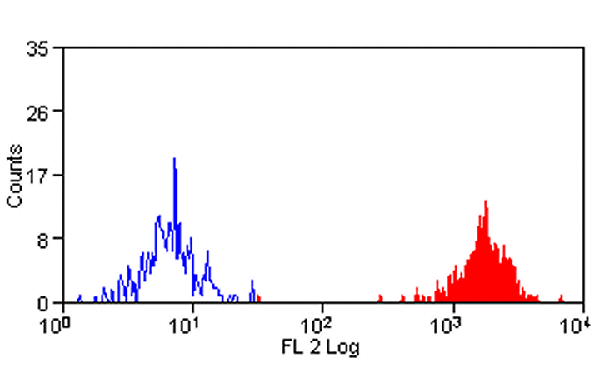
Application Data
(Staining of mouse peripheral blood platelets with Hamster anti Mouse CD61:RPE)
Application Data
(Staining of mouse peripheral blood platelets with Hamster anti Mouse CD61:RPE)
NCBI and Uniprot Product Information
Customer Reviews
Loading reviews...
Share Your Experience
Similar Products

Product Notes
The CD61 itgb3 (Catalog #AAA11873) is an Antibody produced from Hamster and is intended for research purposes only. The product is available for immediate purchase. AAA Biotech's CD61 can be used in a range of immunoassay formats including, but not limited to, FCM/FACS (Flow Cytometry). Flow Cytometry: Use 10ul of the suggested working dilution to label 106 cells in 100ul. The Fc region of monoclonal antibodies may bind non-specifically to cells expressing low affinity Fc receptors. This may be reduced by using SeroBlock FcR. Flow Cytometry: Minimum Dilution: Neat; Maximum Dilution: 1/10. Researchers should empirically determine the suitability of the CD61 itgb3 for an application not listed in the data sheet. Researchers commonly develop new applications and it is an integral, important part of the investigative research process. It is sometimes possible for the material contained within the vial of "CD61, Monoclonal Antibody" to become dispersed throughout the inside of the vial, particularly around the seal of said vial, during shipment and storage. We always suggest centrifuging these vials to consolidate all of the liquid away from the lid and to the bottom of the vial prior to opening. Please be advised that certain products may require dry ice for shipping and that, if this is the case, an additional dry ice fee may also be required.Precautions
All products in the AAA Biotech catalog are strictly for research-use only, and are absolutely not suitable for use in any sort of medical, therapeutic, prophylactic, in-vivo, or diagnostic capacity. By purchasing a product from AAA Biotech, you are explicitly certifying that said products will be properly tested and used in line with industry standard. AAA Biotech and its authorized distribution partners reserve the right to refuse to fulfill any order if we have any indication that a purchaser may be intending to use a product outside of our accepted criteria.Disclaimer
Though we do strive to guarantee the information represented in this datasheet, AAA Biotech cannot be held responsible for any oversights or imprecisions. AAA Biotech reserves the right to adjust any aspect of this datasheet at any time and without notice. It is the responsibility of the customer to inform AAA Biotech of any product performance issues observed or experienced within 30 days of receipt of said product. To see additional details on this or any of our other policies, please see our Terms & Conditions page.Frequently Asked Questions
What cells express CD61 in hamsters and can be detected by this antibody?
This hamster monoclonal detects CD61 (integrin β3, a 90 kDa type I membrane protein) in mouse and rat tissues. Primary CD61-expressing cells include platelets, activated T lymphocytes, polymorphonuclear granulocytes, megakaryocytes, and blastocysts. Cross-reactivity with rat enables comparative studies across common laboratory models.
Can this hamster CD61 antibody be used for flow cytometry analysis?
Yes, clone HM beta 3-1 is specifically optimized for flow cytometry (FCM/FACS) analysis. Hamster-derived monoclonal antibodies show minimal cross-reactivity with mouse Fc receptors, eliminating the need for blocking steps. The antibody is available in multiple fluorescent conjugates for multiplex staining experiments.
Is CD61 a marker for platelets, megakaryocytes, or other cell types in hamster models?
CD61 is the primary marker for platelet development and mature platelets, where it forms the gpIIb/IIIa complex. This antibody also detects megakaryocytes, activated T cells, and myeloid cells. In inflammatory states, CD61 expression increases on activated leukocytes, making it valuable for monitoring inflammatory cell activation.
Can the antibody be used for immunofluorescence or immunohistochemistry?
While this clone is optimized for flow cytometry, hamster monoclonal antibodies can be used for indirect IF with goat anti-hamster secondary antibodies. Immunohistochemistry on fixed tissues is possible but less commonly used than flow cytometry. We recommend validating IF/IHC parameters or contacting technical support for alternative CD61 clones optimized for imaging.
Does CD61 expression change during inflammation or disease states in hamster tissues?
Yes, CD61 expression is dynamically regulated. Platelet activation increases CD61 accessibility to antibody binding. In inflammatory disease states, upregulation of CD61 on activated neutrophils, lymphocytes, and endothelial cells occurs, reflecting inflammatory cell status and providing a functional indicator of thrombotic response in disease models.
Is this antibody suitable for comparing CD61 levels between treated and control groups?
Yes, this antibody is excellent for quantitative flow cytometry-based comparison. Mean fluorescence intensity (MFI) measurements allow precise quantification of CD61 surface density on target cell populations. The monoclonal nature and standardized binding characteristics make it ideal for longitudinal studies and dose-response comparisons.
Item has been added to Shopping Cart
If you are ready to order, navigate to Shopping Cart and get ready to checkout.