
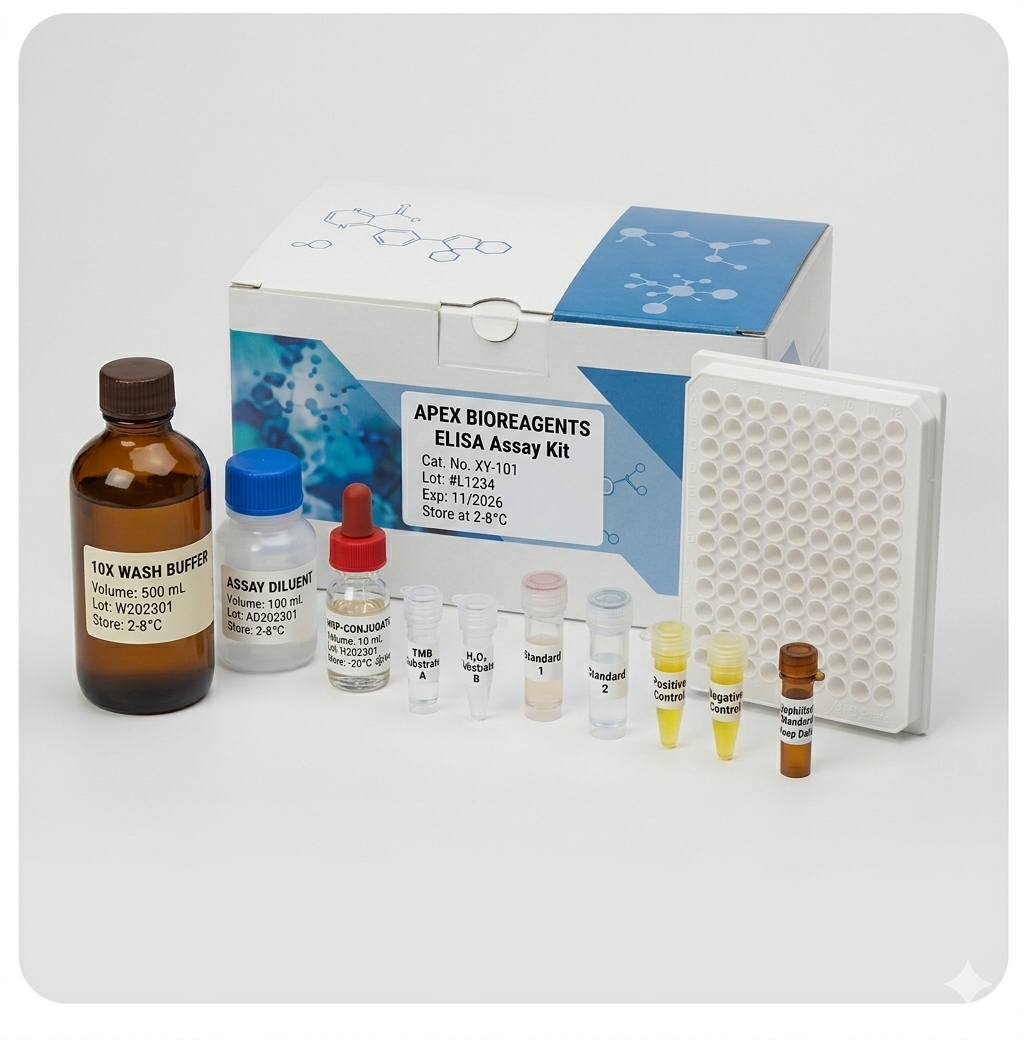
General Double-stranded RNA (dsRNA) ELISA Kit
Double-stranded RNA (dsRNA) ELISA kit (J2 based)
Reactivity
General
Applications
ELISA
Synonyms
Double-stranded RNA (dsRNA), ELISA Kit; Double-stranded RNA (dsRNA) ELISA kit (J2 based); dsRNA ELISA kit; Double-stranded RNA (dsRNA) elisa kit
Reactivity
General
Clonality
Monoclonal
Isotype
Mouse IgG2a kappa/IgM kappa
Clone Number
J2/K2
Assay Type
Quantitative Sandwich
Applicable Applications for Double-stranded RNA (dsRNA) elisa kit
ELISA
Product
Double-stranded RNA (dsRNA) ELISA kit containing the following reagents to perform 500 tests (5x96 well plates):
Reagent 01: 1 vial of coating antibody (store at -20 degree C)
Reagent A: 1 vial of 142 bp dsRNA as positive control (store at -20 degree C)
Reagent B: 1 vial of dsRNA-specific detecting antibody (in RPMI + 5% FBS, store at +4 degree C or, preferably, at -20 degree C)
Reagent C: 1 vial of HRP-conjugated F(ab')2 Fragment of goat-anti mouse secondary antibody (store at +4 degree C or at -20 degree C)
Reagent D: 1 vial of TMB substrate solution (store at +4 degree C, keep in dark)
Reagent 01: 1 vial of coating antibody (store at -20 degree C)
Reagent A: 1 vial of 142 bp dsRNA as positive control (store at -20 degree C)
Reagent B: 1 vial of dsRNA-specific detecting antibody (in RPMI + 5% FBS, store at +4 degree C or, preferably, at -20 degree C)
Reagent C: 1 vial of HRP-conjugated F(ab')2 Fragment of goat-anti mouse secondary antibody (store at +4 degree C or at -20 degree C)
Reagent D: 1 vial of TMB substrate solution (store at +4 degree C, keep in dark)
Assay Protocol
Materials and Equipment Required but Not Provided
2 ELISA plates (96 well)
Microtiter plate reader spectrophotometer with dual wavelength capability at 370 and 450nm.
Single channel pipettes-10ul and 200ul
Multichannel pipettes-200ul
Antigen (standard and sample) diluent (STE Buffer: 0.1M NaCl, 1mM EDTA, 50mM Tris-HCl, pH7.0)
Washing Buffer (PBS + 0.5% Tween 20; PBS: 10mM Pi-buffer, pH7.2, 0.15 M NaCl)
Secondary antibody dilution buffer (PBS+1% BSA)
Incubator allowing incubation at 37 degree C.
2M H2SO4
Preparation of Reagents and ELISA Plates
Reconstitute Reagent A by adding 4ul RNase-free MilliQ water. The concentration will be 1ug/ul dsRNA. (Store it at -20 degree C or -80 degree C.)
Use DEPC treated MilliQ water to prepare STE (when applicable for your own sample preparation)
Sterilize PBS and STE by autoclaving
Prepare PBS + 1% BSA and ELISA washing buffer
Coating of ELISA plates
Transfer the total content of the Reagent 01 tube into 21 ml PBS, mix well and immediately distribute 100ul/well in 2 ELISA plates.
Cover the plates and incubate them overnight at 4 degree C.
Discard contents of wells into waste. Add 100ul/well 1% BSA in PBS + 0.2% NaN3 to each well and incubate at 37 degree C for 2 hours to saturate any remaining free binding sites on the plate.
Discard the solution and wash plates 3 times with PBS + 0.5% Tween 20.
The plates can then be used directly or stored. For storage fill the wells with 200ul/well PBS containing 0.2% sodium azide. Wrap plates in plastic foil and store them refrigerated at 4 degree C. They can be stored without any loss of activity for one month. When stored plates are used, they must be thoroughly washed with PBS to remove all traces of NaN3.
Assay Protocol for 1 plate:
All standards and samples should be assayed at least in duplicate.
Use clean, RNase-free micro-centrifuge tubes with cap.
Do not use buffers which contain NaN3 as it will interfere with the final detection step.
1. Prepare 1:3 serial dilutions from Reagent A. The dilution series of the dsRNA standard should be in the range of expected dsRNA concentration of your sample. We propose starting with 30 ng dsRNA/well as the highest concentration and diluting down to below 0.01ng dsRNA/well. Dilutions should be freshly made for each assay.
2. Prepare dilutions of your sample in STE (when necessary).
3. Cap and vortex all diluted standards and samples.
4. Remove the plastic foil from the ELISA plate, discard the liquid and wash twice with PBS + 0.5 % Tween 20.
5. Discard the solution and transfer 100-100ul antigen to duplicated wells in the plate.
6. Cover and incubate for 60 min at 37 degree C.
7. Discard contents of wells into waste. Wash plate 4 times with PBS + 0.5 % Tween 20 adding 250ul washing solution/well. Do not allow wells to dry before adding the next solution.
8. Pipette 100ul undiluted Reagent B into all wells.
9. Cover and incubate for 60 minutes at 37 degree C.
10. During the incubation (step 9) dilute Reagent C by pipetting 1.4ul Reagent C into 10 ml PBS + 1% BSA (no azide
2 ELISA plates (96 well)
Microtiter plate reader spectrophotometer with dual wavelength capability at 370 and 450nm.
Single channel pipettes-10ul and 200ul
Multichannel pipettes-200ul
Antigen (standard and sample) diluent (STE Buffer: 0.1M NaCl, 1mM EDTA, 50mM Tris-HCl, pH7.0)
Washing Buffer (PBS + 0.5% Tween 20; PBS: 10mM Pi-buffer, pH7.2, 0.15 M NaCl)
Secondary antibody dilution buffer (PBS+1% BSA)
Incubator allowing incubation at 37 degree C.
2M H2SO4
Preparation of Reagents and ELISA Plates
Reconstitute Reagent A by adding 4ul RNase-free MilliQ water. The concentration will be 1ug/ul dsRNA. (Store it at -20 degree C or -80 degree C.)
Use DEPC treated MilliQ water to prepare STE (when applicable for your own sample preparation)
Sterilize PBS and STE by autoclaving
Prepare PBS + 1% BSA and ELISA washing buffer
Coating of ELISA plates
Transfer the total content of the Reagent 01 tube into 21 ml PBS, mix well and immediately distribute 100ul/well in 2 ELISA plates.
Cover the plates and incubate them overnight at 4 degree C.
Discard contents of wells into waste. Add 100ul/well 1% BSA in PBS + 0.2% NaN3 to each well and incubate at 37 degree C for 2 hours to saturate any remaining free binding sites on the plate.
Discard the solution and wash plates 3 times with PBS + 0.5% Tween 20.
The plates can then be used directly or stored. For storage fill the wells with 200ul/well PBS containing 0.2% sodium azide. Wrap plates in plastic foil and store them refrigerated at 4 degree C. They can be stored without any loss of activity for one month. When stored plates are used, they must be thoroughly washed with PBS to remove all traces of NaN3.
Assay Protocol for 1 plate:
All standards and samples should be assayed at least in duplicate.
Use clean, RNase-free micro-centrifuge tubes with cap.
Do not use buffers which contain NaN3 as it will interfere with the final detection step.
1. Prepare 1:3 serial dilutions from Reagent A. The dilution series of the dsRNA standard should be in the range of expected dsRNA concentration of your sample. We propose starting with 30 ng dsRNA/well as the highest concentration and diluting down to below 0.01ng dsRNA/well. Dilutions should be freshly made for each assay.
2. Prepare dilutions of your sample in STE (when necessary).
3. Cap and vortex all diluted standards and samples.
4. Remove the plastic foil from the ELISA plate, discard the liquid and wash twice with PBS + 0.5 % Tween 20.
5. Discard the solution and transfer 100-100ul antigen to duplicated wells in the plate.
6. Cover and incubate for 60 min at 37 degree C.
7. Discard contents of wells into waste. Wash plate 4 times with PBS + 0.5 % Tween 20 adding 250ul washing solution/well. Do not allow wells to dry before adding the next solution.
8. Pipette 100ul undiluted Reagent B into all wells.
9. Cover and incubate for 60 minutes at 37 degree C.
10. During the incubation (step 9) dilute Reagent C by pipetting 1.4ul Reagent C into 10 ml PBS + 1% BSA (no azide
Preparation and Storage
Upon receipt, store entire kit at -20 degree C. Once the kit is thawed, you may keep it at 4 degree C for 5 days. For long-term storage, it is recommended to aliquot and freeze the antibody and dsRNA components at -20 degree C.
The Double-stranded RNA (dsRNA) ELISA kit components are shipped on blue ice.
The Double-stranded RNA (dsRNA) ELISA kit components are shipped on blue ice.
Related Product Information for Double-stranded RNA (dsRNA) elisa kit
Background: Based on the use of two double-stranded RNA (dsRNA)-specific monoclonal antibodies the dsRNA Detection Kit allows sensitive and selective detection of dsRNA molecules (larger than 30-40 bp), independent of their nucleotide composition and sequence. The detection is highly specific: dsRNA can be detected in nucleic acid extracts in the presence of 1.000-10.000-fold excess of other nucleic acids. This assay works on the sandwich-ELISA principle and uses the J2 (IgG2a) mouse monoclonal antibody to dsRNA as a catcher antibody. The monoclonal antibody K2 (IgM) is used as the detector antibody. Over the past decade our double-stranded RNA (dsRNA) antibodies have been used extensively to detect and characterize plant and animal viruses with dsRNA genomes or intermediates. In addition, the anti-dsRNA antibodies can be used as a tool to detect pathogens, including detection in paraffin-embedded fixed tissue samples (Richardson et al. 2010). The J2 anti-dsRNA IgG2a monoclonal antibody (Schönborn et al. 1991) has become the gold standard in dsRNA detection. It was used initially for the study of plant viruses, but since the seminal paper of Weber et al. in 2006, where J2 was used to show that all the positive strand RNA viruses tested produced copious amounts of dsRNA in infected cells, this antibody has been used extensively in a wide range of systems, as documented in over 200 scientific publications. J2 can be used to detect dsRNA intermediates of viruses as diverse as Hepatitis C virus, Dengue virus, rhinovirus, Chikungunya virus, Rabies virus, Polio virus, Classic swine fever virus, Brome mosaic virus and many more in cultured cells and also in fixed paraffin-embedded histological samples. J2 has been used to elucidate how anti-viral responses are initiated, what counter-strategies viruses have adopted to avoid them, and to explore the viral life cycle by enabling ultrastructural localization studies of viral nucleic acid replication sites (Knoops et al., 2011). J2 has also been recommended as a tool to detect whether an unknown pathogen is bacterial or viral in nature (Richardson et al., 2010). Recently J2 has also been used to monitor the removal of dsRNA from in vitro synthethised mRNA preparations that may have potential use in gene therapy (Kariko et al., 2011). J2 has been used successfully in various immunocapture methods, such as ELISA.
Principle of the Assay: Based on the use of two double-stranded RNA (dsRNA)-specific monoclonal antibodies the dsRNA Detection Kit allows sensitive and selective detection of dsRNA molecules (larger than 30-40 bp), independent of their nucleotide composition and sequence. The detection is highly specific: dsRNA can be detected in nucleic acid extracts in the presence of 1.000-10.000-fold excess of other nucleic acids. This assay works on the sandwich-ELISA principle and uses the J2 (IgG2a) mouse monoclonal antibody to dsRNA as a catcher antibody. The monoclonal antibody K2 (IgM) is used as the detector antibody. Over the past decade our double-stranded RNA (dsRNA) antibodies have been used extensively to detect and characterize plant and animal viruses with dsRNA genomes or intermediates. In addition, the anti-dsRNA antibodies can be used as a tool to detect pathogens, including detection in paraffin-embedded fixed tissue samples (Richardson et al. 2010). The J2 anti-dsRNA IgG2a monoclonal antibody (Schönborn et al. 1991) has become the gold standard in dsRNA detection. It was used initially for the study of plant viruses, but since the seminal paper of Weber et al. in 2006, where J2 was used to show that all the positive strand RNA viruses tested produced copious amounts of dsRNA in infected cells, this antibody has been used extensively in a wide range of systems, as documented in over 200 scientific publications. J2 can be used to detect dsRNA intermediates of viruses as diverse as Hepatitis C virus, Dengue virus, rhinovirus, Chikungunya virus, Rabies virus, Polio virus, Classic swine fever virus, Brome mosaic virus and many more in cultured cells and also in fixed paraffin-embedded histological samples. J2 has been used to elucidate how anti-viral responses are initiated, what counter-strategies viruses have adopted to avoid them, and to explore the viral life cycle by enabling ultrastructural localization studies of viral nucleic acid replication sites (Knoops et al., 2011). J2 has also been recommended as a tool to detect whether an unknown pathogen is bacterial or viral in nature (Richardson et al., 2010). Recently J2 has also been used to monitor the removal of dsRNA from in vitro synthethised mRNA preparations that may have potential use in gene therapy (Kariko et al., 2011). J2 has been used successfully in various immunocapture methods, such as ELISA.
Intended Uses: The Double-stranded RNA (dsRNA) ELISA kit (J2 based) can be used to detect viral dsRNAs or large natural or synthetic dsRNAs of non-viral origin in nucleic acid extracts, as well as to detect the presence of undesired dsRNA molecules in artificially synthesized (m)RNA preparations. By using serial dilutions of the Poly (I:C) dsRNA standard (included in the kit) for calibration, quantitative estimates can be made.
Principle of the Assay: Based on the use of two double-stranded RNA (dsRNA)-specific monoclonal antibodies the dsRNA Detection Kit allows sensitive and selective detection of dsRNA molecules (larger than 30-40 bp), independent of their nucleotide composition and sequence. The detection is highly specific: dsRNA can be detected in nucleic acid extracts in the presence of 1.000-10.000-fold excess of other nucleic acids. This assay works on the sandwich-ELISA principle and uses the J2 (IgG2a) mouse monoclonal antibody to dsRNA as a catcher antibody. The monoclonal antibody K2 (IgM) is used as the detector antibody. Over the past decade our double-stranded RNA (dsRNA) antibodies have been used extensively to detect and characterize plant and animal viruses with dsRNA genomes or intermediates. In addition, the anti-dsRNA antibodies can be used as a tool to detect pathogens, including detection in paraffin-embedded fixed tissue samples (Richardson et al. 2010). The J2 anti-dsRNA IgG2a monoclonal antibody (Schönborn et al. 1991) has become the gold standard in dsRNA detection. It was used initially for the study of plant viruses, but since the seminal paper of Weber et al. in 2006, where J2 was used to show that all the positive strand RNA viruses tested produced copious amounts of dsRNA in infected cells, this antibody has been used extensively in a wide range of systems, as documented in over 200 scientific publications. J2 can be used to detect dsRNA intermediates of viruses as diverse as Hepatitis C virus, Dengue virus, rhinovirus, Chikungunya virus, Rabies virus, Polio virus, Classic swine fever virus, Brome mosaic virus and many more in cultured cells and also in fixed paraffin-embedded histological samples. J2 has been used to elucidate how anti-viral responses are initiated, what counter-strategies viruses have adopted to avoid them, and to explore the viral life cycle by enabling ultrastructural localization studies of viral nucleic acid replication sites (Knoops et al., 2011). J2 has also been recommended as a tool to detect whether an unknown pathogen is bacterial or viral in nature (Richardson et al., 2010). Recently J2 has also been used to monitor the removal of dsRNA from in vitro synthethised mRNA preparations that may have potential use in gene therapy (Kariko et al., 2011). J2 has been used successfully in various immunocapture methods, such as ELISA.
Intended Uses: The Double-stranded RNA (dsRNA) ELISA kit (J2 based) can be used to detect viral dsRNAs or large natural or synthetic dsRNAs of non-viral origin in nucleic acid extracts, as well as to detect the presence of undesired dsRNA molecules in artificially synthesized (m)RNA preparations. By using serial dilutions of the Poly (I:C) dsRNA standard (included in the kit) for calibration, quantitative estimates can be made.
Product Categories/Family for Double-stranded RNA (dsRNA) elisa kit
References
1) F. Weber, V. Wagner, S. B. Rasmussen, R. Hartmann, S. R. Paludan. Double-stranded RNA is produced by positive-strand RNA viruses and DNA viruses but not in detectable amounts by negative-strand RNA viruses. J Virol (2006), 80(10):5059-64. doi: 10.1128/JVI.80.10.5059-5064.2006.
2) S. Welsch, S. Miller, I. Romero-Brey, A. Merz, C. K. E. Bleck, P. Walther, S. D. Fuller, C. Antony, J. Krijnse-Locker, R. Bartenschlager. Composition and Three-Dimensional Architecture of the Dengue Virus Replication and Assembly Sites. Cell Host & Microbe (2009) 5(4); 365-375. doi.org/10.1016/j.chom.2009.03.007.
3) K. Knoops , M. Barcena, R. W. Limpens, A. J. Koster, A. M. Mommaas, E. J. Snijder. Ultrastructural characterization of arterivirus replication structures: reshaping the endoplasmic reticulum to accommodate viral RNA synthesis. J Virol. (2012) 86(5); 2474-2487. doi:10.1128/JVI.06677-11.
4) S. J. Richardson, A. Willcox, D. A. Hilton, S. Tauriainen, H. Hyoty, A. J. Bone, A. K. Foulis, N. G. Morgan. Use of antisera directed against dsRNA to detect viral infections in formalin-fixed paraffin-embedded tissue. J Clin Virol. (2010) 49(3); 180-5. doi: 10.1016/j.jcv.2010.07.015.
5) K. Kariko, H. Muramatsu, J. Ludwig, D. Weissman, Generating the optimal mRNA for therapy: HPLC purification eliminates immune activation and improves translation of nucleoside-modified, protein-encoding mRNA, Nucleic Acids Research (2011) 39(21); e142, https://doi.org/10.1093/nar/gkr695.
6) Schonborn, J., Oberstrass, J., Breyel, E., Tittgen, J., Schumacher, J. and Lukacs, N. (1991) Monoclonal antibodies to double-stranded RNA as probes of RNA structure in crude nucleic acid extracts. Nucleic Acids Res.19, 2993-3000.
7) Lukacs, N. (1994) Detection of virus infection in plants and differentiation between coexisting viruses by monoclonal antibodies to double-stranded RNA. J. Virol. Methods 47, 255-272.
8) Lukacs, N. (1997) Detection of sense: antisense duplexes by structurespecific anti-RNA antibodies. In: Antisense Technology. A Practical Approach, C. Lichtenstein and W. Nellen (eds), pp. 281-295. IRL Press, Oxford.
2) S. Welsch, S. Miller, I. Romero-Brey, A. Merz, C. K. E. Bleck, P. Walther, S. D. Fuller, C. Antony, J. Krijnse-Locker, R. Bartenschlager. Composition and Three-Dimensional Architecture of the Dengue Virus Replication and Assembly Sites. Cell Host & Microbe (2009) 5(4); 365-375. doi.org/10.1016/j.chom.2009.03.007.
3) K. Knoops , M. Barcena, R. W. Limpens, A. J. Koster, A. M. Mommaas, E. J. Snijder. Ultrastructural characterization of arterivirus replication structures: reshaping the endoplasmic reticulum to accommodate viral RNA synthesis. J Virol. (2012) 86(5); 2474-2487. doi:10.1128/JVI.06677-11.
4) S. J. Richardson, A. Willcox, D. A. Hilton, S. Tauriainen, H. Hyoty, A. J. Bone, A. K. Foulis, N. G. Morgan. Use of antisera directed against dsRNA to detect viral infections in formalin-fixed paraffin-embedded tissue. J Clin Virol. (2010) 49(3); 180-5. doi: 10.1016/j.jcv.2010.07.015.
5) K. Kariko, H. Muramatsu, J. Ludwig, D. Weissman, Generating the optimal mRNA for therapy: HPLC purification eliminates immune activation and improves translation of nucleoside-modified, protein-encoding mRNA, Nucleic Acids Research (2011) 39(21); e142, https://doi.org/10.1093/nar/gkr695.
6) Schonborn, J., Oberstrass, J., Breyel, E., Tittgen, J., Schumacher, J. and Lukacs, N. (1991) Monoclonal antibodies to double-stranded RNA as probes of RNA structure in crude nucleic acid extracts. Nucleic Acids Res.19, 2993-3000.
7) Lukacs, N. (1994) Detection of virus infection in plants and differentiation between coexisting viruses by monoclonal antibodies to double-stranded RNA. J. Virol. Methods 47, 255-272.
8) Lukacs, N. (1997) Detection of sense: antisense duplexes by structurespecific anti-RNA antibodies. In: Antisense Technology. A Practical Approach, C. Lichtenstein and W. Nellen (eds), pp. 281-295. IRL Press, Oxford.
Customer Reviews
Loading reviews...
Share Your Experience
Similar Products


Product Notes
The General Double-stranded RNA (dsRNA) (Catalog #AAA77711) is an ELISA Kit and is intended for research purposes only. The product is available for immediate purchase. The AAA77711 ELISA Kit recognizes General Double-stranded RNA (dsRNA). AAA Biotech's Double-stranded RNA (dsRNA) can be used in a range of immunoassay formats including, but not limited to, ELISA. Researchers should empirically determine the suitability of the Double-stranded RNA (dsRNA) for an application not listed in the data sheet. Researchers commonly develop new applications and it is an integral, important part of the investigative research process. It is sometimes possible for the material contained within the vial of "Double-stranded RNA (dsRNA), Monoclonal ELISA Kit" to become dispersed throughout the inside of the vial, particularly around the seal of said vial, during shipment and storage. We always suggest centrifuging these vials to consolidate all of the liquid away from the lid and to the bottom of the vial prior to opening. Please be advised that certain products may require dry ice for shipping and that, if this is the case, an additional dry ice fee may also be required.Precautions
All products in the AAA Biotech catalog are strictly for research-use only, and are absolutely not suitable for use in any sort of medical, therapeutic, prophylactic, in-vivo, or diagnostic capacity. By purchasing a product from AAA Biotech, you are explicitly certifying that said products will be properly tested and used in line with industry standard. AAA Biotech and its authorized distribution partners reserve the right to refuse to fulfill any order if we have any indication that a purchaser may be intending to use a product outside of our accepted criteria.Disclaimer
Though we do strive to guarantee the information represented in this datasheet, AAA Biotech cannot be held responsible for any oversights or imprecisions. AAA Biotech reserves the right to adjust any aspect of this datasheet at any time and without notice. It is the responsibility of the customer to inform AAA Biotech of any product performance issues observed or experienced within 30 days of receipt of said product. To see additional details on this or any of our other policies, please see our Terms & Conditions page.Item has been added to Shopping Cart
If you are ready to order, navigate to Shopping Cart and get ready to checkout.