
 Application Data
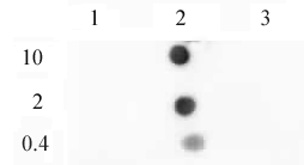
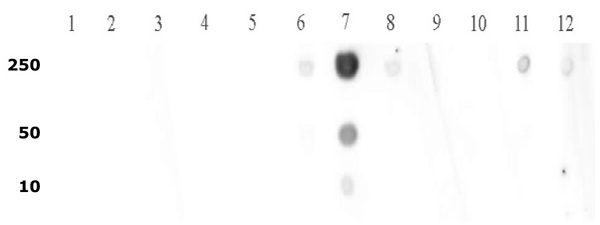
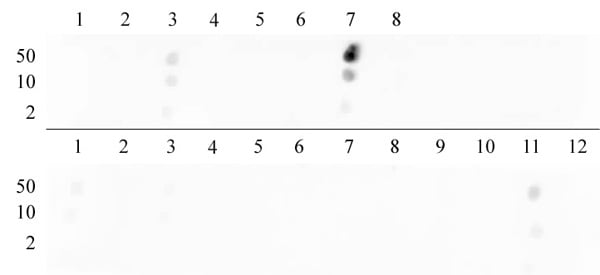
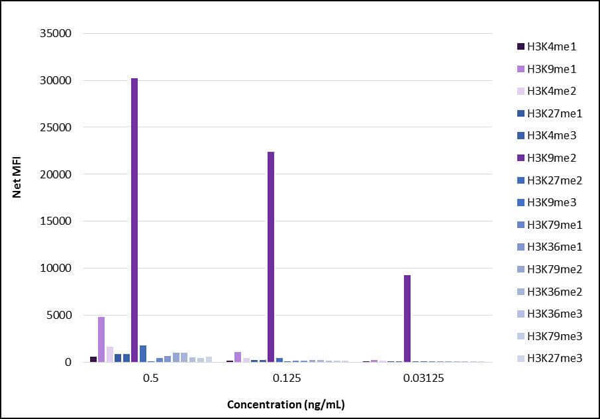
(Histone H3 dimethyl Lys9 antibody specificity tested by peptide array analysis. Peptide array analysis was used to confirm the specificity of this antibody for its intended modification. Histone H3 dimethyl Lys9 antibody was applied at a dilution of 0.1 ug / ml to MODified Histone Peptide Array spotted is indicated next to each row. Lane 1: monomethyl lysine 9 protein. Lane 2: dimethyl lysine 9 protein. Lane 3: trimethyl lysine 9 protein. No detection of proteins (unmodified, mono-, di-, or tri-methylated) corresponding to lysine 27 of histone H3 was observed with Histone H3 dimethyl Lys9 antibody.)
Application Data
(Histone H3 dimethyl Lys9 antibody specificity tested by peptide array analysis. Peptide array analysis was used to confirm the specificity of this antibody for its intended modification. Histone H3 dimethyl Lys9 antibody was applied at a dilution of 0.1 ug / ml to MODified Histone Peptide Array spotted is indicated next to each row. Lane 1: monomethyl lysine 9 protein. Lane 2: dimethyl lysine 9 protein. Lane 3: trimethyl lysine 9 protein. No detection of proteins (unmodified, mono-, di-, or tri-methylated) corresponding to lysine 27 of histone H3 was observed with Histone H3 dimethyl Lys9 antibody.)
Rabbit Histone H3K9me2 Monoclonal Antibody | anti-H3K9me2 antibody
Histone H3K9me2 antibody (mAb)(Clone MABI 0307)
Application Data
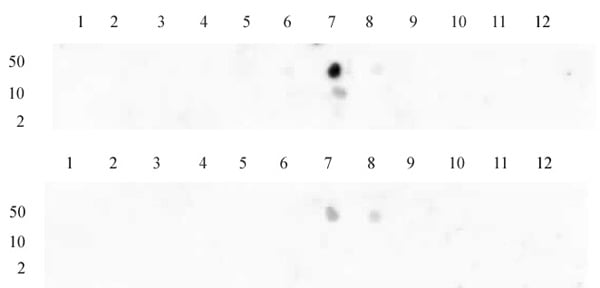
(Histone H3 dimethyl Lys9 antibody specificity tested by peptide array analysis. Peptide array analysis was used to confirm the specificity of this antibody for its intended modification. Histone H3 dimethyl Lys9 antibody was applied at a dilution of 0.1 ug / ml to MODified Histone Peptide Array spotted is indicated next to each row. Lane 1: monomethyl lysine 9 protein. Lane 2: dimethyl lysine 9 protein. Lane 3: trimethyl lysine 9 protein. No detection of proteins (unmodified, mono-, di-, or tri-methylated) corresponding to lysine 27 of histone H3 was observed with Histone H3 dimethyl Lys9 antibody.)
Application Data
(Histone H3 dimethyl Lys9 antibody specificity tested by peptide array analysis. Peptide array analysis was used to confirm the specificity of this antibody for its intended modification. Histone H3 dimethyl Lys9 antibody was applied at a dilution of 0.1 ug / ml to MODified Histone Peptide Array spotted is indicated next to each row. Lane 1: monomethyl lysine 9 protein. Lane 2: dimethyl lysine 9 protein. Lane 3: trimethyl lysine 9 protein. No detection of proteins (unmodified, mono-, di-, or tri-methylated) corresponding to lysine 27 of histone H3 was observed with Histone H3 dimethyl Lys9 antibody.)
WB (Western Blot)
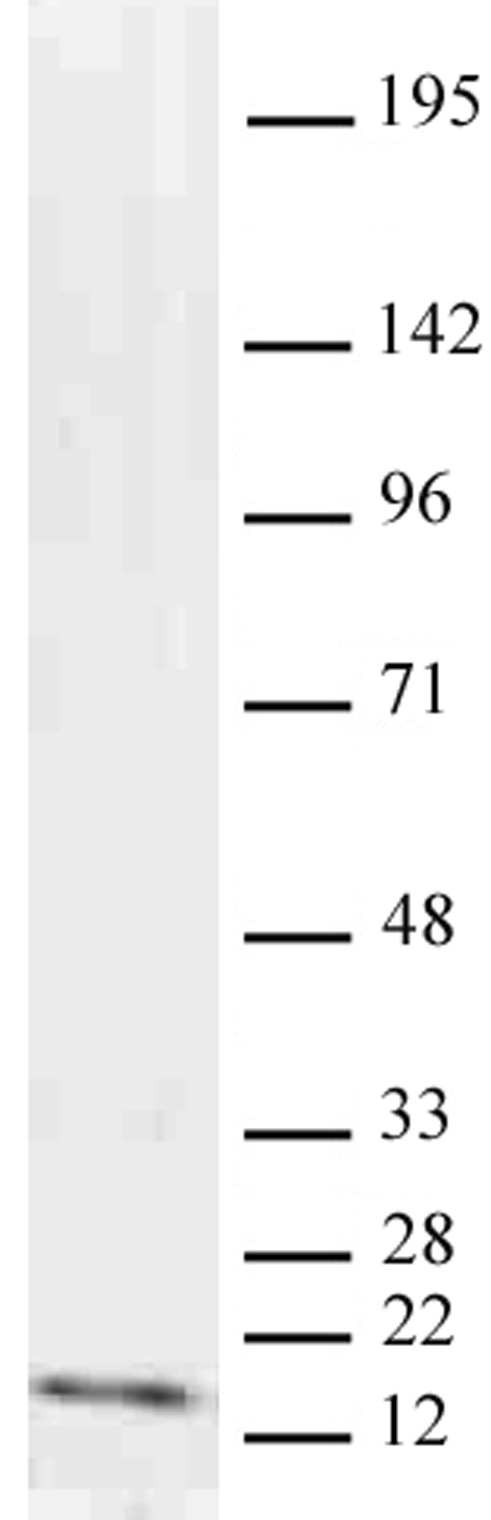
(Histone H3 dimethyl Lys9 antibody tested by Western blot. HeLa nuclear extract (20 ug) probed with Histone H3 dimethyl Lys9 antibody (2 ug/ml dilution).)
WB (Western Blot)
(Histone H3 dimethyl Lys9 antibody tested by Western blot. HeLa nuclear extract (20 ug) probed with Histone H3 dimethyl Lys9 antibody (2 ug/ml dilution).)
IF (Immunofluorescence)
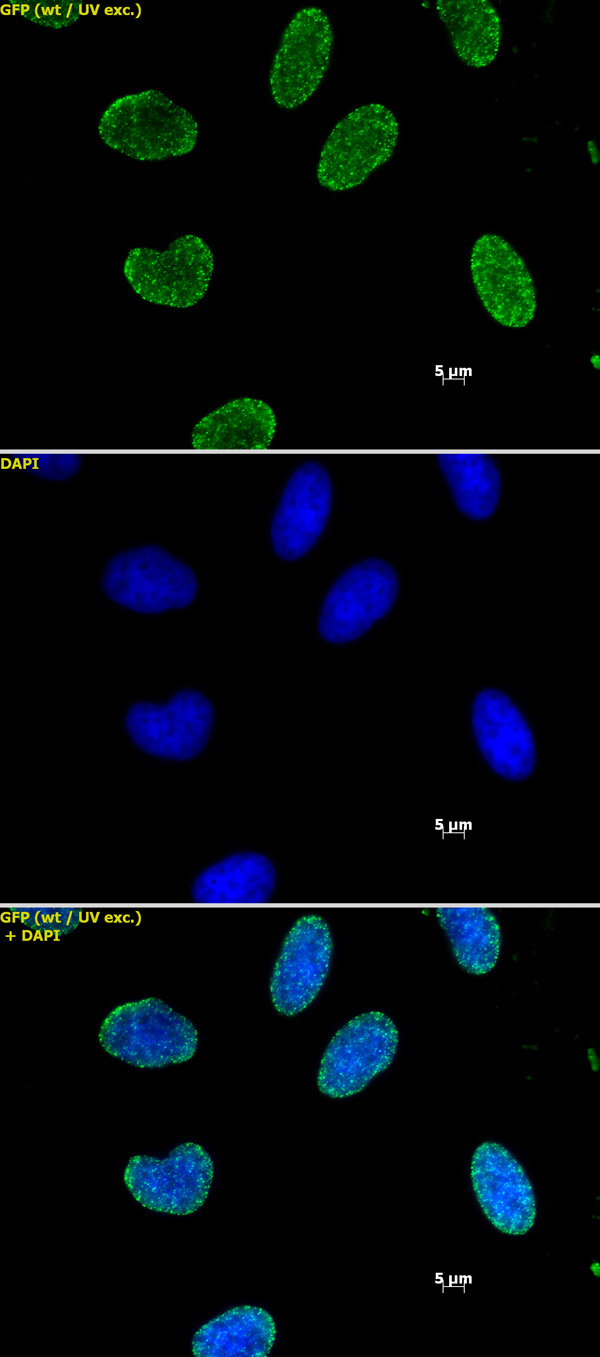
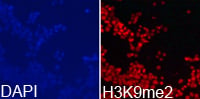
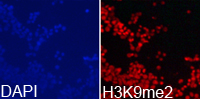
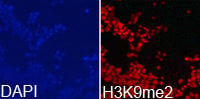
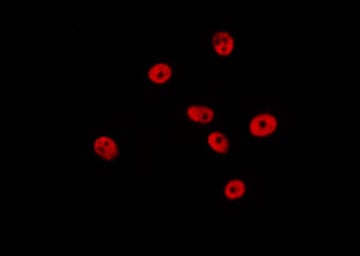
(Histone H3 dimethyl Lys9 antibody tested by immunofluorescence. Staining of HeLa cells with Histone H3 dimethyl Lys9 antibody (1 ug/ml, top panel) and DAPI (middle panel), and a merge of both images (bottom panel).)
IF (Immunofluorescence)
(Histone H3 dimethyl Lys9 antibody tested by immunofluorescence. Staining of HeLa cells with Histone H3 dimethyl Lys9 antibody (1 ug/ml, top panel) and DAPI (middle panel), and a merge of both images (bottom panel).)
ChIP (Chromatin Immunoprecipitation)
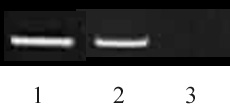
(Histone H3 dimethyl Lys9 antibody tested by ChIP. Chromatin IP performed using the ChIP-IT Express Kit and 100 ul of Ready-to-ChIP HeLa Chromatin per ChIP. Subsequent to the ChIP reaction, DNA was purified from the immunoprecipitated chromatin and a region 1 kb upstream of the human HOXD13 promoter was amplified by PCR. - Lane 1: ChIP using 10 ug of Histone H3 dimethyl Lys9 antibody. - Lane 2: PCR input control. - Lane 3: ChIP using negative control mouse IgG.)
ChIP (Chromatin Immunoprecipitation)
(Histone H3 dimethyl Lys9 antibody tested by ChIP. Chromatin IP performed using the ChIP-IT Express Kit and 100 ul of Ready-to-ChIP HeLa Chromatin per ChIP. Subsequent to the ChIP reaction, DNA was purified from the immunoprecipitated chromatin and a region 1 kb upstream of the human HOXD13 promoter was amplified by PCR. - Lane 1: ChIP using 10 ug of Histone H3 dimethyl Lys9 antibody. - Lane 2: PCR input control. - Lane 3: ChIP using negative control mouse IgG.)
Background: Histone H3 is one of the core components of the nucleosome. The nucleosome is the smallest subunit of chromatin and consists of 147 base pairs of DNA wrapped around an octamer of core histone proteins (two each of Histone H2A, Histone H2B, Histone H3 and Histone H4). Histone H1 is a linker histone, present at the interface between the nucleosome core and DNA entry/exit points. Histone H1 is responsible for establishing higher-order chromatin structure. Chromatin is subject to a variety of chemical modifications, including post-translational modifications of the histone proteins and the methylation of cytosine residues in the DNA. Reported histone modifications include acetylation, methylation, phosphorylation, ubiquitylation, glycosylation, ADP-ribosylation, carbonylation and SUMOylation; these modifications play a major role in regulating gene expression. The methylation of histones can occur on two different residues: arginine or lysine. Histone methylation can be associated with transcriptional activation or repression, depending on the methylated residue. Lysine 9 of histone H3 can be mono-, di- or trimethylated by different histone methyltransferases (HMTs) such as SuvH39H1 or G9a. This methylated lysine can be demethylated by histone demethylases as JMJD1A, LSD1 or JMJD2C. Methylation of this residue is mainly associated with transcriptional repression.
NCBI and Uniprot Product Information
Customer Reviews
Loading reviews...
Share Your Experience
Similar Products


Product Notes
The H3K9me2 (Catalog #AAA59915) is an Antibody produced from Rabbit and is intended for research purposes only. The product is available for immediate purchase. The Histone H3K9me2 antibody (mAb)(Clone MABI 0307) reacts with Human, Wide Range Predicted and may cross-react with other species as described in the data sheet. AAA Biotech's Histone H3K9me2 can be used in a range of immunoassay formats including, but not limited to, WB (Western Blot), IF (Immunofluorescence), ICC (Immunocytochemistry), DB (Dot Blot), ChIP (Chromatin immunoprecipitation). Researchers should empirically determine the suitability of the H3K9me2 for an application not listed in the data sheet. Researchers commonly develop new applications and it is an integral, important part of the investigative research process. It is sometimes possible for the material contained within the vial of "Histone H3K9me2, Monoclonal Antibody" to become dispersed throughout the inside of the vial, particularly around the seal of said vial, during shipment and storage. We always suggest centrifuging these vials to consolidate all of the liquid away from the lid and to the bottom of the vial prior to opening. Please be advised that certain products may require dry ice for shipping and that, if this is the case, an additional dry ice fee may also be required.Precautions
All products in the AAA Biotech catalog are strictly for research-use only, and are absolutely not suitable for use in any sort of medical, therapeutic, prophylactic, in-vivo, or diagnostic capacity. By purchasing a product from AAA Biotech, you are explicitly certifying that said products will be properly tested and used in line with industry standard. AAA Biotech and its authorized distribution partners reserve the right to refuse to fulfill any order if we have any indication that a purchaser may be intending to use a product outside of our accepted criteria.Disclaimer
Though we do strive to guarantee the information represented in this datasheet, AAA Biotech cannot be held responsible for any oversights or imprecisions. AAA Biotech reserves the right to adjust any aspect of this datasheet at any time and without notice. It is the responsibility of the customer to inform AAA Biotech of any product performance issues observed or experienced within 30 days of receipt of said product. To see additional details on this or any of our other policies, please see our Terms & Conditions page.Item has been added to Shopping Cart
If you are ready to order, navigate to Shopping Cart and get ready to checkout.