


 IHC (Immunohistchemistry)
(DAB staining on IHC-P;Samples: Human Cerebrum Tissue)
IHC (Immunohistchemistry)
(DAB staining on IHC-P;Samples: Human Cerebrum Tissue)
Mouse anti-Human Transferrin Receptor (TFR) Monoclonal Antibody | anti-TFR antibody
Monoclonal Antibody to Transferrin Receptor (TFR)
Immunohistochemistry: 5-50ug/mL
Immunocytochemistry: 5-50ug/mL
Optimal working dilutions must be determined by end user.
Avoid repeated freeze/thaw cycles.
Store at 4 degree C for frequent use.
Aliquot and store at -20 degree C for 24 months.
Stability Test:
thermal stability is described by the loss rate. The loss rate was determined by accelerated thermal degradation test, that is, incubate the protein at 37 degree C for 48h, and no obvious degradation and precipitation were observed. The loss rate is less than 5% within the expiration date under appropriate storage condition.
IHC (Immunohistchemistry)
(DAB staining on IHC-P;Samples: Human Cerebrum Tissue)
IHC (Immunohistchemistry)
(DAB staining on IHC-P;Samples: Human Cerebrum Tissue)
IHC (Immunohistochemistry)
(DAB staining on IHC-P;Samples: Human Kidney Tissue)
IHC (Immunohistochemistry)
(DAB staining on IHC-P;Samples: Human Kidney Tissue)
IHC (Immunohistochemistry)
(DAB staining on IHC-P;Samples: Human Small intestine Tissue)
IHC (Immunohistochemistry)
(DAB staining on IHC-P;Samples: Human Small intestine Tissue)
IHC (Immunohistochemistry)
(DAB staining on IHC-P;Samples: Human Liver Tissue;Primary Ab: 40ug/ml Mouse Anti-Human TFR AntibodySecond Ab: 2ug/mL HRP-Linked Caprine Anti-Mouse IgG Polyclonal Antibody)
IHC (Immunohistochemistry)
(DAB staining on IHC-P;Samples: Human Liver Tissue;Primary Ab: 40ug/ml Mouse Anti-Human TFR AntibodySecond Ab: 2ug/mL HRP-Linked Caprine Anti-Mouse IgG Polyclonal Antibody)
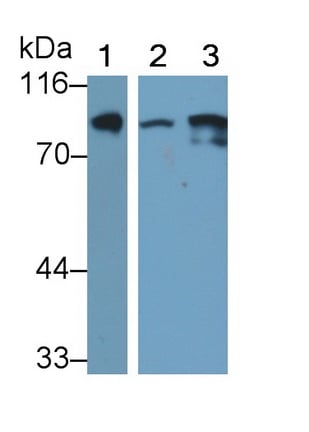
WB (Western Blot)
(Western Blot;Sample: Lane1: Hela cell lysate;Lane 2: MCF7 cell lysate; Lane 3: K562 cell lysatePrimary Ab: 0.4ug/ml Mouse Anti-Human TFR AntibodySecond Ab: 0.2ug/mL HRP-Linked Caprine Anti-Mouse IgG Polyclonal Antibody)
WB (Western Blot)
(Western Blot;Sample: Lane1: Hela cell lysate;Lane 2: MCF7 cell lysate; Lane 3: K562 cell lysatePrimary Ab: 0.4ug/ml Mouse Anti-Human TFR AntibodySecond Ab: 0.2ug/mL HRP-Linked Caprine Anti-Mouse IgG Polyclonal Antibody)
WB (Western Blot)
(Western Blot: Sample: Recombinant TFR, Human)
WB (Western Blot)
(Western Blot: Sample: Recombinant TFR, Human)
NCBI and Uniprot Product Information
Customer Reviews
Loading reviews...
Share Your Experience
Similar Products
Product Notes
The TFR tfrc (Catalog #AAA20069) is an Antibody produced from Mouse and is intended for research purposes only. The product is available for immediate purchase. The Monoclonal Antibody to Transferrin Receptor (TFR) reacts with Human and may cross-react with other species as described in the data sheet. AAA Biotech's Transferrin Receptor (TFR) can be used in a range of immunoassay formats including, but not limited to, WB (Westen Blot), IHC (Immunohistochemistry), ICC (Immunocytochemistry), IP (Immunoprecipitation). Western blotting: 0.5-5ug/mL Immunohistochemistry: 5-50ug/mL Immunocytochemistry: 5-50ug/mL Optimal working dilutions must be determined by end user. Researchers should empirically determine the suitability of the TFR tfrc for an application not listed in the data sheet. Researchers commonly develop new applications and it is an integral, important part of the investigative research process. It is sometimes possible for the material contained within the vial of "Transferrin Receptor (TFR), Monoclonal Antibody" to become dispersed throughout the inside of the vial, particularly around the seal of said vial, during shipment and storage. We always suggest centrifuging these vials to consolidate all of the liquid away from the lid and to the bottom of the vial prior to opening. Please be advised that certain products may require dry ice for shipping and that, if this is the case, an additional dry ice fee may also be required.Precautions
All products in the AAA Biotech catalog are strictly for research-use only, and are absolutely not suitable for use in any sort of medical, therapeutic, prophylactic, in-vivo, or diagnostic capacity. By purchasing a product from AAA Biotech, you are explicitly certifying that said products will be properly tested and used in line with industry standard. AAA Biotech and its authorized distribution partners reserve the right to refuse to fulfill any order if we have any indication that a purchaser may be intending to use a product outside of our accepted criteria.Disclaimer
Though we do strive to guarantee the information represented in this datasheet, AAA Biotech cannot be held responsible for any oversights or imprecisions. AAA Biotech reserves the right to adjust any aspect of this datasheet at any time and without notice. It is the responsibility of the customer to inform AAA Biotech of any product performance issues observed or experienced within 30 days of receipt of said product. To see additional details on this or any of our other policies, please see our Terms & Conditions page.Frequently Asked Questions
What is the transferrin receptor (CD71)?
CD71 is a protein found on the surface of many cells. Its main job is to help cells take in iron from the blood. Iron is very important because cells need it to make energy, grow, and divide properly.
Is CD71 expression associated with cell proliferation or iron uptake?
CD71 is linked to both. Cells that are growing and dividing fast need more iron, so they show more CD71 on their surface. Higher CD71 usually means the cell is actively taking in iron and preparing to grow or divide.
Can a transferrin receptor antibody be used to identify rapidly dividing cells?
Yes, it can. Rapidly dividing cells show more CD71 on their surface. Antibodies against CD71 help scientists spot actively growing or dividing cells, but CD71 alone doesn't confirm cancer.
Is CD71 commonly studied in cancer or anemia research?
Yes, if the antibody is suitable for flow cytometry, it can detect CD71 on the cell surface. Flow cytometry lets scientists quickly measure how much CD71 is present on many cells at once.
Can thisantibody detect cell surface expression by flow cytometry?
Yes, if the antibody is suitable for flow cytometry, it can detect CD71 on the cell surface. Flow cytometry lets scientists quickly measure how much CD71 is present on many cells at once.
How does transferrin receptor expression change during cell activation or differentiation?
Activated or dividing cells boost CD71 levels to grab more iron for growth. Mature or specialized cells lower CD71 since they need less iron.
Item has been added to Shopping Cart
If you are ready to order, navigate to Shopping Cart and get ready to checkout.