
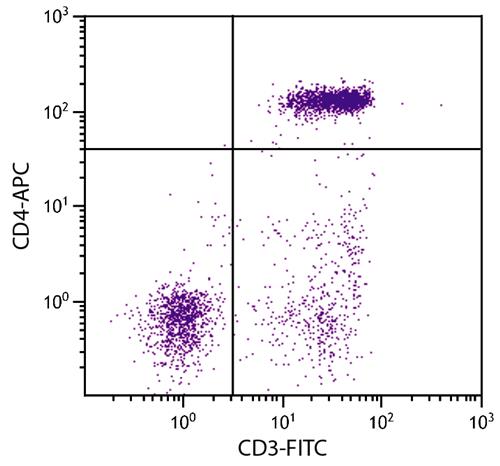
 Application Data
anti-Chicken CD4C Antibody | anti-CD4C antibody
Mouse Anti-Chicken CD4-APC
Reactivity
Chicken
Applications
Flow Cytometry, Functional Assay
Synonyms
CD4C; N/A; Mouse Anti-Chicken CD4-APC; anti-CD4C antibody
Host
Mouse (BALB/c)
Reactivity
Chicken
Isotype
IgG1kappa
Clone Number
CT-4
Specificity
Chicken/Turkey/Quail/Pigeon CD4; Mr 64 kDa
Form/Format
The R-phycoerythrin (PE) and allophycocyanin (APC) conjugates are supplied as 0.1 mg in 1.0 mL of PBS/NaN3 and a stabilizing agent
Applicable Applications for anti-CD4C antibody
FCM/FACS (Flow Cytometry)
Immunogen
Chicken thymocytes and Ig-negative blood leukocytes
Conjugate
APC (Allophycocyanin)
Isotype Control
Mouse IgG1-APC
Preparation and Storage
Store at 2-8 degree C. Do not freeze.
Application Data
Application Data
Related Product Information for anti-CD4C antibody
CD4 is a type I transmembrane glycoprotein expressed on approximately 70% of thymocytes, 10% of spleen cells, and 45% of peripheral blood lymphocytes but less than 1% of bursal cells. The monoclonal antibody CT-4 inhibits both PHA- and Con A-induced proliferative responses of splenocytes and PWM-induced IL-2 production. This antibody also reacts with turkey and quail as demonstrated by flow cytometry.
References
1. Chan MM, Chen CH, Ager LL, Cooper MD. Identification of the avian homologues of mammalian CD4 and CD8 antigens. J Immunol. 1988;140:2133-8. (Immunogen, FC, IP, Block). 2. Tanimura N, Sharma JM. Appearance of T cells in the bursa of Fabricius and cecal tonsils during the acute phase of infectious bursal disease virus infection in chickens. Avian Dis. 1997;41:638-45. (IHC-FS). 3. Pantin-Jackwood MJ, Brown TP, Huff GR. Proventriculitis in broiler chickens: immunohistochemical characterization of the lymphocytes infiltrating the proventricular glands. Vet Pathol. 2004;41:641-8. (IHC-FS). 4. Abdul-Careem MK, Hunter DB, Thanthrige-Don N, Haghighi HR, Lambourne MD, Sharif S. Cellular and cytokine responses associated with dinitrofluorobenzene-induced contact hypersensitivity in the chicken. Vet Immunol Immunopathol. 2008;122:275-84. (IHC-FS). 5. Rebel JM, Peeters B, Fijten H, Post J, Cornelissen J, Vervelde L. Highly pathogenic or low pathogenic avian influenza virus subtype H7N1 infection in chicken lungs: small differences in general acute responses. Vet Res. 2011;42:10. (IHC-PS). 6. Li Z, Nestor KE, Saif YM, Fan Z, Luhtala M, Vainio O. Cross-reactive anti-chicken CD4 and CD8 monoclonal antibodies suggest polymorphism of the turkey CD8alpha molecule. Poult Sci. 1999;78:1526-31. (FC, Turkey Reactivity). 7. Sheela RR, Babu U, Mu J, Elankumaran S, Bautista DA, Raybourne RB, et al. Immune responses against Salmonella enterica serovar enteritidis infection in virally immunosuppressed chickens. Clin Diagn Lab Immunol. 2003;10:670-9. (FC). 8. Koci MD, Kelley LA, Larsen D, Schultz-Cherry S. Astrovirus-induced synthesis of nitric oxide contributes to virus control during infection. J Virol. 2004;78:1564-74. (FC, Turkey Reactivity). 9. Janardhana V, Broadway MM, Bruce MP, Lowenthal JW, Geier MS, Hughes RJ, et al. Prebiotics modulate immune responses in the gut-associated lymphoid tissue of chickens. J Nutr. 2009;139:1404-9. (FC). 10. Tykaowski B, Stenzel T, Mikulski D, Jankowski J, Zdu?czyk Z, Ju?kiewicz J, et al. Level of electrolytes and percentage of T-lymphocyte subpopulations in blood of broiler chickens fed mixtures with different contents of sodium chloride. Bull Vet Inst Pulawy. 2011;55:333-7. (FC). 11. Norup LR, Dalgaard TS, Pedersen AR, Juul-Madsen HR. Assessment of Newcastle disease-specific T cell proliferation in different inbred MHC chicken lines. Scand J Immunol. 2011;74:23-30. (FC). 12. Young JA, Jefferies W. Towards the conservation of endangered avian species a recombinant West Nile Virus vaccine results in increased humoral and cellular immune responses in Japanese Quail (Coturnix japonica). PLoS One. 2013;8 (6):e67137. (FC, Quail Reactivity). 13. Revajová V, Slaminková Z, Grešáková L, Levkut M. Duodenal morphology and immune responses of broiler chickens fed low doses of deoxynivalenol. Acta Vet. Brno. 2013;82:337-42. (FC). 14. Xue M, Shi X, Zhao Y, Cui H, Hu S, Cui X, et al. Effects of reticuloendotheliosis virus infection on cytokine production in SPF chickens. PLoS One. 2013;8 (12):e83918. (FC). 15. Peng X, Zhang K, Bai S, Ding X, Zeng Q, Yang J, et al. Histological lesions, cell cycle arrest, apoptosis and T cell subsets changes of spleen in chicken fed aflatoxin-contaminated corn. Int J Environ Res Public Health. 2014;11:8567-80. (FC). 16. Laniewski P, Kuczkowski M, Chrz?stek K, Wo?niak A, Wyszy?ska A, Wieliczko A, et al. Evaluation of the immunogenicity of Campylobacter jejuni CjaA protein delivered by Salmonella enterica sv. Typhimurium strain with regulated delayed attenuation in chickens. World J Microbiol Biotechnol. 2014;30:281-92. (FC). 17. Kjærup RM, Dalgaard TS, Norup LR, Hamzic E, Sørensen P, Juul-Madsen HR. Characterization of cellular and humoral immune responses after IBV infection in chicken lines differing in MBL serum concentration. Viral Immunol. 2014;27:529-42. (FC). 18. Pleidrup J, Dalgaard TS, Norup LR, Permin A, Schou TW, Skovgaard K, et al. Ascaridia galli infection influences the development of both humoral and cell-mediated immunity after Newcastle Disease vaccination in chickens. Vaccine. 2014;32:383-92. (FC). 19. Dudek K, Bednarek D. Cellular immune response of pigeons in the conditions of endotoxin fever and pyrogenic tolerance. Pol J Vet Sci. 2011;14:127-33. (FC, Pigeon Reactivity)
Customer Reviews
Loading reviews...
Share Your Experience
Similar Products

Product Notes
The CD4C (Catalog #AAA78924) is an Antibody produced from Mouse (BALB/c) and is intended for research purposes only. The product is available for immediate purchase. The Mouse Anti-Chicken CD4-APC reacts with Chicken and may cross-react with other species as described in the data sheet. AAA Biotech's CD4C can be used in a range of immunoassay formats including, but not limited to, FCM/FACS (Flow Cytometry). Researchers should empirically determine the suitability of the CD4C for an application not listed in the data sheet. Researchers commonly develop new applications and it is an integral, important part of the investigative research process. It is sometimes possible for the material contained within the vial of "CD4C, Antibody" to become dispersed throughout the inside of the vial, particularly around the seal of said vial, during shipment and storage. We always suggest centrifuging these vials to consolidate all of the liquid away from the lid and to the bottom of the vial prior to opening. Please be advised that certain products may require dry ice for shipping and that, if this is the case, an additional dry ice fee may also be required.Precautions
All products in the AAA Biotech catalog are strictly for research-use only, and are absolutely not suitable for use in any sort of medical, therapeutic, prophylactic, in-vivo, or diagnostic capacity. By purchasing a product from AAA Biotech, you are explicitly certifying that said products will be properly tested and used in line with industry standard. AAA Biotech and its authorized distribution partners reserve the right to refuse to fulfill any order if we have any indication that a purchaser may be intending to use a product outside of our accepted criteria.Disclaimer
Though we do strive to guarantee the information represented in this datasheet, AAA Biotech cannot be held responsible for any oversights or imprecisions. AAA Biotech reserves the right to adjust any aspect of this datasheet at any time and without notice. It is the responsibility of the customer to inform AAA Biotech of any product performance issues observed or experienced within 30 days of receipt of said product. To see additional details on this or any of our other policies, please see our Terms & Conditions page.Item has been added to Shopping Cart
If you are ready to order, navigate to Shopping Cart and get ready to checkout.