
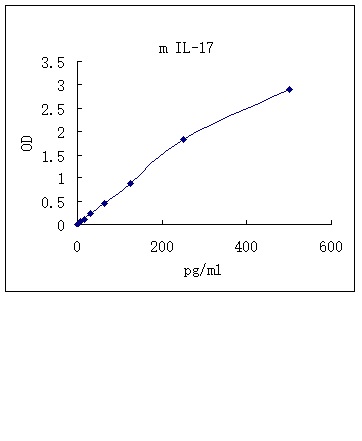
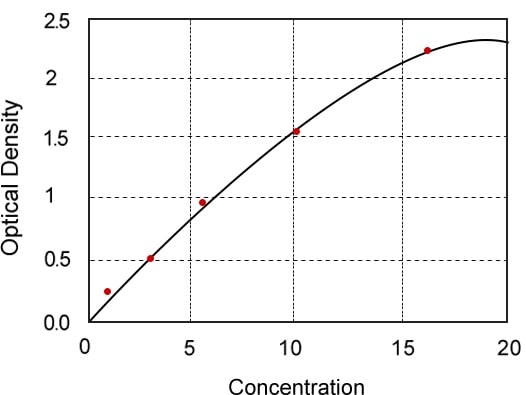
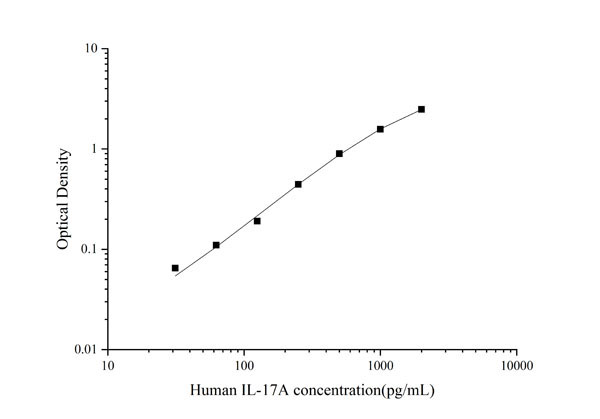
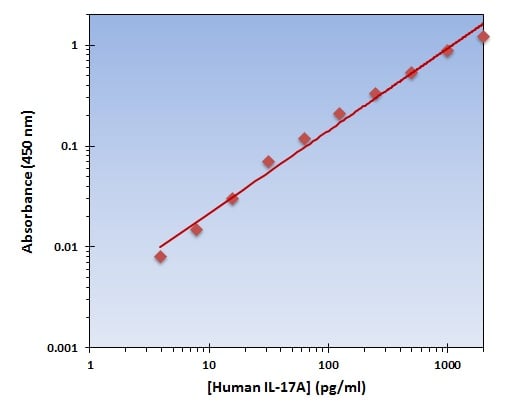
 Standard Curve (Sample)
(Representative standard curve for IL-17 ELISA. IL-17 was diluted in serial two-fold steps in Sample Diluent.)
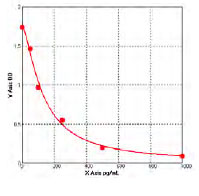
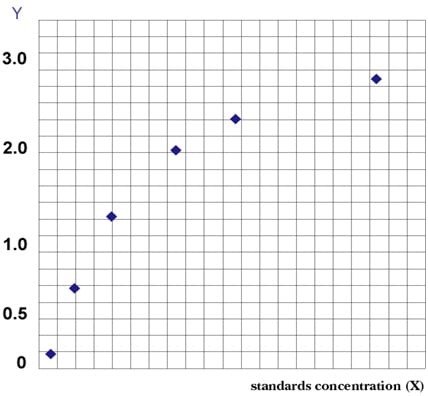
Standard Curve (Sample)
(Representative standard curve for IL-17 ELISA. IL-17 was diluted in serial two-fold steps in Sample Diluent.)
Mouse IL-17A ELISA Kit | IL-17A elisa kit
Mouse IL-17A ELISA KIT
Gene Names
IL17A; IL17; CTLA8; IL-17; CTLA-8; IL-17A
Reactivity
Mouse
Synonyms
IL-17A; N/A; Mouse IL-17A ELISA KIT; Mouse IL-17A; IL-17A elisa kit
Reactivity
Mouse
Specificity
Natural and recombinant Mouse IL-17A Ligand
Assay Type
Solid Phase Sandwich ELISA
Samples
Cell culture supernatant, serum, plasma (EDTA, citrate, heparin)
Detection Range
7.8-500 pg/mL
Sensitivity
4pg/mL
Assay Time
3 hour
Sample Volume
20 uL
Detection Method
Colorimetric
Preparation and Storage
Store at 4 degree C
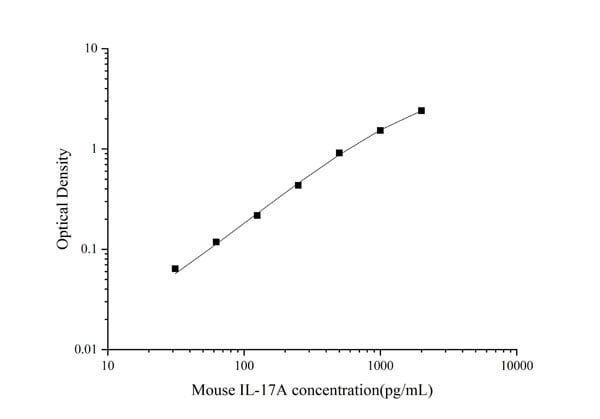
Standard Curve (Sample)
(Representative standard curve for IL-17 ELISA. IL-17 was diluted in serial two-fold steps in Sample Diluent.)
Standard Curve (Sample)
(Representative standard curve for IL-17 ELISA. IL-17 was diluted in serial two-fold steps in Sample Diluent.)
Related Product Information for IL-17A elisa kit
Mouse Interleukin 17 (IL-17; also known as IL-17A and CTLA-8) is a 21 kDa, variably glycosylated polypeptide that belongs to the IL-17 family of cytokines containing a cysteine-knot fold (1-3). Its sequence was originally isolated from an activated hybridoma created from the fusion of a mouse cytotoxic and rat T cell lymphoma cell line (2-5). It is synthesized as a 158 amino acid (aa) precursor that contains a 25 aa signal sequence and a 15 kDa, 133 aa mature segment (5). In both mouse and human, there is one conserved N-linked glycosylation site that likely contributes 5 kDa to its native molecular weight. IL-17A forms both a 35-38 kDa homodimer, and a 45-48 kDa heterodimer with IL-17F (6, 7). Mature mouse IL-17A is 61% and 89% aa identical to human and rat IL-17A, respectively (4, 5, 8). While rodent and human mature sequences show modest aa sequence identity, human IL-17 is active on both mouse and rat cells (5, 9). Cells known to produce IL-17 are the CD4+ Th17 T cells, Paneth cells, GR1+CD11b+ myeloid suppressor cells, CD27-g&d T cells, CD1+NK1.1- iNKT cells and CD3-CD4+ LTi-like cells (3, 5, 6, 10-12).A high affinity receptor for mouse IL-17 has been reported, and appears to be a heteromultimer of IL-17RA and IL-17RC, likely in a 2:1 ratio (1). IL-17RA is a 130 kDa, type I transmembrane glycoprotein that bears no resemblance to members of the cytokine, TNF or immunoglobulin receptor superfamily (2, 10, 13). IL-17RC is also a type I transmembrane protein, approximately 90-95 kDa in size, that shares less than 30% aa identity with IL-17RA (14, 15). Both receptors are needed for IL-17A and IL-17A/F activity. The two receptors appear to form a functional association following ligand binding to IL-17RA (1, 16).IL-17 is best known for its participation in the recruitment and survival of neutrophils (3, 10, 17, 18). Its induction was initially described to be the result of antigen stimulation of dentritic cells, resulting in IL-23 secretion. In a TCR-independent event, IL-23 induces T cell production of IL-17 (3). Once secreted, IL-17 in the bone marrow would seem to induce stromal/fibroblast expression of both G-CSF and SCF (membrane form), an effect that increases neutrophil differentiation and activation. IL-17 may complement this by directly blocking neutrophil apoptosis, promoting greater circulating neutrophil numbers (17). In the tissues, IL-17 seems to promote neutrophil extravasation, principally through its effects on macrophages and endothelial cells (EC). On macrophages, IL-17 induces TNF-a, IL-1b and IL-6 production (19).TNF-a and IL-1b then act on local ECs to induce G-CSF secretion, an effect that is potentiated by IL-17 (20). IL-17 further contributes to neutrophil influx by inducing EC CXC chemokine release and NO production, which may increase vascular permeability (3, 9). IL-17 effects are not limited to neutrophils. In synovial joints, IL-17 upregulates RANKL expression on osteoblasts. This provides a stimulus for osteoclast formation and subsequent bone resorption (18).
NCBI and Uniprot Product Information
NCBI GI #
NCBI GeneID
NCBI Accession #
NCBI GenBank Nucleotide #
Molecular Weight
17,504 Da
NCBI Official Full Name
interleukin-17A
NCBI Official Synonym Full Names
interleukin 17A
NCBI Official Symbol
IL17A
NCBI Official Synonym Symbols
IL17; CTLA8; IL-17; CTLA-8; IL-17A
NCBI Protein Information
interleukin-17A
UniProt Protein Name
Interleukin-17A
UniProt Gene Name
IL17A
UniProt Synonym Gene Names
CTLA8; IL17; IL-17; IL-17A; CTLA-8
Customer Reviews
Loading reviews...
Share Your Experience
Similar Products


Product Notes
The Mouse IL-17A il17a (Catalog #AAA309911) is an ELISA Kit and is intended for research purposes only. The product is available for immediate purchase. The AAA309911 ELISA Kit recognizes Mouse IL-17A. It is sometimes possible for the material contained within the vial of "IL-17A, ELISA Kit" to become dispersed throughout the inside of the vial, particularly around the seal of said vial, during shipment and storage. We always suggest centrifuging these vials to consolidate all of the liquid away from the lid and to the bottom of the vial prior to opening. Please be advised that certain products may require dry ice for shipping and that, if this is the case, an additional dry ice fee may also be required.Precautions
All products in the AAA Biotech catalog are strictly for research-use only, and are absolutely not suitable for use in any sort of medical, therapeutic, prophylactic, in-vivo, or diagnostic capacity. By purchasing a product from AAA Biotech, you are explicitly certifying that said products will be properly tested and used in line with industry standard. AAA Biotech and its authorized distribution partners reserve the right to refuse to fulfill any order if we have any indication that a purchaser may be intending to use a product outside of our accepted criteria.Disclaimer
Though we do strive to guarantee the information represented in this datasheet, AAA Biotech cannot be held responsible for any oversights or imprecisions. AAA Biotech reserves the right to adjust any aspect of this datasheet at any time and without notice. It is the responsibility of the customer to inform AAA Biotech of any product performance issues observed or experienced within 30 days of receipt of said product. To see additional details on this or any of our other policies, please see our Terms & Conditions page.Item has been added to Shopping Cart
If you are ready to order, navigate to Shopping Cart and get ready to checkout.