
 Standard Curve (Sample)
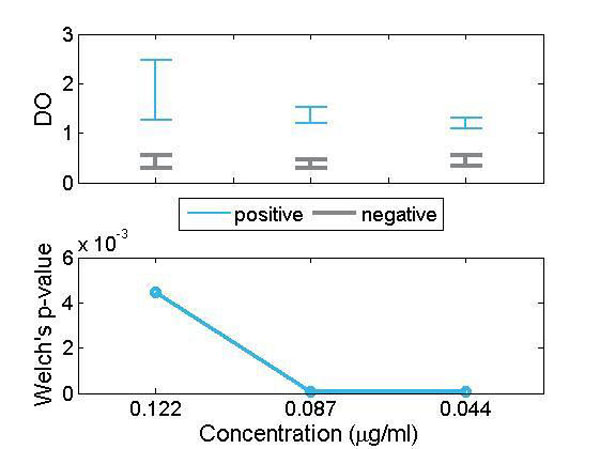
(The titer has been suggested in reference to an "in-house" ELISA kit performed at Rekom Biotech over the first lot obtained.Each end user should carry out their own titration for their particular application.Figure 2. In this plot, the optical density at 450/620 nm for positive (blue) and negative (gray) IgM sera are compared for each concentration of the recombinant antigen. An appropriate statistical test of significance for the comparison of means between both groups, the Welch's test, is employed. Eligible concentrations for the use of the antigen should present statistically significant differences between positive and negative sera. This happens when the intervals at the top do not overlap and, equivalently, when the pvalue at the bottom is below 0.05. In the present figure, all p-values are below 0.05 and thus the intervals do not overlap. Therefore, any of the showed concentrations can be used to distinguish between positive and negative sera.)
Standard Curve (Sample)
(The titer has been suggested in reference to an "in-house" ELISA kit performed at Rekom Biotech over the first lot obtained.Each end user should carry out their own titration for their particular application.Figure 2. In this plot, the optical density at 450/620 nm for positive (blue) and negative (gray) IgM sera are compared for each concentration of the recombinant antigen. An appropriate statistical test of significance for the comparison of means between both groups, the Welch's test, is employed. Eligible concentrations for the use of the antigen should present statistically significant differences between positive and negative sera. This happens when the intervals at the top do not overlap and, equivalently, when the pvalue at the bottom is below 0.05. In the present figure, all p-values are below 0.05 and thus the intervals do not overlap. Therefore, any of the showed concentrations can be used to distinguish between positive and negative sera.)
p18 Recombinant Protein | BFRF3 recombinant protein
RECOMBINANT ANTIGEN p18 from Epstein-Barr Virus (EBV)
Composition: Recombinant antigen with a his-tag in its N-terminus.
Storage buffer before lyohplization: 20mM phosphate bfufer pH 7. 1M NaCl and 0.1% polyoxylethylene (10) tridecylether
DO 280 =0.202
A 0.1%(=1 g/l) = 0.094
CONCENTRATION: 2.15mg/ml
*The meassurement of the protein concentration has been performed with the theoretical extinction coefficient of the recombinant protein obtained from Gill and vonHippel, 1989. It is recommended that the users carry out their absorbance deteminations to avoid equipment variabilities regarding final concentration, mainly in reproducibility analysis.
2. TOTAL QUANTITY PER ALIQUOT: 0.1 mg
3. SUGGESTED TITER BY ELISA: up to 1:48,864, which corresponds to 0.044 ug/ml of protein concentration in plates, for IgM detection.
4. STORAGE: Protein is shipped with dry ice. Upon arrival, it should be aliquoted to avoid repeated freezing and thawing cycles and stored at -20ºC to -80ºC.
5. TESTED APPLICATIONS: ELISA.
6. POSIBLE APPLICATIONS: WB, DB, Indirect ELISA, positive control in direct ELISA, CLIA, lateral-flow. Where this product has not been tested for use in a particular technique, this does not necessarily exclude its use in such procedures. Suggested working dilutions are given as a guide only. It is recommended that the user titrates.
7. OBSERVATIONS: proteins should be maintained frozen at high concentrations. The dilution to be performed for ELISA assays should be made with a small quantity of protein, the same day of the experiment. In order to defrost the protein, maintain the aliquot at 25ºC without shaking to avoid aggregation. Prior making test dilutions and after defrosting the protein, is recommended to remove possible protein aggregates by centrifuging the stock solution, avoiding alterations in the immobilization of the biomolecule to the solid surface.
Standard Curve (Sample)
(The titer has been suggested in reference to an "in-house" ELISA kit performed at Rekom Biotech over the first lot obtained.Each end user should carry out their own titration for their particular application.Figure 2. In this plot, the optical density at 450/620 nm for positive (blue) and negative (gray) IgM sera are compared for each concentration of the recombinant antigen. An appropriate statistical test of significance for the comparison of means between both groups, the Welch's test, is employed. Eligible concentrations for the use of the antigen should present statistically significant differences between positive and negative sera. This happens when the intervals at the top do not overlap and, equivalently, when the pvalue at the bottom is below 0.05. In the present figure, all p-values are below 0.05 and thus the intervals do not overlap. Therefore, any of the showed concentrations can be used to distinguish between positive and negative sera.)
Standard Curve (Sample)
(The titer has been suggested in reference to an "in-house" ELISA kit performed at Rekom Biotech over the first lot obtained.Each end user should carry out their own titration for their particular application.Figure 2. In this plot, the optical density at 450/620 nm for positive (blue) and negative (gray) IgM sera are compared for each concentration of the recombinant antigen. An appropriate statistical test of significance for the comparison of means between both groups, the Welch's test, is employed. Eligible concentrations for the use of the antigen should present statistically significant differences between positive and negative sera. This happens when the intervals at the top do not overlap and, equivalently, when the pvalue at the bottom is below 0.05. In the present figure, all p-values are below 0.05 and thus the intervals do not overlap. Therefore, any of the showed concentrations can be used to distinguish between positive and negative sera.)
SDS-PAGE
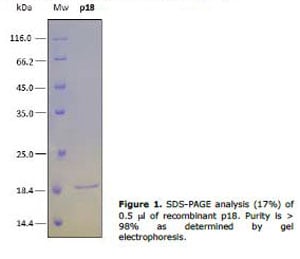
(Purity control in SDS-PAGE: 17%)
SDS-PAGE
(Purity control in SDS-PAGE: 17%)
Bradford, MM. A rapid and sensitive method for the quantitation of microgram quantities of protein utilizing the principle of protein dye binding. Anal Biochem. 1976, 131:499-503.
Customer Reviews
Loading reviews...
Share Your Experience
Similar Products

Product Notes
The BFRF3 (Catalog #AAA72858) is a Recombinant Protein and is intended for research purposes only. The product is available for immediate purchase. It is sometimes possible for the material contained within the vial of "p18, Recombinant Protein" to become dispersed throughout the inside of the vial, particularly around the seal of said vial, during shipment and storage. We always suggest centrifuging these vials to consolidate all of the liquid away from the lid and to the bottom of the vial prior to opening. Please be advised that certain products may require dry ice for shipping and that, if this is the case, an additional dry ice fee may also be required.Precautions
All products in the AAA Biotech catalog are strictly for research-use only, and are absolutely not suitable for use in any sort of medical, therapeutic, prophylactic, in-vivo, or diagnostic capacity. By purchasing a product from AAA Biotech, you are explicitly certifying that said products will be properly tested and used in line with industry standard. AAA Biotech and its authorized distribution partners reserve the right to refuse to fulfill any order if we have any indication that a purchaser may be intending to use a product outside of our accepted criteria.Disclaimer
Though we do strive to guarantee the information represented in this datasheet, AAA Biotech cannot be held responsible for any oversights or imprecisions. AAA Biotech reserves the right to adjust any aspect of this datasheet at any time and without notice. It is the responsibility of the customer to inform AAA Biotech of any product performance issues observed or experienced within 30 days of receipt of said product. To see additional details on this or any of our other policies, please see our Terms & Conditions page.Item has been added to Shopping Cart
If you are ready to order, navigate to Shopping Cart and get ready to checkout.