
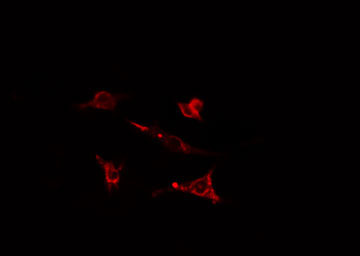
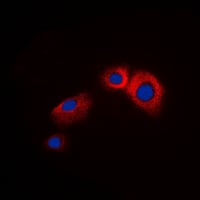
 IF (Immunofluorescence)
(AAA324205 staining Hela cells by IF/ICC. The sample were fixed with PFA and permeabilized in 0.1% Triton X-100, then blocked in 10% serum for 45 minutes at 25 degree C. The primary antibody was diluted at 1/200 and incubated with the sample for 1 hour at 37 degree C. An Alexa Fluor 594 conjugated goat anti-rabbit IgG (H+L) antibody, diluted at 1/600, was used as secondary antibody.)
IF (Immunofluorescence)
(AAA324205 staining Hela cells by IF/ICC. The sample were fixed with PFA and permeabilized in 0.1% Triton X-100, then blocked in 10% serum for 45 minutes at 25 degree C. The primary antibody was diluted at 1/200 and incubated with the sample for 1 hour at 37 degree C. An Alexa Fluor 594 conjugated goat anti-rabbit IgG (H+L) antibody, diluted at 1/600, was used as secondary antibody.)
Rabbit ARRB1 Polyclonal Antibody | anti-ARRB1 antibody
ARRB1 Antibody
Gene Names
ARRB1; ARB1; ARR1
Reactivity
Human, Mouse, Rat
Applications
ELISA, Immunocytochemistry, Immunofluorescence, Western Blot
Purity
The antiserum was purified by peptide affinity chromatography using SulfoLink Coupling Resin.
Synonyms
ARRB1, Antibody; ARRB1 Antibody; ARB1; ARR1; ARRB1; ARRB1_HUMAN; Arrestin 2; Arrestin beta 1; Arrestin beta-1; Beta-arrestin-1; anti-ARRB1 antibody
Host
Rabbit
Reactivity
Human, Mouse, Rat
Clonality
Polyclonal
Isotype
IgG
Specificity
ARRB1 antibody detects endogenous levels of total ARRB1
Purity/Purification
The antiserum was purified by peptide affinity chromatography using SulfoLink Coupling Resin.
Form/Format
Liquid
Phosphate buffered saline, pH 7.4, 150mM NaCl, 0.02% sodium azide and 50% glycerol.
Phosphate buffered saline, pH 7.4, 150mM NaCl, 0.02% sodium azide and 50% glycerol.
Concentration
1mg/ml (varies by lot)
Sequence Length
418
Applicable Applications for anti-ARRB1 antibody
ELISA, ICC (Immunocytochemistry), IF (Immunofluorescence), WB (Western Blot)
Immunogen
A synthesized peptide
Subcellular Location
Cytoplasm. Nucleus. Cell Membrane. Membrane > Clathrin-Coated Pit. Cell projection > Pseudopodium. Cytoplasmic Vesicle. Translocates to the plasma membrane and colocalizes with antagonist-stimulated GPCRs. The monomeric form is predominantly located in the nucleus. The oligomeric form is located in the cytoplasm. Translocates to the nucleus upon stimulation of OPRD1.
Predicted Cross Reactivity
Bovine, Horse, Sheep, Dog
Similarity
Bovine (82%), Horse (91%), Sheep (82%), Dog (91%)
Conjugation
Unconjugated
Preparation and Storage
Store at -20 degree C. Stable for 12 months from date of receipt.
IF (Immunofluorescence)
(AAA324205 staining Hela cells by IF/ICC. The sample were fixed with PFA and permeabilized in 0.1% Triton X-100, then blocked in 10% serum for 45 minutes at 25 degree C. The primary antibody was diluted at 1/200 and incubated with the sample for 1 hour at 37 degree C. An Alexa Fluor 594 conjugated goat anti-rabbit IgG (H+L) antibody, diluted at 1/600, was used as secondary antibody.)
IF (Immunofluorescence)
(AAA324205 staining Hela cells by IF/ICC. The sample were fixed with PFA and permeabilized in 0.1% Triton X-100, then blocked in 10% serum for 45 minutes at 25 degree C. The primary antibody was diluted at 1/200 and incubated with the sample for 1 hour at 37 degree C. An Alexa Fluor 594 conjugated goat anti-rabbit IgG (H+L) antibody, diluted at 1/600, was used as secondary antibody.)
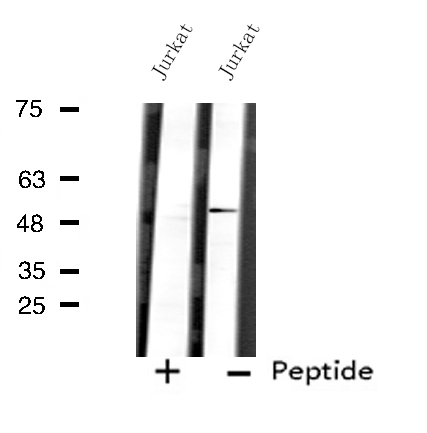
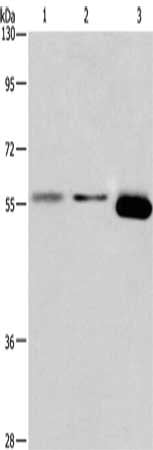
WB (Western Blot)
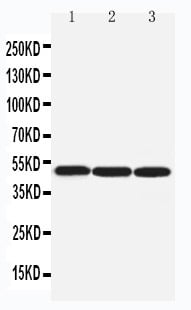
(Western blot analysis of extracts from Jurkat cells using ARRB1 antibody.)
WB (Western Blot)
(Western blot analysis of extracts from Jurkat cells using ARRB1 antibody.)
Related Product Information for anti-ARRB1 antibody
Function: Functions in regulating agonist-mediated G-protein coupled receptor (GPCR) signaling by mediating both receptor desensitization and resensitization processes. During homologous desensitization, beta-arrestins bind to the GPRK-phosphorylated receptor and sterically preclude its coupling to the cognate G-protein; the binding appears to require additional receptor determinants exposed only in the active receptor conformation. The beta-arrestins target many receptors for internalization by acting as endocytic adapters (CLASPs, clathrin-associated sorting proteins) and recruiting the GPRCs to the adapter protein 2 complex 2 (AP-2) in clathrin-coated pits (CCPs). However, the extent of beta-arrestin involvement appears to vary significantly depending on the receptor, agonist and cell type. Internalized arrestin-receptor complexes traffic to intracellular endosomes, where they remain uncoupled from G-proteins. Two different modes of arrestin-mediated internalization occur. Class A receptors, like ADRB2, OPRM1, ENDRA, D1AR and ADRA1B dissociate from beta-arrestin at or near the plasma membrane and undergo rapid recycling. Class B receptors, like AVPR2, AGTR1, NTSR1, TRHR and TACR1 internalize as a complex with arrestin and traffic with it to endosomal vesicles, presumably as desensitized receptors, for extended periods of time. Receptor resensitization then requires that receptor-bound arrestin is removed so that the receptor can be dephosphorylated and returned to the plasma membrane. Involved in internalization of P2RY4 and UTP-stimulated internalization of P2RY2. Involved in phosphorylation-dependent internalization of OPRD1 ands subsequent recycling. Involved in the degradation of cAMP by recruiting cAMP phosphodiesterases to ligand-activated receptors. Beta-arrestins function as multivalent adapter proteins that can switch the GPCR from a G-protein signaling mode that transmits short-lived signals from the plasma membrane via small molecule second messengers and ion channels to a beta-arrestin signaling mode that transmits a distinct set of signals that are initiated as the receptor internalizes and transits the intracellular compartment. Acts as signaling scaffold for MAPK pathways such as MAPK1/3 (ERK1/2). ERK1/2 activated by the beta-arrestin scaffold is largely excluded from the nucleus and confined to cytoplasmic locations such as endocytic vesicles, also called beta-arrestin signalosomes. Recruits c-Src/SRC to ADRB2 resulting in ERK activation. GPCRs for which the beta-arrestin-mediated signaling relies on both ARRB1 and ARRB2 (codependent regulation) include ADRB2, F2RL1 and PTH1R. For some GPCRs the beta-arrestin-mediated signaling relies on either ARRB1 or ARRB2 and is inhibited by the other respective beta-arrestin form (reciprocal regulation). Inhibits ERK1/2 signaling in AGTR1-and AVPR2-mediated activation (reciprocal regulation). Is required for SP-stimulated endocytosis of NK1R and recruits c-Src/SRC to internalized NK1R resulting in ERK1/2 activation, which is required for the antiapoptotic effects of SP. Is involved in proteinase-activated F2RL1-mediated ERK activity. Acts as signaling scaffold for the AKT1 pathway. Is involved in alpha-thrombin-stimulated AKT1 signaling. Is involved in IGF1-stimulated AKT1 signaling leading to increased protection from apoptosis. Involved in activation of the p38 MAPK signaling pathway and in actin bundle formation. Involved in F2RL1-mediated cytoskeletal rearrangement and chemotaxis. Involved in AGTR1-mediated stress fiber formation by acting together with GNAQ to activate RHOA. Appears to function as signaling scaffold involved in regulation of MIP-1-beta-stimulated CCR5-dependent chemotaxis. Involved in attenuation of NF-kappa-B-dependent transcription in response to GPCR or cytokine stimulation by interacting with and stabilizing CHUK. May serve as nuclear messenger for GPCRs. Involved in OPRD1-stimulated transcriptional regulation by translocating to CDKN1B and FOS promoter regions and recruiting EP300 resulting in acetylation of histone H4. Involved in regulation of LEF1 transcriptional activity via interaction with DVL1 and/or DVL2 Also involved in regulation of receptors other than GPCRs. Involved in Toll-like receptor and IL-1 receptor signaling through the interaction with TRAF6 which prevents TRAF6 autoubiquitination and oligomerization required for activation of NF-kappa-B and JUN. Binds phosphoinositides. Binds inositolhexakisphosphate (InsP6) (By similarity). Involved in IL8-mediated granule release in neutrophils. Required for atypical chemokine receptor ACKR2-induced RAC1-LIMK1-PAK1-dependent phosphorylation of cofilin (CFL1) and for the up-regulation of ACKR2 from endosomal compartment to cell membrane, increasing its efficiency in chemokine uptake and degradation. Involved in the internalization of the atypical chemokine receptor ACKR3. Negatively regulates the NOTCH signaling pathway by mediating the ubiquitination and degradation of NOTCH1 by ITCH. Participates to the recruitment of the ubiquitin-protein ligase to the receptor (PubMed:23886940).
Subunit Structure: Monomer. Homodimer. Homooligomer; the self-association is mediated by InsP6-binding. Heterooligomer with ARRB2; the association is mediated by InsP6-binding. Interacts with GPR143. Interacts with ADRB2 (phosphorylated). Interacts with CHRM2 (phosphorylated). Interacts with LHCGR. Interacts with CYTH2 and CASR. Interacts with AP2B1 (dephosphorylated at 'Tyr-737'); phosphorylation of AP2B1 at 'Tyr-737' disrupts the interaction. Interacts (dephosphorylated at Ser-412) with CLTC. Interacts with CCR2 and GRK2. Interacts with CRR5. Interacts with PTAFR (phosphorylated on serine residues). Interacts with CLTC and MAP2K3. Interacts with CREB1. Interacts with TRAF6. Interacts with IGF1R and MDM2. Interacts with C5AR1. Interacts with PDE4D. Interacts with SRC (via the SH3 domain and the protein kinase domain); the interaction is independent of the phosphorylation state of SRC C-terminus. Interacts with TACR1. Interacts with RAF1. Interacts with CHUK, IKBKB and MAP3K14. Interacts with DVL1; the interaction is enhanced by phosphorylation of DVL1. Interacts with DVL2; the interaction is enhanced by phosphorylation of DVL2. Interacts with IGF1R. Associates with MAP kinase p38. Part of a MAPK signaling complex consisting of TACR1, ARRB1, SRC, MAPK1 (activated) and MAPK3 (activated). Part of a MAPK signaling complex consisting of F2RL1, ARRB1, RAF1, MAPK1 (activated) and MAPK3 (activated) (By similarity). Interacts with MAP2K4/MKK4. Interacts with HCK and CXCR1 (phosphorylated). Interacts with ACKR3 and ACKR4. Interacts with ARRDC1; the interaction is direct (PubMed:23886940). Interacts with GPR61, GPR62 and GPR135 (PubMed:28827538).
Post-translational Modifications: Constitutively phosphorylated at Ser-412 in the cytoplasm. At the plasma membrane, is rapidly dephosphorylated, a process that is required for clathrin binding and ADRB2 endocytosis but not for ADRB2 binding and desensitization. Once internalized, is rephosphorylated. The ubiquitination status appears to regulate the formation and trafficking of beta-arrestin-GPCR complexes and signaling. Ubiquitination appears to occur GPCR-specific. Ubiquitinated by MDM2; the ubiquitination is required for rapid internalization of ADRB2. Deubiquitinated by USP33; the deubiquitination leads to a dissociation of the beta-arrestin-GPCR complex. Stimulation of a class A GPCR, such as ADRB2, induces transient ubiquitination and subsequently promotes association with USP33.
Similarity: The [DE]-X(1, 2)-F-X-X-[FL]-X-X-X-R motif mediates interaction the AP-2 complex subunit AP2B1 (By similarity). Binding to phosphorylated GPCRs induces a conformationanl change that exposes the motif to the surface.The N-terminus binds InsP6 with low affinity.The C-terminus binds InsP6 with high affinity. Belongs to the arrestin family.
Subunit Structure: Monomer. Homodimer. Homooligomer; the self-association is mediated by InsP6-binding. Heterooligomer with ARRB2; the association is mediated by InsP6-binding. Interacts with GPR143. Interacts with ADRB2 (phosphorylated). Interacts with CHRM2 (phosphorylated). Interacts with LHCGR. Interacts with CYTH2 and CASR. Interacts with AP2B1 (dephosphorylated at 'Tyr-737'); phosphorylation of AP2B1 at 'Tyr-737' disrupts the interaction. Interacts (dephosphorylated at Ser-412) with CLTC. Interacts with CCR2 and GRK2. Interacts with CRR5. Interacts with PTAFR (phosphorylated on serine residues). Interacts with CLTC and MAP2K3. Interacts with CREB1. Interacts with TRAF6. Interacts with IGF1R and MDM2. Interacts with C5AR1. Interacts with PDE4D. Interacts with SRC (via the SH3 domain and the protein kinase domain); the interaction is independent of the phosphorylation state of SRC C-terminus. Interacts with TACR1. Interacts with RAF1. Interacts with CHUK, IKBKB and MAP3K14. Interacts with DVL1; the interaction is enhanced by phosphorylation of DVL1. Interacts with DVL2; the interaction is enhanced by phosphorylation of DVL2. Interacts with IGF1R. Associates with MAP kinase p38. Part of a MAPK signaling complex consisting of TACR1, ARRB1, SRC, MAPK1 (activated) and MAPK3 (activated). Part of a MAPK signaling complex consisting of F2RL1, ARRB1, RAF1, MAPK1 (activated) and MAPK3 (activated) (By similarity). Interacts with MAP2K4/MKK4. Interacts with HCK and CXCR1 (phosphorylated). Interacts with ACKR3 and ACKR4. Interacts with ARRDC1; the interaction is direct (PubMed:23886940). Interacts with GPR61, GPR62 and GPR135 (PubMed:28827538).
Post-translational Modifications: Constitutively phosphorylated at Ser-412 in the cytoplasm. At the plasma membrane, is rapidly dephosphorylated, a process that is required for clathrin binding and ADRB2 endocytosis but not for ADRB2 binding and desensitization. Once internalized, is rephosphorylated. The ubiquitination status appears to regulate the formation and trafficking of beta-arrestin-GPCR complexes and signaling. Ubiquitination appears to occur GPCR-specific. Ubiquitinated by MDM2; the ubiquitination is required for rapid internalization of ADRB2. Deubiquitinated by USP33; the deubiquitination leads to a dissociation of the beta-arrestin-GPCR complex. Stimulation of a class A GPCR, such as ADRB2, induces transient ubiquitination and subsequently promotes association with USP33.
Similarity: The [DE]-X(1, 2)-F-X-X-[FL]-X-X-X-R motif mediates interaction the AP-2 complex subunit AP2B1 (By similarity). Binding to phosphorylated GPCRs induces a conformationanl change that exposes the motif to the surface.The N-terminus binds InsP6 with low affinity.The C-terminus binds InsP6 with high affinity. Belongs to the arrestin family.
NCBI and Uniprot Product Information
NCBI GI #
NCBI GeneID
NCBI Accession #
NCBI GenBank Nucleotide #
Molecular Weight
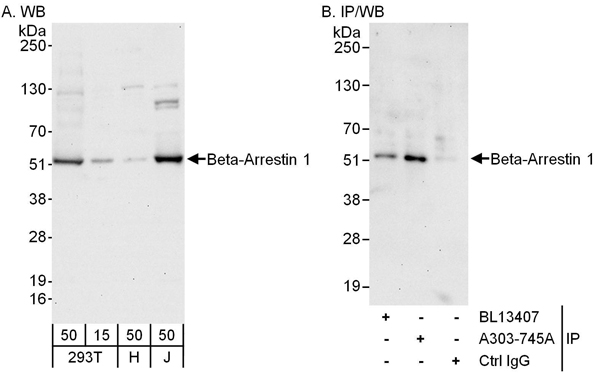
Observed: 50 kD
Predicted: 48 kDa
Predicted: 48 kDa
NCBI Official Full Name
beta-arrestin-1 isoform A
NCBI Official Synonym Full Names
arrestin beta 1
NCBI Official Symbol
ARRB1
NCBI Official Synonym Symbols
ARB1; ARR1
NCBI Protein Information
beta-arrestin-1
UniProt Protein Name
Beta-arrestin-1
UniProt Gene Name
ARRB1
UniProt Synonym Gene Names
ARR1
Customer Reviews
Loading reviews...
Share Your Experience
Similar Products


Product Notes
The ARRB1 arrb1 (Catalog #AAA324205) is an Antibody produced from Rabbit and is intended for research purposes only. The product is available for immediate purchase. The ARRB1 Antibody reacts with Human, Mouse, Rat and may cross-react with other species as described in the data sheet. AAA Biotech's ARRB1 can be used in a range of immunoassay formats including, but not limited to, ELISA, ICC (Immunocytochemistry), IF (Immunofluorescence), WB (Western Blot). Researchers should empirically determine the suitability of the ARRB1 arrb1 for an application not listed in the data sheet. Researchers commonly develop new applications and it is an integral, important part of the investigative research process. It is sometimes possible for the material contained within the vial of "ARRB1, Polyclonal Antibody" to become dispersed throughout the inside of the vial, particularly around the seal of said vial, during shipment and storage. We always suggest centrifuging these vials to consolidate all of the liquid away from the lid and to the bottom of the vial prior to opening. Please be advised that certain products may require dry ice for shipping and that, if this is the case, an additional dry ice fee may also be required.Precautions
All products in the AAA Biotech catalog are strictly for research-use only, and are absolutely not suitable for use in any sort of medical, therapeutic, prophylactic, in-vivo, or diagnostic capacity. By purchasing a product from AAA Biotech, you are explicitly certifying that said products will be properly tested and used in line with industry standard. AAA Biotech and its authorized distribution partners reserve the right to refuse to fulfill any order if we have any indication that a purchaser may be intending to use a product outside of our accepted criteria.Disclaimer
Though we do strive to guarantee the information represented in this datasheet, AAA Biotech cannot be held responsible for any oversights or imprecisions. AAA Biotech reserves the right to adjust any aspect of this datasheet at any time and without notice. It is the responsibility of the customer to inform AAA Biotech of any product performance issues observed or experienced within 30 days of receipt of said product. To see additional details on this or any of our other policies, please see our Terms & Conditions page.Item has been added to Shopping Cart
If you are ready to order, navigate to Shopping Cart and get ready to checkout.