
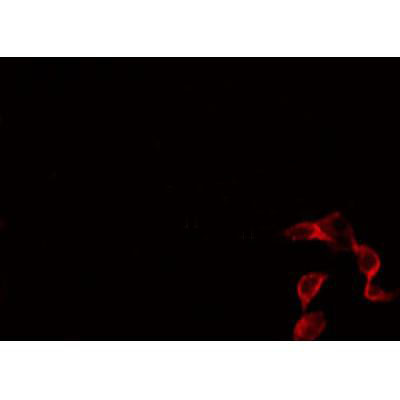
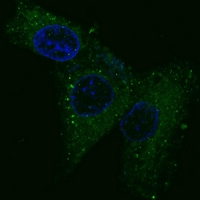
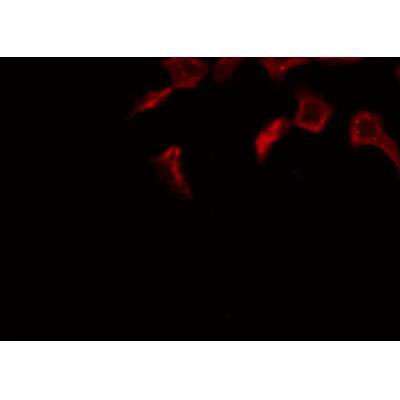
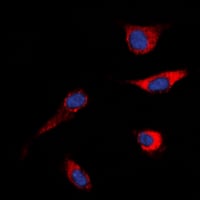
 IF (Immunofluorescence)
(Staining NIH-3T3 by IF/ICC. The sample were fixed with PFA and permeabilized in 0.1% Triton X-100,then blocked in 10% serum for 45 minutes at 25 degree C. The primary antibody was diluted at 1/200 and incubated with the sample for 1 hour at 37 degree C. An Alexa Fluor 594 conjugated goat anti-rabbit IgG (H+L) Ab, diluted at 1/600, was used as the secondary antibody.)
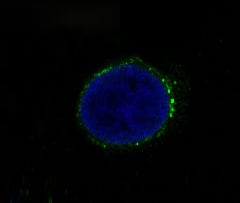
IF (Immunofluorescence)
(Staining NIH-3T3 by IF/ICC. The sample were fixed with PFA and permeabilized in 0.1% Triton X-100,then blocked in 10% serum for 45 minutes at 25 degree C. The primary antibody was diluted at 1/200 and incubated with the sample for 1 hour at 37 degree C. An Alexa Fluor 594 conjugated goat anti-rabbit IgG (H+L) Ab, diluted at 1/600, was used as the secondary antibody.)
Rabbit c-Met Polyclonal Antibody | anti-c-Met antibody
Phospho-c-Met (Tyr1365) Antibody
Gene Names
MET; HGFR; AUTS9; RCCP2; c-Met
Reactivity
Human, Mouse, RatPredicted Reactivity: Pig (100%), Bovine (100%), Horse (100%), Sheep (90%), Rabbit (100%), Dog (100%), Chicken (100%), Xenopus (80%)
Applications
ELISA, Immunocytochemistry, Immunofluorescence, Western Blot
Purity
The antibody is from purified rabbit serum by affinity purification via sequential chromatography on phospho-peptide and non-phospho-peptide affinity columns.
Synonyms
c-Met, Antibody; Phospho-c-Met (Tyr1365) Antibody; AUTS9; c met; D249; Hepatocyte growth factor receptor; HGF; HGF receptor; HGF/SF receptor; HGFR; MET; Met proto oncogene tyrosine kinase; MET proto oncogene, receptor tyrosine kinase; Met proto-oncogene (hepatocyte growth factor receptor); Met proto-oncogene; Met protooncogene; MET_HUMAN; Oncogene MET; Par4; Proto-oncogene c-Met; RCCP2; Scatter factor receptor; SF receptor; Tyrosine-protein kinase Met; anti-c-Met antibody
Host
Rabbit
Reactivity
Human, Mouse, Rat
Predicted Reactivity: Pig (100%), Bovine (100%), Horse (100%), Sheep (90%), Rabbit (100%), Dog (100%), Chicken (100%), Xenopus (80%)
Predicted Reactivity: Pig (100%), Bovine (100%), Horse (100%), Sheep (90%), Rabbit (100%), Dog (100%), Chicken (100%), Xenopus (80%)
Clonality
Polyclonal
Isotype
Rabbit IgG
Specificity
Phospho-c-Met (Tyr1365) Antibody detects endogenous levels of c-Met only when phosphorylated at Tyr1365.
Tissue Specificity: Expressed in normal hepatocytes as well as in epithelial cells lining the stomach, the small and the large intestine. Found also in basal keratinocytes of esophagus and skin. High levels are found in liver, gastrointestinal tract, thyroid and kidney. Also present in the brain. Expressed in metaphyseal bone (at protein level).
Tissue Specificity: Expressed in normal hepatocytes as well as in epithelial cells lining the stomach, the small and the large intestine. Found also in basal keratinocytes of esophagus and skin. High levels are found in liver, gastrointestinal tract, thyroid and kidney. Also present in the brain. Expressed in metaphyseal bone (at protein level).
Purity/Purification
The antibody is from purified rabbit serum by affinity purification via sequential chromatography on phospho-peptide and non-phospho-peptide affinity columns.
Form/Format
Liquid. Rabbit IgG in phosphate buffered saline, pH7.4, 150mM NaCl, 0.02% sodium azide and 50% glycerol.
Concentration
1mg/ml (varies by lot)
Applicable Applications for anti-c-Met antibody
ELISA (Peptide ELISA), ICC (Immunocytochemistry), IF (Immunofluorescence), WB (Western Blot)
Immunogen
A synthesized peptide derived from human c-Met around the phosphorylation site of Tyr1365.
Conjugation
Unconjugated
Fragment
Fab fragment
Post Translational Modifications
Autophosphorylated in response to ligand binding on Tyr-1234 and Tyr-1235 in the kinase domain leading to further phosphorylation of Tyr-1349 and Tyr-1356 in the C-terminal multifunctional docking site. Dephosphorylated by PTPRJ at Tyr-1349 and Tyr-1365. Dephosphorylated by PTPN1 and PTPN2.Ubiquitinated. Ubiquitination by CBL regulates MET endocytosis, resulting in decreasing plasma membrane receptor abundance, and in endosomal degradation and/or recycling of internalized receptors. (Microbial infection) Tyrosine phosphorylation is stimulated by L.monocytogenes InlB. Tyrosine phosphorylation is maximal 10-20 minutes after treatment with InlB and disappears by 60 minutes. The phosphorylated residues were not identified.
Subunit Structure
Heterodimer made of an alpha chain (50kDa) and a beta chain (145kDa) which are disulfide linked. Binds PLXNB1. Interacts when phosphorylated with downstream effectors including STAT3, PIK3R1, SRC, PCLG1, GRB2 and GAB1. Interacts with SPSB1, SPSB2 and SPSB4 (By similarity). Interacts with INPP5D/SHIP1. When phosphorylated at Tyr-1356, interacts with INPPL1/SHIP2. Interacts with RANBP9 and RANBP10, as well as SPSB1, SPSB2, SPSB3 and SPSB4. SPSB1 binding occurs in the presence and in the absence of HGF, however HGF treatment has a positive effect on this interaction. Interacts with MUC20; prevents interaction with GRB2 and suppresses hepatocyte growth factor-induced cell proliferation. Interacts with GRB10. Interacts with PTPN1 and PTPN2. Interacts with LECT2; this interaction may have an antagonistic effect on receptor activation. Interacts with HSP90AA1 and HSP90AB1; the interaction suppresses MET kinase activity. (Microbial infection) Interacts via extracytoplasmic residues 25-656 with L.monocytogenes InlB; MET can bind HGF, its endogenous ligand, and InlB simultaneously. InlB probably dimerizes upon binding to MET, which encourages subsequent dimerization of MET (Probable).
Similarity
The kinase domain is involved in SPSB1 binding.The beta-propeller Sema domain mediates binding to HGF.Belongs to the protein kinase superfamily. Tyr protein kinase family.
Subcellular Location
Membrane>Single-pass type I membrane protein. Secreted.
Preparation and Storage
Store at -20 degree C. Stable for 12 months from date of receipt.
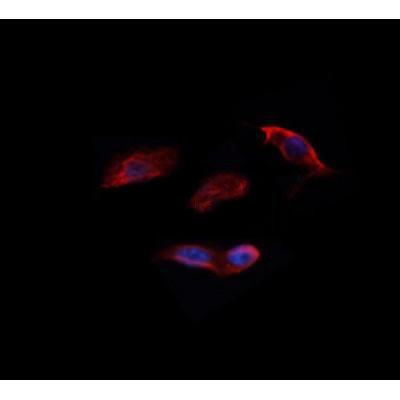
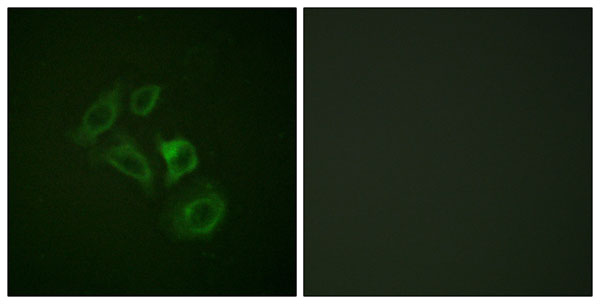
IF (Immunofluorescence)
(Staining NIH-3T3 by IF/ICC. The sample were fixed with PFA and permeabilized in 0.1% Triton X-100,then blocked in 10% serum for 45 minutes at 25 degree C. The primary antibody was diluted at 1/200 and incubated with the sample for 1 hour at 37 degree C. An Alexa Fluor 594 conjugated goat anti-rabbit IgG (H+L) Ab, diluted at 1/600, was used as the secondary antibody.)
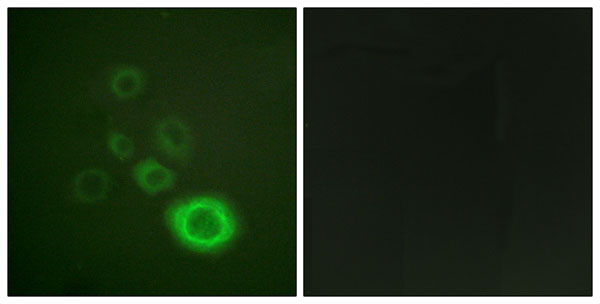
IF (Immunofluorescence)
(Staining NIH-3T3 by IF/ICC. The sample were fixed with PFA and permeabilized in 0.1% Triton X-100,then blocked in 10% serum for 45 minutes at 25 degree C. The primary antibody was diluted at 1/200 and incubated with the sample for 1 hour at 37 degree C. An Alexa Fluor 594 conjugated goat anti-rabbit IgG (H+L) Ab, diluted at 1/600, was used as the secondary antibody.)
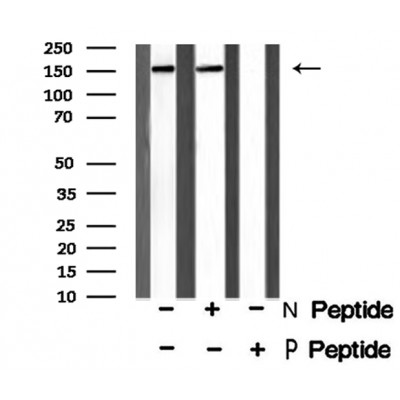
WB (Western Blot)
(Western blot analysis of MET (Phospho-Tyr1365) using heatshock treated HeLa whole cell lysates.-/+ means absence or presence of N peptide(non-phospho peptide) and P peptide(phospho peptide).)
WB (Western Blot)
(Western blot analysis of MET (Phospho-Tyr1365) using heatshock treated HeLa whole cell lysates.-/+ means absence or presence of N peptide(non-phospho peptide) and P peptide(phospho peptide).)
Related Product Information for anti-c-Met antibody
Receptor tyrosine kinase that transduces signals from the extracellular matrix into the cytoplasm by binding to hepatocyte growth factor/HGF ligand. Regulates many physiological processes including proliferation, scattering, morphogenesis and survival. Ligand binding at the cell surface induces autophosphorylation of MET on its intracellular domain that provides docking sites for downstream signaling molecules. Following activation by ligand, interacts with the PI3-kinase subunit PIK3R1, PLCG1, SRC, GRB2, STAT3 or the adapter GAB1. Recruitment of these downstream effectors by MET leads to the activation of several signaling cascades including the RAS-ERK, PI3 kinase-AKT, or PLCgamma-PKC. The RAS-ERK activation is associated with the morphogenetic effects while PI3K/AKT coordinates prosurvival effects. During embryonic development, MET signaling plays a role in gastrulation, development and migration of muscles and neuronal precursors, angiogenesis and kidney formation. In adults, participates in wound healing as well as organ regeneration and tissue remodeling. Promotes also differentiation and proliferation of hematopoietic cells. May regulate cortical bone osteogenesis (By similarity). (Microbial infection) Acts as a receptor for Listeria monocytogenes internalin InlB, mediating entry of the pathogen into cells.
NCBI and Uniprot Product Information
NCBI GI #
NCBI GeneID
NCBI Accession #
NCBI GenBank Nucleotide #
Molecular Weight
155,541 Da
NCBI Official Full Name
hepatocyte growth factor receptor isoform b
NCBI Official Synonym Full Names
met proto-oncogene (hepatocyte growth factor receptor)
NCBI Official Symbol
MET
NCBI Official Synonym Symbols
HGFR; AUTS9; RCCP2; c-Met
NCBI Protein Information
hepatocyte growth factor receptor; SF receptor; HGF receptor; HGF/SF receptor; proto-oncogene c-Met; scatter factor receptor; tyrosine-protein kinase Met; met proto-oncogene tyrosine kinase
UniProt Protein Name
Hepatocyte growth factor receptor
UniProt Gene Name
MET
UniProt Synonym Gene Names
HGF receptor; SF receptor
UniProt Entry Name
MET_HUMAN
Customer Reviews
Loading reviews...
Share Your Experience
Similar Products

Product Notes
The c-Met met (Catalog #AAA329881) is an Antibody produced from Rabbit and is intended for research purposes only. The product is available for immediate purchase. The Phospho-c-Met (Tyr1365) Antibody reacts with Human, Mouse, Rat Predicted Reactivity: Pig (100%), Bovine (100%), Horse (100%), Sheep (90%), Rabbit (100%), Dog (100%), Chicken (100%), Xenopus (80%) and may cross-react with other species as described in the data sheet. AAA Biotech's c-Met can be used in a range of immunoassay formats including, but not limited to, ELISA (Peptide ELISA), ICC (Immunocytochemistry), IF (Immunofluorescence), WB (Western Blot). Researchers should empirically determine the suitability of the c-Met met for an application not listed in the data sheet. Researchers commonly develop new applications and it is an integral, important part of the investigative research process. It is sometimes possible for the material contained within the vial of "c-Met, Polyclonal Antibody" to become dispersed throughout the inside of the vial, particularly around the seal of said vial, during shipment and storage. We always suggest centrifuging these vials to consolidate all of the liquid away from the lid and to the bottom of the vial prior to opening. Please be advised that certain products may require dry ice for shipping and that, if this is the case, an additional dry ice fee may also be required.Precautions
All products in the AAA Biotech catalog are strictly for research-use only, and are absolutely not suitable for use in any sort of medical, therapeutic, prophylactic, in-vivo, or diagnostic capacity. By purchasing a product from AAA Biotech, you are explicitly certifying that said products will be properly tested and used in line with industry standard. AAA Biotech and its authorized distribution partners reserve the right to refuse to fulfill any order if we have any indication that a purchaser may be intending to use a product outside of our accepted criteria.Disclaimer
Though we do strive to guarantee the information represented in this datasheet, AAA Biotech cannot be held responsible for any oversights or imprecisions. AAA Biotech reserves the right to adjust any aspect of this datasheet at any time and without notice. It is the responsibility of the customer to inform AAA Biotech of any product performance issues observed or experienced within 30 days of receipt of said product. To see additional details on this or any of our other policies, please see our Terms & Conditions page.Item has been added to Shopping Cart
If you are ready to order, navigate to Shopping Cart and get ready to checkout.