
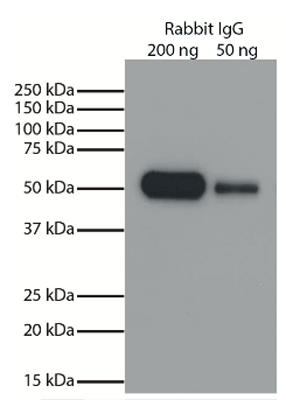
 Application Data
(Purified rabbit igG was resolved by electrophoresis, transferred to PVDF membrane, and visualized using Goat Anti-Rabbit IgG-HRP secondary antibody and chemiluminescent detection.)
Application Data
(Purified rabbit igG was resolved by electrophoresis, transferred to PVDF membrane, and visualized using Goat Anti-Rabbit IgG-HRP secondary antibody and chemiluminescent detection.)
Goat anti Rabbit IgG Secondary Antibody
Goat Anti-Rabbit IgG-UNLB
FLISA:
FITC conjugate 1:200-1:400
TRITC conjugate 1:100-1:400
R-PE conjugate 1ug/mL
ELISA:
AP conjugate 1:2,000 - 1:4,000
HRP conjugate 1:4,000-1:8,000
BIOT conjugate 1:5,000-1:20,000
Other Applications: Since applications vary, you should determines the optimum working dilution of the product that is appropriate for you specific need.
The fluorescein (FITC) and rhodamine (TRITC) conjugates are supplied as 1.0 mg in 1.0 mL PBS/NaN3. Store at 2-8 degree C.
The alkaline phosphatase (AP) conjugate is supplied as 1.0 mL of stock solution in 50mM Tris/1mM MgCl2/50% Glycerol, pH 8.0, containing 0.1% NaN3 as preservative. Store at 2-8 degree C or long-term at -20 degree C.
The horseradish peroxidase (HRP) conjugate is supplied as 1.0 mL of stock solution in 50% glycerol/50% PBS, pH 7.4. No preservative added. Store at 2-8 degree C or long-term at -20 degree C.
The biotin (BIOT) conjugate is supplied as 1.0 mg in 2.0 mL PBS/NaN3. Store at 2-8 degree C.
The R-phycoerythrin (R-PE) conjugate is supplied as 0.5 mg in 1.0 mL of PBS/NaN3 and a stabilizing agent. Store at 2-8 degree C. Do not freeze!
Protect fluorochrome-conjugated forms from light. Reagents are stable for the period shown on the label if stored as directed.
Application Data
(Purified rabbit igG was resolved by electrophoresis, transferred to PVDF membrane, and visualized using Goat Anti-Rabbit IgG-HRP secondary antibody and chemiluminescent detection.)
Application Data
(Purified rabbit igG was resolved by electrophoresis, transferred to PVDF membrane, and visualized using Goat Anti-Rabbit IgG-HRP secondary antibody and chemiluminescent detection.)
Customer Reviews
Loading reviews...
Share Your Experience
Similar Products


Product Notes
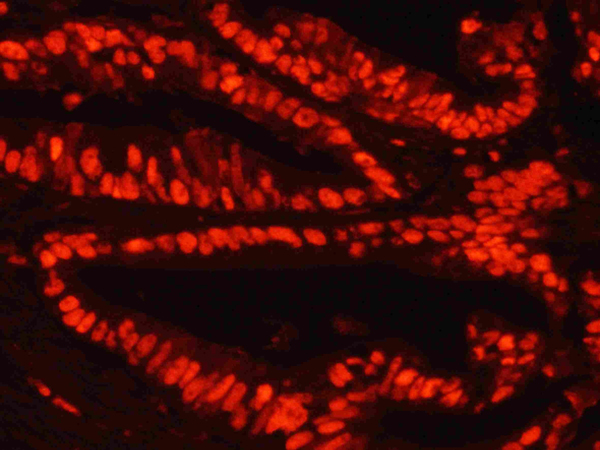
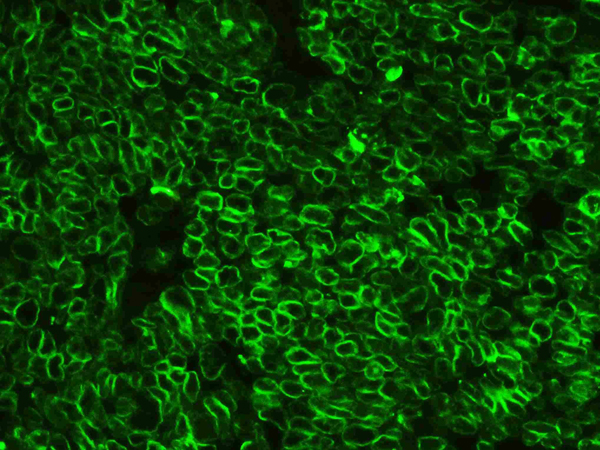
The Goat anti Rabbit IgG (Catalog #AAA14909) is a Secondary Antibody produced from Goat and is intended for research purposes only. The product is available for immediate purchase. The Goat Anti-Rabbit IgG-UNLB reacts with Rabbit and may cross-react with other species as described in the data sheet. AAA Biotech's Goat anti Rabbit IgG can be used in a range of immunoassay formats including, but not limited to, ELISA, FLISA, IB (Immunoblot), IF (Immunofluorescence), IHC (Immunohistochemistry). WORKING DILUTIONS: FLISA: FITC conjugate 1:200-1:400 TRITC conjugate 1:100-1:400 R-PE conjugate 1ug/mL ELISA: AP conjugate 1:2,000 - 1:4,000 HRP conjugate 1:4,000-1:8,000 BIOT conjugate 1:5,000-1:20,000 Other Applications: Since applications vary, you should determines the optimum working dilution of the product that is appropriate for you specific need. Researchers should empirically determine the suitability of the Goat anti Rabbit IgG for an application not listed in the data sheet. Researchers commonly develop new applications and it is an integral, important part of the investigative research process. It is sometimes possible for the material contained within the vial of "Goat anti Rabbit IgG, Polyclonal Secondary Antibody" to become dispersed throughout the inside of the vial, particularly around the seal of said vial, during shipment and storage. We always suggest centrifuging these vials to consolidate all of the liquid away from the lid and to the bottom of the vial prior to opening. Please be advised that certain products may require dry ice for shipping and that, if this is the case, an additional dry ice fee may also be required.Precautions
All products in the AAA Biotech catalog are strictly for research-use only, and are absolutely not suitable for use in any sort of medical, therapeutic, prophylactic, in-vivo, or diagnostic capacity. By purchasing a product from AAA Biotech, you are explicitly certifying that said products will be properly tested and used in line with industry standard. AAA Biotech and its authorized distribution partners reserve the right to refuse to fulfill any order if we have any indication that a purchaser may be intending to use a product outside of our accepted criteria.Disclaimer
Though we do strive to guarantee the information represented in this datasheet, AAA Biotech cannot be held responsible for any oversights or imprecisions. AAA Biotech reserves the right to adjust any aspect of this datasheet at any time and without notice. It is the responsibility of the customer to inform AAA Biotech of any product performance issues observed or experienced within 30 days of receipt of said product. To see additional details on this or any of our other policies, please see our Terms & Conditions page.Frequently Asked Questions
What is goat anti-human IgG and used for?
Goat anti-human IgG is a secondary antibody that binds to human immunoglobulin G heavy and light chains. It's used in detection systems for techniques including ELISA, Western blot, immunohistochemistry, immunofluorescence, protein arrays, and tissue imaging to identify and quantify human IgG-based primary antibodies.
What is goat anti rabbit secondary antibody?
Goat anti-rabbit IgG (H+L) is an affinity-purified polyclonal secondary antibody raised in goats that specifically recognizes rabbit immunoglobulins. It's available with various conjugates (HRP, biotin, fluorescent dyes) and is used for detecting rabbit primary antibodies in Western blots, ELISA, immunohistochemistry, and immunofluorescence assays.
What is the recommended dilution for common assays?
For goat anti-rabbit antibodies: ELISA 1:50,000-1:90,000; Western blot 1:10,000-1:50,000; immunohistochemistry 1:500-1:5,000. For goat anti-human IgG, Odyssey Western blot detection uses 1:20,000 (range 1:10,000-1:50,000). Optimal dilutions should be empirically determined for specific applications.
How should the antibody be stored for long-term stability?
Store lyophilized goat antibodies at 2-8°C. After reconstitution, add glycerol to a 50% final concentration and store as a liquid at -20°C to maintain enzymatic activity. Store reconstituted liquid antibodies at -20°C for up to 12 months. Avoid repeated freeze-thaw cycles and prepare fresh working dilutions daily.
Is this antibody validated for use with serum or plasma samples?
Goat anti-human and anti-rabbit antibodies are validated for diverse applications, including tissue and cell staining, ELISAs, and blots. These antibodies are highly cross-adsorbed to minimize cross-reactivity with non-target proteins. Validation data are provided by manufacturers for specific applications and sample types.
What is goat anti-rabbit IgG secondary antibody used for?
Goat anti-rabbit IgG is a secondary antibody used to detect and visualize primary antibodies that were raised in rabbits. In assays like Western blot or IHC, the primary antibody binds to the target antigen, and the AAA Biotech goat anti-rabbit IgG then binds to the rabbit primary antibody, allowing for signal amplification and detection through various conjugated labels.
Why is goat anti-rabbit IgG commonly used in immunoassays?
This secondary antibody is popular because rabbit-derived primary antibodies are widely available and highly diverse. Goat anti-rabbit IgG offers high specificity and affinity for rabbit immunoglobulins. By using a secondary antibody from AAA Biotech, researchers can achieve significant signal amplification, as multiple secondary antibodies can bind to a single primary antibody, enhancing the sensitivity of the experiment.
Is FITC-conjugated goat anti-rabbit IgG a secondary antibody?
Yes, FITC-conjugated goat anti-rabbit IgG is a secondary antibody. The FITC (fluorescein isothiocyanate) label is a fluorescent dye that allows the antibody to be used in applications like immunofluorescence or flow cytometry. It specifically targets rabbit IgG, enabling researchers using AAA Biotech products to visualize the localization of their rabbit primary antibodies under a fluorescence microscope.
What does goat anti-rabbit IgG HRP conjugate do in an experiment?
The HRP (Horseradish Peroxidase) conjugate acts as an enzyme label for detection. When a chromogenic or chemiluminescent substrate is added, the HRP catalyzes a reaction that produces a visible color change or light emission. This allows for the sensitive detection of the target protein in Western blotting or ELISA, a standard methodology supported by AAA Biotech reagents.
What is the difference between anti-rabbit IgG and anti-goat IgG?
The difference lies in the target species of the antibody. Anti-rabbit IgG is designed to recognize and bind to antibodies produced in rabbits. Conversely, anti-goat IgG targets antibodies produced in goats. For example, if your primary antibody is rabbit-derived, you must use an anti-rabbit secondary antibody from AAA Biotech to ensure proper binding and successful experimental results.
Can goat anti-rabbit IgG be used for ELISA or Western blot?
Absolutely. Goat anti-rabbit IgG is a versatile tool for both ELISA and Western blot applications. In Western blotting, it helps identify specific protein bands on a membrane, while in ELISA, it is used to quantify the amount of a specific antigen in a solution. AAA Biotech provides these antibodies to ensure consistent performance across these common laboratory techniques.
Item has been added to Shopping Cart
If you are ready to order, navigate to Shopping Cart and get ready to checkout.