
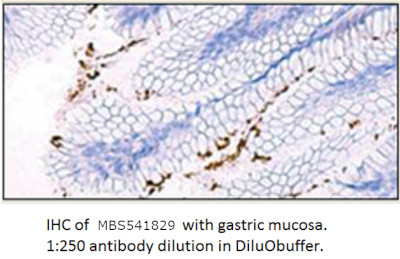
 IHC (Immunohistochemistry)
Rabbit Helicobacter pylori Polyclonal Antibody | anti-OPTN antibody
Helicobacter pylori Antibody BIOTIN
Gene Names
OPTN; NRP; FIP2; HIP7; HYPL; ALS12; GLC1E; TFIIIA-INTP
Reactivity
Helicobacter pylori
Applications
Western Blot, Immunohistochemistry, Immunoprecipitation, Immunofluorescence, Immunocytochemistry, ELISA
Synonyms
Helicobacter pylori, Antibody; Helicobacter pylori Antibody BIOTIN; H. pylori antibody; anti-OPTN antibody
Host
Rabbit
Reactivity
Helicobacter pylori
Clonality
Polyclonal
Form/Format
BIOTIN-Conjugated Immunoglobulins
Concentration
0.80-1.35 ug/ul in antibody stabilization buffer (varies by lot)
Sequence Length
577
Applicable Applications for anti-OPTN antibody
WB (Western Blot), IHC (Immunohistochemistry), IP (Immunoprecipitation), IF (Immunofluorescence), ICC (Immunocytochemistry), ELISA, CM (Confocal Microscopy)
Immunogen
Heat killed and denatured Helicobacter pylori extracts
Expression
Present in aqueous humor of the eye (at protein level). Highly expressed in trabecular meshwork. Expressed nonpigmented ciliary epithelium, retina, brain, adrenal cortex, fetus, lymphocyte, fibroblast, skeletal muscle, heart, liver, brain and placenta.
Molecular Function
polyubiquitin binding, Rab GTPase binding, protein C-terminus binding
Structure
Interacts with HD, Rab8 (RAB8A and/or RAB8B) (active GTP-bound form), GTF3A, TRAF3, TBK1, MYO6 and TFRC. Binds to linear ubiquitin chains. Interacts with LC3 family members MAP1LC3A, MAP1LC3B, GABARAP, GABARAPL1 and GABARAPL2; OPTN phosphorylation increas
Subcellular Location
Cytoplasm degree perinuclear region. Golgi apparatus. Golgi apparatus degree trans-Golgi network. Cytoplasmic vesicle degree autophagosome. Cytoplasmic vesicle. Recycling endosome
Preparation and Storage
-20 degree C for long term storage
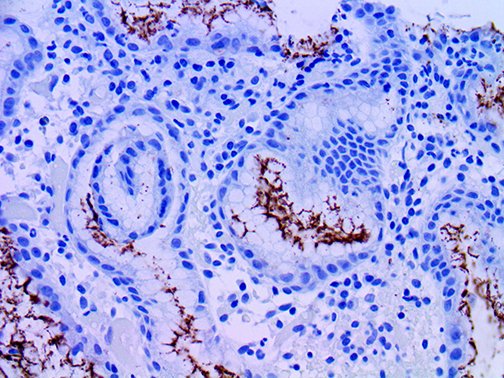
IHC (Immunohistochemistry)
IHC (Immunohistochemistry)
Related Product Information for anti-OPTN antibody
Helicobacter pylori is a spiral shaped bacterium that lives in the stomach. It has a unique way of adapting to the harsh, acidic gastric environment. It has been studied rather extensively and believed by many in the medical community to play an important role in the development of gastritis and peptic ulcers. Consequently, there has been a fundamental shift in mainstream ulcer care from the widespread use of antacids, which temporarily alleviated some symptoms, but did nothing to address the root cause of the problem, to the treatment of gastritis and ulcers with potent antibiotics intended to kill H. pylori . H. pylori produces peptic ulcers by weakening the protective mucous coating of the stomach and duodenum, which allows acid to get through to the sensitive lining beneath . Both the acid and the bacteria irritate the lining and cause a sore or ulcer. The binding of H. pylori to MHC class II receptors in gastric epithelial cells led to increased activity of caspases and apoptosis. H. pylori is able to survive in stomach acid because it secretes enzymes that neutralize the acid. This mechanism allows H. pylori to make its way through the protective mucous lining. Once there, the bacterium's spiral shape helps it burrow through the lining . It is not clear why only a fraction of infected patients become symptomatic for the disease while others do not. H pylori infections are also associated with iron deficiency and anemia. H pylori infection has been manifested in a number of vascular disorder including heart disease.
Helicobacter pylori antibodies were produced using heat killed and denatured Helicobacter pylori bacteria. The H. pylori selective antibodies are affinity purified against immobilized antigen based affinity chromatography which yielded epitope-specific antibodies. The H pylori antibodies label the bacteria on fixed and frozen sections. H pylori-selective antibodies are also available in enzyme and fluorescent dye conjugated form for immunohistochemistry applications. FabGennix. will conjugate antibodies with other fluorescent probes or secondary enzymes upon request at extra charge. Limited quantities of heat killed and denatured bacterial extracts are also available for immunodepletion assays or as a positive control.
Helicobacter pylori antibodies were produced using heat killed and denatured Helicobacter pylori bacteria. The H. pylori selective antibodies are affinity purified against immobilized antigen based affinity chromatography which yielded epitope-specific antibodies. The H pylori antibodies label the bacteria on fixed and frozen sections. H pylori-selective antibodies are also available in enzyme and fluorescent dye conjugated form for immunohistochemistry applications. FabGennix. will conjugate antibodies with other fluorescent probes or secondary enzymes upon request at extra charge. Limited quantities of heat killed and denatured bacterial extracts are also available for immunodepletion assays or as a positive control.
NCBI and Uniprot Product Information
NCBI GI #
NCBI GeneID
UniProt Accession #
NCBI Official Full Name
Optineurin
NCBI Official Synonym Full Names
optineurin
NCBI Official Symbol
OPTN
NCBI Official Synonym Symbols
NRP; FIP2; HIP7; HYPL; ALS12; GLC1E; TFIIIA-INTP
NCBI Protein Information
optineurin
UniProt Protein Name
Optineurin
UniProt Gene Name
OPTN
UniProt Synonym Gene Names
FIP2; GLC1E; HIP7; HYPL; NRP; HIP-7; TFIIIA-IntP
UniProt Entry Name
OPTN_HUMAN
Customer Reviews
Loading reviews...
Share Your Experience
Similar Products

Product Notes
The OPTN optn (Catalog #AAA75891) is an Antibody produced from Rabbit and is intended for research purposes only. The product is available for immediate purchase. The Helicobacter pylori Antibody BIOTIN reacts with Helicobacter pylori and may cross-react with other species as described in the data sheet. AAA Biotech's Helicobacter pylori can be used in a range of immunoassay formats including, but not limited to, WB (Western Blot), IHC (Immunohistochemistry), IP (Immunoprecipitation), IF (Immunofluorescence), ICC (Immunocytochemistry), ELISA, CM (Confocal Microscopy). Researchers should empirically determine the suitability of the OPTN optn for an application not listed in the data sheet. Researchers commonly develop new applications and it is an integral, important part of the investigative research process. It is sometimes possible for the material contained within the vial of "Helicobacter pylori, Polyclonal Antibody" to become dispersed throughout the inside of the vial, particularly around the seal of said vial, during shipment and storage. We always suggest centrifuging these vials to consolidate all of the liquid away from the lid and to the bottom of the vial prior to opening. Please be advised that certain products may require dry ice for shipping and that, if this is the case, an additional dry ice fee may also be required.Precautions
All products in the AAA Biotech catalog are strictly for research-use only, and are absolutely not suitable for use in any sort of medical, therapeutic, prophylactic, in-vivo, or diagnostic capacity. By purchasing a product from AAA Biotech, you are explicitly certifying that said products will be properly tested and used in line with industry standard. AAA Biotech and its authorized distribution partners reserve the right to refuse to fulfill any order if we have any indication that a purchaser may be intending to use a product outside of our accepted criteria.Disclaimer
Though we do strive to guarantee the information represented in this datasheet, AAA Biotech cannot be held responsible for any oversights or imprecisions. AAA Biotech reserves the right to adjust any aspect of this datasheet at any time and without notice. It is the responsibility of the customer to inform AAA Biotech of any product performance issues observed or experienced within 30 days of receipt of said product. To see additional details on this or any of our other policies, please see our Terms & Conditions page.Item has been added to Shopping Cart
If you are ready to order, navigate to Shopping Cart and get ready to checkout.