
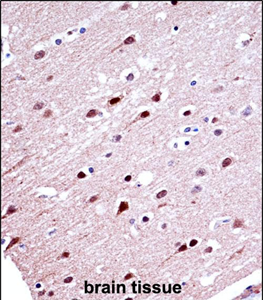
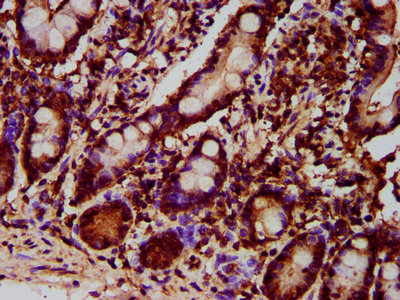
 IHC (Immunohiostchemistry)
(KCND2 Antibody (N-term) (AAA287621) immunohistochemistry analysis in formalin fixed and paraffin embedded human brain tissue followed by peroxidase conjugation of the secondary antibody and DAB staining.This data demonstrates the use of KCND2 Antibody (N-term) for immunohistochemistry. Clinical relevance has not been evaluated.)
IHC (Immunohiostchemistry)
(KCND2 Antibody (N-term) (AAA287621) immunohistochemistry analysis in formalin fixed and paraffin embedded human brain tissue followed by peroxidase conjugation of the secondary antibody and DAB staining.This data demonstrates the use of KCND2 Antibody (N-term) for immunohistochemistry. Clinical relevance has not been evaluated.)
Rabbit KCND2 Polyclonal Antibody | anti-KCND2 antibody
KCND2 Antibody (N-term)
Gene Names
KCND2; RK5; KV4.2
Reactivity
Human (Predicted Reactivity: Mouse, Rabbit, Rat)
Applications
Immunohistochemistry, ELISA, Western Blot
Purity
Peptide Affinity Purified Rabbit Polyclonal Antibody (Pab)
Synonyms
KCND2, Antibody; KCND2 Antibody (N-term); Potassium voltage-gated channel subfamily D member 2; Voltage-gated potassium channel subunit Kv42; KCND2; KIAA1044; anti-KCND2 antibody
Host
Rabbit
Reactivity
Human (Predicted Reactivity: Mouse, Rabbit, Rat)
Clonality
Polyclonal
Isotype
IgG
Specificity
This KCND2 antibody is generated from rabbits immunized with a KLH conjugated synthetic peptide between 123-151 amino acids from the N-terminal region of human KCND2.
Purity/Purification
Peptide Affinity Purified Rabbit Polyclonal Antibody (Pab)
Form/Format
Purified polyclonal antibody supplied in PBS with 0.09% (W/V) sodium azide. This antibody is purified through a protein A column, followed by peptide affinity purification.
Sequence Positions
123-151
Sequence Length
630
Applicable Applications for anti-KCND2 antibody
IHC (Immunohistochemistry), ELISA, WB (Western Blot)
Function
Voltage-gated potassium channel that mediates transmembrane potassium transport in excitable membranes, primarily in the brain. Mediates the major part of the dendritic A-type current I(SA) in brain neurons (By similarity). This current is activated at membrane potentials that are below the threshold for action potentials. It regulates neuronal excitability, prolongs the latency before the first spike in a series of action potentials, regulates the frequency of repetitive action potential firing, shortens the duration of action potentials and regulates the back-propagation of action potentials from the neuronal cell body to the dendrites. Contributes to the regulation of the circadian rhythm of action potential firing in suprachiasmatic nucleus neurons, which regulates the circadian rhythm of locomotor activity (By similarity). Functions downstream of the metabotropic glutamate receptor GRM5 and plays a role in neuronal excitability and in nociception mediated by activation of GRM5 (By similarity). Mediates the transient outward current I(to) in rodent heart left ventricle apex cells, but not in human heart, where this current is mediated by another family member. Forms tetrameric potassium-selective channels through which potassium ions pass in accordance with their electrochemical gradient (PubMed:10551270, PubMed:15454437, PubMed:14695263, PubMed:14623880, PubMed:14980201, PubMed:16934482, PubMed:24811166, PubMed:24501278). The channel alternates between opened and closed conformations in response to the voltage difference across the membrane (PubMed:11507158). Can form functional homotetrameric channels and heterotetrameric channels that contain variable proportions of KCND2 and KCND3; channel properties depend on the type of pore-forming alpha subunits that are part of the channel. In vivo, membranes probably contain a mixture of heteromeric potassium channel complexes. Interaction with specific isoforms of the regulatory subunits KCNIP1, KCNIP2, KCNIP3 or KCNIP4 strongly increases expression at the cell surface and thereby increases channel activity; it modulates the kinetics of channel activation and inactivation, shifts the threshold for channel activation to more negative voltage values, shifts the threshold for inactivation to less negative voltages and accelerates recovery after inactivation (PubMed:15454437, PubMed:14623880, PubMed:14980201, PubMed:19171772, PubMed:24501278, PubMed:24811166). Likewise, interaction with DPP6 or DPP10 promotes expression at the cell membrane and regulates both channel characteristics and activity (By similarity).
Cellular Location
Cell membrane; Multi-pass membrane protein {ECO:0000269|PubMed:11102480, ECO:0000269|PubMed:14980201, ECO:0000305}. Cell projection, dendrite Synapse {ECO:0000250|UniProtKB:Q63881}. Perikaryon {ECO:0000250|UniProtKB:Q63881}. Postsynaptic cell membrane {ECO:0000250|UniProtKB:Q63881}. Cell projection, dendritic spine {ECO:0000250|UniProtKB:Q63881}. Cell junction {ECO:0000250|UniProtKB:Q63881}. Note=In neurons, primarily detected on dendrites, dendritic spines and on the neuron cell body, but not on axons. Localized preferentially at the dendrites of pyramidal cells in the hippocampus CA1 layer. Detected at GABAergic synapses. Detected at cell junctions that are distinct from synaptic cell contacts. Detected in lipid rafts. Detected primarily at the endoplasmic reticulum or Golgi when expressed by itself (PubMed:15454437). Interaction with KCNIP1, KCNIP2, KCNIP3 or KCNIP4 promotes expression at the cell membrane (PubMed:15454437, PubMed:24811166). Interaction with DPP6 or DPP10 promotes expression at the cell membrane (By similarity) Internalized from the cell membrane by clathrin-dependent endocytosis in response to activation of AMPA-selective glutamate receptors and PKA-mediated phosphorylation at Ser-552. Redistributed from dendritic spines to the main dendritic shaft in response to activation of AMPA- selective glutamate receptors and activation of PKA (By similarity) {ECO:0000250|UniProtKB:Q63881, ECO:0000250|UniProtKB:Q9Z0V2, ECO:0000269|PubMed:15454437, ECO:0000269|PubMed:24811166}
Tissue Location
Detected in ovary, in corpus luteum and in granulosa and theca cells in the follicle (at protein level) (PubMed:15991246). Highly expressed throughout the brain (PubMed:10551270, PubMed:10729221). Detected in amygdala, caudate nucleus, cerebellum, hippocampus, substantia nigra and thalamus (PubMed:10551270, PubMed:10729221). Expression is not detectable or very low in heart, kidney, liver, lung, pancreas and skeletal muscle (PubMed:10551270, PubMed:10729221). Not detectable in human heart atrium (PubMed:12395204).
Preparation and Storage
Store at at 2-8°C for up to 2 weeks. For long term storage store at -20°C in small aliquots to prevent freeze-thaw cycles.
IHC (Immunohiostchemistry)
(KCND2 Antibody (N-term) (AAA287621) immunohistochemistry analysis in formalin fixed and paraffin embedded human brain tissue followed by peroxidase conjugation of the secondary antibody and DAB staining.This data demonstrates the use of KCND2 Antibody (N-term) for immunohistochemistry. Clinical relevance has not been evaluated.)
IHC (Immunohiostchemistry)
(KCND2 Antibody (N-term) (AAA287621) immunohistochemistry analysis in formalin fixed and paraffin embedded human brain tissue followed by peroxidase conjugation of the secondary antibody and DAB staining.This data demonstrates the use of KCND2 Antibody (N-term) for immunohistochemistry. Clinical relevance has not been evaluated.)
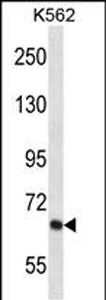
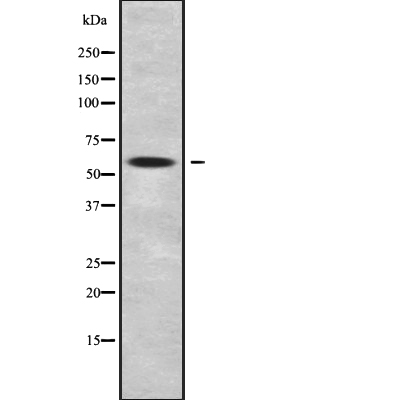
WB (Western Blot)
(KCND2 Antibody (N-term) (AAA287621) western blot analysis in K562 cell line lysates (35ug/lane).This demonstrates the KCND2 antibody detected the KCND2 protein (arrow).)
WB (Western Blot)
(KCND2 Antibody (N-term) (AAA287621) western blot analysis in K562 cell line lysates (35ug/lane).This demonstrates the KCND2 antibody detected the KCND2 protein (arrow).)
Related Product Information for anti-KCND2 antibody
Voltage-gated potassium (Kv) channels represent the most complex class of voltage-gated ion channels from both functional and structural standpoints. Their diverse functions include regulating neurotransmitter release, heart rate, insulin secretion, neuronal excitability, epithelial electrolyte transport, smooth muscle contraction, and cell volume. Four sequence-related potassium channel genes - shaker, shaw, shab, and shal - have been identified in Drosophila, and each has been shown to have human homolog(s). This gene encodes a member of the potassium channel, voltage-gated, shal-related subfamily, members of which form voltage-activated A-type potassium ion channels and are prominent in the repolarization phase of the action potential. This member mediates a rapidly inactivating, A-type outward potassium current which is not under the control of the N terminus as it is in Shaker channels.
Product Categories/Family for anti-KCND2 antibody
References
Foeger, N.C., et al. J. Biol. Chem. 285(43):33413-33422(2010)
Levy, D.I., et al. J. Physiol. (Lond.) 588 (PT 14), 2657-2668 (2010) :
Rose, J.E., et al. Mol. Med. 16 (7-8), 247-253 (2010) :
Aronica, E., et al. Neurobiol. Dis. 36(1):81-95(2009)
Tayo, B.O., et al. Circ Cardiovasc Genet 2(1):38-45(2009)
Levy, D.I., et al. J. Physiol. (Lond.) 588 (PT 14), 2657-2668 (2010) :
Rose, J.E., et al. Mol. Med. 16 (7-8), 247-253 (2010) :
Aronica, E., et al. Neurobiol. Dis. 36(1):81-95(2009)
Tayo, B.O., et al. Circ Cardiovasc Genet 2(1):38-45(2009)
NCBI and Uniprot Product Information
NCBI GI #
NCBI GeneID
NCBI Accession #
NCBI GenBank Nucleotide #
Molecular Weight
Calculated MW: 70537
NCBI Official Full Name
potassium voltage-gated channel subfamily D member 2
NCBI Official Synonym Full Names
potassium channel, voltage gated Shal related subfamily D, member 2
NCBI Official Symbol
KCND2
NCBI Official Synonym Symbols
RK5; KV4.2
NCBI Protein Information
potassium voltage-gated channel subfamily D member 2
UniProt Protein Name
Potassium voltage-gated channel subfamily D member 2
UniProt Gene Name
KCND2
UniProt Synonym Gene Names
KIAA1044
UniProt Entry Name
KCND2_HUMAN
Customer Reviews
Loading reviews...
Share Your Experience
Similar Products



Product Notes
The KCND2 kcnd2 (Catalog #AAA287621) is an Antibody produced from Rabbit and is intended for research purposes only. The product is available for immediate purchase. The immunogen sequence is 123-151. The KCND2 Antibody (N-term) reacts with Human (Predicted Reactivity: Mouse, Rabbit, Rat) and may cross-react with other species as described in the data sheet. AAA Biotech's KCND2 can be used in a range of immunoassay formats including, but not limited to, IHC (Immunohistochemistry), ELISA, WB (Western Blot). Researchers should empirically determine the suitability of the KCND2 kcnd2 for an application not listed in the data sheet. Researchers commonly develop new applications and it is an integral, important part of the investigative research process. It is sometimes possible for the material contained within the vial of "KCND2, Polyclonal Antibody" to become dispersed throughout the inside of the vial, particularly around the seal of said vial, during shipment and storage. We always suggest centrifuging these vials to consolidate all of the liquid away from the lid and to the bottom of the vial prior to opening. Please be advised that certain products may require dry ice for shipping and that, if this is the case, an additional dry ice fee may also be required.Precautions
All products in the AAA Biotech catalog are strictly for research-use only, and are absolutely not suitable for use in any sort of medical, therapeutic, prophylactic, in-vivo, or diagnostic capacity. By purchasing a product from AAA Biotech, you are explicitly certifying that said products will be properly tested and used in line with industry standard. AAA Biotech and its authorized distribution partners reserve the right to refuse to fulfill any order if we have any indication that a purchaser may be intending to use a product outside of our accepted criteria.Disclaimer
Though we do strive to guarantee the information represented in this datasheet, AAA Biotech cannot be held responsible for any oversights or imprecisions. AAA Biotech reserves the right to adjust any aspect of this datasheet at any time and without notice. It is the responsibility of the customer to inform AAA Biotech of any product performance issues observed or experienced within 30 days of receipt of said product. To see additional details on this or any of our other policies, please see our Terms & Conditions page.Item has been added to Shopping Cart
If you are ready to order, navigate to Shopping Cart and get ready to checkout.