
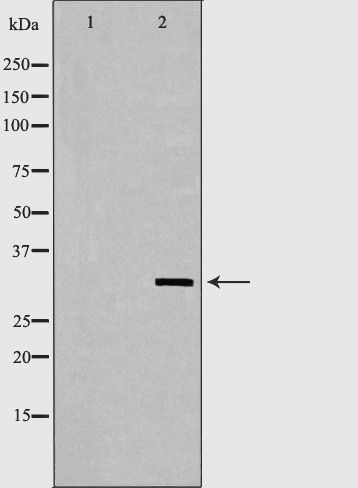
 WB (Western Blot)
(Western blot analysis of Jurkat whole cell lysates, using MyD88 Antibody. The lane on the left is treated with the antigen-specific peptide.)
WB (Western Blot)
(Western blot analysis of Jurkat whole cell lysates, using MyD88 Antibody. The lane on the left is treated with the antigen-specific peptide.)
Rabbit MyD88 Polyclonal Antibody | anti-MyD88 antibody
MyD88 Antibody
Gene Names
MYD88; MYD88D
Reactivity
Human, Mouse, Rat
Applications
ELISA, Immunohistochemistry, Western Blot
Purity
The antiserum was purified by peptide affinity chromatography using SulfoLink Coupling Resin.
Synonyms
MyD88, Antibody; MyD88 Antibody; Mutant myeloid differentiation primary response 88; MYD 88; Myd88; MYD88_HUMAN; MYD88D; Myeloid differentiation marker 88; Myeloid differentiation primary response 88; Myeloid differentiation primary response gene (88); Myeloid differentiation primary response gene 88; Myeloid differentiation primary response gene; Myeloid differentiation primary response protein MyD88; OTTHUMP00000161718; OTTHUMP00000208595; OTTHUMP00000209058; OTTHUMP00000209059; OTTHUMP00000209060; anti-MyD88 antibody
Host
Rabbit
Reactivity
Human, Mouse, Rat
Clonality
Polyclonal
Isotype
IgG
Specificity
MyD88 antibody detects endogenous levels of total MyD88
Purity/Purification
The antiserum was purified by peptide affinity chromatography using SulfoLink Coupling Resin.
Form/Format
Liquid
Phosphate buffered saline, pH 7.4, 150mM NaCl, 0.02% sodium azide and 50% glycerol.
Phosphate buffered saline, pH 7.4, 150mM NaCl, 0.02% sodium azide and 50% glycerol.
Concentration
1mg/ml (varies by lot)
Sequence Length
159
Applicable Applications for anti-MyD88 antibody
ELISA, IHC (Immunohistochemistry), WB (Western Blot)
Immunogen
A synthesized peptide derived from human MyD88
Subcellular Location
Cytoplasm.
Tissue Specificity
Ubiquitous.
Conjugation
Unconjugated
Preparation and Storage
Store at -20 degree C. Stable for 12 months from date of receipt.
WB (Western Blot)
(Western blot analysis of Jurkat whole cell lysates, using MyD88 Antibody. The lane on the left is treated with the antigen-specific peptide.)
WB (Western Blot)
(Western blot analysis of Jurkat whole cell lysates, using MyD88 Antibody. The lane on the left is treated with the antigen-specific peptide.)
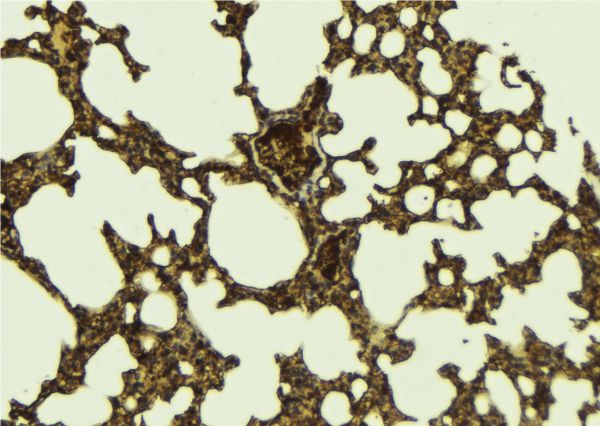
IHC (Immunohistochemistry)
(AAA325944 at 1/100 staining Mouse lung tissue by IHC-P. The sample was formaldehyde fixed and a heat mediated antigen retrieval step in citrate buffer was performed. The sample was then blocked and incubated with the antibody for 1.5 hours at 22 degree C. An HRP conjugated goat anti-rabbit antibody was used as the secondary.)
IHC (Immunohistochemistry)
(AAA325944 at 1/100 staining Mouse lung tissue by IHC-P. The sample was formaldehyde fixed and a heat mediated antigen retrieval step in citrate buffer was performed. The sample was then blocked and incubated with the antibody for 1.5 hours at 22 degree C. An HRP conjugated goat anti-rabbit antibody was used as the secondary.)
Related Product Information for anti-MyD88 antibody
Description: Members of the Toll-like receptor (TLR) family, named for the closely related Toll receptor in Drosophila, play a pivotal role in innate immune responses (1-3). TLRs recognize conserved motifs found in various pathogens and mediate defense responses. Triggering of the TLR pathway leads to the activation of NF-kappaB and subsequent regulation of immune and inflammatory genes. The TLRs and members of the IL-1 receptor family share a conserved stretch of approximately 200 amino acids known as the TIR domain. Upon activation, TLRs associate with a number of cytoplasmic adaptor proteins containing TIR domains including MyD88 (myeloid differentiation factor), MAL/TIRAP (MyD88-adaptor-like/TIR-associated protein), TRIF (Toll-receptor-associated activator of interferon), and TRAM (Toll-receptor-associated molecule). This association leads to the recruitment and activation of IRAK1 and IRAK4, which form a complex with TRAF6 to activate TAK1 and IKK. Activation of IKK leads to the degradation of IkappaB that normally maintains NF-kappaB inactivity by sequestering it in the cytoplasm. MyD88 was originally isolated as a myeloid differentiation primary response gene that is rapidly induced upon IL-6 stimulated differentiation of M1 myeloleukemic cells into macrophages (4-6). It contains an amino-terminal death domain separated from a carboxyl-terminal TIR domain and functions as an adaptor in TLR/IL-1 receptor signaling (7). The death domain of MyD88 mediates interactions with the IRAK complex triggering a signaling cascade that includes the activation of NF-kappaB (8, 9).
Function: Adapter protein involved in the Toll-like receptor and IL-1 receptor signaling pathway in the innate immune response (PubMed:15361868, PubMed:18292575). Acts via IRAK1, IRAK2, IRF7 and TRAF6, leading to NF-kappa-B activation, cytokine secretion and the inflammatory response (PubMed:15361868, PubMed:24316379, PubMed:19506249). Increases IL-8 transcription (PubMed:9013863). Involved in IL-18-mediated signaling pathway. Activates IRF1 resulting in its rapid migration into the nucleus to mediate an efficient induction of IFN-beta, NOS2/INOS, and IL12A genes. MyD88-mediated signaling in intestinal epithelial cells is crucial for maintenance of gut homeostasis and controls the expression of the antimicrobial lectin REG3G in the small intestine (By similarity).
Subunit Structure: Homodimer. Also forms heterodimers with TIRAP. Binds to TLR2, TLR4, IRAK1, IRAK2 and IRAK4 via their respective TIR domains. Interacts with IL18R1. Interacts with BMX, IL1RL1, IKBKE and IRF7. Interacts with LRRFIP1 and LRRFIP2; this interaction positively regulates Toll-like receptor (TLR) signaling in response to agonist. Interacts with FLII. LRRFIP1 and LRRFIP2 compete with FLII for MYD88-binding. Interacts with IRF1. Upon IL1B treatment, forms a complex with PELI1, IRAK1, IRAK4 and TRAF6; this complex recruits MAP3K7/TAK1, TAB1 and TAB2 to mediate NF-kappa-B activation. Direct binding of SMAD6 to PELI1 prevents the complex formation and hence negatively regulates IL1R-TLR signaling and eventually NF-kappa-B-mediated gene expression. May interact with PIK3AP1. Interacts (via TIR domain) with DHX9 (via H2A and OB-fold regions); this interaction is direct (PubMed:20696886). Interacts with OTUD4 deubiquitinase; the interaction is direct (PubMed:29395066).
Post-translational Modifications: Ubiquitinated; undergoes 'Lys-63'-linked polyubiquitination. OTUD4 specifically hydrolyzes 'Lys-63'-linked polyubiquitinated MYD88.
Similarity: The intermediate domain (ID) is required for the phosphorylation and activation of IRAK.
Function: Adapter protein involved in the Toll-like receptor and IL-1 receptor signaling pathway in the innate immune response (PubMed:15361868, PubMed:18292575). Acts via IRAK1, IRAK2, IRF7 and TRAF6, leading to NF-kappa-B activation, cytokine secretion and the inflammatory response (PubMed:15361868, PubMed:24316379, PubMed:19506249). Increases IL-8 transcription (PubMed:9013863). Involved in IL-18-mediated signaling pathway. Activates IRF1 resulting in its rapid migration into the nucleus to mediate an efficient induction of IFN-beta, NOS2/INOS, and IL12A genes. MyD88-mediated signaling in intestinal epithelial cells is crucial for maintenance of gut homeostasis and controls the expression of the antimicrobial lectin REG3G in the small intestine (By similarity).
Subunit Structure: Homodimer. Also forms heterodimers with TIRAP. Binds to TLR2, TLR4, IRAK1, IRAK2 and IRAK4 via their respective TIR domains. Interacts with IL18R1. Interacts with BMX, IL1RL1, IKBKE and IRF7. Interacts with LRRFIP1 and LRRFIP2; this interaction positively regulates Toll-like receptor (TLR) signaling in response to agonist. Interacts with FLII. LRRFIP1 and LRRFIP2 compete with FLII for MYD88-binding. Interacts with IRF1. Upon IL1B treatment, forms a complex with PELI1, IRAK1, IRAK4 and TRAF6; this complex recruits MAP3K7/TAK1, TAB1 and TAB2 to mediate NF-kappa-B activation. Direct binding of SMAD6 to PELI1 prevents the complex formation and hence negatively regulates IL1R-TLR signaling and eventually NF-kappa-B-mediated gene expression. May interact with PIK3AP1. Interacts (via TIR domain) with DHX9 (via H2A and OB-fold regions); this interaction is direct (PubMed:20696886). Interacts with OTUD4 deubiquitinase; the interaction is direct (PubMed:29395066).
Post-translational Modifications: Ubiquitinated; undergoes 'Lys-63'-linked polyubiquitination. OTUD4 specifically hydrolyzes 'Lys-63'-linked polyubiquitinated MYD88.
Similarity: The intermediate domain (ID) is required for the phosphorylation and activation of IRAK.
NCBI and Uniprot Product Information
NCBI GI #
NCBI GeneID
NCBI Accession #
NCBI GenBank Nucleotide #
Molecular Weight
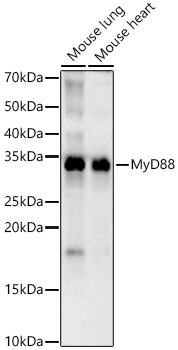
Observed: 33 kDa
Predicted: 34 kDa
Predicted: 34 kDa
NCBI Official Full Name
myeloid differentiation primary response protein MyD88 isoform 5
NCBI Official Synonym Full Names
MYD88, innate immune signal transduction adaptor
NCBI Official Symbol
MYD88
NCBI Official Synonym Symbols
MYD88D
NCBI Protein Information
myeloid differentiation primary response protein MyD88
UniProt Protein Name
Myeloid differentiation primary response protein MyD88
UniProt Gene Name
MYD88
Customer Reviews
Loading reviews...
Share Your Experience
Similar Products

Product Notes
The MyD88 myd88 (Catalog #AAA325944) is an Antibody produced from Rabbit and is intended for research purposes only. The product is available for immediate purchase. The MyD88 Antibody reacts with Human, Mouse, Rat and may cross-react with other species as described in the data sheet. AAA Biotech's MyD88 can be used in a range of immunoassay formats including, but not limited to, ELISA, IHC (Immunohistochemistry), WB (Western Blot). Researchers should empirically determine the suitability of the MyD88 myd88 for an application not listed in the data sheet. Researchers commonly develop new applications and it is an integral, important part of the investigative research process. It is sometimes possible for the material contained within the vial of "MyD88, Polyclonal Antibody" to become dispersed throughout the inside of the vial, particularly around the seal of said vial, during shipment and storage. We always suggest centrifuging these vials to consolidate all of the liquid away from the lid and to the bottom of the vial prior to opening. Please be advised that certain products may require dry ice for shipping and that, if this is the case, an additional dry ice fee may also be required.Precautions
All products in the AAA Biotech catalog are strictly for research-use only, and are absolutely not suitable for use in any sort of medical, therapeutic, prophylactic, in-vivo, or diagnostic capacity. By purchasing a product from AAA Biotech, you are explicitly certifying that said products will be properly tested and used in line with industry standard. AAA Biotech and its authorized distribution partners reserve the right to refuse to fulfill any order if we have any indication that a purchaser may be intending to use a product outside of our accepted criteria.Disclaimer
Though we do strive to guarantee the information represented in this datasheet, AAA Biotech cannot be held responsible for any oversights or imprecisions. AAA Biotech reserves the right to adjust any aspect of this datasheet at any time and without notice. It is the responsibility of the customer to inform AAA Biotech of any product performance issues observed or experienced within 30 days of receipt of said product. To see additional details on this or any of our other policies, please see our Terms & Conditions page.Item has been added to Shopping Cart
If you are ready to order, navigate to Shopping Cart and get ready to checkout.