
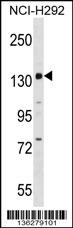
 WB (Western Blot)
(PER1 Antibody (C-term) (AAA286990) western blot analysis in NCI-H292 cell line lysates (35ug/lane).This demonstrates the PER1 antibody detected the PER1 protein (arrow).)
WB (Western Blot)
(PER1 Antibody (C-term) (AAA286990) western blot analysis in NCI-H292 cell line lysates (35ug/lane).This demonstrates the PER1 antibody detected the PER1 protein (arrow).)
Rabbit PER1 Polyclonal Antibody | anti-PER1 antibody
PER1 Antibody (C-term)
Gene Names
PER1; PER; hPER; RIGUI
Reactivity
Human (Predicted Reactivity: Mouse, Rat)
Applications
ELISA, Western Blot
Purity
This antibody is purified through a protein A column, followed by peptide affinity purification.
Synonyms
PER1, Antibody; PER1 Antibody (C-term); Period circadian protein homolog 1; hPER1; Circadian clock protein PERIOD 1; Circadian pacemaker protein Rigui; PER1; KIAA0482; PER; RIGUI; anti-PER1 antibody
Host
Rabbit
Reactivity
Human (Predicted Reactivity: Mouse, Rat)
Clonality
Polyclonal
Isotype
Rabbit Ig
Specificity
This PER1 antibody is generated from rabbits immunized with a KLH conjugated synthetic peptide between 1156-1183 amino acids from the C-terminal region of human PER1.
Purity/Purification
This antibody is purified through a protein A column, followed by peptide affinity purification.
Form/Format
Purified polyclonal antibody supplied in PBS with 0.09% (W/V) sodium azide.
Sequence Positions
1156-1183
Sequence Length
1290
Applicable Applications for anti-PER1 antibody
ELISA, WB (Western Blot)
Clone Names
RB36279
Function
Transcriptional repressor which forms a core component of the circadian clock. The circadian clock, an internal time- keeping system, regulates various physiological processes through the generation of approximately 24 hour circadian rhythms in gene expression, which are translated into rhythms in metabolism and behavior. It is derived from the Latin roots 'circa' (about) and 'diem' (day) and acts as an important regulator of a wide array of physiological functions including metabolism, sleep, body temperature, blood pressure, endocrine, immune, cardiovascular, and renal function. Consists of two major components: the central clock, residing in the suprachiasmatic nucleus (SCN) of the brain, and the peripheral clocks that are present in nearly every tissue and organ system. Both the central and peripheral clocks can be reset by environmental cues, also known as Zeitgebers (German for 'time givers'). The predominant Zeitgeber for the central clock is light, which is sensed by retina and signals directly to the SCN. The central clock entrains the peripheral clocks through neuronal and hormonal signals, body temperature and feeding-related cues, aligning all clocks with the external light/dark cycle. Circadian rhythms allow an organism to achieve temporal homeostasis with its environment at the molecular level by regulating gene expression to create a peak of protein expression once every 24 hours to control when a particular physiological process is most active with respect to the solar day. Transcription and translation of core clock components (CLOCK, NPAS2, ARNTL/BMAL1, ARNTL2/BMAL2, PER1, PER2, PER3, CRY1 andCRY2) plays a critical role in rhythm eneration, whereas delays imposed by post-translational modifications (PTMs) are important for determining the period (tau) of the rhythms (tau refers to the period of a rhythm and is the length, in time, of one complete cycle). A diurnal rhythm is synchronized with the day/night cycle, while the ultradian and infradian rhythms have a period shorter and longer than 24 hours, respectively. Disruptions in the circadian rhythms contribute to the pathology of cardiovascular diseases, cancer, metabolic syndromes and aging. A transcription/translation feedback loop (TTFL) forms the core of the molecular circadian clock mechanism. Transcription factors, CLOCK or NPAS2 and ARNTL/BMAL1 orARNTL2/BMAL2, form the positive limb of the feedback loop, act in the form of a heterodimer and activate the transcription of core clock genes and clock-controlled genes(involved in key metabolic processes),harboring E-box elements (5'-CACGTG-3')within their promoters. The core clock genes:PER1/2/3 and CRY1/2 which are transcriptional repressors form the negative Utge, S.J., et al. PLoS ONE 5 (2), E9259 (2010) :Zhu, Y., et al. Cancer Res.69(24):9315-9322(2009) Pendergast, J.S., et al. J. Neurosci.29(46):14681-14686(2009) limb of the feedback loop and interact withtheCLOCK|NPAS2-ARNTL/BMAL1|ARNTL2/BMAL2heterodimer inhibiting its activity and there by negatively regulating their own expression. This heterodimer also activates nuclear receptors NR1D1/2 and RORA/B/G, which form a second feedback loop and which activate and repress ARNTL/BMAL1transcription, respectively. Regulates circadian target genes expression atpost-transcriptional levels, but may not be required for the repression at transcriptional level. Controls PER2 protein decay. RepressesCRY2 preventing its repression on CLOCK/ARNTL target genes such as FXYD5and SCNN1A in kidney and PPARA in liver. Besides its involvement in the maintenance of the circadian clock, has an important function in the regulation of several processes. Participates in the repression of glucocorticoid receptor NR3C1/GR-induced transcriptional activity by reducing the association of NR3C1/GR to glucocorticoid response elements (GREs) by ARNTL:CLOCK. Plays a role in the modulation of the neuroinflammatory state via the regulation of inflammatory mediators release, such asCCL2 and IL6. In spinal astrocytes, negatively regulates the MAPK14/p38 and MAPK8/JNKMAPK cascades as well as the subsequent activation of NFkappaB. Coordinately regulates the expression of multiple genes that are involved in the regulation of renal sodium reabsorption. Can act as gene expression activator in a gene and tissue specific manner, in kidney enhances WNK1and SLC12A3 expression in collaboration with CLOCK. Modulates hair follicle cycling. Represses the CLOCK- ARNTL/BMAL1 induced transcription of BHLHE40/DEC1.
Cellular Location
Nucleus. Cytoplasm. Note=Nucleocytoplasmic shuttling is effected by interaction with other circadian core oscillator proteins and/or by phosphorylation. Retention of PER1 in the cytoplasm occurs through PER1-PER2heterodimer formation Translocate to the nucleus after phosphorylation by CSNK1D orCSNK1E. Also translocated to the nucleus byCRY1 or CRY2 (By similarity).
Tissue Location
Widely expressed. Expressed in hair follicles (at protein level).Found in heart, brain, placenta, lung, liver, skeletal muscle, pancreas, kidney, spleen, thymus, prostate, testis, ovary and small intestine. Highest level in skeletal muscle.
Preparation and Storage
Maintain refrigerated at 2-8 degree C for up to 2 weeks. For long term storage store at -20 degree C in small aliquots to prevent freeze-thaw cycles.
WB (Western Blot)
(PER1 Antibody (C-term) (AAA286990) western blot analysis in NCI-H292 cell line lysates (35ug/lane).This demonstrates the PER1 antibody detected the PER1 protein (arrow).)
WB (Western Blot)
(PER1 Antibody (C-term) (AAA286990) western blot analysis in NCI-H292 cell line lysates (35ug/lane).This demonstrates the PER1 antibody detected the PER1 protein (arrow).)
Related Product Information for anti-PER1 antibody
This gene is a member of the Period family of genes and is expressed in a circadian pattern in the suprachiasmatic nucleus, the primary circadian pacemaker in the mammalian brain. Genes in this family encode components of the circadian rhythms of locomotor activity, metabolism, and behavior. Circadian expression in the suprachiasmatic nucleus continues in constant darkness, and a shift in the light/dark cycle evokes a proportional shift of gene expression in the suprachiasmatic nucleus. The specific function of this gene is not yet known. Alternative splicing has been observed in this gene; however, these variants have not been fully described.
Product Categories/Family for anti-PER1 antibody
References
Xia, H.C., et al. Can J Neurol Sci 37(3):365-370(2010)
Soria, V., et al. Neuropsychopharmacology 35(6):1279-1289(2010)
Utge, S.J., et al. PLoS ONE 5 (2), E9259 (2010) :
Zhu, Y., et al. Cancer Res. 69(24):9315-9322(2009)
Pendergast, J.S., et al. J. Neurosci. 29(46):14681-14686(2009)
Soria, V., et al. Neuropsychopharmacology 35(6):1279-1289(2010)
Utge, S.J., et al. PLoS ONE 5 (2), E9259 (2010) :
Zhu, Y., et al. Cancer Res. 69(24):9315-9322(2009)
Pendergast, J.S., et al. J. Neurosci. 29(46):14681-14686(2009)
NCBI and Uniprot Product Information
NCBI GI #
NCBI GeneID
NCBI Accession #
NCBI GenBank Nucleotide #
NCBI Official Full Name
period circadian protein homolog 1
NCBI Official Synonym Full Names
period circadian clock 1
NCBI Official Symbol
PER1
NCBI Official Synonym Symbols
PER; hPER; RIGUI
NCBI Protein Information
period circadian protein homolog 1
UniProt Protein Name
Period circadian protein homolog 1
UniProt Gene Name
PER1
UniProt Synonym Gene Names
KIAA0482; PER; RIGUI; hPER1
UniProt Entry Name
PER1_HUMAN
Customer Reviews
Loading reviews...
Share Your Experience
Similar Products


Product Notes
The PER1 per1 (Catalog #AAA286990) is an Antibody produced from Rabbit and is intended for research purposes only. The product is available for immediate purchase. The immunogen sequence is 1156-1183. The PER1 Antibody (C-term) reacts with Human (Predicted Reactivity: Mouse, Rat) and may cross-react with other species as described in the data sheet. AAA Biotech's PER1 can be used in a range of immunoassay formats including, but not limited to, ELISA, WB (Western Blot). Researchers should empirically determine the suitability of the PER1 per1 for an application not listed in the data sheet. Researchers commonly develop new applications and it is an integral, important part of the investigative research process. It is sometimes possible for the material contained within the vial of "PER1, Polyclonal Antibody" to become dispersed throughout the inside of the vial, particularly around the seal of said vial, during shipment and storage. We always suggest centrifuging these vials to consolidate all of the liquid away from the lid and to the bottom of the vial prior to opening. Please be advised that certain products may require dry ice for shipping and that, if this is the case, an additional dry ice fee may also be required.Precautions
All products in the AAA Biotech catalog are strictly for research-use only, and are absolutely not suitable for use in any sort of medical, therapeutic, prophylactic, in-vivo, or diagnostic capacity. By purchasing a product from AAA Biotech, you are explicitly certifying that said products will be properly tested and used in line with industry standard. AAA Biotech and its authorized distribution partners reserve the right to refuse to fulfill any order if we have any indication that a purchaser may be intending to use a product outside of our accepted criteria.Disclaimer
Though we do strive to guarantee the information represented in this datasheet, AAA Biotech cannot be held responsible for any oversights or imprecisions. AAA Biotech reserves the right to adjust any aspect of this datasheet at any time and without notice. It is the responsibility of the customer to inform AAA Biotech of any product performance issues observed or experienced within 30 days of receipt of said product. To see additional details on this or any of our other policies, please see our Terms & Conditions page.Item has been added to Shopping Cart
If you are ready to order, navigate to Shopping Cart and get ready to checkout.