
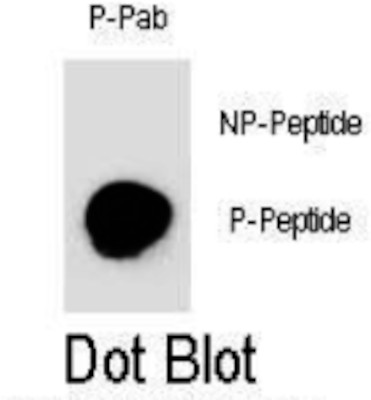
 DB (Dot Blot)
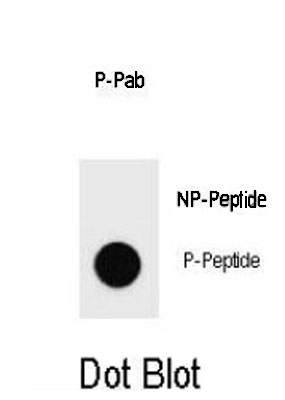
(Dot blot analysis of Phospho-PARP1-S782 Antibody Phospho-specific Pab (AAA288409) on nitrocellulose membrane. 50ng of Phospho-peptide or Non Phospho-peptide per dot were adsorbed. Antibody working concentrations are 0.6ug per ml.)
DB (Dot Blot)
(Dot blot analysis of Phospho-PARP1-S782 Antibody Phospho-specific Pab (AAA288409) on nitrocellulose membrane. 50ng of Phospho-peptide or Non Phospho-peptide per dot were adsorbed. Antibody working concentrations are 0.6ug per ml.)
Rabbit Phospho-PARP1 (S782) Polyclonal Antibody | anti-PARP1 antibody
Phospho-PARP1 (S782) Antibody
Gene Names
PARP1; PARP; PPOL; ADPRT; ARTD1; ADPRT1; PARP-1; ADPRT 1; pADPRT-1
Reactivity
Human (Predicted Reactivity: Bovine, Hamster, Mouse, Rat)
Applications
ELISA, Dot Blot
Purity
This antibody is purified through a protein A column, followed by peptide affinity purification.
Synonyms
Phospho-PARP1 (S782), Antibody; Phospho-PARP1 (S782) Antibody; Poly [ADP-ribose] polymerase 1; PARP-1; ADP-ribosyltransferase diphtheria toxin-like 1; ARTD1; NAD(+) ADP-ribosyltransferase 1; ADPRT 1; Poly[ADP-ribose] synthase 1; PARP1; ADPRT; PPOL; anti-PARP1 antibody
Host
Rabbit
Reactivity
Human (Predicted Reactivity: Bovine, Hamster, Mouse, Rat)
Clonality
Polyclonal
Isotype
Rabbit IgG
Specificity
This PARP1 Antibody is generated from rabbits immunized with a KLH conjugated synthetic phosphopeptide corresponding to amino acid residues surrounding S782 of human PARP1.
Purity/Purification
This antibody is purified through a protein A column, followed by peptide affinity purification.
Form/Format
Purified polyclonal antibody supplied in PBS with 0.09% (W/V) sodium azide.
Sequence Length
1,014
Applicable Applications for anti-PARP1 antibody
ELISA, DB (Dot Blot)
Cellular Location
Chromosome. Nucleus. Nucleus, nucleolus. Cytoplasm, cytosol. Note=Localizes to sites of DNA damage (PubMed:23230272, PubMed:26344098, PubMed:27568560, PubMed:30675909,PubMed:34625544, PubMed:34795260, PubMed:32358582, PubMed:22683995, PubMed:32241924). Recognizes (via PARP-type zinc-fingers) and binds DNA strand breaks (PubMed:22683995). Also binds normal/undamaged chromatin (PubMed:15607977). Auto poly-ADP-ribosylation promotes dissociation from chromatin (PubMed:15607977, PubMed:30675909, PubMed:32358582, PubMed:34625544). Extracted from chromatin by VCP/p97 following sumoylation and ubiquitination (PubMed:35013556). Translocates from the nucleus to the cytosol following phosphorylation by PRKDC (PubMed:35460603). Recruited to replication forks following interaction with CARM1 (PubMed:33412112). [Poly [ADP-ribose] polymerase 1, processed C- terminus]: Cytoplasm. Note=Following cleavage by caspase-3 (CASP3) and caspase-7 (CASP7) in response to apoptosis, translocates into the cytoplasm, where the auto-poly-ADP- ribosylated form serves as a poly-ADP-ribose carrier to induce AIFM1- mediated apoptosis.
Function
Poly-ADP-ribosyltransferase that mediates poly-ADP- ribosylation of proteins and plays a key role in DNA repair (PubMed: , PubMed: , PubMed: , PubMed: , PubMed: , PubMed: , PubMed: ). Mainly mediates glutamate and aspartate ADPribosylation of target proteins: the ADP-D-ribosyl group of NAD(+) is transferred to the acceptor carboxyl group of glutamate and aspartate residues and further ADP-ribosyl groups are transferred to the 2'-position of the terminal adenosine moiety, building up a polymer with an average chain length of 20-30 units (PubMed: , PubMed: , PubMed: , PubMed: ). Mediates the poly(ADP-ribosyl)ation of a number of proteins, including itself, APLF and CHFR (PubMed: , PubMed: ). Also mediates serine ADP-ribosylation of target proteins following interaction with HPF1; HPF1 conferring serine specificity (PubMed: ). Probably also catalyzes tyrosine ADP-ribosylation of target proteins following interaction with HPF1 (PubMed: ). Catalyzes the poly-ADP-ribosylation of histones in a HPF1-dependent manner (PubMed: ). Involved in the base excision repair (BER) pathway by catalyzing the poly-ADP- ribosylation of a limited number of acceptor proteins involved in chromatin architecture and in DNA metabolism (PubMed: , PubMed: , PubMed: , PubMed: , PubMed: ). ADP-ribosylation follows DNA damage and appears as an obligatory step in a detection/signaling pathway leading to the reparation of DNA strand breaks (PubMed: , PubMed: , PubMed: , PubMed: , PubMed: ). In addition to base excision repair (BER) pathway, also involved in double-strand breaks (DSBs) repair: together with TIMELESS, accumulates at DNA damage sites and promotes homologous recombination repair by mediating poly-ADP- ribosylation (PubMed: , PubMed: ). In addition to proteins, also able to ADP-ribosylate DNA: catalyzes ADPribosylation of DNA strand break termini containing terminal phosphates and a 2'-OH group in single- and double-stranded DNA, respectively (PubMed: ). Required for PARP9 and DTX3L recruitment to DNA damage sites (PubMed: ). PARP1-dependent PARP9-DTX3L-mediated ubiquitination promotes the rapid and specific recruitment of 53BP1/TP53BP1, UIMC1/RAP80, and BRCA1 to DNA damage sites (PubMed: ). Acts as a regulator of transcription: positively regulates the transcription of MTUS1 and negatively regulates the transcription of MTUS2/TIP150 (PubMed: ). With EEF1A1 and TXK, forms a complex that acts as a T-helper 1 (Th1) cell-specific transcription factor and binds the promoter of IFN-gamma to directly regulate its transcription, and is thus involved importantly in Th1 cytokine production (PubMed: ). Involved in the synthesis of ATP in the nucleus, togetherwith NMNAT1, PARG and NUDT5 (PubMed: ). Nuclear ATP generation is required for extensive chromatin remodeling events that are energy-consuming (PubMed: ).
Preparation and Storage
Maintain refrigerated at 2-8 degree C for up to 2 weeks. For long term storage store at -20 degree C in small aliquots to prevent freeze-thaw cycles.
DB (Dot Blot)
(Dot blot analysis of Phospho-PARP1-S782 Antibody Phospho-specific Pab (AAA288409) on nitrocellulose membrane. 50ng of Phospho-peptide or Non Phospho-peptide per dot were adsorbed. Antibody working concentrations are 0.6ug per ml.)
DB (Dot Blot)
(Dot blot analysis of Phospho-PARP1-S782 Antibody Phospho-specific Pab (AAA288409) on nitrocellulose membrane. 50ng of Phospho-peptide or Non Phospho-peptide per dot were adsorbed. Antibody working concentrations are 0.6ug per ml.)
Related Product Information for anti-PARP1 antibody
Description: This gene encodes a chromatin-associated enzyme, poly(ADP-ribosyl)transferase, which modifies various nuclear proteins by poly(ADP-ribosyl)ation. The modification is dependent on DNA and is involved in the regulation of various important cellular processes such as differentiation, proliferation, and tumor transformation and also in the regulation of the molecular events involved in the recovery of cell from DNA damage. In addition, this enzyme may be the site of mutation in Fanconi anemia, and may participate in the pathophysiology of type I diabetes.
Product Categories/Family for anti-PARP1 antibody
References
Majewski, P.M., et al. J. Biol. Chem. 285(45):34828-34838(2010)
Kim, M., et al. Cancer Sci. 101(11):2436-2442(2010)
Dong, Y., et al. Cancer Res. 70(20):8088-8096(2010)
Krishnakumar, R., et al. Mol. Cell 39(5):736-749(2010)
Lee, K.A., et al. Rheumatol. Int. (2010) In press :
Kim, M., et al. Cancer Sci. 101(11):2436-2442(2010)
Dong, Y., et al. Cancer Res. 70(20):8088-8096(2010)
Krishnakumar, R., et al. Mol. Cell 39(5):736-749(2010)
Lee, K.A., et al. Rheumatol. Int. (2010) In press :
NCBI and Uniprot Product Information
NCBI GI #
NCBI GeneID
NCBI Accession #
NCBI GenBank Nucleotide #
Molecular Weight
113084
NCBI Official Full Name
poly
NCBI Official Synonym Full Names
poly (ADP-ribose) polymerase 1
NCBI Official Symbol
PARP1
NCBI Official Synonym Symbols
PARP; PPOL; ADPRT; ARTD1; ADPRT1; PARP-1; ADPRT 1; pADPRT-1
NCBI Protein Information
poly [ADP-ribose] polymerase 1
UniProt Protein Name
Poly [ADP-ribose] polymerase 1
UniProt Gene Name
PARP1
UniProt Synonym Gene Names
ADPRT; PPOL; PARP-1; ARTD1; ADPRT 1
UniProt Entry Name
PARP1_HUMAN
Customer Reviews
Loading reviews...
Share Your Experience
Similar Products



Product Notes
The PARP1 parp1 (Catalog #AAA288409) is an Antibody produced from Rabbit and is intended for research purposes only. The product is available for immediate purchase. The Phospho-PARP1 (S782) Antibody reacts with Human (Predicted Reactivity: Bovine, Hamster, Mouse, Rat) and may cross-react with other species as described in the data sheet. AAA Biotech's Phospho-PARP1 (S782) can be used in a range of immunoassay formats including, but not limited to, ELISA, DB (Dot Blot). Researchers should empirically determine the suitability of the PARP1 parp1 for an application not listed in the data sheet. Researchers commonly develop new applications and it is an integral, important part of the investigative research process. It is sometimes possible for the material contained within the vial of "Phospho-PARP1 (S782), Polyclonal Antibody" to become dispersed throughout the inside of the vial, particularly around the seal of said vial, during shipment and storage. We always suggest centrifuging these vials to consolidate all of the liquid away from the lid and to the bottom of the vial prior to opening. Please be advised that certain products may require dry ice for shipping and that, if this is the case, an additional dry ice fee may also be required.Precautions
All products in the AAA Biotech catalog are strictly for research-use only, and are absolutely not suitable for use in any sort of medical, therapeutic, prophylactic, in-vivo, or diagnostic capacity. By purchasing a product from AAA Biotech, you are explicitly certifying that said products will be properly tested and used in line with industry standard. AAA Biotech and its authorized distribution partners reserve the right to refuse to fulfill any order if we have any indication that a purchaser may be intending to use a product outside of our accepted criteria.Disclaimer
Though we do strive to guarantee the information represented in this datasheet, AAA Biotech cannot be held responsible for any oversights or imprecisions. AAA Biotech reserves the right to adjust any aspect of this datasheet at any time and without notice. It is the responsibility of the customer to inform AAA Biotech of any product performance issues observed or experienced within 30 days of receipt of said product. To see additional details on this or any of our other policies, please see our Terms & Conditions page.Item has been added to Shopping Cart
If you are ready to order, navigate to Shopping Cart and get ready to checkout.