
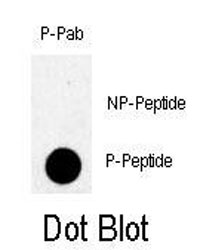
 DB (Dot Blot)
(Dot blot analysis of anti-Phospho-TBK-pS172 Antibody (AAA283616) on nitrocellulose membrane. 50ng of Phospho-peptide or Non Phospho-peptide per dot were adsorbed. Antibody working concentrations are 0.5ug per ml.)
DB (Dot Blot)
(Dot blot analysis of anti-Phospho-TBK-pS172 Antibody (AAA283616) on nitrocellulose membrane. 50ng of Phospho-peptide or Non Phospho-peptide per dot were adsorbed. Antibody working concentrations are 0.5ug per ml.)
Rabbit Phospho-TBK (S172) Polyclonal Antibody | anti-TBK1 antibody
Phospho-TBK (S172) Antibody
Gene Names
TBK1; NAK; T2K
Reactivity
Human; Predicted: Zebrafish, Mouse, Xenopus
Applications
ELISA, Dot Blot
Purity
Pepide Affinity Purified Rabbit Polyclonal Antibody (Pab)
Synonyms
Phospho-TBK (S172), Antibody; Phospho-TBK (S172) Antibody; Serine/threonine-protein kinase TBK1; NF-kappa-B-activating kinase; T2K; TANK-binding kinase 1; TBK1; NAK; anti-TBK1 antibody
Host
Rabbit
Reactivity
Human; Predicted: Zebrafish, Mouse, Xenopus
Clonality
Polyclonal
Isotype
Rabbit Ig
Clone Number
RB16573
Specificity
This TBK Antibody is generated from rabbits immunized with a KLH conjugated synthetic phosphopeptide corresponding to amino acid residues surrounding S172 of human TBK.
Purity/Purification
Pepide Affinity Purified Rabbit Polyclonal Antibody (Pab)
Form/Format
Purified polyclonal antibody supplied in PBS with 0.09% (W/V) sodium azide. This antibody is purified through a protein A column, followed by peptide affinity purification.
Applicable Applications for anti-TBK1 antibody
ELISA, DB (Dot Blot)
Cellular Location
Cytoplasm. Note=Upon mitogen stimulation or triggering of the immune system, TBK1 is recruited to the exocyst by EXOC2
Tissue Location
Ubiquitous with higher expression in testis. Expressed in the ganglion cells, nerve fiber layer and microvasculature of the retina.
Preparation and Storage
Maintain refrigerated at 2-8°C for up to 2 weeks. For long term storage store at -20°C in small aliquots to prevent freeze-thaw cycles.
DB (Dot Blot)
(Dot blot analysis of anti-Phospho-TBK-pS172 Antibody (AAA283616) on nitrocellulose membrane. 50ng of Phospho-peptide or Non Phospho-peptide per dot were adsorbed. Antibody working concentrations are 0.5ug per ml.)
DB (Dot Blot)
(Dot blot analysis of anti-Phospho-TBK-pS172 Antibody (AAA283616) on nitrocellulose membrane. 50ng of Phospho-peptide or Non Phospho-peptide per dot were adsorbed. Antibody working concentrations are 0.5ug per ml.)
Related Product Information for anti-TBK1 antibody
Background: The NF-kappa-B (NFKB) complex of proteins is inhibited by I-kappa-B (IKB) proteins, which inactivate NFKB by trapping it in the cytoplasm. Phosphorylation of serine residues on the IKB proteins by IKB kinases marks them for destruction via the ubiquitination pathway, thereby allowing activation and nuclear translocation of the NFKB complex. TKB is similar to IKB kinases and can mediate NFKB activation in response to certain growth factors. The protein can form a complex with the IKB protein TANK and TRAF2 and release the NFKB inhibition caused by TANK.
Function: Serine/threonine kinase that plays an essential role in regulating inflammatory responses to foreign agents. Following activation of toll-like receptors by viral or bacterial components, associates with TRAF3 and TANK and phosphorylates interferon regulatory factors (IRFs) IRF3 and IRF7 as well as DDX3X. This activity allows subsequent homodimerization and nuclear translocation of the IRFs leading to transcriptional activation of pro-inflammatory and antiviral genes including IFNA and IFNB. In order to establish such an antiviral state, TBK1 form several different complexes whose composition depends on the type of cell and cellular stimuli. Thus, several scaffolding molecules including FADD, TRADD, MAVS, AZI2, TANK or TBKBP1/SINTBAD can be recruited to the TBK1-containing-complexes. Under particular conditions, functions as a NF-kappa-B effector by phosphorylating NF-kappa-B inhibitor alpha/NFKBIA, IKBKB or RELA to translocate NF-Kappa-B to the nucleus. Restricts bacterial proliferation by phosphorylating the autophagy receptor OPTN/Optineurin on 'Ser- 177', thus enhancing LC3 binding affinity and antibacterial autophagy (PubMed:21617041). Phosphorylates SMCR8 component of the C9orf72-SMCR8 complex, promoting autophagosome maturation (PubMed:27103069). Phosphorylates and activates AKT1 (PubMed:21464307). Seems to play a role in energy balance regulation by sustaining a state of chronic, low-grade inflammation in obesity, wich leads to a negative impact on insulin sensitivity. Attenuates retroviral budding by phosphorylating the endosomal sorting complex required for transport-I (ESCRT-I) subunit VPS37C (PubMed:21270402). Phosphorylates Borna disease virus (BDV) P protein (PubMed:16155125). Plays an essential role in the TLR3- and IFN dependent control of herpes virus HSV-1 and HSV-2 infections in the central nervous system (PubMed:22851595).
Function: Serine/threonine kinase that plays an essential role in regulating inflammatory responses to foreign agents. Following activation of toll-like receptors by viral or bacterial components, associates with TRAF3 and TANK and phosphorylates interferon regulatory factors (IRFs) IRF3 and IRF7 as well as DDX3X. This activity allows subsequent homodimerization and nuclear translocation of the IRFs leading to transcriptional activation of pro-inflammatory and antiviral genes including IFNA and IFNB. In order to establish such an antiviral state, TBK1 form several different complexes whose composition depends on the type of cell and cellular stimuli. Thus, several scaffolding molecules including FADD, TRADD, MAVS, AZI2, TANK or TBKBP1/SINTBAD can be recruited to the TBK1-containing-complexes. Under particular conditions, functions as a NF-kappa-B effector by phosphorylating NF-kappa-B inhibitor alpha/NFKBIA, IKBKB or RELA to translocate NF-Kappa-B to the nucleus. Restricts bacterial proliferation by phosphorylating the autophagy receptor OPTN/Optineurin on 'Ser- 177', thus enhancing LC3 binding affinity and antibacterial autophagy (PubMed:21617041). Phosphorylates SMCR8 component of the C9orf72-SMCR8 complex, promoting autophagosome maturation (PubMed:27103069). Phosphorylates and activates AKT1 (PubMed:21464307). Seems to play a role in energy balance regulation by sustaining a state of chronic, low-grade inflammation in obesity, wich leads to a negative impact on insulin sensitivity. Attenuates retroviral budding by phosphorylating the endosomal sorting complex required for transport-I (ESCRT-I) subunit VPS37C (PubMed:21270402). Phosphorylates Borna disease virus (BDV) P protein (PubMed:16155125). Plays an essential role in the TLR3- and IFN dependent control of herpes virus HSV-1 and HSV-2 infections in the central nervous system (PubMed:22851595).
Product Categories/Family for anti-TBK1 antibody
References
Deng,W., J. Biol. Chem. 283 (51), 35590-35597 (2008)
Chessler,A.D., J. Immunol. 181 (11), 7917-7924 (2008)
Soulat,D., EMBO J. 27 (15), 2135-2146 (2008)
Chessler,A.D., J. Immunol. 181 (11), 7917-7924 (2008)
Soulat,D., EMBO J. 27 (15), 2135-2146 (2008)
NCBI and Uniprot Product Information
NCBI GI #
NCBI GeneID
NCBI Accession #
NCBI GenBank Nucleotide #
NCBI Official Full Name
serine/threonine-protein kinase TBK1
NCBI Official Synonym Full Names
TANK-binding kinase 1
NCBI Official Symbol
TBK1
NCBI Official Synonym Symbols
NAK; T2K
NCBI Protein Information
serine/threonine-protein kinase TBK1
UniProt Protein Name
Serine/threonine-protein kinase TBK1
UniProt Gene Name
TBK1
UniProt Synonym Gene Names
NAK
UniProt Entry Name
TBK1_HUMAN
Customer Reviews
Loading reviews...
Share Your Experience
Similar Products





Product Notes
The TBK1 tbk1 (Catalog #AAA283616) is an Antibody produced from Rabbit and is intended for research purposes only. The product is available for immediate purchase. The Phospho-TBK (S172) Antibody reacts with Human; Predicted: Zebrafish, Mouse, Xenopus and may cross-react with other species as described in the data sheet. AAA Biotech's Phospho-TBK (S172) can be used in a range of immunoassay formats including, but not limited to, ELISA, DB (Dot Blot). Researchers should empirically determine the suitability of the TBK1 tbk1 for an application not listed in the data sheet. Researchers commonly develop new applications and it is an integral, important part of the investigative research process. It is sometimes possible for the material contained within the vial of "Phospho-TBK (S172), Polyclonal Antibody" to become dispersed throughout the inside of the vial, particularly around the seal of said vial, during shipment and storage. We always suggest centrifuging these vials to consolidate all of the liquid away from the lid and to the bottom of the vial prior to opening. Please be advised that certain products may require dry ice for shipping and that, if this is the case, an additional dry ice fee may also be required.Precautions
All products in the AAA Biotech catalog are strictly for research-use only, and are absolutely not suitable for use in any sort of medical, therapeutic, prophylactic, in-vivo, or diagnostic capacity. By purchasing a product from AAA Biotech, you are explicitly certifying that said products will be properly tested and used in line with industry standard. AAA Biotech and its authorized distribution partners reserve the right to refuse to fulfill any order if we have any indication that a purchaser may be intending to use a product outside of our accepted criteria.Disclaimer
Though we do strive to guarantee the information represented in this datasheet, AAA Biotech cannot be held responsible for any oversights or imprecisions. AAA Biotech reserves the right to adjust any aspect of this datasheet at any time and without notice. It is the responsibility of the customer to inform AAA Biotech of any product performance issues observed or experienced within 30 days of receipt of said product. To see additional details on this or any of our other policies, please see our Terms & Conditions page.Item has been added to Shopping Cart
If you are ready to order, navigate to Shopping Cart and get ready to checkout.