
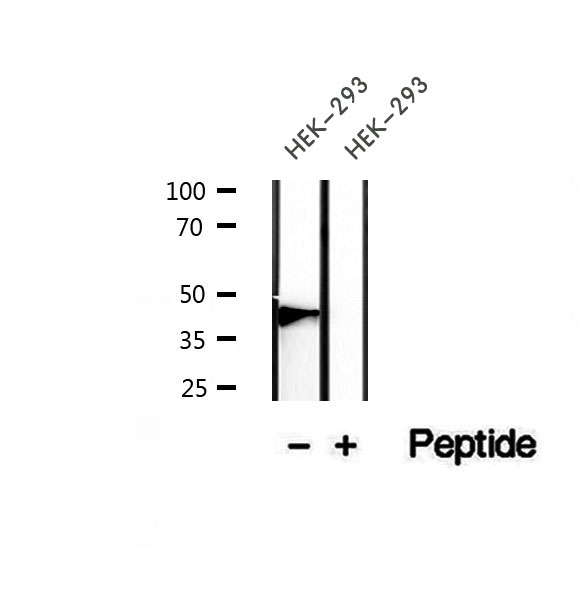
 WB (Western Blot)
(Western blot analysis of extracts of HEK-293 cells, using Podoplanin antibody.)
WB (Western Blot)
(Western blot analysis of extracts of HEK-293 cells, using Podoplanin antibody.)
Rabbit anti-Human, Mouse Podoplanin Polyclonal Antibody | anti-PDPN antibody
Podoplanin Antibody
Gene Names
PDPN; T1A; GP36; GP40; Gp38; OTS8; T1A2; TI1A; T1A-2; AGGRUS; HT1A-1; PA2.26
Reactivity
Human, Mouse
Applications
Immunohistochemistry, Western Blot
Purity
The antiserum was purified by peptide affinity chromatography using SulfoLink Coupling Resin.
Synonyms
Podoplanin, Antibody; Podoplanin Antibody; Aggrus; Glycoprotein 36 KD; Glycoprotein 36; gp 36; GP 38; GP 40; gp36; GP38; GP40; HT1A 1; HT1A1; hT1alpha 1; hT1alpha 2; hT1alpha1; hT1alpha2; Lung type I cell membrane associated glycoprotein; Lung type I cell membrane associated glycoprotein isoform a; Lung type I cell membrane associated glycoprotein T1A 2; OTS 8; OTS8; OTTHUMP00000009640; OTTHUMP00000044504; PA2.26; PA2.26 antigen; Pdpn; PDPN_HUMAN; Podoplanin; PSEC0003; PSEC0025; T1 alpha; T1 ALPHA GENE; T1-alpha; T1A 2; T1A; TI1A; TIA 2; TIA2; anti-PDPN antibody
Host
Rabbit
Reactivity
Human, Mouse
Clonality
Polyclonal
Isotype
IgG
Specificity
Podoplanin antibody detects endogenous levels of Podoplanin.
Purity/Purification
The antiserum was purified by peptide affinity chromatography using SulfoLink Coupling Resin.
Form/Format
Liquid
Phosphate buffered saline, pH 7.4, 150mM NaCl, 0.02% sodium azide and 50% glycerol.
Phosphate buffered saline, pH 7.4, 150mM NaCl, 0.02% sodium azide and 50% glycerol.
Concentration
1mg/ml (varies by lot)
Sequence Length
120
Applicable Applications for anti-PDPN antibody
IHC (Immunohistochemistry), WB (Western Blot)
Immunogen
A synthesized peptide derived from human Podoplanin.
Subcellular Location
Membrane. Cell Projection > Filopodium Membrane. Cell Projection > Lamellipodium Membrane. Cell Projection > Microvillus Membrane. Cell Projection > Ruffle Membrane. Localized to actin-rich microvilli and plasma membrane projections such as filopodia, lamellipodia and ruffles.
Tissue Specificity
Highly expressed in placenta, lung, skeletal muscle and brain. Weakly expressed in brain, kidney and liver. In placenta, expressed on the apical plasma membrane of endothelium. In lung, expressed in alveolar epithelium. Up-regulated in colorectal tumors and expressed in 25% of early oral squamous cell carcinomas.
Predicted Cross Reactivity
Dog
Similarity
Dog (83%)
Conjugation
Unconjugated
Preparation and Storage
Store at -20 degree C. Stable for 12 months from date of receipt.
WB (Western Blot)
(Western blot analysis of extracts of HEK-293 cells, using Podoplanin antibody.)
WB (Western Blot)
(Western blot analysis of extracts of HEK-293 cells, using Podoplanin antibody.)
IHC (Immunohistochemistry)
(AAA323279 at 1/100 staining Mouse brain tissue by IHC-P. The sample was formaldehyde fixed and a heat mediated antigen retrieval step in citrate buffer was performed. The sample was then blocked and incubated with the antibody for 1.5 hours at 22 degree C. An HRP conjugated goat anti-rabbit antibody was used as the secondary.)
IHC (Immunohistochemistry)
(AAA323279 at 1/100 staining Mouse brain tissue by IHC-P. The sample was formaldehyde fixed and a heat mediated antigen retrieval step in citrate buffer was performed. The sample was then blocked and incubated with the antibody for 1.5 hours at 22 degree C. An HRP conjugated goat anti-rabbit antibody was used as the secondary.)
Related Product Information for anti-PDPN antibody
Function: Mediates effects on cell migration and adhesion through its different partners. During development plays a role in blood and lymphatic vessels separation by binding CLEC1B, triggering CLEC1B activation in platelets and leading to platelet activation and/or aggregation (PubMed:14522983, PubMed:15231832, PubMed:17616532, PubMed:18215137, PubMed:17222411). Interaction with CD9, on the contrary, attenuates platelet aggregation induced by PDPN (PubMed:18541721). Through MSN or EZR interaction promotes epithelial-mesenchymal transition (EMT) leading to ERZ phosphorylation and triggering RHOA activation leading to cell migration increase and invasiveness (PubMed:17046996, PubMed:21376833). Interaction with CD44 promotes directional cell migration in epithelial and tumor cells (PubMed:20962267). In lymph nodes (LNs), controls fibroblastic reticular cells (FRCs) adhesion to the extracellular matrix (ECM) and contraction of the actomyosin by maintaining ERM proteins (EZR; MSN and RDX) and MYL9 activation through association with unknown transmembrane proteins. Engagement of CLEC1B by PDPN promotes FRCs relaxation by blocking lateral membrane interactions leading to reduction of ERM proteins (EZR; MSN and RDX) and MYL9 activation (By similarity). Through binding with LGALS8 may participate to connection of the lymphatic endothelium to the surrounding extracellular matrix (PubMed:19268462). In keratinocytes, induces changes in cell morphology showing an elongated shape, numerous membrane protrusions, major reorganization of the actin cytoskeleton, increased motility and decreased cell adhesion (PubMed:15515019). Controls invadopodia stability and maturation leading to efficient degradation of the extracellular matrix (ECM) in tumor cells through modulation of RHOC activity in order to activate ROCK1/ROCK2 and LIMK1/LIMK2 and inactivation of CFL1 (PubMed:25486435). Required for normal lung cell proliferation and alveolus formation at birth (By similarity). Does not function as a water channel or as a regulator of aquaporin-type water channels (PubMed:9651190). Does not have any effect on folic acid or amino acid transport (By similarity).
Subunit Structure: Homodimer (PubMed:21376833). Interacts with CLEC1B; the interaction is independent of CLEC1B glycosylation and activates CLEC1B; the interaction is dependent of sialic acid on O-glycans (PubMed:18215137, PubMed:17616532, PubMed:25458834). Interacts with CD9; this interaction is homophilic and attenuates platelet aggregation and pulmonary metastasis induced by PDPN (PubMed:18541721). Interacts with LGALS8; the interaction is glycosylation-dependent; may participate to connection of the lymphatic endothelium to the surrounding extracellular matrix (PubMed:19268462). Interacts with HSPA9 (PubMed:23541579). Interacts (via extracellular domain) with CD44; this interaction is required for PDPN-mediated directional migration and regulation of lamellipodia extension/stabilization during cell spreading and migration (PubMed:20962267). Interacts (via cytoplasmic domain) with MSN and EZR; activates RHOA and promotes epithelial-mesenchymal transition (PubMed:17046996). Interacts with CCL21; relocalized PDPN to the basolateral membrane (PubMed:14978162).
Post-translational Modifications: Extensively O-glycosylated. Contains sialic acid residues. O-glycosylation is necessary for platelet aggregation activity. Disialylated at Thr-52; sialic acid is critical for platelet-aggregating activity and for CLEC1B interaction (PubMed:17222411, PubMed:25458834). The N-terminus is blocked. Cleaved by a metalloprotease within its extracellular (EC) domain, generating a membrane-bound C-terminal fragment (PCTF33) and an extracellular fragment. The resulting membrane-bound C-terminal fragment (PCTF33) is further processed between Val-150 and Val-151 by PSEN1/gamma-secretase generating the intracellular domain of podoplanin (PICD).
Similarity: The cytoplasmic domain controls FRC elongation but is dispensable for contraction (By similarity). The cytoplasmic domain is essential for recruitment to invadopodia and ECM degradation (PubMed:25486435). Belongs to the podoplanin family.
Subunit Structure: Homodimer (PubMed:21376833). Interacts with CLEC1B; the interaction is independent of CLEC1B glycosylation and activates CLEC1B; the interaction is dependent of sialic acid on O-glycans (PubMed:18215137, PubMed:17616532, PubMed:25458834). Interacts with CD9; this interaction is homophilic and attenuates platelet aggregation and pulmonary metastasis induced by PDPN (PubMed:18541721). Interacts with LGALS8; the interaction is glycosylation-dependent; may participate to connection of the lymphatic endothelium to the surrounding extracellular matrix (PubMed:19268462). Interacts with HSPA9 (PubMed:23541579). Interacts (via extracellular domain) with CD44; this interaction is required for PDPN-mediated directional migration and regulation of lamellipodia extension/stabilization during cell spreading and migration (PubMed:20962267). Interacts (via cytoplasmic domain) with MSN and EZR; activates RHOA and promotes epithelial-mesenchymal transition (PubMed:17046996). Interacts with CCL21; relocalized PDPN to the basolateral membrane (PubMed:14978162).
Post-translational Modifications: Extensively O-glycosylated. Contains sialic acid residues. O-glycosylation is necessary for platelet aggregation activity. Disialylated at Thr-52; sialic acid is critical for platelet-aggregating activity and for CLEC1B interaction (PubMed:17222411, PubMed:25458834). The N-terminus is blocked. Cleaved by a metalloprotease within its extracellular (EC) domain, generating a membrane-bound C-terminal fragment (PCTF33) and an extracellular fragment. The resulting membrane-bound C-terminal fragment (PCTF33) is further processed between Val-150 and Val-151 by PSEN1/gamma-secretase generating the intracellular domain of podoplanin (PICD).
Similarity: The cytoplasmic domain controls FRC elongation but is dispensable for contraction (By similarity). The cytoplasmic domain is essential for recruitment to invadopodia and ECM degradation (PubMed:25486435). Belongs to the podoplanin family.
NCBI and Uniprot Product Information
NCBI GI #
NCBI GeneID
NCBI Accession #
NCBI GenBank Nucleotide #
Molecular Weight
Observed: 43 kDa
Predicted: 17 kDa
Predicted: 17 kDa
NCBI Official Full Name
podoplanin isoform c
NCBI Official Synonym Full Names
podoplanin
NCBI Official Symbol
PDPN
NCBI Official Synonym Symbols
T1A; GP36; GP40; Gp38; OTS8; T1A2; TI1A; T1A-2; AGGRUS; HT1A-1; PA2.26
NCBI Protein Information
podoplanin
UniProt Protein Name
Podoplanin
UniProt Gene Name
PDPN
UniProt Synonym Gene Names
Gp361 PublicationManual assertion based on opinion iniRef.2; T1ABy similarityManual assertion inferred from sequence similarity toiUniProtKB:Q64294Â (PDPN_RAT); PICD1 PublicationManual assertion based on opinion iniRef.11
Customer Reviews
Loading reviews...
Share Your Experience
Similar Products






Product Notes
The PDPN pdpn (Catalog #AAA323279) is an Antibody produced from Rabbit and is intended for research purposes only. The product is available for immediate purchase. The Podoplanin Antibody reacts with Human, Mouse and may cross-react with other species as described in the data sheet. AAA Biotech's Podoplanin can be used in a range of immunoassay formats including, but not limited to, IHC (Immunohistochemistry), WB (Western Blot). Researchers should empirically determine the suitability of the PDPN pdpn for an application not listed in the data sheet. Researchers commonly develop new applications and it is an integral, important part of the investigative research process. It is sometimes possible for the material contained within the vial of "Podoplanin, Polyclonal Antibody" to become dispersed throughout the inside of the vial, particularly around the seal of said vial, during shipment and storage. We always suggest centrifuging these vials to consolidate all of the liquid away from the lid and to the bottom of the vial prior to opening. Please be advised that certain products may require dry ice for shipping and that, if this is the case, an additional dry ice fee may also be required.Precautions
All products in the AAA Biotech catalog are strictly for research-use only, and are absolutely not suitable for use in any sort of medical, therapeutic, prophylactic, in-vivo, or diagnostic capacity. By purchasing a product from AAA Biotech, you are explicitly certifying that said products will be properly tested and used in line with industry standard. AAA Biotech and its authorized distribution partners reserve the right to refuse to fulfill any order if we have any indication that a purchaser may be intending to use a product outside of our accepted criteria.Disclaimer
Though we do strive to guarantee the information represented in this datasheet, AAA Biotech cannot be held responsible for any oversights or imprecisions. AAA Biotech reserves the right to adjust any aspect of this datasheet at any time and without notice. It is the responsibility of the customer to inform AAA Biotech of any product performance issues observed or experienced within 30 days of receipt of said product. To see additional details on this or any of our other policies, please see our Terms & Conditions page.Item has been added to Shopping Cart
If you are ready to order, navigate to Shopping Cart and get ready to checkout.