
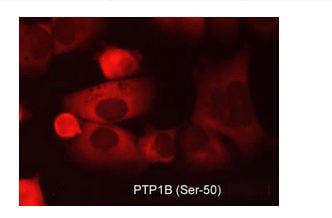
 ICC (Immunocytochemistry)
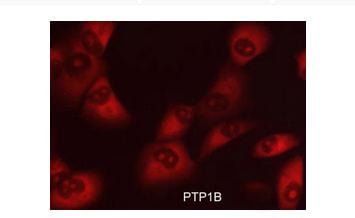
(Immunocytochemical labeling of PTP1B in aldehyde-fixed and NP-40 permeabilized human NCI-H1915 lung carcinoma cells. The cells were labeled with rabbit polyclonal anti-PTP1B (Ser-50) (PP2411) phosphospecific antibody. The antibody was detected using appropriate secondary antibody conjugated to DyLight 594.)
ICC (Immunocytochemistry)
(Immunocytochemical labeling of PTP1B in aldehyde-fixed and NP-40 permeabilized human NCI-H1915 lung carcinoma cells. The cells were labeled with rabbit polyclonal anti-PTP1B (Ser-50) (PP2411) phosphospecific antibody. The antibody was detected using appropriate secondary antibody conjugated to DyLight 594.)
Rabbit PTP1B Polyclonal Antibody | anti-PTP1B antibody
PTP1B (Ser-50), phospho-specific Antibody
Gene Names
PTPN1; PTP1B
Reactivity
Human, Rat, Mouse
Applications
Immunocytochemistry, ELISA, Western Blot
Synonyms
PTP1B, Antibody; PTP1B (Ser-50), phospho-specific Antibody; PTP1B (Ser-50), phospho-specific; PTP1B Ser-50; anti-PTP1B antibody
Host
Rabbit
Reactivity
Human, Rat, Mouse
Clonality
Polyclonal
Specificity
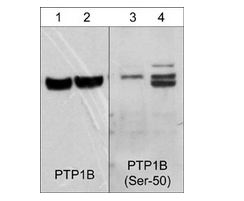
This antibody was affinity purified with phospho-PTP1B (Ser-50) peptide. The purified antibody detects a 50kDa* doublet corresponding to PTP1B in western blots of calyculin A treated human A431 and Jurkat cells. This reactivity is observed as a weak singlet in control cells and is not observed after lambda phosphatase treatment.
Form/Format
Rabbit polyclonal, affinity-purified antibody is supplied in 100ul phosphate-buffered saline, 50% glycerol, 1mg/ml BSA, and 0.05% sodium azide.
Applicable Applications for anti-PTP1B antibody
ICC (Immunocytochemistry), ELISA, WB (Western Blot)
Immunogen
PTP1B (Ser-50) synthetic peptide (coupled to carrier protein) corresponds to amino acids surrounding Ser-50 in human PTP1B. This sequence has significant homology to the conserved site in rat and mouse PTP1B, and has homology to conserved sites in TC-PTP and MPTP, but not other protein tyrosine phosphatase family members.
Preparation and Storage
Store at -20 degree C. Stable for 1 year.
ICC (Immunocytochemistry)
(Immunocytochemical labeling of PTP1B in aldehyde-fixed and NP-40 permeabilized human NCI-H1915 lung carcinoma cells. The cells were labeled with rabbit polyclonal anti-PTP1B (Ser-50) (PP2411) phosphospecific antibody. The antibody was detected using appropriate secondary antibody conjugated to DyLight 594.)
ICC (Immunocytochemistry)
(Immunocytochemical labeling of PTP1B in aldehyde-fixed and NP-40 permeabilized human NCI-H1915 lung carcinoma cells. The cells were labeled with rabbit polyclonal anti-PTP1B (Ser-50) (PP2411) phosphospecific antibody. The antibody was detected using appropriate secondary antibody conjugated to DyLight 594.)
WB (Western Blot)
(Western blot image of human Jurkat cells untreated (lanes 1 & 3) or treated (lanes 2 & 4) with calyculin A (100nM for 30 min.). The blots were probed with mouse monoclonal anti-PTP1B (lanes 1 & 2) or rabbit polyclonal anti-PTP1B (Ser-50) (lanes 3 & 4).)
WB (Western Blot)
(Western blot image of human Jurkat cells untreated (lanes 1 & 3) or treated (lanes 2 & 4) with calyculin A (100nM for 30 min.). The blots were probed with mouse monoclonal anti-PTP1B (lanes 1 & 2) or rabbit polyclonal anti-PTP1B (Ser-50) (lanes 3 & 4).)
Related Product Information for anti-PTP1B antibody
PTP1B is a nonreceptor type protein tyrosine phosphatase that has essential roles in insulin and leptin signaling, as well as important functions in growth factor and integrin signaling. The structure of PTP1B includes a conserved phosphatase domain, C-terminal hydrophobic residues for targeting to the cytoplasmic face of the endoplasmic reticulum, and proline-rich regions characteristic of SH3 domain binding motifs. PTP1B can interact with N-Cadherin and dephosphorylate beta-catenin associated with cadherin complexes. PTP1B also interacts with Insulin and EGF receptors, and undergoes phosphorylation after receptor stimulation. Tyrosine phosphorylation at Tyr-66, Tyr-152, and Tyr-153 occurs after insulin receptor activation, and tyrosine phosphorylation of Tyr-152 may be required for interactions with N-Cadherin. In addition, Akt can phosphorylate Ser-50 and this phosphorylation can reduce PTP1B activity.
References
Lingamanaidu, V. et al. (2001) Molecular Endocrinology 15(10):1768.
Rhee, J. et al. (2001) J. Biol. Chem. 276(9):6640.
Bandyopadhyay, D. et al. (1997) J. Biol. Chem. 272(3):1639.
Rhee, J. et al. (2001) J. Biol. Chem. 276(9):6640.
Bandyopadhyay, D. et al. (1997) J. Biol. Chem. 272(3):1639.
NCBI and Uniprot Product Information
NCBI GI #
NCBI GeneID
NCBI Accession #
NCBI GenBank Nucleotide #
Molecular Weight
49,967 Da
NCBI Official Full Name
tyrosine-protein phosphatase non-receptor type 1
NCBI Official Synonym Full Names
protein tyrosine phosphatase, non-receptor type 1
NCBI Official Symbol
PTPN1
NCBI Official Synonym Symbols
PTP1B
NCBI Protein Information
tyrosine-protein phosphatase non-receptor type 1; protein tyrosine phosphatase 1B; protein-tyrosine phosphatase 1B; protein tyrosine phosphatase, placental
UniProt Protein Name
Tyrosine-protein phosphatase non-receptor type 1
UniProt Gene Name
PTPN1
UniProt Synonym Gene Names
PTP1B; PTP-1B
UniProt Entry Name
PTN1_HUMAN
Customer Reviews
Loading reviews...
Share Your Experience
Similar Products



Product Notes
The PTP1B ptpn1 (Catalog #AAA71693) is an Antibody produced from Rabbit and is intended for research purposes only. The product is available for immediate purchase. The PTP1B (Ser-50), phospho-specific Antibody reacts with Human, Rat, Mouse and may cross-react with other species as described in the data sheet. AAA Biotech's PTP1B can be used in a range of immunoassay formats including, but not limited to, ICC (Immunocytochemistry), ELISA, WB (Western Blot). Researchers should empirically determine the suitability of the PTP1B ptpn1 for an application not listed in the data sheet. Researchers commonly develop new applications and it is an integral, important part of the investigative research process. It is sometimes possible for the material contained within the vial of "PTP1B, Polyclonal Antibody" to become dispersed throughout the inside of the vial, particularly around the seal of said vial, during shipment and storage. We always suggest centrifuging these vials to consolidate all of the liquid away from the lid and to the bottom of the vial prior to opening. Please be advised that certain products may require dry ice for shipping and that, if this is the case, an additional dry ice fee may also be required.Precautions
All products in the AAA Biotech catalog are strictly for research-use only, and are absolutely not suitable for use in any sort of medical, therapeutic, prophylactic, in-vivo, or diagnostic capacity. By purchasing a product from AAA Biotech, you are explicitly certifying that said products will be properly tested and used in line with industry standard. AAA Biotech and its authorized distribution partners reserve the right to refuse to fulfill any order if we have any indication that a purchaser may be intending to use a product outside of our accepted criteria.Disclaimer
Though we do strive to guarantee the information represented in this datasheet, AAA Biotech cannot be held responsible for any oversights or imprecisions. AAA Biotech reserves the right to adjust any aspect of this datasheet at any time and without notice. It is the responsibility of the customer to inform AAA Biotech of any product performance issues observed or experienced within 30 days of receipt of said product. To see additional details on this or any of our other policies, please see our Terms & Conditions page.Item has been added to Shopping Cart
If you are ready to order, navigate to Shopping Cart and get ready to checkout.