
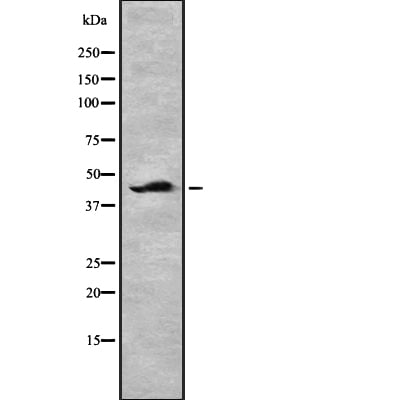
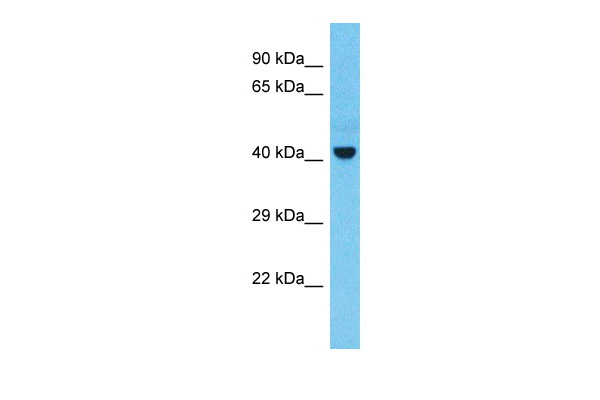
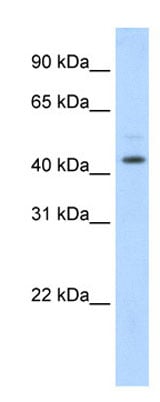
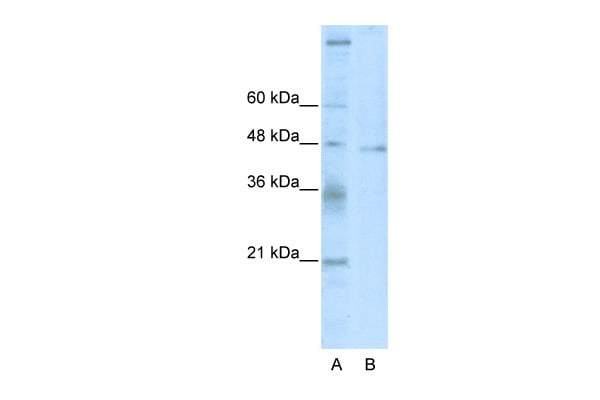
 WB (Western Blot)
(Western blot analysis of TSG101 using K562 whole cell lysates)
WB (Western Blot)
(Western blot analysis of TSG101 using K562 whole cell lysates)
Rabbit TSG101 Polyclonal Antibody | anti-TSG101 antibody
TSG101 Antibody
Gene Names
TSG101; TSG10; VPS23
Reactivity
Human, Monkey
Applications
ELISA, Immunocytochemistry, Immunofluorescence, Western Blot
Purity
The antiserum was purified by peptide affinity chromatography using SulfoLink Coupling Resin.
Synonyms
TSG101, Antibody; TSG101 Antibody; ESCRT I complex subunit TSG101; ESCRT-I complex subunit TSG101; TS101_HUMAN; TSG 10; TSG 101; TSG10; Tsg101; Tumor susceptibility gene 10; Tumor susceptibility gene 101; Tumor susceptibility gene 101 protein; Tumor susceptibility protein; Tumor susceptibility protein isoform 3; VPS 23; VPS23; anti-TSG101 antibody
Host
Rabbit
Reactivity
Human, Monkey
Clonality
Polyclonal
Isotype
IgG
Specificity
TSG101 antibody detects endogenous levels of total TSG101
Purity/Purification
The antiserum was purified by peptide affinity chromatography using SulfoLink Coupling Resin.
Form/Format
Liquid
Phosphate buffered saline, pH 7.4, 150mM NaCl, 0.02% sodium azide and 50% glycerol.
Phosphate buffered saline, pH 7.4, 150mM NaCl, 0.02% sodium azide and 50% glycerol.
Concentration
1mg/ml (varies by lot)
Sequence Length
390
Applicable Applications for anti-TSG101 antibody
ELISA, ICC (Immunocytochemistry), IF (Immunofluorescence), WB (Western Blot)
Immunogen
A synthesized peptide derived from human TSG101
Subcellular Location
Cytoplasm. Membrane. Nucleus. Late Endosome Membrane. Mainly cytoplasmic. Membrane-associated when active and soluble when inactive. Depending on the stage of the cell cycle, detected in the nucleus. Colocalized with CEP55 in the midbody during cytokinesis.
Tissue Specificity
Heart, brain, placenta, lung, liver, skeletal, kidney and pancreas.
Predicted Cross Reactivity
Bovine, Horse, Sheep, Rabbit, Dog
Similarity
Bovine (91%), Horse (100%), Sheep (91%), Rabbit (100%), Dog (100%)
Conjugation
Unconjugated
Preparation and Storage
Store at -20 degree C. Stable for 12 months from date of receipt.
WB (Western Blot)
(Western blot analysis of TSG101 using K562 whole cell lysates)
WB (Western Blot)
(Western blot analysis of TSG101 using K562 whole cell lysates)
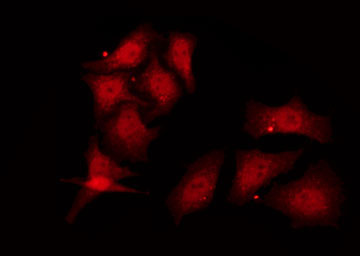
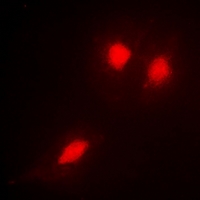
IF (Immunofluorescence)
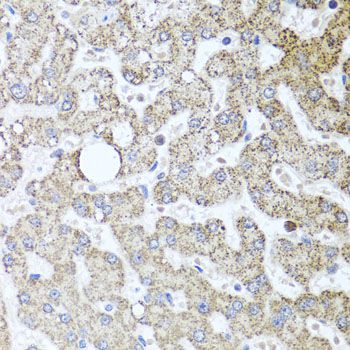
(AAA327482 staining COS7 by IF/ICC. The sample were fixed with PFA and permeabilized in 0.1% Triton X-100, then blocked in 10% serum for 45 minutes at 25 degree C. The primary antibody was diluted at 1/200 and incubated with the sample for 1 hour at 37 degree C. An Alexa Fluor 594 conjugated goat anti-rabbit IgG (H+L) Ab, diluted at 1/600, was used as the secondary antibody.)
IF (Immunofluorescence)
(AAA327482 staining COS7 by IF/ICC. The sample were fixed with PFA and permeabilized in 0.1% Triton X-100, then blocked in 10% serum for 45 minutes at 25 degree C. The primary antibody was diluted at 1/200 and incubated with the sample for 1 hour at 37 degree C. An Alexa Fluor 594 conjugated goat anti-rabbit IgG (H+L) Ab, diluted at 1/600, was used as the secondary antibody.)
Related Product Information for anti-TSG101 antibody
Function: Component of the ESCRT-I complex, a regulator of vesicular trafficking process. Binds to ubiquitinated cargo proteins and is required for the sorting of endocytic ubiquitinated cargos into multivesicular bodies (MVBs). Mediates the association between the ESCRT-0 and ESCRT-I complex. Required for completion of cytokinesis; the function requires CEP55. May be involved in cell growth and differentiation. Acts as a negative growth regulator. Involved in the budding of many viruses through an interaction with viral proteins that contain a late-budding motif P-[ST]-A-P. This interaction is essential for viral particle budding of numerous retroviruses. Required for the exosomal release of SDCBP, CD63 and syndecan (PubMed:22660413). It may also play a role in the extracellular release of microvesicles that differ from the exosomes (PubMed:22315426).
Subunit Structure: Component of the ESCRT-I complex (endosomal sorting complex required for transport I) which consists of TSG101, VPS28, a VPS37 protein (VPS37A to-D) and MVB12A or MVB12B in a 1:1:1:1 stoichiometry (PubMed:18005716). Interacts with VPS37A, VPS37B and VPS37C (PubMed:15218037, PubMed:15509564). Interacts with DMAP1 (PubMed:10888872). Interacts with ubiquitin (PubMed:11595185). Interacts with stathmin, GMCL and AATF (By similarity). Component of an ESCRT-I complex (endosomal sorting complex required for transport I) which consists of TSG101, VPS28, VPS37A and UBAP1 in a 1:1:1:1 stoichiometry (PubMed:21757351). Interacts with HGS; the interaction mediates the association with the ESCRT-0 complex. Interacts with GGA1 and GGA3 (PubMed:15143060, PubMed:15039775). Interacts (via UEV domain) with PDCD6IP/AIP1 (PubMed:14505570, PubMed:14519844). Interacts with VPS28, SNF8 and VPS36 (PubMed:14505570). Self-associates (PubMed:14505570, PubMed:14519844). Interacts with MVB12A; the association appears to be mediated by the TSG101-VPS37 binary subcomplex. Interacts with VPS37D. Interacts with LRSAM1. Interacts with CEP55; the interaction is required for cytokinesis but not for viral budding (PubMed:17853893). Interacts with PDCD6 (PubMed:18256029). Interacts with LITAF (PubMed:23166352). Interacts with HIV-1 p6 (PubMed:11595185, PubMed:11427703, PubMed:12006492, PubMed:21070952, PubMed:21643473). Interacts with human spumavirus Gag (PubMed:15858022). Interacts with HTLV-1 Gag (PubMed:14581525). Interacts with Ebola virus VP40 (PubMed:12559917). Interacts with EIAV p9; the interaction has been shown in vitro (PubMed:14519844). Interacts with MGRN1 (PubMed:17229889). Interacts with ARRDC1; recruits TSG101 to the plasma membrane (PubMed:21191027, PubMed:22315426).
Post-translational Modifications: Monoubiquitinated at multiple sites by LRSAM1 and by MGRN1. Ubiquitination inactivates it, possibly by regulating its shuttling between an active membrane-bound protein and an inactive soluble form. Ubiquitination by MGRN1 requires the presence of UBE2D1.
Similarity: The UEV domain is required for the interaction of the complex with ubiquitin. It also mediates the interaction with PTAP/PSAP motifs of HIV-1 P6 protein and human spumaretrovirus Gag protein.The coiled coil domain may interact with stathmin.The UEV domain binds ubiquitin and P-[ST]-A-P peptide motif independently. Belongs to the ubiquitin-conjugating enzyme family. UEV subfamily.
Subunit Structure: Component of the ESCRT-I complex (endosomal sorting complex required for transport I) which consists of TSG101, VPS28, a VPS37 protein (VPS37A to-D) and MVB12A or MVB12B in a 1:1:1:1 stoichiometry (PubMed:18005716). Interacts with VPS37A, VPS37B and VPS37C (PubMed:15218037, PubMed:15509564). Interacts with DMAP1 (PubMed:10888872). Interacts with ubiquitin (PubMed:11595185). Interacts with stathmin, GMCL and AATF (By similarity). Component of an ESCRT-I complex (endosomal sorting complex required for transport I) which consists of TSG101, VPS28, VPS37A and UBAP1 in a 1:1:1:1 stoichiometry (PubMed:21757351). Interacts with HGS; the interaction mediates the association with the ESCRT-0 complex. Interacts with GGA1 and GGA3 (PubMed:15143060, PubMed:15039775). Interacts (via UEV domain) with PDCD6IP/AIP1 (PubMed:14505570, PubMed:14519844). Interacts with VPS28, SNF8 and VPS36 (PubMed:14505570). Self-associates (PubMed:14505570, PubMed:14519844). Interacts with MVB12A; the association appears to be mediated by the TSG101-VPS37 binary subcomplex. Interacts with VPS37D. Interacts with LRSAM1. Interacts with CEP55; the interaction is required for cytokinesis but not for viral budding (PubMed:17853893). Interacts with PDCD6 (PubMed:18256029). Interacts with LITAF (PubMed:23166352). Interacts with HIV-1 p6 (PubMed:11595185, PubMed:11427703, PubMed:12006492, PubMed:21070952, PubMed:21643473). Interacts with human spumavirus Gag (PubMed:15858022). Interacts with HTLV-1 Gag (PubMed:14581525). Interacts with Ebola virus VP40 (PubMed:12559917). Interacts with EIAV p9; the interaction has been shown in vitro (PubMed:14519844). Interacts with MGRN1 (PubMed:17229889). Interacts with ARRDC1; recruits TSG101 to the plasma membrane (PubMed:21191027, PubMed:22315426).
Post-translational Modifications: Monoubiquitinated at multiple sites by LRSAM1 and by MGRN1. Ubiquitination inactivates it, possibly by regulating its shuttling between an active membrane-bound protein and an inactive soluble form. Ubiquitination by MGRN1 requires the presence of UBE2D1.
Similarity: The UEV domain is required for the interaction of the complex with ubiquitin. It also mediates the interaction with PTAP/PSAP motifs of HIV-1 P6 protein and human spumaretrovirus Gag protein.The coiled coil domain may interact with stathmin.The UEV domain binds ubiquitin and P-[ST]-A-P peptide motif independently. Belongs to the ubiquitin-conjugating enzyme family. UEV subfamily.
NCBI and Uniprot Product Information
NCBI GI #
NCBI GeneID
NCBI Accession #
NCBI GenBank Nucleotide #
Molecular Weight
Observed: 45 kDa
Predicted: 44 kDa
Predicted: 44 kDa
NCBI Official Full Name
tumor susceptibility gene 101 protein
NCBI Official Synonym Full Names
tumor susceptibility 101
NCBI Official Symbol
TSG101
NCBI Official Synonym Symbols
TSG10; VPS23
NCBI Protein Information
tumor susceptibility gene 101 protein
UniProt Protein Name
Tumor susceptibility gene 101 protein
UniProt Gene Name
TSG101
Customer Reviews
Loading reviews...
Share Your Experience
Similar Products

Product Notes
The TSG101 tsg101 (Catalog #AAA327482) is an Antibody produced from Rabbit and is intended for research purposes only. The product is available for immediate purchase. The TSG101 Antibody reacts with Human, Monkey and may cross-react with other species as described in the data sheet. AAA Biotech's TSG101 can be used in a range of immunoassay formats including, but not limited to, ELISA, ICC (Immunocytochemistry), IF (Immunofluorescence), WB (Western Blot). Researchers should empirically determine the suitability of the TSG101 tsg101 for an application not listed in the data sheet. Researchers commonly develop new applications and it is an integral, important part of the investigative research process. It is sometimes possible for the material contained within the vial of "TSG101, Polyclonal Antibody" to become dispersed throughout the inside of the vial, particularly around the seal of said vial, during shipment and storage. We always suggest centrifuging these vials to consolidate all of the liquid away from the lid and to the bottom of the vial prior to opening. Please be advised that certain products may require dry ice for shipping and that, if this is the case, an additional dry ice fee may also be required.Precautions
All products in the AAA Biotech catalog are strictly for research-use only, and are absolutely not suitable for use in any sort of medical, therapeutic, prophylactic, in-vivo, or diagnostic capacity. By purchasing a product from AAA Biotech, you are explicitly certifying that said products will be properly tested and used in line with industry standard. AAA Biotech and its authorized distribution partners reserve the right to refuse to fulfill any order if we have any indication that a purchaser may be intending to use a product outside of our accepted criteria.Disclaimer
Though we do strive to guarantee the information represented in this datasheet, AAA Biotech cannot be held responsible for any oversights or imprecisions. AAA Biotech reserves the right to adjust any aspect of this datasheet at any time and without notice. It is the responsibility of the customer to inform AAA Biotech of any product performance issues observed or experienced within 30 days of receipt of said product. To see additional details on this or any of our other policies, please see our Terms & Conditions page.Item has been added to Shopping Cart
If you are ready to order, navigate to Shopping Cart and get ready to checkout.