
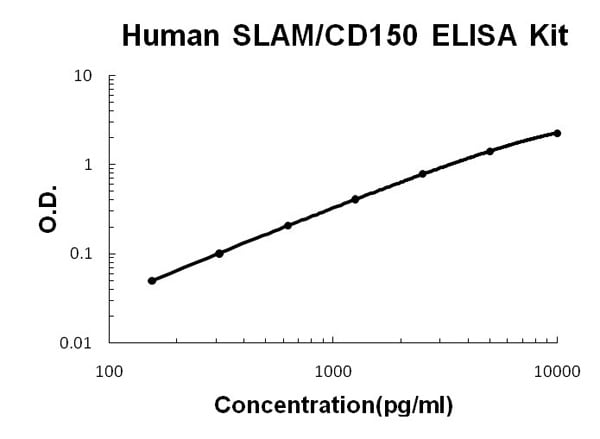
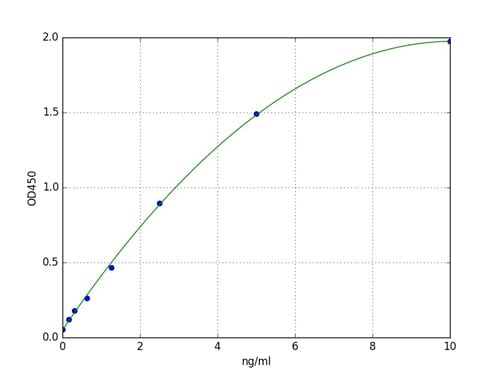
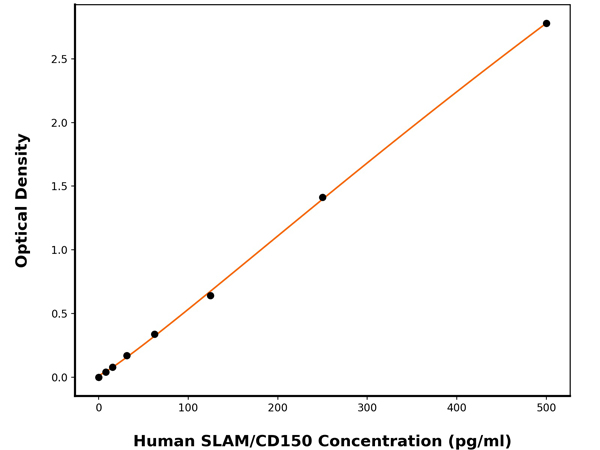
 Standard Curve (Sample)
(Human SLAM/CD150 PicoKine ELISA Kit standard curve)
Standard Curve (Sample)
(Human SLAM/CD150 PicoKine ELISA Kit standard curve)
Human SLAM/CD150 ELISA Kit | SLAMF1 elisa kit
Human SLAM/CD150 PicoKine ELISA Kit
Gene Names
SLAMF1; SLAM; CD150; CDw150
Reactivity
Human
Synonyms
SLAM/CD150; N/A; Human SLAM/CD150 PicoKine ELISA Kit; Signaling lymphocytic activation molecule; signaling lymphocytic activation molecule family member 1; 4933415F16; AA177906; CD 150; Cd150; CD150 antigen; Cdw150; Estm51; Ipo 3; IPO-3; Ipo3; MGC151472; MGC151476; OTTHUMP00000025670; OTTHUMP00000060252; RGD1560634; Signaling lymphocytic activation molecule family member 1; Signaling lymphocytic activation molecule family member 1, isoform CRA_a; Signaling lymphocytic activation molecule family member 1, isoform CRA_b; Signaling lymphocytic activation molecule precursor; Slaf1; SLAF1_HUMAN; SLAM family, member 1; Slamf 1; Slamf1; SLAMF1 protein; SLAMF1 elisa kit
Reactivity
Human
Specificity
Natural and recombinant human SLAM
Sequence Length
335
Samples
Cell culture supernates, serum and plasma (heparin, EDTA)
Assay Type
Sandwich
Detection Range
156pg/ml-10,000pg/ml
Sensitivity
< 10pg/ml
Intra-assay Precision
Intra-Assay Precision (Precision within an assay) Three samples of known concentration were tested on one plate to assess intra-assay precision.
Inter-assay Precision
Inter-Assay Precision (Precision between assays) Three samples of known concentration were tested in separate assays to assess inter-assay precision.
Preparation and Storage
Store at 4 degree C for 6 months, at -20 degree C for 12 months. Avoid multiple freeze-thaw cycles (Shipped with wet ice.)
Standard Curve (Sample)
(Human SLAM/CD150 PicoKine ELISA Kit standard curve)
Standard Curve (Sample)
(Human SLAM/CD150 PicoKine ELISA Kit standard curve)
Related Product Information for SLAMF1 elisa kit
Principle of the assay: human SLAM ELISA Kit was based on standard sandwich enzyme-linked immune-sorbent assay technology. A monoclonal antibody from mouse specific for SLAM has been precoated onto 96-well plates. Standards(NSO, A21-K236) and test samples are added to the wells, a biotinylated detection polyclonal antibody from goat specific for SLAM is added subsequently and then followed by washing with PBS or TBS buffer. Avidin-Biotin-Peroxidase Complex was added and unbound conjugates were washed away with PBS or TBS buffer. HRP substrate TMB was used to visualize HRP enzymatic reaction. TMB was catalyzed by HRP to produce a blue color product that changed into yellow after adding acidic stop solution. The density of yellow is proportional to the human SLAM amount of sample captured in plate.
Background: Signaling lymphocytic activation molecule is a protein that in humans is encoded by the SLAMF1 gene. It belongs to the immunoglobulin gene superfamily. This gene is mapped to 1q23.3. It has found that SLAM is constitutively expressed on peripheral blood memory T cells, T-cell clones, immature thymocytes and a proportion of B cells, and is rapidly induced on naive T cells after activation. In MV-resistant cell lines, infection with clinical MV and expression of SLAM, but not CD46, caused cytopathic effects (CPE). The expression of SLAM on activated B and T lymphocytes correlates with the pathology of MV infection in humans and monkeys, in which lymphoid organs are the chief sites of MV replication and the binding of MV to SLAM may impair the signaling functions of SLAM in lymphocyte activation and inhibit Th0/Th1 cytokine production, thereby promoting Th2 cytokine production. It has reported that antibody-mediated ligation of SLAM on thymocytes triggered a protein tyrosine phosphorylation signal in T cells in a SAP-dependent manner. This signal also involved SHIP, the adaptor molecules DOK2, DOK1, and SHC and RASGAP.
Background: Signaling lymphocytic activation molecule is a protein that in humans is encoded by the SLAMF1 gene. It belongs to the immunoglobulin gene superfamily. This gene is mapped to 1q23.3. It has found that SLAM is constitutively expressed on peripheral blood memory T cells, T-cell clones, immature thymocytes and a proportion of B cells, and is rapidly induced on naive T cells after activation. In MV-resistant cell lines, infection with clinical MV and expression of SLAM, but not CD46, caused cytopathic effects (CPE). The expression of SLAM on activated B and T lymphocytes correlates with the pathology of MV infection in humans and monkeys, in which lymphoid organs are the chief sites of MV replication and the binding of MV to SLAM may impair the signaling functions of SLAM in lymphocyte activation and inhibit Th0/Th1 cytokine production, thereby promoting Th2 cytokine production. It has reported that antibody-mediated ligation of SLAM on thymocytes triggered a protein tyrosine phosphorylation signal in T cells in a SAP-dependent manner. This signal also involved SHIP, the adaptor molecules DOK2, DOK1, and SHC and RASGAP.
NCBI and Uniprot Product Information
NCBI GI #
NCBI GeneID
Molecular Weight
33,839 Da
NCBI Official Full Name
Signaling lymphocytic activation molecule
NCBI Official Synonym Full Names
signaling lymphocytic activation molecule family member 1
NCBI Official Symbol
SLAMF1
NCBI Official Synonym Symbols
SLAM; CD150; CDw150
NCBI Protein Information
signaling lymphocytic activation molecule; IPO-3
UniProt Protein Name
Signaling lymphocytic activation molecule
UniProt Gene Name
SLAMF1
UniProt Synonym Gene Names
SLAM
UniProt Entry Name
SLAF1_HUMAN
Customer Reviews
Loading reviews...
Share Your Experience
Similar Products


Product Notes
The Human SLAMF1 slamf1 (Catalog #AAA45895) is an ELISA Kit and is intended for research purposes only. The product is available for immediate purchase. The AAA45895 ELISA Kit recognizes Human SLAMF1. It is sometimes possible for the material contained within the vial of "SLAM/CD150, ELISA Kit" to become dispersed throughout the inside of the vial, particularly around the seal of said vial, during shipment and storage. We always suggest centrifuging these vials to consolidate all of the liquid away from the lid and to the bottom of the vial prior to opening. Please be advised that certain products may require dry ice for shipping and that, if this is the case, an additional dry ice fee may also be required.Precautions
All products in the AAA Biotech catalog are strictly for research-use only, and are absolutely not suitable for use in any sort of medical, therapeutic, prophylactic, in-vivo, or diagnostic capacity. By purchasing a product from AAA Biotech, you are explicitly certifying that said products will be properly tested and used in line with industry standard. AAA Biotech and its authorized distribution partners reserve the right to refuse to fulfill any order if we have any indication that a purchaser may be intending to use a product outside of our accepted criteria.Disclaimer
Though we do strive to guarantee the information represented in this datasheet, AAA Biotech cannot be held responsible for any oversights or imprecisions. AAA Biotech reserves the right to adjust any aspect of this datasheet at any time and without notice. It is the responsibility of the customer to inform AAA Biotech of any product performance issues observed or experienced within 30 days of receipt of said product. To see additional details on this or any of our other policies, please see our Terms & Conditions page.Item has been added to Shopping Cart
If you are ready to order, navigate to Shopping Cart and get ready to checkout.