
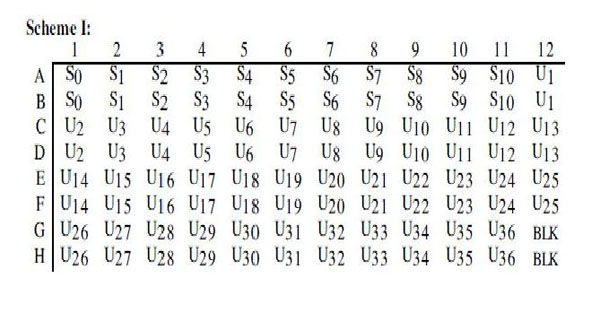
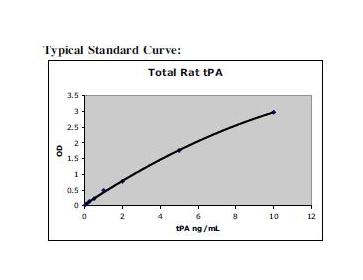
 Application Data
tPA assay kit
Rat tPA total antigen ELISA Kit
Gene Names
PLAT; TPA; T-PA
Synonyms
tPA; N/A; Rat tPA total antigen ELISA Kit; Activity Assay for Total Rat tPa; tPA assay kit
Sequence Length
19
Procedural Notes
1. This assay should be run at room temperature.
2. Use aseptic technique when opening and dispensing reagents.
3. To minimize error due to handling, wipe the exterior bottom of the microplate wells with a lintfree paper towel.
2. Use aseptic technique when opening and dispensing reagents.
3. To minimize error due to handling, wipe the exterior bottom of the microplate wells with a lintfree paper towel.
Reagent Preparation
The following solutions should be prepared fresh before starting the assay.
1. TBS Buffer: 0.10 M TRIS, 0.15 M NaCl, pH 7.4
2. Blocking Buffer: 3% BSA in TBS Buffer.
3. 10x Wash Buffer: Dilute to 1x prior to use. Do this by combining 1 part of 10x Wash Buffer to 9 parts of DI Water relative to the amount required for the assay, either in whole or in part.
1. TBS Buffer: 0.10 M TRIS, 0.15 M NaCl, pH 7.4
2. Blocking Buffer: 3% BSA in TBS Buffer.
3. 10x Wash Buffer: Dilute to 1x prior to use. Do this by combining 1 part of 10x Wash Buffer to 9 parts of DI Water relative to the amount required for the assay, either in whole or in part.
Sample Collection, Storage and Preparation
Samples should be collected using trisodium citrate, acidified citrate or Stabilytetm (DiaPharma) collection media. Collection should be in accordance with the collection vials manufacturers instructions or in a 1:10 ratio of collection media to blood. Immediately, upon collection of blood, the samples should be centrifuged at 3000 x g. This should ensure the removal of platelets as they can release PAI-1 that, in turn, complexes with tPA. The plasma can be transferred to a clean plastic tube and stored frozen for up to one month. Samples are stable for approximately 24 hours when stored at 4 degree C with the Sabilytetm media or one month if stored at -20 degree C. Note: Detergents such as Triton X cause interference with the assay. If using detergent extracted samples, it is necessary to dialyze the samples overnight to remove the detergent.
Preparation and Storage
1. Store the kit and all of its components at 4 degree C before use.
2. If not using the entire plate at once, prepare only the appropriate amount of Primary
Antibody
and PAI-1 Standard. The remaining stock solutions should be frozen and stored at At -70C.
Primary Antibody should be used within two weeks. All other components should remain
refrigerated.
3. Store unused portions of the microplate in the pouch with a desiccant at 4 degree C.
2. If not using the entire plate at once, prepare only the appropriate amount of Primary
Antibody
and PAI-1 Standard. The remaining stock solutions should be frozen and stored at At -70C.
Primary Antibody should be used within two weeks. All other components should remain
refrigerated.
3. Store unused portions of the microplate in the pouch with a desiccant at 4 degree C.
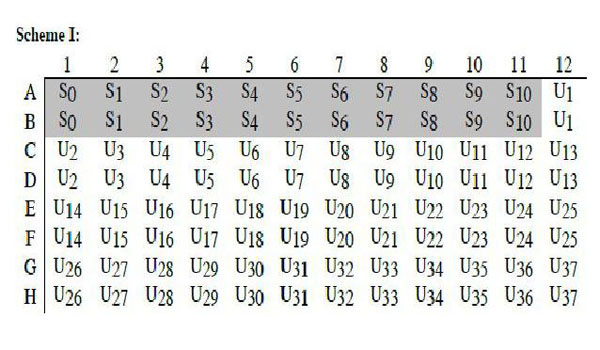
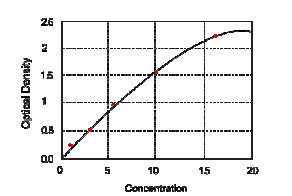
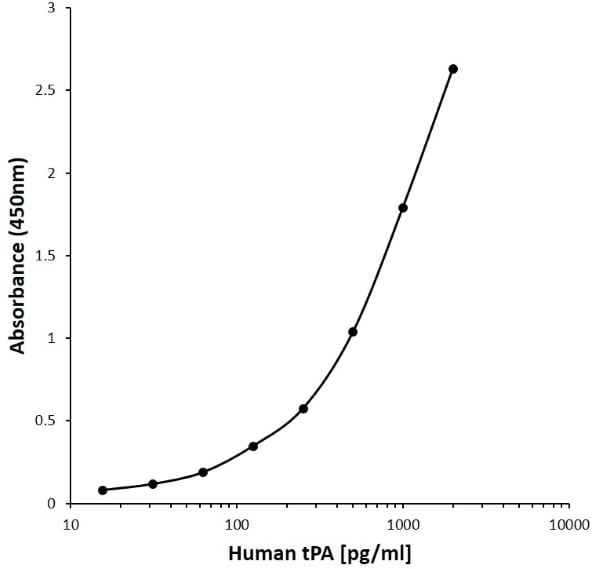
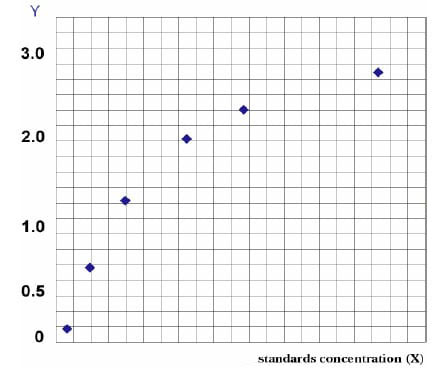
Application Data
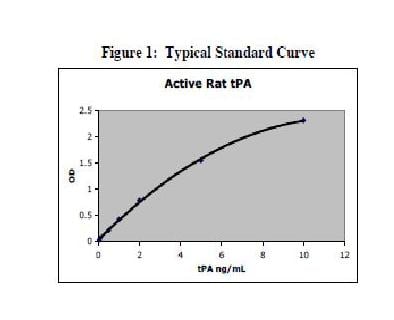
Application Data
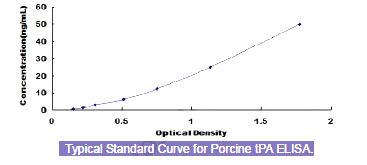
Application Data
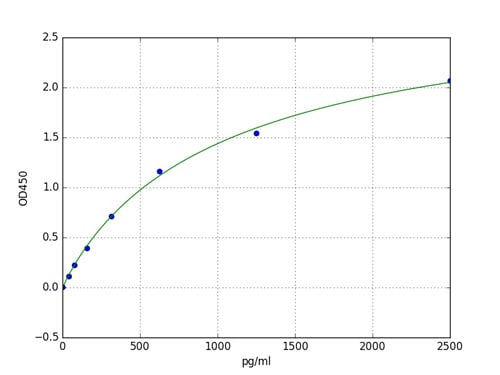
Application Data
Related Product Information for tPA assay kit
Introduction: Tissue-type Plasminogen Actvator (tPA) is a member of the serine proteinase family. tPA functions to lyse fibrin clots into soluble plasmin fragments. tPA is active in two forms, single chain and two chain. The two chain tPA is created via interaction with the plasmin product cleaving the single chain. This two chain form is regarded as the more active form. Both single chain and two chain tPA are complexable with PAI-1. PAI-1 acts as an inhibitor for tPA by binding to the tPA and thus stifling its ability to lyse fibrin. tPA can serve as an indicator of both myocardial infarction for patients with impaired fibrinolytic systems as well as a marker for type-II diabetes.
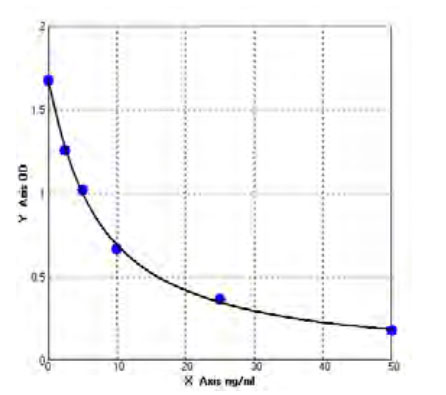
Principle of assay: This is an ELISA (Enzyme-Linked Immunosorbent Assay) for the quantitative analysis of tPa levels in biological fluid. This test kit operates on the basis of sandwich ELISA where free, latent and complexed tPa is quantified with the use of an HRP labeled secondary antibody. The various forms of tPA present in the standard or unknown is captured by the tPA capture antibody coated on the well. A primary antibody specific for tPA is then added to each well followed by the HRP conjugated secondary antibody. The bound conjugated secondary antibody is detected by the addition of substrate, which generates an optimal color after 10 minutes. Quantitative test results may be obtained by the measure and comparison of the sample and standard absorbance readings when read with a microplate reader at 450 nm.
Principle of assay: This is an ELISA (Enzyme-Linked Immunosorbent Assay) for the quantitative analysis of tPa levels in biological fluid. This test kit operates on the basis of sandwich ELISA where free, latent and complexed tPa is quantified with the use of an HRP labeled secondary antibody. The various forms of tPA present in the standard or unknown is captured by the tPA capture antibody coated on the well. A primary antibody specific for tPA is then added to each well followed by the HRP conjugated secondary antibody. The bound conjugated secondary antibody is detected by the addition of substrate, which generates an optimal color after 10 minutes. Quantitative test results may be obtained by the measure and comparison of the sample and standard absorbance readings when read with a microplate reader at 450 nm.
References
1. Lidbury, P., et al., (1990) Br J Pharmacol 101(3):527-530
2. Krishnamurti, C., et al., (1991) J Lab Clin Med 118(6):523-530
3. Nordt, T., et al., (1995) Circulation 91(3):764-770
4. Debrock, S., et al., (1997) Biochem Biophys Acta 1337(2):257-266
5. Nordt, T., et al., (1998) J Mol Cell Cardiol 30(8):1535-1543
6. Ngo, T., et al., (1999) Thromb Haemost 82(5):1510-1515
2. Krishnamurti, C., et al., (1991) J Lab Clin Med 118(6):523-530
3. Nordt, T., et al., (1995) Circulation 91(3):764-770
4. Debrock, S., et al., (1997) Biochem Biophys Acta 1337(2):257-266
5. Nordt, T., et al., (1998) J Mol Cell Cardiol 30(8):1535-1543
6. Ngo, T., et al., (1999) Thromb Haemost 82(5):1510-1515
NCBI and Uniprot Product Information
NCBI GI #
NCBI GeneID
Molecular Weight
2,342 Da
NCBI Official Full Name
tPA, partial
NCBI Official Synonym Full Names
plasminogen activator, tissue
NCBI Official Symbol
PLAT
NCBI Official Synonym Symbols
TPA; T-PA
NCBI Protein Information
tissue-type plasminogen activator; alteplase; plasminogen activator, tissue type; plasminogen/activator kringle; reteplase; t-plasminogen activator; tissue plasminogen activator (t-PA)
UniProt Protein Name
TPA protein
UniProt Gene Name
tPA
UniProt Entry Name
Q6LBF5_HUMAN
Customer Reviews
Loading reviews...
Share Your Experience
Similar Products


Product Notes
The tPA tpa (Catalog #AAA71825) is an Assay Kit and is intended for research purposes only. The product is available for immediate purchase. It is sometimes possible for the material contained within the vial of "tPA, Assay Kit" to become dispersed throughout the inside of the vial, particularly around the seal of said vial, during shipment and storage. We always suggest centrifuging these vials to consolidate all of the liquid away from the lid and to the bottom of the vial prior to opening. Please be advised that certain products may require dry ice for shipping and that, if this is the case, an additional dry ice fee may also be required.Precautions
All products in the AAA Biotech catalog are strictly for research-use only, and are absolutely not suitable for use in any sort of medical, therapeutic, prophylactic, in-vivo, or diagnostic capacity. By purchasing a product from AAA Biotech, you are explicitly certifying that said products will be properly tested and used in line with industry standard. AAA Biotech and its authorized distribution partners reserve the right to refuse to fulfill any order if we have any indication that a purchaser may be intending to use a product outside of our accepted criteria.Disclaimer
Though we do strive to guarantee the information represented in this datasheet, AAA Biotech cannot be held responsible for any oversights or imprecisions. AAA Biotech reserves the right to adjust any aspect of this datasheet at any time and without notice. It is the responsibility of the customer to inform AAA Biotech of any product performance issues observed or experienced within 30 days of receipt of said product. To see additional details on this or any of our other policies, please see our Terms & Conditions page.Item has been added to Shopping Cart
If you are ready to order, navigate to Shopping Cart and get ready to checkout.