What Is His Tag vs GST, FLAG & MBP? Protein Tags Compared
 Cynthia
11 min read
Cynthia
11 min read
In this Article
- What Are Protein Tags And Why Are They Used?
- What Is A His Tag? Sequence, Size & Purification
- What Is A GST Tag? Structure, Size & Purification
- What Is A FLAG Tag? Sequence, Size & Use Cases
- What Is Maltose Binding Protein (MBP)? Sequence, Size & Purification
- How To Choose The Right Protein Tag?
- Protein Tag Troubleshooting: Common Problems And Fixes


All of the products listed in AAA Biotech’s catalog are strictly for research-use only (RUO).
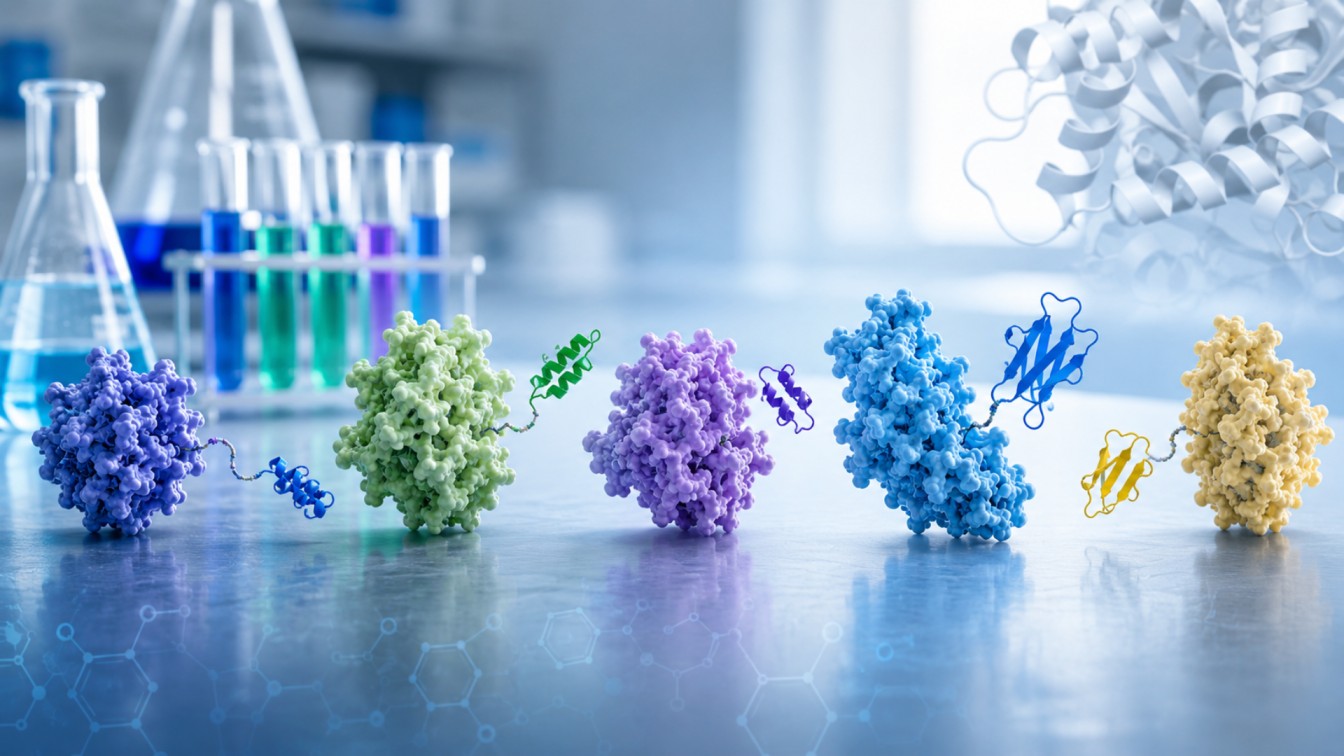
If you've cloned a construct, expressed it in E. coli, and stared at an empty elution fraction, you already know that the right protein tag can make or break a purification. Protein tags are short peptide sequences or full protein domains fused to a protein of interest to simplify detection, purification, or solubility.
His-tag/nickel affinity chromatography is widely regarded as the most common first-purification method for recombinant proteins in structural biology and academic labs alike. That popularity is exactly why picking the wrong tag for your specific protein, instead of just the most common one, is one of the costliest mistakes in early-stage cloning.
This guide compares the four most widely used protein tags, His, GST, FLAG, and MBP, plus SUMO, covering sequence, size, purification method, and real troubleshooting fixes.
Key Takeaway
|
What Are Protein Tags And Why Are They Used?
A protein tag is a DNA sequence added to your gene of interest so the expressed protein carries an extra "handle" for detection or purification.
Types of Protein Tags
- Short peptide tags: His tag, FLAG epitope tag (usually under 15 amino acids)
- Full protein-domain tags: GST tag, MBP tag, SUMO (ranging 12–45 kDa)
Why Tag Structure and Placement Matter
- Determines how the protein is captured on resin (metal ion, small molecule, or antibody)
- Determines whether the tag must be removed before downstream use
- Affects whether the tag interferes with native folding or activity
- Tags are typically fused at the N-terminus or C-terminus, often with a built-in protease cleavage site (TEV, thrombin, PreScission, or SUMO protease) for later removal
What Is A His Tag? Sequence, Size & Purification
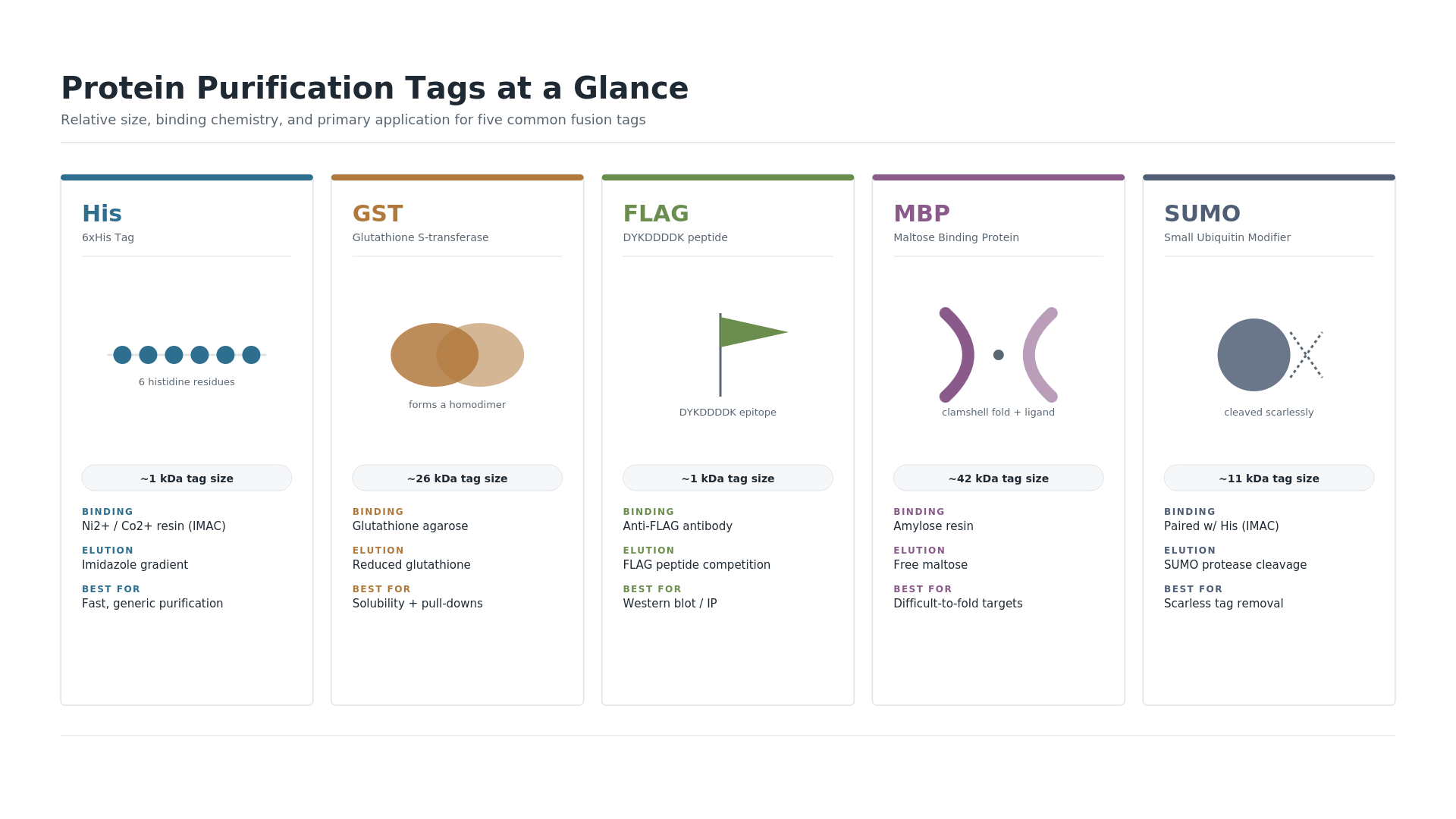
A stretch of six to ten consecutive histidine residues (most commonly a 6xHis tag: HHHHHH) fused to the N- or C-terminus of a recombinant protein. The His tag sequence works because histidine's imidazole ring coordinates with divalent metal ions.
His Tag Sequence & Size
- His tag molecular weight: ~0.8–1.2 kDa for a standard 6xHis tag (negligible compared to most target proteins)
- Rarely interferes with folding or activity due to its minimal size
His Tag Chromatography & Purification
- Method: Immobilized Metal Affinity Chromatography (IMAC) using Ni²⁺, Co²⁺, or Zn²⁺-charged resin (e.g., Ni-NTA)
- Load: cell lysate onto charged resin
- Wash: low imidazole (10–20 mM) to remove non-specific binders
- Elute: high imidazole (150–300 mM) or a pH shift
Vector & Resin Notes
- Most His-tagged constructs use pET-series vectors under T7 promoter control for high-yield E. coli expression
- Ni-NTA resin: high binding capacity, tolerates less imidazole before non-specific proteins wash off
- Cobalt resin (TALON): more selective binding, cleaner single-step purity, slightly lower capacity
Native vs. Denaturing Purification
- His tags can be purified even from inclusion bodies
- Solubilize in 6–8M urea or guanidine-HCl, then load onto Ni-NTA under denaturing conditions
- Elute denatured, or refold on-column by gradually removing the chaotrope
- This flexibility is why HIS-tag chromatography sees broader adoption than any solubility-domain tag, even though it doesn't solubilize a difficult protein on its own
One of the most common His-tag protein purification mistakes! Using EDTA or other metal chelators in your lysis or wash buffers. These compounds remove the metal ions from the resin, preventing your His-tagged protein from binding properly and reducing the resin's effectiveness.
What Is A GST Tag? Structure, Size & Purification
Glutathione S-transferase (GST) is a solubility and affinity tag originally characterized in the parasite Schistosoma japonicum.
GST Tag Structure & Size
- GST tag protein: a full enzymatic domain fused to the N-terminus of the target
- GST tag size: ~26 kDa (roughly 220 amino acids)
- GST tag molecular weight: ~26 kDa in the literature; native GST can dimerize, effectively doubling functional mass on the resin
GST Tag Purification
- Binding: glutathione-conjugated agarose or Sepharose beads
- Elution: excess free reduced glutathione (~10 mM, pH 8), gentle, near-physiological conditions that keep the protein folded and active
GST Fusion & Downstream Applications
- GST fusion promotes solubility: because GST folds independently and is highly soluble in E. coli, it "drags" poorly-behaved fusion partners into the soluble fraction
- Built on pGEX-series vectors, which include a built-in PreScission or thrombin cleavage site
- Common downstream uses:
- GST pull-downs to test binary protein-protein interactions
- GST-tagged bait screens against cell lysates to identify unknown binding partners
- In vitro kinase/enzymatic assays performed directly on-bead without elution
Limitation to Watch For
- GST naturally dimerizes, which can force artificial oligomerization onto fusion partners that don't dimerize on their own, a known confound in interaction studies
- Factor this in if your assay depends on the protein's native oligomeric state
What Is A FLAG Tag? Sequence, Size & Use Cases
An 8-amino-acid peptide with the sequence DYKDDDDK, developed specifically to be recognized by high-affinity monoclonal antibodies.
FLAG Tag Sequence & Size
- FLAG tag size: ~1 kDa (8 residues), rarely interferes with folding or function
- Highly hydrophilic and charged, so it stays surface-accessible even when fused internally
FLAG Detection & Purification
- FLAG-tagged protein detection/purification relies on antibody-based methods rather than metal or small-molecule chemistry:
- Western blot
- Immunoprecipitation
- Anti-FLAG affinity resin
- Elution: competitive elution with free FLAG peptide under gentle, near-native conditions; preserves protein activity better than low-pH antibody elution
Variants & Placement Flexibility
- 3xFLAG tag (three tandem repeats) boosts antibody sensitivity for detecting low-abundance, endogenous-level proteins
- Flexible placement (N-terminal, C-terminal, or internal) makes it useful for membrane proteins or multi-domain complexes where a bulky tag like GST or MBP would be impractical
- Common dual-tag strategy: FLAG + His, giving a robust primary IMAC purification plus a clean, antibody-verifiable secondary detection step
When to Choose FLAG? Choose FLAG when immunodetection is your priority, especially for techniques like co-IP, ChIP, and flow cytometry, instead of bulk protein purification.
What Is Maltose Binding Protein (MBP)? Sequence, Size & Purification
Maltose binding protein (MBP) is a bacterial protein used both as a solubility enhancer and an affinity tag.
Maltose Binding Protein Sequence & Structure
- Maltose binding protein tag sequence: derived from the E. coli malE gene
- Available in cytoplasmic and periplasmic-signal versions, so know which construct you're using
- Maltose binding protein structure: a two-domain, clamshell-shaped fold that closes around its maltose ligand
Maltose Binding Protein Size
- Molecular weight: ~40–43 kDa, the largest of the four tags covered here
- A real consideration for mass spec, crystallography, or NMR work, where a large fusion partner can obscure the target protein's own signal
Maltose Binding Protein Purification
- Binding: amylose resin
- Elution: free maltose (~10 mM), gentle, non-reducing, non-chelating conditions
- Unlike GST, MBP does not dimerize, and its elution buffer isn't a reducing agent, an advantage for proteins with structural disulfide bonds
Vector & Best Use Cases
- Built on pMAL-series vectors (pMAL-c for cytoplasmic, pMAL-p for periplasmic), with a built-in Factor Xa cleavage site
- Maltose binding protein fusion is a go-to strategy for chronically difficult targets:
- Membrane proteins
- Viral proteins
- Intrinsically disordered regions
- MBP-mediated crystallization: MBP's large, stable fold can nucleate crystal contacts for partners that wouldn't crystallize alone, often worth retaining the tag rather than cleaving it off
Why Choose A SUMO Tag?
Need a clean protein after tag removal? A SUMO tag is one of the best options.
- Leaves no extra amino acids after cleavage for a truly scarless result.
- Commonly paired with a His tag for simple purification followed by precise tag removal.
- SUMO proteases recognize the 3D structure of the SUMO tag, making unwanted cleavage highly unlikely.
- Works well in both bacterial and mammalian expression systems.
- Can also improve protein solubility without leaving a cleavage scar.
How To Choose The Right Protein Tag?
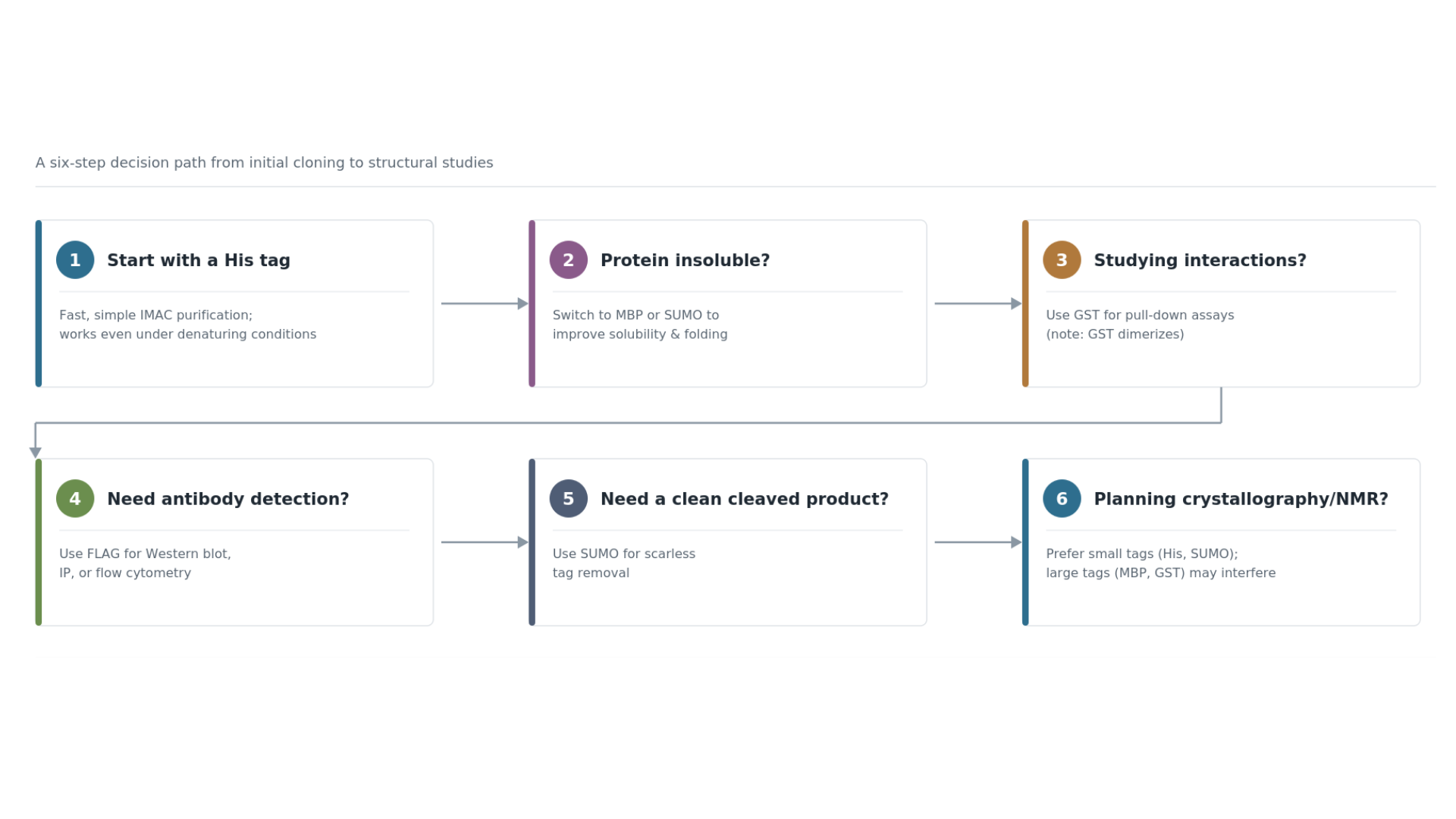
Step 1: Start with a His Tag
If you need fast, simple purification, a HIS tag is the best starting point. It works with a wide range of buffers, including denaturing conditions.
Step 2: Improve Protein Solubility
If your protein is insoluble or forms aggregates, switch to an MBP or SUMO tag. Both can improve solubility and reduce the need for refolding from inclusion bodies.
Step 3: Study Protein Interactions
For protein-protein interaction studies, choose a GST tag. It is widely used for pull-down assays, but keep in mind that GST naturally forms dimers, which may influence some experiments.
Step 4: Optimize Antibody Detection
When antibody-based detection is your priority, use a FLAG tag. Its small size helps minimize interference with your protein's structure and function.
Step 5: Remove the Tag Cleanly
If you need a protein without any leftover amino acids after cleavage, use a SUMO fusion. SUMO proteases remove the tag cleanly, leaving a native protein sequence.
Step 6: Plan for Structural Studies
For crystallography or NMR, smaller tags like HIS or SUMO are usually better choices. Larger tags such as MBP and GST may affect structural analysis.
Protein Tag Troubleshooting: Common Problems And Fixes
Most protein tag issues have straightforward causes. Start with the symptom, then work through the possible fixes below.
His Tag Issues
- Why isn't my His-tagged protein binding to the Ni-NTA column?
This is usually caused by metal chelators such as EDTA or citrate in your lysis or wash buffers. Even small amounts can strip nickel ions from the resin and prevent binding.
Also, confirm that the His tag is still present and accessible. If the tag is buried inside the folded protein or removed because of truncation, binding efficiency will be poor. A Western blot can help verify tag expression.
- Why is my His-tagged protein degraded after purification?
Protein degradation is often caused by protease activity during cell lysis, not by the His tag itself.
Use protease inhibitors that do not contain EDTA, keep samples cold throughout purification, and minimize processing time to reduce degradation.
GST Tag Issues
- Why is my GST fusion protein still insoluble?
Although GST often improves protein solubility, it cannot prevent aggregation in every case, especially with large or highly disordered proteins.
Before changing tags, try lowering the induction temperature (16 to 18°C) and reducing the IPTG concentration. These adjustments often improve soluble expression.
- Why isn't my GST-tagged protein eluting from glutathione beads?
The most common reason is old or oxidized glutathione. Make sure you're using fresh, properly reduced glutathione at the recommended concentration.
Also check whether the beads have been over-washed with high-salt buffers, which can weaken GST-glutathione binding.
FLAG Tag Issues
- Why can't I detect my FLAG-tagged protein on a Western blot?
First, verify you're using the correct antibody clone. For example, M1 antibodies require an N-terminal FLAG tag and calcium, while M2 antibodies recognize a wider range of FLAG-tagged proteins.
Also check that the FLAG epitope wasn't removed during sample preparation or cloning.
MBP Tag Issues
- Why is my MBP-tagged protein still insoluble?
Start by confirming that you're using the correct expression construct, especially if your experiment requires cytoplasmic or periplasmic expression.
If the construct is correct, try lowering the induction temperature and inducing expression at a lower cell density to improve folding.
Tag Cleavage Issues
- Why won't my protein tag cleave completely?
Incomplete cleavage often happens because the cleavage site is difficult for the protease to access, especially when it's too close to the folded protein.
Adding a flexible glycine-serine linker between the tag and the cleavage site can improve accessibility. If you need scarless tag removal, consider using a SUMO fusion, which allows highly specific cleavage without leaving extra amino acids behind.
Final Thought
There's no single "best" protein tag, only the one that best fits your protein, expression system, and downstream application. Choosing the right tag early can improve purification, solubility, detection, and overall experimental success while reducing unnecessary troubleshooting.
At AAA Biotech, we offer high-quality recombinant proteins, affinity purification reagents, and research-grade tools to support every stage of your protein expression and purification workflow. Explore our products or contact our technical team to find the right solution for your research.
Faq's
Why does only the GST control protein bind to my MBP-tagged protein in a pull-down assay?
This often indicates non-specific binding between GST and the MBP-tagged protein or the resin itself. Include proper negative controls, optimize washing conditions, and confirm interactions using an independent method such as co-immunoprecipitation or surface plasmon resonance.
How can I reduce non-specific protein binding in a GST pull-down experiment?
Reduce non-specific binding by increasing wash stringency, adding mild detergents or salt to the wash buffer, and blocking the resin before use. Including appropriate negative controls also helps distinguish true protein interactions from background binding.
Can I cleave a GST-tagged protein if my expression vector does not contain a protease cleavage site?
Not directly. If your vector lacks a built-in cleavage sequence, the GST tag cannot be removed without redesigning the construct. For future experiments, choose vectors that include TEV, PreScission, or thrombin cleavage sites.
Why is my GST fusion protein appearing in the flow-through or wash fractions?
This usually happens when the protein fails to bind efficiently to glutathione resin. Common causes include low GST expression, degraded fusion protein, overloaded resin, or incorrect binding buffer conditions. Confirm protein integrity before purification.
How do I separate my target protein from GST after PreScission protease cleavage?
After cleavage, pass the sample over fresh glutathione resin. The free GST tag and GST-tagged protease bind to the resin, while your cleaved target protein is collected in the flow-through with minimal contamination.
What is FLAG-tagged protein immunoprecipitation?
FLAG immunoprecipitation uses anti-FLAG antibodies attached to beads to capture FLAG-tagged proteins and their interacting partners. It is commonly used for protein interaction studies, complex isolation, and downstream Western blot or mass spectrometry analysis.
Can I use more than one protein tag on the same recombinant protein?
Yes. Dual-tag strategies such as His-FLAG or His-SUMO combine the strengths of different tags. This approach can simplify purification, improve detection, and allow efficient tag removal when needed.
Lead Clinical Research Coordinator (LCRC)
Cynthia Lee is the President of AAA Biotech and specializes in understanding highly validated and characterized monoclonal/polyclonal antibodies, recombinant proteins, and ELISA kits.
Related Posts