
 Application Data
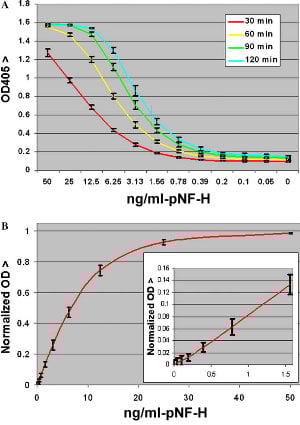
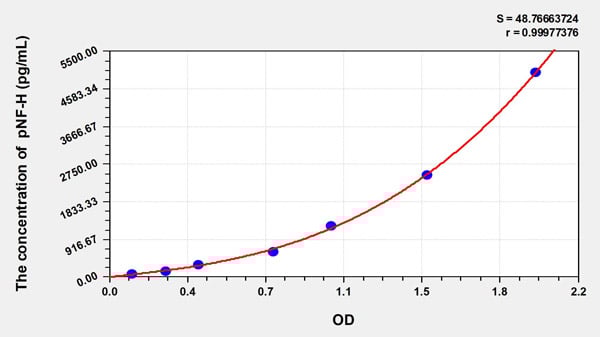
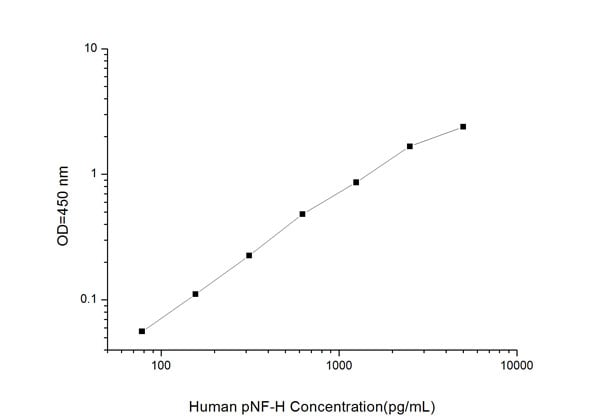
(Prototype ELISA characterization. (A) Standard curves obtained with 1:1 serial dilutions of pure pNF-H, starting at 50 ng/ml, applied to ELISA plates coated with of NF-H, and binding of pNF-H detected with NF-H. Data show average of 16 determinations, & error bars show one standard deviation. (B) Shows normalized data for 1H development time, & the inset shows the data obtained at very low levels of pNF-H. Biochemical and Biophysical Research Communications 336 (2005) 1268-1277.)
Application Data
(Prototype ELISA characterization. (A) Standard curves obtained with 1:1 serial dilutions of pure pNF-H, starting at 50 ng/ml, applied to ELISA plates coated with of NF-H, and binding of pNF-H detected with NF-H. Data show average of 16 determinations, & error bars show one standard deviation. (B) Shows normalized data for 1H development time, & the inset shows the data obtained at very low levels of pNF-H. Biochemical and Biophysical Research Communications 336 (2005) 1268-1277.)
pNF-H elisa kit
pNF-H Sandwich ELISA Kit
Reactivity
Human, Mouse, Rat, Bovine, Cat, Porcine
Applications
ELISA
Synonyms
pNF-H; N/A; pNF-H Sandwich ELISA Kit; pNF-H elisa kit
Reactivity
Human, Mouse, Rat, Bovine, Cat, Porcine
Applicable Applications for pNF-H elisa kit
ELISA
Preparation and Storage
Store at 4 degree C-8 degree C short term. Store at -20 degree C for long term.
Application Data
(Prototype ELISA characterization. (A) Standard curves obtained with 1:1 serial dilutions of pure pNF-H, starting at 50 ng/ml, applied to ELISA plates coated with of NF-H, and binding of pNF-H detected with NF-H. Data show average of 16 determinations, & error bars show one standard deviation. (B) Shows normalized data for 1H development time, & the inset shows the data obtained at very low levels of pNF-H. Biochemical and Biophysical Research Communications 336 (2005) 1268-1277.)
Application Data
(Prototype ELISA characterization. (A) Standard curves obtained with 1:1 serial dilutions of pure pNF-H, starting at 50 ng/ml, applied to ELISA plates coated with of NF-H, and binding of pNF-H detected with NF-H. Data show average of 16 determinations, & error bars show one standard deviation. (B) Shows normalized data for 1H development time, & the inset shows the data obtained at very low levels of pNF-H. Biochemical and Biophysical Research Communications 336 (2005) 1268-1277.)
Related Product Information for pNF-H elisa kit
Background/Introduction: This is an enzyme linked immunosorbent assay (ELISA) for the sensitive detection of pNF-H, one of the major proteins of the axon. When neurological disease or injury occurs, pNF-H leaks from damaged axons into the cerebrospinal fluid and blood, and can be detected by ELISAs such as this one. The level of pNF-H detected can give information about the degree of injury, the progression and recovery state and response of an individual to therapies. The kit can be used to quantify levels of this protein in tissue extracts, in cells in tissue culture in cerebrospinal fluid (CSF) and blood. It has been shown to detect pNF-H, released from damaged or degenerating axons in a variety of animal models of human disease and also in several human disease states. The kit has been shown to work in human, pig, rat, mouse, cat and dog, and is expected to work in many other species also. The intermediate or 10nm filament protein/gene superfamily which also includes the keratins, the major structural proteins of skin. Neurofilaments are generally regarded as being composed of three major protein subunits referred to as NF-L, NF-M and NF-H. NF-L is the "low" or "light" subunit, NF-M is the "medium" or "middle" subunit and NF-H is the "heavy" or "high" subunit. This nomenclature is based on the apparent size of these proteins on SDS-PAGE gels, on which NF-L is typically ~68 kDa, NF-M is ~150 kDa and NF-H is ~200 kDa. The three proteins were discovered in the 1970s as a result of studies of axonally transported proteins internexin, a.k.a NF66, which was discovered a little later as a protein which copurifies with the neurofilament triplet proteins (Pachter and Liem 1985). A fifth protein, peripherin, is found in some neurofilaments along with the other four proteins, mostly in the peripheral nervous system (Portier et al. 1983). Neurofilaments are major proteins of neurons and are particularly concentrated in axons. The protein NF-H has some very unusual properties. Firstly, it contain 50 back to back hexa, hepta or octapeptide repeats each containing the sequence Lysine- Serine-Proline (KSP). The serine residues in these peptide repeats are in vivo phosphorylation sites, and, in axonal neurofilaments, these sites are heavily phosphorylated. The phosphorylated forms of NF-H are also quite resistant to proteases, which suggests that on being released from damaged and diseased axons, this very abundant protein might be particularly resistant to proteases. This means that detection of this protein in cerebrospinal fluid (CSF) and blood would provide information about the degree of axonal injury which has occurred (reviewed in Petzold 2005). The pNF-H protein can be detected in quite large amounts following experimental spinal cord and brain injury in rats (Shaw et al. 2005). Levels of greater than 100 ng/mL of pNF-H were detectable in blood following serious spinal cord injury and lower but still easily detectable levels were seen in blood of animals given experimental brain injury. More recent studies have revealed considerable amounts of this protein in the blood of mice transgenic for mutations of human copper/zinc superoxide dismutase 1 which are associated with amyotrophic lateral sclerosis (ALS, Boylan et al. 2008). These mice develop an axonal degeneration pathology similar to that seen in humans with ALS, and blood pNF-H levels can be used to monitor this. Interestingly, pNF-H is detectable before the onset of obvious disease symptoms. Other studies show that pNF-H can be detected in tissue homogenates. Other experiments show that pNF-H can be detected in the plasma of humans suffering from optic neuritis (Petzold et al 2004) and in elevated levels in the cerebrospinal fluid (CSF) of individuals suffering from brain tumors and stroke (Petzold and Shaw 2007). More recent work has shown that the original pNFH ELISA can detect informative levels of pNF-H in the blood and CSF of a variety of CNS damage and disease states, such patients suffering from aneurysmal subarachnoid hemorrhage (Lewis et al. 2008), animal models of Multiple Sclerosis (Gresle et al. 2008), animal models of traumatic brain injury (Anderson et al. 2008), patients with Leber's hereditary optic neuropathy (Guy et al. 2008) and both animal models and patients with ALS (Boylan et al. 2009). The Boylan et al. study described a novel pNF-H ELISA that was developed making use of two monoclonal antibodies to pNF-H.
Customer Reviews
Loading reviews...
Share Your Experience
Similar Products


Product Notes
The Human, Mouse, Rat, Bovine, Cat, Porcine pNF-H (Catalog #AAA76621) is an ELISA Kit and is intended for research purposes only. The product is available for immediate purchase. The AAA76621 ELISA Kit recognizes Human, Mouse, Rat, Bovine, Cat, Porcine pNF-H. AAA Biotech's pNF-H can be used in a range of immunoassay formats including, but not limited to, ELISA. Researchers should empirically determine the suitability of the pNF-H for an application not listed in the data sheet. Researchers commonly develop new applications and it is an integral, important part of the investigative research process. It is sometimes possible for the material contained within the vial of "pNF-H, ELISA Kit" to become dispersed throughout the inside of the vial, particularly around the seal of said vial, during shipment and storage. We always suggest centrifuging these vials to consolidate all of the liquid away from the lid and to the bottom of the vial prior to opening. Please be advised that certain products may require dry ice for shipping and that, if this is the case, an additional dry ice fee may also be required.Precautions
All products in the AAA Biotech catalog are strictly for research-use only, and are absolutely not suitable for use in any sort of medical, therapeutic, prophylactic, in-vivo, or diagnostic capacity. By purchasing a product from AAA Biotech, you are explicitly certifying that said products will be properly tested and used in line with industry standard. AAA Biotech and its authorized distribution partners reserve the right to refuse to fulfill any order if we have any indication that a purchaser may be intending to use a product outside of our accepted criteria.Disclaimer
Though we do strive to guarantee the information represented in this datasheet, AAA Biotech cannot be held responsible for any oversights or imprecisions. AAA Biotech reserves the right to adjust any aspect of this datasheet at any time and without notice. It is the responsibility of the customer to inform AAA Biotech of any product performance issues observed or experienced within 30 days of receipt of said product. To see additional details on this or any of our other policies, please see our Terms & Conditions page.Item has been added to Shopping Cart
If you are ready to order, navigate to Shopping Cart and get ready to checkout.