
 Application Data
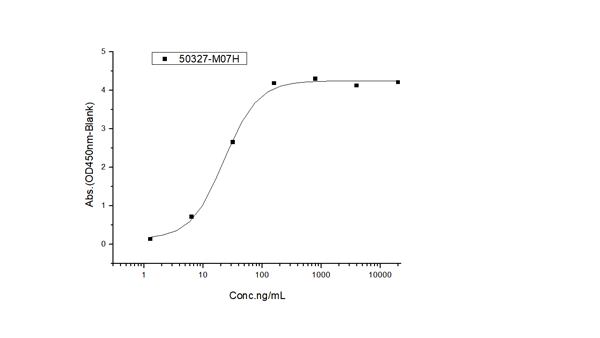
(Immobilized Recombinant Mouse CD40 / TNFRSF5 Protein (Fc Tag) (Cat:50324-M02H) at 2ug/mL (100uL/well) can bind Recombinant Mouse CD40 Ligand Protein (ECD, His Tag) (Cat:AAA259249), the EC50 is 14-36 ng/mL.)
Application Data
(Immobilized Recombinant Mouse CD40 / TNFRSF5 Protein (Fc Tag) (Cat:50324-M02H) at 2ug/mL (100uL/well) can bind Recombinant Mouse CD40 Ligand Protein (ECD, His Tag) (Cat:AAA259249), the EC50 is 14-36 ng/mL.)
CD40 Ligand/TNFSF5 Recombinant Protein | CD40 recombinant protein
CD40 Ligand/TNFSF5 Protein, Mouse, Recombinant (ECD, His Tag)
Gene Names
Cd40lg; IGM; IMD3; Ly62; TRAP; gp39; CD154; Cd40l; HIGM1; Ly-62; T-BAM; CD40-L; Tnfsf5; Tnlg8b
Purity
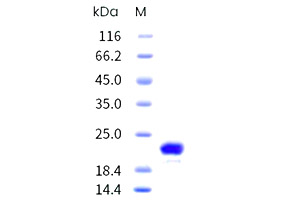
>= 95% as determined by SDS-PAGE.
Synonyms
CD40 Ligand/TNFSF5; N/A; CD40 Ligand/TNFSF5 Protein, Mouse, Recombinant (ECD, His Tag); CD40 ligand; CD154 Protein, Mouse; CD40-L Protein, Mouse; Cd40l Protein, Mouse; gp39 Protein, Mouse; HIGM1 Protein, Mouse; IGM Protein, Mouse; IMD3 Protein, Mouse; Ly-62 Protein, Mouse; Ly62 Protein, Mouse; T-BAM Protein, Mouse; Tnfsf5 Protein, Mouse; TRAP Protein, Mouse; CD40 recombinant protein
Host
HEK293 Cells
Purity/Purification
>= 95% as determined by SDS-PAGE.
Form/Format
Lyophilized from sterile PBS, pH 7.4.
Normally 5%-8% trehalose, mannitol and 0.01% Tween80 are added as protectants before lyophilization.
Normally 5%-8% trehalose, mannitol and 0.01% Tween80 are added as protectants before lyophilization.
Species
Mouse
Predicted N Terminal
His
Endotoxin
<1.0 EU per ug protein as determined by the LAL method.
Protein Construction
A DNA sequence encoding the Mouse CD40LG (P27548)(Gly115-Leu260) was expressed, with a polyhistidine tag at the N-terminus.
Activity
Immobilized Recombinant Mouse CD40/TNFRSF5 Protein (Fc Tag)(Cat:50324-M02H) at 2ug/mL (100uL/well) can bind Recombinant Mouse CD40 Ligand Protein (ECD, His Tag)(Cat:50327-M07H), the EC50 is 14-36 ng/mL.
Preparation and Storage
Samples are stable for up to twelve months from date of receipt at -20 degree C to -80 degree C. Store it under sterile conditions at -20 degree C to -80 degree C. It is recommended that the protein be aliquoted for optimal storage. Avoid repeated freeze-thaw cycles.
Application Data
(Immobilized Recombinant Mouse CD40 / TNFRSF5 Protein (Fc Tag) (Cat:50324-M02H) at 2ug/mL (100uL/well) can bind Recombinant Mouse CD40 Ligand Protein (ECD, His Tag) (Cat:AAA259249), the EC50 is 14-36 ng/mL.)
Application Data
(Immobilized Recombinant Mouse CD40 / TNFRSF5 Protein (Fc Tag) (Cat:50324-M02H) at 2ug/mL (100uL/well) can bind Recombinant Mouse CD40 Ligand Protein (ECD, His Tag) (Cat:AAA259249), the EC50 is 14-36 ng/mL.)
Application Data
Application Data
Related Product Information for CD40 recombinant protein
The cluster of differentiation (CD) system is commonly used as cell markers in immunophenotyping. Different kinds of cells in the immune system can be identified through the surface CD molecules which associating with the immune function of the cell. There are more than 320 CD unique clusters and subclusters have been identified. Some of the CD molecules serve as receptors or ligands important to the cell through initiating a signal cascade which then alter the behavior of the cell. Some CD proteins do not take part in cell signal process but have other functions such as cell adhesion. CD154, also known as CD40 ligand or CD40L, is a member of the TNF superfamily. While CD154 was originally found on T cell surface, its expression has since been found on a wide variety of cells, including platelets, mast cells, macrophages and NK cells. CD154's ability is achieved through binding to the CD40 on antigen-presenting cells (APC). In the macrophage cells, the primary signal for activation is IFN-gamma from Th1 type CD4 T cells. The secondary signal is CD40L on the T cell, which interacting with the CD40 molecules, helping increase the level of activation.
References
Zola H, et al. (2007) CD molecules 2006-human cell differentiation molecules. J Immunol Methods. 318 (1-2): 1-5.
Ho IC, et al. (2009) GATA3 and the T-cell lineage: essential functions before and after T-helper-2-cell differentiation. Nat Rev Immunol. 9 (2): 125-35.
Matesanz-Isabel J, et al. (2011) New B-cell CD molecules. Immunology Letters.134 (2): 104-12.Grewal IS, et al. (1998) CD40 and CD154 in cell-mediated immunity. Annual Review of Immunology. 16: 111-35.
Ho IC, et al. (2009) GATA3 and the T-cell lineage: essential functions before and after T-helper-2-cell differentiation. Nat Rev Immunol. 9 (2): 125-35.
Matesanz-Isabel J, et al. (2011) New B-cell CD molecules. Immunology Letters.134 (2): 104-12.Grewal IS, et al. (1998) CD40 and CD154 in cell-mediated immunity. Annual Review of Immunology. 16: 111-35.
NCBI and Uniprot Product Information
NCBI GI #
NCBI GeneID
NCBI Accession #
NCBI GenBank Nucleotide #
UniProt Accession #
Molecular Weight
29,370 Da
NCBI Official Full Name
CD40 ligand
NCBI Official Synonym Full Names
CD40 ligand
NCBI Official Symbol
Cd40lg
NCBI Official Synonym Symbols
IGM; IMD3; Ly62; TRAP; gp39; CD154; Cd40l; HIGM1; Ly-62; T-BAM; CD40-L; Tnfsf5; Tnlg8b
NCBI Protein Information
CD40 ligand
UniProt Protein Name
CD40 ligand
UniProt Gene Name
Cd40lg
UniProt Synonym Gene Names
Cd40l; Tnfsf5; CD40-L; TRAP
UniProt Entry Name
CD40L_MOUSE
Customer Reviews
Loading reviews...
Share Your Experience
Similar Products


Product Notes
The CD40 cd40lg (Catalog #AAA259249) is a Recombinant Protein produced from HEK293 Cells and is intended for research purposes only. The product is available for immediate purchase. It is sometimes possible for the material contained within the vial of "CD40 Ligand/TNFSF5, Recombinant Protein" to become dispersed throughout the inside of the vial, particularly around the seal of said vial, during shipment and storage. We always suggest centrifuging these vials to consolidate all of the liquid away from the lid and to the bottom of the vial prior to opening. Please be advised that certain products may require dry ice for shipping and that, if this is the case, an additional dry ice fee may also be required.Precautions
All products in the AAA Biotech catalog are strictly for research-use only, and are absolutely not suitable for use in any sort of medical, therapeutic, prophylactic, in-vivo, or diagnostic capacity. By purchasing a product from AAA Biotech, you are explicitly certifying that said products will be properly tested and used in line with industry standard. AAA Biotech and its authorized distribution partners reserve the right to refuse to fulfill any order if we have any indication that a purchaser may be intending to use a product outside of our accepted criteria.Disclaimer
Though we do strive to guarantee the information represented in this datasheet, AAA Biotech cannot be held responsible for any oversights or imprecisions. AAA Biotech reserves the right to adjust any aspect of this datasheet at any time and without notice. It is the responsibility of the customer to inform AAA Biotech of any product performance issues observed or experienced within 30 days of receipt of said product. To see additional details on this or any of our other policies, please see our Terms & Conditions page.Item has been added to Shopping Cart
If you are ready to order, navigate to Shopping Cart and get ready to checkout.