
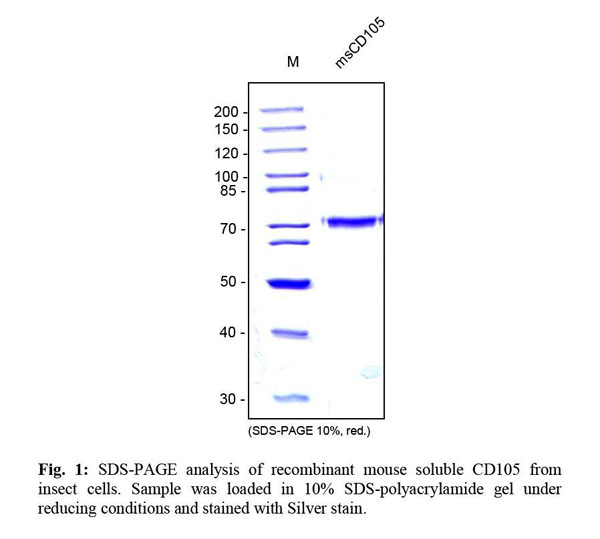
 Application Data
CD105/Endoglin, soluble Active Protein | CD105/Endoglin active protein
Mouse CD105/Endoglin, soluble
Gene Names
Eng; Endo; CD105; AI528660; AI662476; S-endoglin
Reactivity
Mouse
Purity
> 90% by SDS-PAGE & silver stain
Synonyms
CD105/Endoglin, soluble; N/A; Mouse CD105/Endoglin, soluble; Recombinant Mouse Soluble CD105/Endoglin; Cell surface MJ7/18 antigen; CD105; Endoglin; CD105/Endoglin active protein
Host
Insect Cells
Reactivity
Mouse
Purity/Purification
> 90% by SDS-PAGE & silver stain
Form/Format
Lyophilized
Sequence
ERVGCDLQPV DPTRGEVTFT TSQVSEGCVA QAANAVREVH VLFLDFPGML SHLELTLQAS KQNGTETQEV FLVLVSNKNV FVKFQAPEIP LHLAYDSSLV IFQGQPRVNI TVLPSLTSRK QILDWAATKG AITSIAALDD PQSIVLQLGQ DPKAPFLCLP EAHKDMGATL EWQPRAQTPV QSCRLEGVSG HKEAYILRIL PGSEAGPRTV TVMMELSCTS GDAILILHGP PYVSWFIDIN HSMQILTTGE YSVKIFPGSK DKGVELPDTP QGLIAEARKL NASIVTSFVE LPLVSNVSLR ASSCGGVFQT TPAPVVTTPP KDTCSPVLLM SLIQPKCGNQ VMTLALNKKH VQTLQCTITG LTFWDSSCQA EDTDDHLVLS SAYSSCGMKV TAHVVSNEVI ISFPSGSPPL RKKVQCIDMD SLSFQLGLYL SPHFLQASNT IELGQQAFVQ VSVSPLTSEV TVQLDSCHLD LGPEGDMVEL IQSRTAKGSC VTLLSPSPEG DPRFSFLLRV YMVPTPTAGT LSCNLALRPS TLSQEVYKTV SMRLNIVSPD LSHHHHHH
Sequence Length
558
Gene
Egn
Stabilizer
None
Reconstitution
The lyophilized sCD105 is soluble in water and most aqueous buffers. The lyophilized sCD105 should be reconstituted in PBS or medium to a concentration not lower than 50ug/ml.
Buffer
PBS
Biological Activity
Not tested so far
Preparation and Storage
Lyophilized samples are stable for greater than six months at -20 degree C to -70 degree C. Reconstituted sCD105 should be stored in working aliquots at -20 degree C.
Application Data
Application Data
Related Product Information for CD105/Endoglin active protein
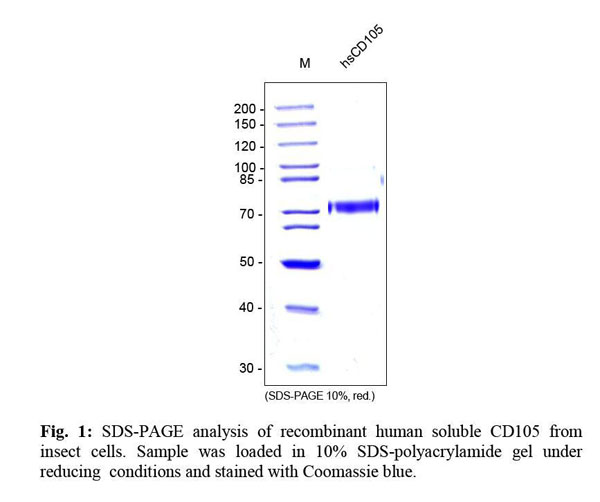
A DNA sequence encoding the extracellular domain of mouse Endoglin (Met 1 - Gly 581) was expressed in insect cells. Mouse Endoglin is a disulfide-linked homodimeric protein. Based on N-terminal sequence analysis, the primary structure of recombinant mature Endoglin starts at Glu 26. Endoglin has a calculated monomeric molecular mass of 61 kDa but as a result of glycosylation, migrates at approximately 75 - 85 kDa under reducing conditions in SDS-PAGE. Endoglin, also known as CD105, is a Type I integral membrane glycoprotein with a large, disulfide-linked, extracellular region and a short, constitutively phosphorylated, cytoplasmic tail. Two splice variants of human endoglin, the S-endoglin and L-endoglin that differ in the length of their cytoplasmic tails have been identified. Endoglin is highly expressed on vascular endothelial cells, chondrocytes, and syncytiotrophoblasts of term placenta. It is also found on activated monocytes, bone marrow pro-erythroblasts, and leukemic cells of lymphoid and myeloid lineages. Human and mouse endoglin share approximately 70% and 97 % amino acid sequence identity in their extracellular and intracellular domains, respectively. In common with betaglycan (also named TbetaRIII), a proteoglycan that shares regions of sequence similarity, endoglin is an accessory receptor for the TGF-ï¢ superfamily ligands. Endoglin does not bind ligands by itself, but does so by associating with a ligand-binding serine/threonine kinase receptor. Endoglin binds TGF-ï¢1 and TGF-ï¢3 but not TGF-ï¢2 efficiently by associating with TGF-ï¢ type II receptor (TbetaRII). It interacts with activin-A and BMP-7 using either the activin type II or type IIB receptors. In the case of BMP-2 which binds directly to the type I but not the type II BMP receptor, endoglin binds via either BMPR-IA (ALK-3) or BMPR-1B (ALK-6). Although the consequence of endoglin interactions on the functions of TGF-ï¢ family ligands is poorly understood, endoglin has clearly been shown to be required for angiogenesis and to play a key role in heart development. Mutations in human endoglin or ALK-1 (another type I serine/threonine receptor) lead to the vascular disorder hereditary hemorrhagic telangiectasia (HHT). Mice heterozygous for endoglin have been developed as disease models for HHT. Endoglin has been shown to be a powerful marker of neovascularization. It is also useful as a functional marker that defines long-term repopulating hematopoietic stem cells.
Product Categories/Family for CD105/Endoglin active protein
References
1. Cheifetz et al., J Biol Chem 267:19027, 1992 2. Parker et al., J Bone Miner Res 18:289, 2003 3. Barbara et al., J Biol Chem 274:584, 1999 4. McAllister et al., Nature Genet 8:345, 1994 5. Chen et al., Proc Natl Acad Sci 99:15468, 2002
NCBI and Uniprot Product Information
NCBI GI #
NCBI GeneID
NCBI Accession #
NCBI GenBank Nucleotide #
Molecular Weight
70-75 kDa
NCBI Official Full Name
endoglin isoform 1
NCBI Official Synonym Full Names
endoglin
NCBI Official Symbol
Eng
NCBI Official Synonym Symbols
Endo; CD105; AI528660; AI662476; S-endoglin
NCBI Protein Information
endoglin; transmembrane glycoprotein; cell surface MJ7/18 antigen
UniProt Protein Name
Endoglin
UniProt Gene Name
Eng
UniProt Synonym Gene Names
Edg
UniProt Entry Name
EGLN_MOUSE
Customer Reviews
Loading reviews...
Share Your Experience
Similar Products




Product Notes
The CD105/Endoglin eng (Catalog #AAA79282) is an Active Protein produced from Insect Cells and is intended for research purposes only. The product is available for immediate purchase. The Mouse CD105/Endoglin, soluble reacts with Mouse and may cross-react with other species as described in the data sheet. The amino acid sequence is listed below: ERVGCDLQPV DPTRGEVTFT TSQVSEGCVA QAANAVREVH VLFLDFPGML SHLELTLQAS KQNGTETQEV FLVLVSNKNV FVKFQAPEIP LHLAYDSSLV IFQGQPRVNI TVLPSLTSRK QILDWAATKG AITSIAALDD PQSIVLQLGQ DPKAPFLCLP EAHKDMGATL EWQPRAQTPV QSCRLEGVSG HKEAYILRIL PGSEAGPRTV TVMMELSCTS GDAILILHGP PYVSWFIDIN HSMQILTTGE YSVKIFPGSK DKGVELPDTP QGLIAEARKL NASIVTSFVE LPLVSNVSLR ASSCGGVFQT TPAPVVTTPP KDTCSPVLLM SLIQPKCGNQ VMTLALNKKH VQTLQCTITG LTFWDSSCQA EDTDDHLVLS SAYSSCGMKV TAHVVSNEVI ISFPSGSPPL RKKVQCIDMD SLSFQLGLYL SPHFLQASNT IELGQQAFVQ VSVSPLTSEV TVQLDSCHLD LGPEGDMVEL IQSRTAKGSC VTLLSPSPEG DPRFSFLLRV YMVPTPTAGT LSCNLALRPS TLSQEVYKTV SMRLNIVSPD LSHHHHHH. It is sometimes possible for the material contained within the vial of "CD105/Endoglin, soluble, Active Protein" to become dispersed throughout the inside of the vial, particularly around the seal of said vial, during shipment and storage. We always suggest centrifuging these vials to consolidate all of the liquid away from the lid and to the bottom of the vial prior to opening. Please be advised that certain products may require dry ice for shipping and that, if this is the case, an additional dry ice fee may also be required.Precautions
All products in the AAA Biotech catalog are strictly for research-use only, and are absolutely not suitable for use in any sort of medical, therapeutic, prophylactic, in-vivo, or diagnostic capacity. By purchasing a product from AAA Biotech, you are explicitly certifying that said products will be properly tested and used in line with industry standard. AAA Biotech and its authorized distribution partners reserve the right to refuse to fulfill any order if we have any indication that a purchaser may be intending to use a product outside of our accepted criteria.Disclaimer
Though we do strive to guarantee the information represented in this datasheet, AAA Biotech cannot be held responsible for any oversights or imprecisions. AAA Biotech reserves the right to adjust any aspect of this datasheet at any time and without notice. It is the responsibility of the customer to inform AAA Biotech of any product performance issues observed or experienced within 30 days of receipt of said product. To see additional details on this or any of our other policies, please see our Terms & Conditions page.Item has been added to Shopping Cart
If you are ready to order, navigate to Shopping Cart and get ready to checkout.