


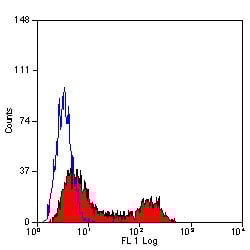

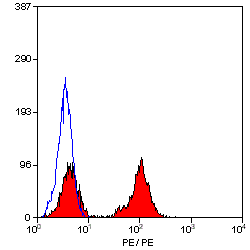
 Application Data
(Staining of human peripheral blood lymphocytes with RAT ANTI HUMAN CD28:RPE)
Application Data
(Staining of human peripheral blood lymphocytes with RAT ANTI HUMAN CD28:RPE)
Rat anti-Human CD28 Monoclonal Antibody | anti-CD28 antibody
CD28 (CD28 Antigen, CD28 Molecule, MGC138290, T cell Antigen CD28, T cell Specific Surface Glycoprotein, T cell Specific Surface Glycoprotein CD28, Tp44) (MaxLight 405)
Application Data
(Staining of human peripheral blood lymphocytes with RAT ANTI HUMAN CD28:RPE)
Application Data
(Staining of human peripheral blood lymphocytes with RAT ANTI HUMAN CD28:RPE)
Application Data
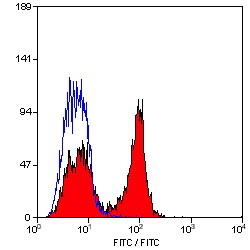
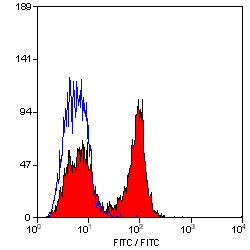
(Staining of human peripheral blood lymphocytes with RAT ANTI HUMAN CD28:FITC)
Application Data
(Staining of human peripheral blood lymphocytes with RAT ANTI HUMAN CD28:FITC)
Application Data
(Staining of human peripheral blood lymphocytes with RAT ANTI HUMAN CD28: AZIDE FREE)
Application Data
(Staining of human peripheral blood lymphocytes with RAT ANTI HUMAN CD28: AZIDE FREE)
Application Data
(Staining of human peripheral blood lymphocytes with RAT ANTI HUMAN CD28: Alexa Fluor® 647)
Application Data
(Staining of human peripheral blood lymphocytes with RAT ANTI HUMAN CD28: Alexa Fluor® 647)
Application Data
(Staining of human peripheral blood lymphocytes with RAT ANTI HUMAN CD28)
Application Data
(Staining of human peripheral blood lymphocytes with RAT ANTI HUMAN CD28)
Application Data
(MCA709B staining of human peripheral blood lymphocytes)
Application Data
(MCA709B staining of human peripheral blood lymphocytes)
Customer Reviews
Loading reviews...
Share Your Experience
Similar Products



Product Notes
The CD28 (Catalog #AAA26779) is an Antibody produced from Rat and is intended for research purposes only. The product is available for immediate purchase. The CD28 (CD28 Antigen, CD28 Molecule, MGC138290, T cell Antigen CD28, T cell Specific Surface Glycoprotein, T cell Specific Surface Glycoprotein CD28, Tp44) (MaxLight 405) reacts with Human and may cross-react with other species as described in the data sheet. AAA Biotech's CD28 can be used in a range of immunoassay formats including, but not limited to, FCM/FACS (Flow Cytometry), IHC (Immunohistochemistry). Researchers should empirically determine the suitability of the CD28 for an application not listed in the data sheet. Researchers commonly develop new applications and it is an integral, important part of the investigative research process. It is sometimes possible for the material contained within the vial of "CD28, Monoclonal Antibody" to become dispersed throughout the inside of the vial, particularly around the seal of said vial, during shipment and storage. We always suggest centrifuging these vials to consolidate all of the liquid away from the lid and to the bottom of the vial prior to opening. Please be advised that certain products may require dry ice for shipping and that, if this is the case, an additional dry ice fee may also be required.Precautions
All products in the AAA Biotech catalog are strictly for research-use only, and are absolutely not suitable for use in any sort of medical, therapeutic, prophylactic, in-vivo, or diagnostic capacity. By purchasing a product from AAA Biotech, you are explicitly certifying that said products will be properly tested and used in line with industry standard. AAA Biotech and its authorized distribution partners reserve the right to refuse to fulfill any order if we have any indication that a purchaser may be intending to use a product outside of our accepted criteria.Disclaimer
Though we do strive to guarantee the information represented in this datasheet, AAA Biotech cannot be held responsible for any oversights or imprecisions. AAA Biotech reserves the right to adjust any aspect of this datasheet at any time and without notice. It is the responsibility of the customer to inform AAA Biotech of any product performance issues observed or experienced within 30 days of receipt of said product. To see additional details on this or any of our other policies, please see our Terms & Conditions page.Frequently Asked Questions
What does CD28 stand for?
CD28 stands for Cluster of Differentiation 28, also known as T-cell-specific surface glycoprotein CD28. It's a critical costimulatory molecule expressed on T cells that works together with the T cell receptor to provide signals essential for optimal T cell activation and proliferation.
What drugs are anti-CD38 monoclonal antibodies and do?
Daratumumab (Darzalex) is the primary FDA-approved anti-CD38 monoclonal antibody used for treating multiple myeloma. It binds CD38 on tumor cells, inducing apoptosis through antibody-dependent cellular cytotoxicity, complement-dependent cytotoxicity, and cellular phagocytosis. Isatuximab is another anti-CD38 antibody with similar mechanisms.
Which species does this CD28 antibody specifically detect?
CD28 antibodies vary by clone. Most commercial CD28 monoclonal antibodies are designed to detect human CD28. Species reactivity depends on the specific antibody clone; human CD28 antibodies typically show reactivity to human T cells but not necessarily to mouse or other species CD28, requiring species-specific variants.
What is the recommended working dilution for cell staining or activation?
For T cell activation using anti-CD28 antibodies, typical working concentrations are 1-10 μg/mL when plate-coated or soluble in cell culture. For flow cytometry staining, dilutions typically range from 1:100 to 1:500, but optimal concentrations should be empirically determined for each specific antibody clone and application.
Can this antibody be used for blocking or stimulation experiments?
Yes. CD28 antibodies serve dual functions: agonistic antibodies stimulate T cell activation and proliferation through CD28 costimulation (often combined with anti-CD3), while blocking antibodies can inhibit CD28 signaling to suppress T cell responses. CD28 blocking can enhance regulatory T cell suppressive function and is used therapeutically.
How should the CD28 monoclonal antibody be stored for long-term stability?
Store concentrated CD28 monoclonal antibodies at -20°C or 2-8°C depending on formulation. Avoid repeated freeze-thaw cycles. Store reconstituted antibodies with 50% glycerol at -20°C for extended stability. For short-term use, store at 4°C but prepare fresh working dilutions to maintain biological activity and prevent degradation.
Item has been added to Shopping Cart
If you are ready to order, navigate to Shopping Cart and get ready to checkout.