
 IF (Immunofluorescence)
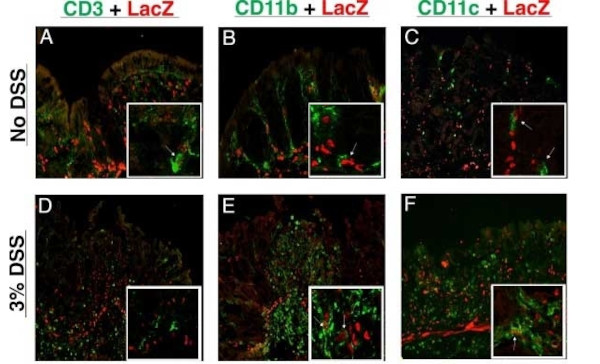
(Published customer image:Hamster anti Mouse CD3 antibody, clone 145-2C11 used for the identification of murine colonic lymphocytes by immunofluorescence.Image caption:Intestinal Myeloid Cells Respond Directly to Hh Signalling during Homeostasis and Inflammation (A–C) No DSS treatment. (D–F) 4 d of 3% DSS. (A, D) Few CD3+ T lymphocytes respond to Hh signalling during colonic homeostasis. Infiltrating T cells in DSS-induced ulcers do not express Gli1 or respond to Hh signalling. (B, E) Many but not all CD11b+ myeloid cells respond to Hh signalling and express LacZ. After 4 d of DSS, ulcers in Gli1+/lacZ animals are filled with myeloid cells, many of which respond to Hh signals. (C, F) CD11c+ dendritic cells respond directly to Hh signals during homeostasis and inflammation. Nuclear DAPI staining was performed but has been omitted to allow clear visualization of co-expression of nuclear LacZ and cell surface markers.From: Lees CW, Zacharias WJ, Tremelling M, Noble CL, Nimmo ER, Tenesa A, et al. (2008) Analysis of Germline GLI1 Variation Implicates Hedgehog Signalling in the Regulation of Intestinal Inflammatory Pathways.)
IF (Immunofluorescence)
(Published customer image:Hamster anti Mouse CD3 antibody, clone 145-2C11 used for the identification of murine colonic lymphocytes by immunofluorescence.Image caption:Intestinal Myeloid Cells Respond Directly to Hh Signalling during Homeostasis and Inflammation (A–C) No DSS treatment. (D–F) 4 d of 3% DSS. (A, D) Few CD3+ T lymphocytes respond to Hh signalling during colonic homeostasis. Infiltrating T cells in DSS-induced ulcers do not express Gli1 or respond to Hh signalling. (B, E) Many but not all CD11b+ myeloid cells respond to Hh signalling and express LacZ. After 4 d of DSS, ulcers in Gli1+/lacZ animals are filled with myeloid cells, many of which respond to Hh signals. (C, F) CD11c+ dendritic cells respond directly to Hh signals during homeostasis and inflammation. Nuclear DAPI staining was performed but has been omitted to allow clear visualization of co-expression of nuclear LacZ and cell surface markers.From: Lees CW, Zacharias WJ, Tremelling M, Noble CL, Nimmo ER, Tenesa A, et al. (2008) Analysis of Germline GLI1 Variation Implicates Hedgehog Signalling in the Regulation of Intestinal Inflammatory Pathways.)
Hamster CD3 Monoclonal Antibody | anti-CD3 antibody
HAMSTER ANTI MOUSE CD3
IF (Immunofluorescence)
(Published customer image:Hamster anti Mouse CD3 antibody, clone 145-2C11 used for the identification of murine colonic lymphocytes by immunofluorescence.Image caption:Intestinal Myeloid Cells Respond Directly to Hh Signalling during Homeostasis and Inflammation (A–C) No DSS treatment. (D–F) 4 d of 3% DSS. (A, D) Few CD3+ T lymphocytes respond to Hh signalling during colonic homeostasis. Infiltrating T cells in DSS-induced ulcers do not express Gli1 or respond to Hh signalling. (B, E) Many but not all CD11b+ myeloid cells respond to Hh signalling and express LacZ. After 4 d of DSS, ulcers in Gli1+/lacZ animals are filled with myeloid cells, many of which respond to Hh signals. (C, F) CD11c+ dendritic cells respond directly to Hh signals during homeostasis and inflammation. Nuclear DAPI staining was performed but has been omitted to allow clear visualization of co-expression of nuclear LacZ and cell surface markers.From: Lees CW, Zacharias WJ, Tremelling M, Noble CL, Nimmo ER, Tenesa A, et al. (2008) Analysis of Germline GLI1 Variation Implicates Hedgehog Signalling in the Regulation of Intestinal Inflammatory Pathways.)
IF (Immunofluorescence)
(Published customer image:Hamster anti Mouse CD3 antibody, clone 145-2C11 used for the identification of murine colonic lymphocytes by immunofluorescence.Image caption:Intestinal Myeloid Cells Respond Directly to Hh Signalling during Homeostasis and Inflammation (A–C) No DSS treatment. (D–F) 4 d of 3% DSS. (A, D) Few CD3+ T lymphocytes respond to Hh signalling during colonic homeostasis. Infiltrating T cells in DSS-induced ulcers do not express Gli1 or respond to Hh signalling. (B, E) Many but not all CD11b+ myeloid cells respond to Hh signalling and express LacZ. After 4 d of DSS, ulcers in Gli1+/lacZ animals are filled with myeloid cells, many of which respond to Hh signals. (C, F) CD11c+ dendritic cells respond directly to Hh signals during homeostasis and inflammation. Nuclear DAPI staining was performed but has been omitted to allow clear visualization of co-expression of nuclear LacZ and cell surface markers.From: Lees CW, Zacharias WJ, Tremelling M, Noble CL, Nimmo ER, Tenesa A, et al. (2008) Analysis of Germline GLI1 Variation Implicates Hedgehog Signalling in the Regulation of Intestinal Inflammatory Pathways.)
IF (Immunofluorescence)
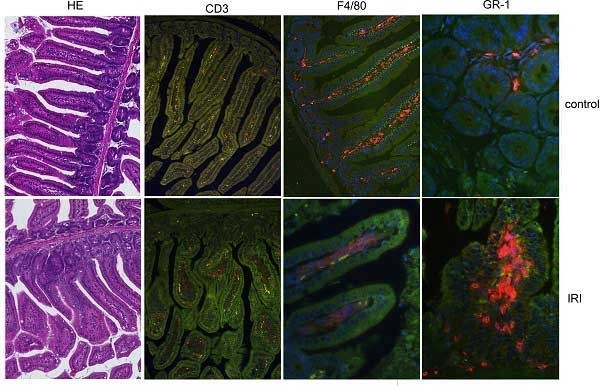
(Published customer image:Hamster anti Mouse CD3 antibody, clone 145-2C11 used to identify T lymphocytes in mouse lamina propria by immunofluorescence.Image caption:Representative H&E staining of WT mice subjected to IRI or sham procedure with epithelial swelling and damage, cellular infiltrate, and signs of immune cell activation as well as apoptosis (left column). The immunohistological studies show constant numbers of CD3+ cells, a slightly decreased expression of F4/80 (tissue resident macrophages) and a strong increase of GR-1, which is expressed on neutrophils and activated macrophages. (GR-1, F4/80, or CD3 in red, DAPI positive nuclei in blue, autofluorescence of epithelial cells in green).From: Yu Y, Feng X, Vieten G, Dippel S, Imvised T, Gueler F, et al. (2017) Conventional alpha beta (αβ) T cells do not contribute to acute intestinal ischemia-reperfusion injury in mice.)
IF (Immunofluorescence)
(Published customer image:Hamster anti Mouse CD3 antibody, clone 145-2C11 used to identify T lymphocytes in mouse lamina propria by immunofluorescence.Image caption:Representative H&E staining of WT mice subjected to IRI or sham procedure with epithelial swelling and damage, cellular infiltrate, and signs of immune cell activation as well as apoptosis (left column). The immunohistological studies show constant numbers of CD3+ cells, a slightly decreased expression of F4/80 (tissue resident macrophages) and a strong increase of GR-1, which is expressed on neutrophils and activated macrophages. (GR-1, F4/80, or CD3 in red, DAPI positive nuclei in blue, autofluorescence of epithelial cells in green).From: Yu Y, Feng X, Vieten G, Dippel S, Imvised T, Gueler F, et al. (2017) Conventional alpha beta (αβ) T cells do not contribute to acute intestinal ischemia-reperfusion injury in mice.)
Application Data
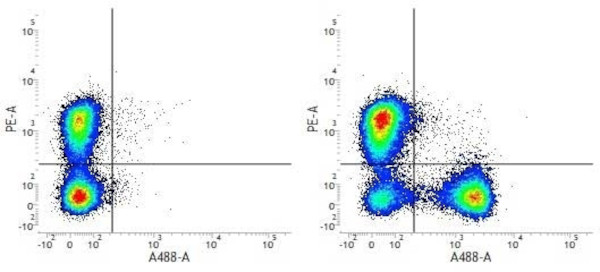
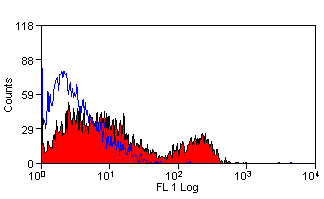
(Figure A. RPE conjugated Rat anti Mouse CD22 and A488 conjugated Hamster IgG isotype control (Cat# please inquire).Figure B. RPE conjugated Rat anti Mouse CD22 and A488 conjugated Hamster anti Mouse CD3 (Cat # please inquire).All experiments were performed on mouse splenocytes in the presence of murine SeroBlock)
Application Data
(Figure A. RPE conjugated Rat anti Mouse CD22 and A488 conjugated Hamster IgG isotype control (Cat# please inquire).Figure B. RPE conjugated Rat anti Mouse CD22 and A488 conjugated Hamster anti Mouse CD3 (Cat # please inquire).All experiments were performed on mouse splenocytes in the presence of murine SeroBlock)
NCBI and Uniprot Product Information
Customer Reviews
Loading reviews...
Share Your Experience
Similar Products




Product Notes
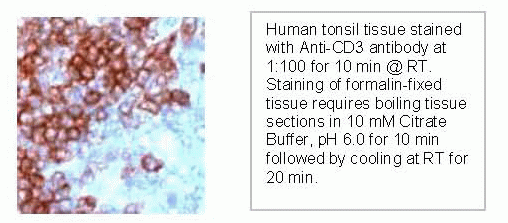
The CD3 cd3e (Catalog #AAA49789) is an Antibody produced from Hamster and is intended for research purposes only. The product is available for immediate purchase. AAA Biotech's CD3 can be used in a range of immunoassay formats including, but not limited to, WB (Western Blot), IP (Immunoprecipitation), IF (Immunofluorescence), FCM/FACS (Flow Cytometry), IHC (Immunohistochemistry). Researchers should empirically determine the suitability of the CD3 cd3e for an application not listed in the data sheet. Researchers commonly develop new applications and it is an integral, important part of the investigative research process. It is sometimes possible for the material contained within the vial of "CD3, Monoclonal Antibody" to become dispersed throughout the inside of the vial, particularly around the seal of said vial, during shipment and storage. We always suggest centrifuging these vials to consolidate all of the liquid away from the lid and to the bottom of the vial prior to opening. Please be advised that certain products may require dry ice for shipping and that, if this is the case, an additional dry ice fee may also be required.Precautions
All products in the AAA Biotech catalog are strictly for research-use only, and are absolutely not suitable for use in any sort of medical, therapeutic, prophylactic, in-vivo, or diagnostic capacity. By purchasing a product from AAA Biotech, you are explicitly certifying that said products will be properly tested and used in line with industry standard. AAA Biotech and its authorized distribution partners reserve the right to refuse to fulfill any order if we have any indication that a purchaser may be intending to use a product outside of our accepted criteria.Disclaimer
Though we do strive to guarantee the information represented in this datasheet, AAA Biotech cannot be held responsible for any oversights or imprecisions. AAA Biotech reserves the right to adjust any aspect of this datasheet at any time and without notice. It is the responsibility of the customer to inform AAA Biotech of any product performance issues observed or experienced within 30 days of receipt of said product. To see additional details on this or any of our other policies, please see our Terms & Conditions page.Item has been added to Shopping Cart
If you are ready to order, navigate to Shopping Cart and get ready to checkout.