


 WB (Western Blot)
(CDK6 monoclonal antibody, Western Blot analysis of CDK6 expression in Jurkat.)
WB (Western Blot)
(CDK6 monoclonal antibody, Western Blot analysis of CDK6 expression in Jurkat.)
Mouse anti-Human, Rat CDK6 Monoclonal Antibody | anti-CDK6 antibody
CDK6 (Cell Division Protein Kinase 6, Serine/Threonine-protein Kinase PLSTIRE, Crk2, MGC59692) (HRP)
Applications are based on unconjugated antibody.
WB (Western Blot)
(CDK6 monoclonal antibody, Western Blot analysis of CDK6 expression in Jurkat.)
WB (Western Blot)
(CDK6 monoclonal antibody, Western Blot analysis of CDK6 expression in Jurkat.)
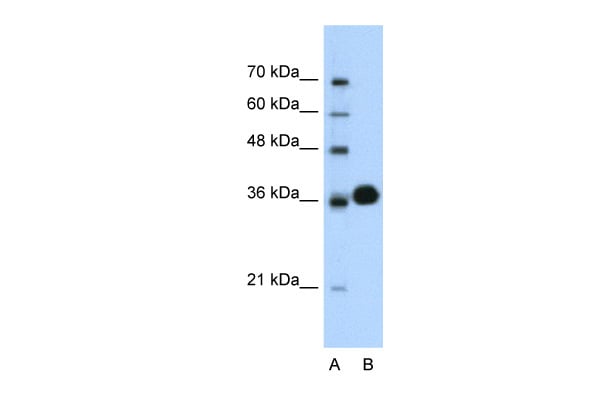
WB (Western Blot)
(CDK6 monoclonal antibody. Western Blot analysis of CDK6 expression in PC-12.)
WB (Western Blot)
(CDK6 monoclonal antibody. Western Blot analysis of CDK6 expression in PC-12.)
Application Data
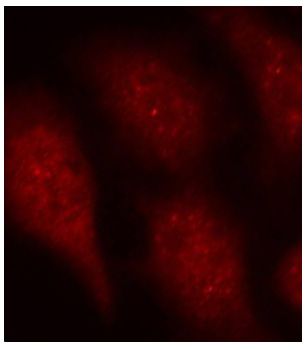
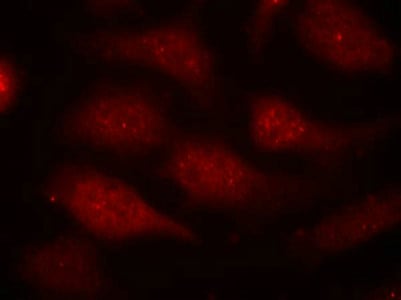
(Proximity Ligation Analysis (PLA) of protein-protein interactions between CDK2 and CDK6 HeLa cells were stained with CDK2 rabbit purified polyclonal 1:1200 and CDK6 mouse monoclonal antibody 1:50. Signals were detected by 30 Detection Kit 613 (red), and nuclei were counterstained with DAPI (blue). Each red dot represents the detection of protein-protein interaction complex.)
Application Data
(Proximity Ligation Analysis (PLA) of protein-protein interactions between CDK2 and CDK6 HeLa cells were stained with CDK2 rabbit purified polyclonal 1:1200 and CDK6 mouse monoclonal antibody 1:50. Signals were detected by 30 Detection Kit 613 (red), and nuclei were counterstained with DAPI (blue). Each red dot represents the detection of protein-protein interaction complex.)
IF (Immunofluorescence)
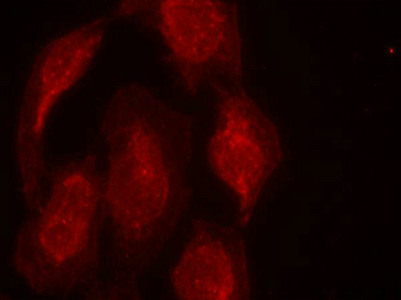
(Immunofluorescence of monoclonal antibody to CDK6 on HeLa cell. [antibody concentration 10ug/ml].)
IF (Immunofluorescence)
(Immunofluorescence of monoclonal antibody to CDK6 on HeLa cell. [antibody concentration 10ug/ml].)
IHC (Immunohistochemistry)
(Immunoperoxidase of monoclonal antibody to CDK6 on formalin-fixed paraffin-embedded human colon. [antibody concentration 3ug/ml].)
IHC (Immunohistochemistry)
(Immunoperoxidase of monoclonal antibody to CDK6 on formalin-fixed paraffin-embedded human colon. [antibody concentration 3ug/ml].)
WB (Western Blot)
(Western Blot analysis of CDK6 expression in transfected 293T cell line by CDK6 monoclonal antibody. Lane 1: CDK6 transfected lysate (36.9kD). Lane 2: Non-transfected lysate.)
WB (Western Blot)
(Western Blot analysis of CDK6 expression in transfected 293T cell line by CDK6 monoclonal antibody. Lane 1: CDK6 transfected lysate (36.9kD). Lane 2: Non-transfected lysate.)
WB (Western Blot)
(Western Blot detection against Immunogen (36.41kD).)
WB (Western Blot)
(Western Blot detection against Immunogen (36.41kD).)
NCBI and Uniprot Product Information
Customer Reviews
Loading reviews...
Share Your Experience
Similar Products











Product Notes
The CDK6 cdk6 (Catalog #AAA25349) is an Antibody produced from Mouse and is intended for research purposes only. The product is available for immediate purchase. The CDK6 (Cell Division Protein Kinase 6, Serine/Threonine-protein Kinase PLSTIRE, Crk2, MGC59692) (HRP) reacts with Human, Rat and may cross-react with other species as described in the data sheet. AAA Biotech's CDK6 can be used in a range of immunoassay formats including, but not limited to, ELISA, IHC (Immunohistochemistry), WB (Western Blot). IHC-P: 3ug/ml Applications are based on unconjugated antibody. Researchers should empirically determine the suitability of the CDK6 cdk6 for an application not listed in the data sheet. Researchers commonly develop new applications and it is an integral, important part of the investigative research process. It is sometimes possible for the material contained within the vial of "CDK6, Monoclonal Antibody" to become dispersed throughout the inside of the vial, particularly around the seal of said vial, during shipment and storage. We always suggest centrifuging these vials to consolidate all of the liquid away from the lid and to the bottom of the vial prior to opening. Please be advised that certain products may require dry ice for shipping and that, if this is the case, an additional dry ice fee may also be required.Precautions
All products in the AAA Biotech catalog are strictly for research-use only, and are absolutely not suitable for use in any sort of medical, therapeutic, prophylactic, in-vivo, or diagnostic capacity. By purchasing a product from AAA Biotech, you are explicitly certifying that said products will be properly tested and used in line with industry standard. AAA Biotech and its authorized distribution partners reserve the right to refuse to fulfill any order if we have any indication that a purchaser may be intending to use a product outside of our accepted criteria.Disclaimer
Though we do strive to guarantee the information represented in this datasheet, AAA Biotech cannot be held responsible for any oversights or imprecisions. AAA Biotech reserves the right to adjust any aspect of this datasheet at any time and without notice. It is the responsibility of the customer to inform AAA Biotech of any product performance issues observed or experienced within 30 days of receipt of said product. To see additional details on this or any of our other policies, please see our Terms & Conditions page.Frequently Asked Questions
What role does CDK6 play in cell cycle regulation?
CDK6 is a serine/threonine kinase that forms complexes with D-type cyclins (cyclin D1, D2, D3) to phosphorylate the retinoblastoma (RB) protein during the G1 phase of the cell cycle. CDK6-cyclin D complexes release E2F transcription factors from RB repression, allowing expression of S-phase genes and promoting progression from G1 to S phase. Unlike CDK4, CDK6 also has kinase-independent transcriptional regulatory functions.
Which cell types or cancers commonly show high CDK6 expression?
High CDK6 expression is observed in multiple myeloma, hematopoietic malignancies (AML, ALL), breast cancers, melanoma, and lymphomas. CDK6 upregulation is often associated with drug resistance and poor prognosis, particularly in multiple myeloma resistant to immunomodulatory drugs (IMiDs).
How is a CDK6 monoclonal antibody used in cancer research?
CDK6 monoclonal antibodies enable immunodetection of CDK6 protein levels in tumor samples and cell lines via Western blotting, immunohistochemistry (IHC), and immunofluorescence. This allows researchers to correlate CDK6 expression with cell cycle status, proliferation rates, drug resistance, and cancer prognosis in both primary tumors and cultured cancer cells.
What is the difference between CDK4 and CDK6 detection?
While CDK4 and CDK6 share 71% sequence identity and both phosphorylate the RB protein, CDK6 has distinct transcriptional regulatory functions independent of kinase activity, particularly in hematologic cancers and angiogenesis regulation. CDK6-specific antibodies detect CDK6 without cross-reactivity with CDK4, allowing isoform-specific studies of their redundant and unique roles in cell cycle and transcriptional control.
Is CDK6 expression affected by CDK inhibitors or drug treatment?
Yes, CDK6 expression and activity are sensitive to CDK4/6 inhibitors (e.g., palbociclib, ribociclib) and PROTAC-mediated protein degradation. CDK inhibitor treatment causes RB phosphorylation inhibition, cell cycle arrest, and can modulate CDK6 protein levels through altered expression or degradation, depending on the drug mechanism.
Is the antibody suitable for detecting nuclear CDK6 localization?
Yes, CDK6 monoclonal antibodies are suitable for detecting nuclear CDK6 localization via immunofluorescence and confocal microscopy. Nuclear CDK6 is functionally important for its transcriptional regulatory roles, independent of its cell cycle kinase function, making localization studies valuable for understanding CDK6's diverse cellular roles.
Can CDK6 levels be compared between normal and tumor samples?
Yes, CDK6 monoclonal antibodies enable quantitative comparison of CDK6 protein levels between normal and tumor tissues/cells. Elevated CDK6 in tumors correlates with aggressive phenotypes, drug resistance, and poor prognosis, making it a biomarker for treatment response prediction and stratification.
Is this CDK6 monoclonal antibody validated for cell cycle studies?
Yes, CDK6 monoclonal antibodies are routinely validated for cell cycle studies, detecting CDK6 in asynchronous and cell cycle-synchronized populations. Combined with cyclin, RB phosphorylation, and cell cycle phase markers (e.g., PCNA, Ki-67), CDK6 detection enables mechanistic studies of G1/S transition and cell proliferation rates.
Item has been added to Shopping Cart
If you are ready to order, navigate to Shopping Cart and get ready to checkout.