


 FCM (Flow Cytometry)
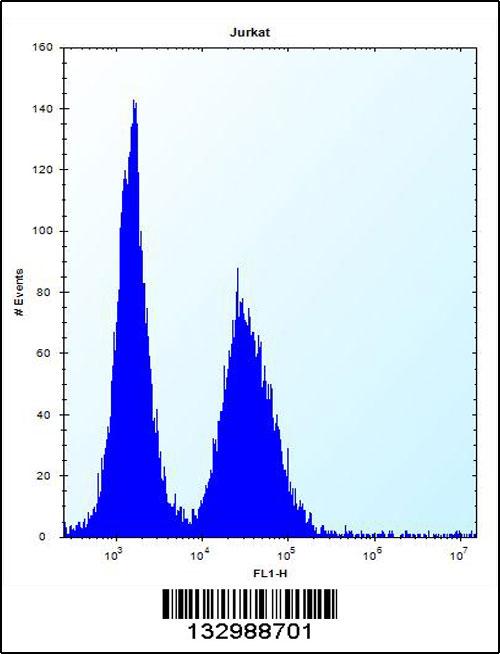
(Flow cytometric analysis of Hela cells with DDIT3 antibody at 1/50 dilution (red) compared with an unlabelled control (cells without incubation with primary antibody; black). Alexa Fluor 488-conjugated goat anti rabbit IgG was used as the secondary antibody.)
FCM (Flow Cytometry)
(Flow cytometric analysis of Hela cells with DDIT3 antibody at 1/50 dilution (red) compared with an unlabelled control (cells without incubation with primary antibody; black). Alexa Fluor 488-conjugated goat anti rabbit IgG was used as the secondary antibody.)
Rabbit DDIT3 Monoclonal Antibody | anti-DDIT3 antibody
DDIT3 Antibody
IHC: 1:50-1:200
FC/FACS: 1:50-1:100
FCM (Flow Cytometry)
(Flow cytometric analysis of Hela cells with DDIT3 antibody at 1/50 dilution (red) compared with an unlabelled control (cells without incubation with primary antibody; black). Alexa Fluor 488-conjugated goat anti rabbit IgG was used as the secondary antibody.)
FCM (Flow Cytometry)
(Flow cytometric analysis of Hela cells with DDIT3 antibody at 1/50 dilution (red) compared with an unlabelled control (cells without incubation with primary antibody; black). Alexa Fluor 488-conjugated goat anti rabbit IgG was used as the secondary antibody.)
IHC (Immunohistchemistry)
(Immunohistochemical analysis of paraffin-embedded mouse brain tissue using anti-DDIT3 antibody. Counter stained with hematoxylin.)
IHC (Immunohistchemistry)
(Immunohistochemical analysis of paraffin-embedded mouse brain tissue using anti-DDIT3 antibody. Counter stained with hematoxylin.)
IHC (Immunohistochemistry)
(Immunohistochemical analysis of paraffin-embedded mouse pancreas tissue using anti-DDIT3 antibody. Counter stained with hematoxylin.)
IHC (Immunohistochemistry)
(Immunohistochemical analysis of paraffin-embedded mouse pancreas tissue using anti-DDIT3 antibody. Counter stained with hematoxylin.)
IHC (Immunohistochemistry)
(Immunohistochemical analysis of paraffin-embedded human pancreas tissue using anti-DDIT3 antibody. Counter stained with hematoxylin.)
IHC (Immunohistochemistry)
(Immunohistochemical analysis of paraffin-embedded human pancreas tissue using anti-DDIT3 antibody. Counter stained with hematoxylin.)
IHC (Immunohistochemistry)
(Immunohistochemical analysis of paraffin-embedded human gastric carcinoma tissue using anti-DDIT3 antibody. Counter stained with hematoxylin.)
IHC (Immunohistochemistry)
(Immunohistochemical analysis of paraffin-embedded human gastric carcinoma tissue using anti-DDIT3 antibody. Counter stained with hematoxylin.)
IHC (Immunohistochemistry)
(Immunohistochemical analysis of paraffin-embedded human breast carcinoma tissue using anti-DDIT3 antibody. Counter stained with hematoxylin.)
IHC (Immunohistochemistry)
(Immunohistochemical analysis of paraffin-embedded human breast carcinoma tissue using anti-DDIT3 antibody. Counter stained with hematoxylin.)
WB (Western Blot)
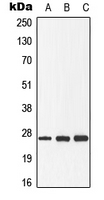
(Western blot analysis of DDIT3 on PC-12 cells lysates using anti-DDIT3 antibody at 1/1, 000 dilution.)
WB (Western Blot)
(Western blot analysis of DDIT3 on PC-12 cells lysates using anti-DDIT3 antibody at 1/1, 000 dilution.)
NCBI and Uniprot Product Information
Customer Reviews
Loading reviews...
Share Your Experience
Similar Products





Product Notes
The DDIT3 ddit3 (Catalog #AAA30300) is an Antibody produced from Rabbit and is intended for research purposes only. The product is available for immediate purchase. The DDIT3 Antibody reacts with Human, Mouse, Rat and may cross-react with other species as described in the data sheet. AAA Biotech's DDIT3 can be used in a range of immunoassay formats including, but not limited to, WB (Western Blot), IHC (Immunohistochemistry), FCM/FACS (Flow Cytometry). WB: 1:1000 IHC: 1:50-1:200 FC/FACS: 1:50-1:100. Researchers should empirically determine the suitability of the DDIT3 ddit3 for an application not listed in the data sheet. Researchers commonly develop new applications and it is an integral, important part of the investigative research process. It is sometimes possible for the material contained within the vial of "DDIT3, Monoclonal Antibody" to become dispersed throughout the inside of the vial, particularly around the seal of said vial, during shipment and storage. We always suggest centrifuging these vials to consolidate all of the liquid away from the lid and to the bottom of the vial prior to opening. Please be advised that certain products may require dry ice for shipping and that, if this is the case, an additional dry ice fee may also be required.Precautions
All products in the AAA Biotech catalog are strictly for research-use only, and are absolutely not suitable for use in any sort of medical, therapeutic, prophylactic, in-vivo, or diagnostic capacity. By purchasing a product from AAA Biotech, you are explicitly certifying that said products will be properly tested and used in line with industry standard. AAA Biotech and its authorized distribution partners reserve the right to refuse to fulfill any order if we have any indication that a purchaser may be intending to use a product outside of our accepted criteria.Disclaimer
Though we do strive to guarantee the information represented in this datasheet, AAA Biotech cannot be held responsible for any oversights or imprecisions. AAA Biotech reserves the right to adjust any aspect of this datasheet at any time and without notice. It is the responsibility of the customer to inform AAA Biotech of any product performance issues observed or experienced within 30 days of receipt of said product. To see additional details on this or any of our other policies, please see our Terms & Conditions page.Frequently Asked Questions
What is DDIT3 (CHOP) used as a marker for in ER stress studies?
DDIT3, encoding C/EBP homologous protein (CHOP), is a pro-apoptotic transcription factor marking severe endoplasmic reticulum (ER) stress. CHOP expression is extremely low under basal conditions but sharply increases upon ER stress via PERK, ATF6, and IRE1α unfolded protein response (UPR) branches. DDIT3 indicates UPR activation failure and commitment to apoptosis, making it a sensitive biomarker for ER stress, cellular dysfunction, and disease states.
Is DDIT3 expression increased during apoptosis or unfolded protein response?
Yes, DDIT3/CHOP is strongly upregulated during both processes. The unfolded protein response (UPR) activates DDIT3 through PERK-mediated eIF2α phosphorylation, inducing CHOP translation. Under prolonged, unresolved ER stress, CHOP protein accumulates and induces pro-apoptotic genes (BAX, PUMA, BIM), promoting cell death. DDIT3 therefore serves as a dual biomarker: an early UPR activation marker and an indicator of apoptosis commitment in neurodegenerative disease, cancer, and metabolic disorders.
Can this DDIT3 antibody be used for immunofluorescence or Western blot?
Yes, DDIT3 antibodies work effectively for both applications. In immunofluorescence, DDIT3 shows nuclear localization (expected for transcription factors). Use formaldehyde fixation with permeabilization; nuclear epitopes require optimized permeabilization buffers. Western blots detect CHOP at ~29 kDa. DDIT3 expression increases dramatically during ER stress induction (thapsigargin, tunicamycin), providing clear dose-response relationships suitable for quantitative analysis.
Does DDIT3 localize to the nucleus under stress conditions?
Yes, DDIT3/CHOP exclusively localizes to the nucleus, where it functions as a transcription factor. Upon ER stress, newly synthesized CHOP protein translocates to the nucleus and binds DNA regulatory elements (CHOP-binding sites) in pro-apoptotic gene promoters. This nuclear translocation is essential for CHOP's function; cytoplasmic CHOP is inactive. Immunofluorescence reveals concentrated nuclear signal, confirming DDIT3 activation and transcriptional activity.
Is DDIT3 commonly studied in cancer or neurodegenerative disease research?
Yes, DDIT3/CHOP is extensively studied in both fields. In cancer, elevated CHOP promotes tumor cell death, making it therapeutically relevant; some tumors suppress CHOP to escape apoptosis. In neurodegenerative diseases (Alzheimer's, Parkinson's, and prion disease), ER stress-induced DDIT3 upregulation drives neuronal apoptosis. Manipulating DDIT3 expression represents a potential therapeutic strategy: enhancing CHOP in cancer, suppressing it in neurodegeneration to preserve neuronal survival.
Does fixation method affect DDIT3 antibody staining quality?
Yes, fixation significantly impacts DDIT3 staining. Formaldehyde (formalin) fixation preserves nuclear morphology but requires heat-induced epitope retrieval (HIER) to unmask cross-linked epitopes. Methanol or ethanol fixation avoids extensive cross-linking, preserving antigenicity without retrieval. However, aldehyde-based fixation better maintains nuclear structure and morphology. Optimize fixation time (4% formalin, 10-24 hours) to balance antigenicity and morphological preservation for accurate nuclear localization assessment.
Item has been added to Shopping Cart
If you are ready to order, navigate to Shopping Cart and get ready to checkout.