
 Application Data
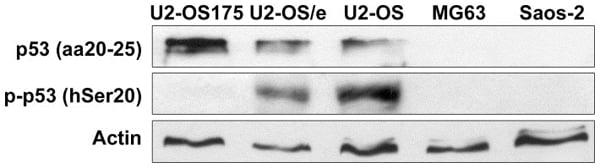
(Published customer image: p53 protein expression in OS cells. wt-p53 U2-OS, U2-OS transfected with empty vector (U2-OS/e) and p53-impaired U2-OS175 cells were positive to anti-p53 that binds the transactivation site of N-terminal domain (aa20-25), with increased expression in U2-OS175 cells. U2-OS and U2-OS/e also presented accumulation of p53 phosphorylated at Ser20 residue (p-p53). MG63 and Saos-2 were negative to both antibodies. Actina was used as loading control.From: Novello C, Pazzaglia L, Conti A, Quattrini I, Pollino S, et al. (2014) p53-Dependent Activation of microRNA-34a in Response to Etoposide-Induced DNA Damage in Osteosarcoma Cell Lines Not Impaired by Dominant Negative p53 Expression. PLoS ONE 9(12): e114757.)
Application Data
(Published customer image: p53 protein expression in OS cells. wt-p53 U2-OS, U2-OS transfected with empty vector (U2-OS/e) and p53-impaired U2-OS175 cells were positive to anti-p53 that binds the transactivation site of N-terminal domain (aa20-25), with increased expression in U2-OS175 cells. U2-OS and U2-OS/e also presented accumulation of p53 phosphorylated at Ser20 residue (p-p53). MG63 and Saos-2 were negative to both antibodies. Actina was used as loading control.From: Novello C, Pazzaglia L, Conti A, Quattrini I, Pollino S, et al. (2014) p53-Dependent Activation of microRNA-34a in Response to Etoposide-Induced DNA Damage in Osteosarcoma Cell Lines Not Impaired by Dominant Negative p53 Expression. PLoS ONE 9(12): e114757.)
Mouse p53 Monoclonal Antibody | anti-p53 antibody
MOUSE ANTI p53 (aa20-25)
Purified IgG - liquid
When thawed, aliquot the sample as needed. Keep aliquots at 2-8°C for short term use (up to 4 weeks) and store the remaining aliquots at -20°C.
Avoid repeated freezing and thawing as this may denature the antibody. Storage in frost-free freezers is not recommended.
Application Data
(Published customer image: p53 protein expression in OS cells. wt-p53 U2-OS, U2-OS transfected with empty vector (U2-OS/e) and p53-impaired U2-OS175 cells were positive to anti-p53 that binds the transactivation site of N-terminal domain (aa20-25), with increased expression in U2-OS175 cells. U2-OS and U2-OS/e also presented accumulation of p53 phosphorylated at Ser20 residue (p-p53). MG63 and Saos-2 were negative to both antibodies. Actina was used as loading control.From: Novello C, Pazzaglia L, Conti A, Quattrini I, Pollino S, et al. (2014) p53-Dependent Activation of microRNA-34a in Response to Etoposide-Induced DNA Damage in Osteosarcoma Cell Lines Not Impaired by Dominant Negative p53 Expression. PLoS ONE 9(12): e114757.)
Application Data
(Published customer image: p53 protein expression in OS cells. wt-p53 U2-OS, U2-OS transfected with empty vector (U2-OS/e) and p53-impaired U2-OS175 cells were positive to anti-p53 that binds the transactivation site of N-terminal domain (aa20-25), with increased expression in U2-OS175 cells. U2-OS and U2-OS/e also presented accumulation of p53 phosphorylated at Ser20 residue (p-p53). MG63 and Saos-2 were negative to both antibodies. Actina was used as loading control.From: Novello C, Pazzaglia L, Conti A, Quattrini I, Pollino S, et al. (2014) p53-Dependent Activation of microRNA-34a in Response to Etoposide-Induced DNA Damage in Osteosarcoma Cell Lines Not Impaired by Dominant Negative p53 Expression. PLoS ONE 9(12): e114757.)
Application Data
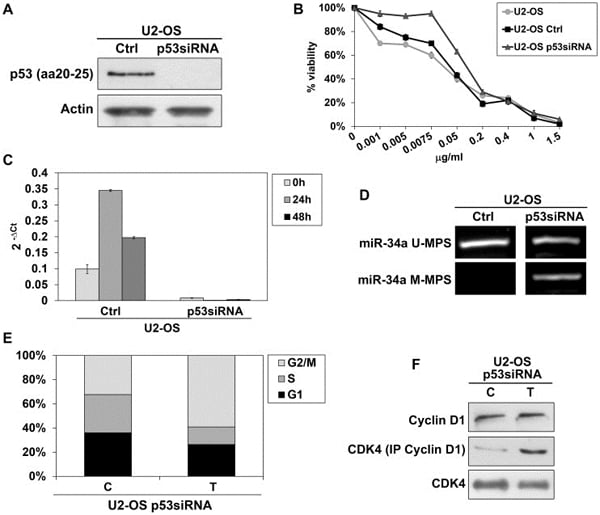
(Published customer image:Response of p53siRNA U2-OS cells to etoposide. (A) Inhibition of p53 expression in p53siRNA U2-OS. Actin was used as loading control. (B) p53siRNA U2-OS were less sensitive to etoposide when compared with parental and Ctrl U2-OS;). Student's test from three independent experiments indicated significantly higher IC50 mean values at 72 h of treatment in p53siRNA U2-OS than in Ctrl and parental U2-OS cells; p = 0.05 (C) Etoposide treatment did not induce mature miR-34a expression in p53siRNA U2-OS, as opposed to Ctrl U2-OS. (D) p53siRNA U2-OS cells presented CpG island methylation (M-MSP) of one of the two alleles of miR-34a. In Ctrl U2-OS both alleles were unmethylated. (E) p53siRNA transfection determined lengthening of G2/M phase after 48 h of etoposide treatment when compared to untreated cells. (F) Western blot of cyclin D1 and CDK4 in p53siRNA cell showed increased amount of CDK4 linked to cyclin D1 and total CDK4 after etoposide treatment when compared to control. No differences in cyclin D1 levels were seen. Ctrl = siRNA negative control duplex; C = Untreated cells; T = Etoposide treated cells.From: Novello C, Pazzaglia L, Conti A, Quattrini I, Pollino S, et al. (2014) p53-Dependent Activation of microRNA-34a in Response to Etoposide-Induced DNA Damage in Osteosarcoma Cell Lines Not Impaired by Dominant Negative p53 Expression. PLoS ONE 9(12): e114757.)
Application Data
(Published customer image:Response of p53siRNA U2-OS cells to etoposide. (A) Inhibition of p53 expression in p53siRNA U2-OS. Actin was used as loading control. (B) p53siRNA U2-OS were less sensitive to etoposide when compared with parental and Ctrl U2-OS;). Student's test from three independent experiments indicated significantly higher IC50 mean values at 72 h of treatment in p53siRNA U2-OS than in Ctrl and parental U2-OS cells; p = 0.05 (C) Etoposide treatment did not induce mature miR-34a expression in p53siRNA U2-OS, as opposed to Ctrl U2-OS. (D) p53siRNA U2-OS cells presented CpG island methylation (M-MSP) of one of the two alleles of miR-34a. In Ctrl U2-OS both alleles were unmethylated. (E) p53siRNA transfection determined lengthening of G2/M phase after 48 h of etoposide treatment when compared to untreated cells. (F) Western blot of cyclin D1 and CDK4 in p53siRNA cell showed increased amount of CDK4 linked to cyclin D1 and total CDK4 after etoposide treatment when compared to control. No differences in cyclin D1 levels were seen. Ctrl = siRNA negative control duplex; C = Untreated cells; T = Etoposide treated cells.From: Novello C, Pazzaglia L, Conti A, Quattrini I, Pollino S, et al. (2014) p53-Dependent Activation of microRNA-34a in Response to Etoposide-Induced DNA Damage in Osteosarcoma Cell Lines Not Impaired by Dominant Negative p53 Expression. PLoS ONE 9(12): e114757.)
Application Data
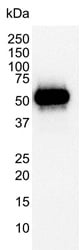
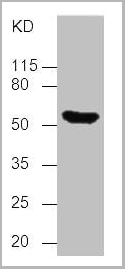
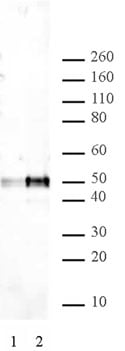
(Western blot analysis of COS-7 simian fibroblast-like whole cell lysate probed with Mouse anti p53 antibody followed by HRP conjugated Goat anti Mouse IgG, visualized using chemiluminescence)
Application Data
(Western blot analysis of COS-7 simian fibroblast-like whole cell lysate probed with Mouse anti p53 antibody followed by HRP conjugated Goat anti Mouse IgG, visualized using chemiluminescence)
NCBI and Uniprot Product Information
Customer Reviews
Loading reviews...
Share Your Experience
Similar Products





Product Notes
The p53 tp53 (Catalog #AAA49285) is an Antibody produced from Mouse and is intended for research purposes only. The product is available for immediate purchase. The MOUSE ANTI p53 (aa20-25) reacts with Bovine, Cat, Green Monkey, Horse and may cross-react with other species as described in the data sheet. AAA Biotech's p53 can be used in a range of immunoassay formats including, but not limited to, WB (Western Blot), IHC (Immunohistochemistry), IP (Immunoprecipitation), ELISA, IHC (Immunohistochemistry). Researchers should empirically determine the suitability of the p53 tp53 for an application not listed in the data sheet. Researchers commonly develop new applications and it is an integral, important part of the investigative research process. It is sometimes possible for the material contained within the vial of "p53, Monoclonal Antibody" to become dispersed throughout the inside of the vial, particularly around the seal of said vial, during shipment and storage. We always suggest centrifuging these vials to consolidate all of the liquid away from the lid and to the bottom of the vial prior to opening. Please be advised that certain products may require dry ice for shipping and that, if this is the case, an additional dry ice fee may also be required.Precautions
All products in the AAA Biotech catalog are strictly for research-use only, and are absolutely not suitable for use in any sort of medical, therapeutic, prophylactic, in-vivo, or diagnostic capacity. By purchasing a product from AAA Biotech, you are explicitly certifying that said products will be properly tested and used in line with industry standard. AAA Biotech and its authorized distribution partners reserve the right to refuse to fulfill any order if we have any indication that a purchaser may be intending to use a product outside of our accepted criteria.Disclaimer
Though we do strive to guarantee the information represented in this datasheet, AAA Biotech cannot be held responsible for any oversights or imprecisions. AAA Biotech reserves the right to adjust any aspect of this datasheet at any time and without notice. It is the responsibility of the customer to inform AAA Biotech of any product performance issues observed or experienced within 30 days of receipt of said product. To see additional details on this or any of our other policies, please see our Terms & Conditions page.Item has been added to Shopping Cart
If you are ready to order, navigate to Shopping Cart and get ready to checkout.