
 FCM/FACS (Flow Cytometry)
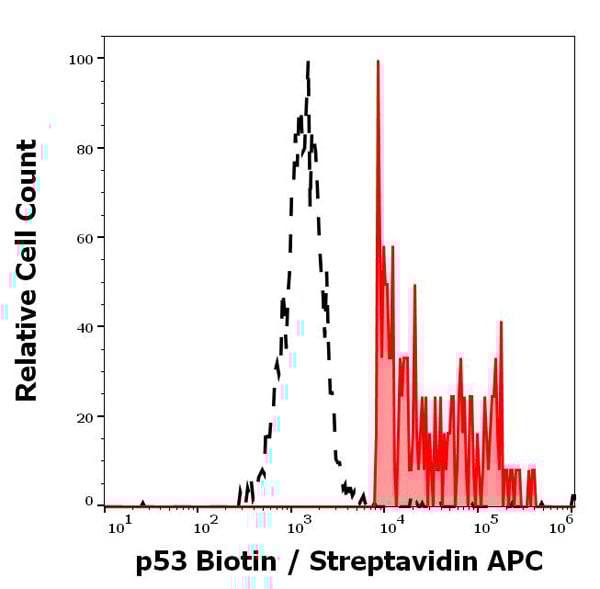
(Separation of human p53 high positive leukocytes (red-filled) from blood debris (black-dashed) in flow cytometry analysis (intracellular staining) of human peripheral whole blood stained using anti-p53 (BP53-12) Biotin antibody (concentration in sample 1ug/ml, Streptavidin APC).)
FCM/FACS (Flow Cytometry)
(Separation of human p53 high positive leukocytes (red-filled) from blood debris (black-dashed) in flow cytometry analysis (intracellular staining) of human peripheral whole blood stained using anti-p53 (BP53-12) Biotin antibody (concentration in sample 1ug/ml, Streptavidin APC).)
Mouse p53 Antibody | anti-p53 antibody
Anti-p53 Biotin
Gene Names
TP53; P53; BCC7; LFS1; TRP53
Reactivity
Human, Non-human primates
Applications
Immunoprecipitation, ELISA, Flow Cytometry, Functional Assay, Immunocytochemistry, Immunohistochemistry, Western Blot
Purity
Purified antibody is conjugated with biotin LC-NHS ester under optimum conditions and unconjugated antibody and free biotin are removed by size-exclusion chromatography.
Synonyms
p53; N/A; Anti-p53 Biotin; tumor protein p53; BCC7, TRP53, TP53, LFS1; anti-p53 antibody
Host
Mouse
Reactivity
Human, Non-human primates
Isotype
Mouse IgG2a
Clone Number
BP53-12
Specificity
The antibody BP53-12 recognizes a defined epitope (aa 16-25) on human p53, a 50 kDa intracellular tumour suppressor found in increased amounts in a wide variety of transformed cells; it is frequently mutated or inactivated in many types of cancer.
Purity/Purification
Purified antibody is conjugated with biotin LC-NHS ester under optimum conditions and unconjugated antibody and free biotin are removed by size-exclusion chromatography.
Form/Format
Phosphate buffered saline (PBS), pH 7.4, 15 mM sodium azide
Concentration
1mg/ml (varies by lot)
Applicable Applications for anti-p53 antibody
IP (Immunoprecipitation), ELISA, FCM/FACS (Flow Cytometry), ICC (Immunocytochemistry), IHC (Immunohistochemistry), WB (Western Blot)
Immunogen
Bacterially expressed full-length wild-type p53
Conjugation
Biotin
Preparation and Storage
Store at 2-8 degree C. Do not freeze.
FCM/FACS (Flow Cytometry)
(Separation of human p53 high positive leukocytes (red-filled) from blood debris (black-dashed) in flow cytometry analysis (intracellular staining) of human peripheral whole blood stained using anti-p53 (BP53-12) Biotin antibody (concentration in sample 1ug/ml, Streptavidin APC).)
FCM/FACS (Flow Cytometry)
(Separation of human p53 high positive leukocytes (red-filled) from blood debris (black-dashed) in flow cytometry analysis (intracellular staining) of human peripheral whole blood stained using anti-p53 (BP53-12) Biotin antibody (concentration in sample 1ug/ml, Streptavidin APC).)
FCM/FACS (Flow Cytometry)
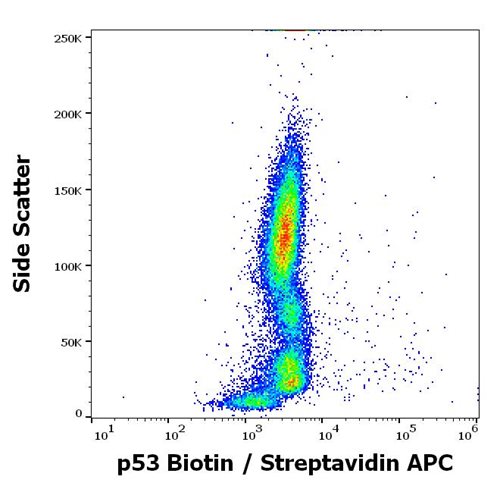
(Flow cytometry intracellular staining pattern of human peripheral whole blood stained using anti-p53 (BP53-12) Biotin antibody (concentration in sample 1ug/ml, Streptavidin APC).)
FCM/FACS (Flow Cytometry)
(Flow cytometry intracellular staining pattern of human peripheral whole blood stained using anti-p53 (BP53-12) Biotin antibody (concentration in sample 1ug/ml, Streptavidin APC).)
Related Product Information for anti-p53 antibody
The tumour suppressor protein p53 is a key element of intracellular anticancer protection. It mediates cell cycle arrest or apoptosis in response to DNA damage or to starvation for pyrimidine nukleotides. It is up-regulated in response to these stress signals and stimulated to activate transcription of specific genes, resulting in expression of p21waf1 and other proteins involved in G1 or G2/M arrest, or proteins that trigger apoptosis, such as Bcl-2. The structure of p53 comprises N-terminal transactivation domain, central DNA-binding domain, oligomerisation domain, and C-terminal regulatory domain. There are various phosphorylation sites on p53, of which the phosphorylation at Ser15 is important for p53 activation and stabilization.
References
*Agarwal ML, Agarwal A, Taylor WR, Stark GR: p53 controls both the G2/M and the G1 cell cycle checkpoints and mediates reversible growth arrest in human fibroblasts. Proc Natl Acad Sci U S A. 1995 Aug 29;92(18):8493-7., URL: https://www.ncbi.nlm.nih.gov/pubmed/7667317 ordina,*Agarwal ML, Agarwal A, Taylor WR, Chernova O, Sharma Y, Stark GR: A p53-dependent S-phase checkpoint helps to protect cells from DNA damage in response to starvation for pyrimidine nucleotides. Proc Natl Acad Sci U S A. 1998 Dec 8;95(25):14775-80., URL: https://www.ncbi.nlm.nih.gov/pubmed/9843965 ordina,*Taylor WR, DePrimo SE, Agarwal A, Agarwal ML, Schonthal AH, Katula KS, Stark GR: Mechanisms of G2 arrest in response to overexpression of p53. Mol Biol Cell. 1999 Nov;10(11):3607-22., URL: https://www.ncbi.nlm.nih.gov/pubmed/10564259?ordin,*Taylor WR, Agarwal ML, Agarwal A, Stacey DW, Stark GR: p53 inhibits entry into mitosis when DNA synthesis is blocked. Oncogene. 1999 Jan 14;18(2):283-95., URL: https://www.ncbi.nlm.nih.gov/pubmed/9927185 ordina,*Tanigawa S, Fujii M, Hou DX: Stabilization of p53 is involved in quercetin-induced cell cycle arrest and apoptosis in HepG2 cells. Biosci Biotechnol Biochem. 2008 Mar;72(3):797-804., URL: https://www.ncbi.nlm.nih.gov/pubmed/18323654?ordin,
*Bartek J, Bartkova J, Vojtesek B, Staskova Z, Lukas J, Rejthar A, Kovarik J, Midgley CA, Gannon JV, Lane DP: Aberrant expression of the p53 oncoprotein is a common feature of a wide spectrum of human malignancies. Oncogene. 1991 Sep;6(9):1699-703., URL: https://www.ncbi.nlm.nih.gov/pubmed/1923535?dopt=A,*Bartkova J, Bartek J, Lukas J, Vojtesek B, Staskova Z, Rejthar A, Kovarik J, Midgley CA, Lane DP: p53 protein alterations in human testicular cancer including pre-invasive intratubular germ-cell neoplasia. Int J Cancer. 1991 Sep 9;49(2):196-202., URL: https://www.ncbi.nlm.nih.gov/pubmed/1652567?dopt=A,*Rossner P Jr, Binková B, Chvátalová I, Srám RJ: Acrylonitrile exposure: the effect on p53 and p21(WAF1) protein levels in the blood plasma of occupationally exposed workers and in vitro in human diploid lung fibroblasts. Mutat Res. 2002 May 27;517(1-2):239-50., URL: https://www.ncbi.nlm.nih.gov/pubmed/12034325 ,*Dolezalova H, Vojtesek B, Kovarik J: Epitope analysis of the human p53 tumour suppressor protein. Folia Biol (Praha). 1997;43(1):49-51. , URL: https://www.ncbi.nlm.nih.gov/pubmed/9158951?dopt=A,
*Bartek J, Bartkova J, Vojtesek B, Staskova Z, Lukas J, Rejthar A, Kovarik J, Midgley CA, Gannon JV, Lane DP: Aberrant expression of the p53 oncoprotein is a common feature of a wide spectrum of human malignancies. Oncogene. 1991 Sep;6(9):1699-703., URL: https://www.ncbi.nlm.nih.gov/pubmed/1923535?dopt=A,*Bartkova J, Bartek J, Lukas J, Vojtesek B, Staskova Z, Rejthar A, Kovarik J, Midgley CA, Lane DP: p53 protein alterations in human testicular cancer including pre-invasive intratubular germ-cell neoplasia. Int J Cancer. 1991 Sep 9;49(2):196-202., URL: https://www.ncbi.nlm.nih.gov/pubmed/1652567?dopt=A,*Rossner P Jr, Binková B, Chvátalová I, Srám RJ: Acrylonitrile exposure: the effect on p53 and p21(WAF1) protein levels in the blood plasma of occupationally exposed workers and in vitro in human diploid lung fibroblasts. Mutat Res. 2002 May 27;517(1-2):239-50., URL: https://www.ncbi.nlm.nih.gov/pubmed/12034325 ,*Dolezalova H, Vojtesek B, Kovarik J: Epitope analysis of the human p53 tumour suppressor protein. Folia Biol (Praha). 1997;43(1):49-51. , URL: https://www.ncbi.nlm.nih.gov/pubmed/9158951?dopt=A,
NCBI and Uniprot Product Information
NCBI GI #
NCBI GeneID
NCBI Accession #
NCBI GenBank Nucleotide #
UniProt Accession #
Molecular Weight
43,653 Da
NCBI Official Full Name
cellular tumor antigen p53 isoform a
NCBI Official Synonym Full Names
tumor protein p53
NCBI Official Symbol
TP53
NCBI Official Synonym Symbols
P53; BCC7; LFS1; TRP53
NCBI Protein Information
cellular tumor antigen p53; antigen NY-CO-13; phosphoprotein p53; p53 tumor suppressor; transformation-related protein 53
UniProt Protein Name
Cellular tumor antigen p53
UniProt Gene Name
TP53
UniProt Synonym Gene Names
P53
UniProt Entry Name
P53_HUMAN
Customer Reviews
Loading reviews...
Share Your Experience
Similar Products
Product Notes
The p53 tp53 (Catalog #AAA129324) is an Antibody produced from Mouse and is intended for research purposes only. The product is available for immediate purchase. The Anti-p53 Biotin reacts with Human, Non-human primates and may cross-react with other species as described in the data sheet. AAA Biotech's p53 can be used in a range of immunoassay formats including, but not limited to, IP (Immunoprecipitation), ELISA, FCM/FACS (Flow Cytometry), ICC (Immunocytochemistry), IHC (Immunohistochemistry), WB (Western Blot). Researchers should empirically determine the suitability of the p53 tp53 for an application not listed in the data sheet. Researchers commonly develop new applications and it is an integral, important part of the investigative research process. It is sometimes possible for the material contained within the vial of "p53, Antibody" to become dispersed throughout the inside of the vial, particularly around the seal of said vial, during shipment and storage. We always suggest centrifuging these vials to consolidate all of the liquid away from the lid and to the bottom of the vial prior to opening. Please be advised that certain products may require dry ice for shipping and that, if this is the case, an additional dry ice fee may also be required.Precautions
All products in the AAA Biotech catalog are strictly for research-use only, and are absolutely not suitable for use in any sort of medical, therapeutic, prophylactic, in-vivo, or diagnostic capacity. By purchasing a product from AAA Biotech, you are explicitly certifying that said products will be properly tested and used in line with industry standard. AAA Biotech and its authorized distribution partners reserve the right to refuse to fulfill any order if we have any indication that a purchaser may be intending to use a product outside of our accepted criteria.Disclaimer
Though we do strive to guarantee the information represented in this datasheet, AAA Biotech cannot be held responsible for any oversights or imprecisions. AAA Biotech reserves the right to adjust any aspect of this datasheet at any time and without notice. It is the responsibility of the customer to inform AAA Biotech of any product performance issues observed or experienced within 30 days of receipt of said product. To see additional details on this or any of our other policies, please see our Terms & Conditions page.Item has been added to Shopping Cart
If you are ready to order, navigate to Shopping Cart and get ready to checkout.