
 FCM/FACS (Flow Cytometry)
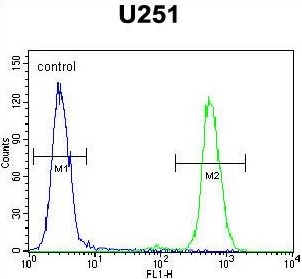
(CMKOR1 Antibody (C-term) (Cat. # AAA286482) flow cytometric analysis of U251 cells (right histogram) compared to a negative control cell (left histogram).FITC-conjugated goat-anti-rabbit secondary antibodies were used for the analysis.)
FCM/FACS (Flow Cytometry)
(CMKOR1 Antibody (C-term) (Cat. # AAA286482) flow cytometric analysis of U251 cells (right histogram) compared to a negative control cell (left histogram).FITC-conjugated goat-anti-rabbit secondary antibodies were used for the analysis.)
Rabbit anti-Human CMKOR1 Polyclonal Antibody | anti-ACKR3 antibody
CMKOR1 Antibody (C-term)
Gene Names
ACKR3; RDC1; CXCR7; RDC-1; CMKOR1; CXC-R7; CXCR-7; GPR159
Reactivity
Human
Applications
Flow Cytometry, Functional Assay, ELISA, Western Blot
Purity
Peptide Affinity Purified Rabbit Polyclonal Antibody (Pab)
Synonyms
CMKOR1, Antibody; CMKOR1 Antibody (C-term); Atypical chemokine receptor 3; C-X-C chemokine receptor type 7; CXC-R7; CXCR-7; Chemokine orphan receptor 1; G-protein coupled receptor 159; G-protein coupled receptor RDC1 homolog; RDC-1; ACKR3; CMKOR1; CXCR7; GPR159; RDC1; anti-ACKR3 antibody
Host
Rabbit
Reactivity
Human
Clonality
Polyclonal
Isotype
Rabbit IgG
Specificity
This CMKOR1 antibody is generated from rabbits immunized with a KLH conjugated synthetic peptide between 333-362 amino acids from the C-terminal region of human CMKOR1.
Purity/Purification
Peptide Affinity Purified Rabbit Polyclonal Antibody (Pab)
Form/Format
Purified polyclonal antibody supplied in PBS with 0.09% (W/V) sodium azide. This antibody is purified through a protein A column, followed by peptide affinity purification.
Sequence Positions
333-362
Sequence Length
362
Applicable Applications for anti-ACKR3 antibody
FCM/FACS (Flow Cytometry), ELISA, WB (Western Blot)
Function
Atypical chemokine receptor that controls chemokine levels and localization via high-affinity chemokine binding that is uncoupled from classic ligand-driven signal transduction cascades, resulting instead in chemokine sequestration, degradation, or transcytosis. Also known as interceptor (internalizing receptor) or chemokine-scavenging receptor or chemokine decoy receptor. Acts as a receptor for chemokines CXCL11 and CXCL12/SDF1 (PubMed:16107333, PubMed:19255243, PubMed:19380869, PubMed:20161793, PubMed:22300987). Chemokine binding does not activate G-protein-mediated signal transduction but instead induces beta-arrestin recruitment, leading to ligand internalization and activation of MAPK signaling pathway (PubMed:16940167, PubMed:18653785, PubMed:20018651). Required for regulation of CXCR4 protein levels in migrating interneurons, thereby adapting their chemokine responsiveness (PubMed:16940167, PubMed:18653785). In glioma cells, transduces signals via MEK/ERK pathway, mediating resistance to apoptosis. Promotes cell growth and survival (PubMed:16940167, PubMed:20388803). Not involved in cell migration, adhesion or proliferation of normal hematopoietic progenitors but activated by CXCL11 in malignant hemapoietic cells, leading to phosphorylation of ERK1/2 (MAPK3/MAPK1) and enhanced cell adhesion and migration (PubMed:17804806, PubMed:18653785, PubMed:19641136, PubMed:20887389). Plays a regulatory role in CXCR4-mediated activation of cell surface integrins by CXCL12 (PubMed:18653785). Required for heart valve development (PubMed:17804806). Regulates axon guidance in the oculomotor system through the regulation of CXCL12 levels (PubMed:31211835).
Cellular Location
Cell membrane; Multi-pass membrane protein. Early endosome. Recycling endosome. Note=Predominantly localizes to endocytic vesicles, and upon stimulation by the ligand is internalized via clathrin-coated pits in a beta-arrestin-dependent manner. Once internalized, the ligand dissociates from the receptor, and is targeted to degradation while the receptor is recycled back to the cell membrane.
Tissue Location
Expressed in monocytes, basophils, B-cells, umbilical vein endothelial cells (HUVEC) and B-lymphoblastoid cells Lower expression detected in CD4+ T-lymphocytes and natural killer cells. In the brain, detected in endothelial cells and capillaries, and in mature neurons of the frontal cortex and hippocampus. Expressed in tubular formation in the kidney. Highly expressed in astroglial tumor endothelial, microglial and glioma cells. Expressed at low levels in normal CD34+ progenitor cells, but at very high levels in several myeloid malignant cell lines. Expressed in breast carcinomas but not in normal breast tissue (at protein level).
Preparation and Storage
Maintain refrigerated at 2-8°C for up to 2 weeks. For long term storage store at -20°C in small aliquots to prevent freeze-thaw cycles.
FCM/FACS (Flow Cytometry)
(CMKOR1 Antibody (C-term) (Cat. # AAA286482) flow cytometric analysis of U251 cells (right histogram) compared to a negative control cell (left histogram).FITC-conjugated goat-anti-rabbit secondary antibodies were used for the analysis.)
FCM/FACS (Flow Cytometry)
(CMKOR1 Antibody (C-term) (Cat. # AAA286482) flow cytometric analysis of U251 cells (right histogram) compared to a negative control cell (left histogram).FITC-conjugated goat-anti-rabbit secondary antibodies were used for the analysis.)
WB (Western Blot)
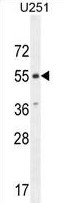
(CMKOR1 Antibody (C-term) (Cat. # AAA286482) western blot analysis in U251 cell line lysates (35ug/lane).This demonstrates the CMKOR1 antibody detected the CMKOR1 protein (arrow).)
WB (Western Blot)
(CMKOR1 Antibody (C-term) (Cat. # AAA286482) western blot analysis in U251 cell line lysates (35ug/lane).This demonstrates the CMKOR1 antibody detected the CMKOR1 protein (arrow).)
Related Product Information for anti-ACKR3 antibody
CXCR7 encodes a member of the G-protein coupled receptor family. Although this protein was earlier thought to be a receptor for vasoactive intestinal peptide (VIP), it is now considered to be an orphan receptor, in that its endogenous ligand has not been identified. The protein is also a coreceptor for human immunodeficiency viruses (HIV). Translocations involving this gene and HMGA2 on chromosome 12 have been observed in lipomas. [provided by RefSeq].
Product Categories/Family for anti-ACKR3 antibody
References
Berahovich, R.D., et al. J. Immunol. 185(9):5130-5139(2010)
Watanabe, K., et al. Arthritis Rheum. 62(11):3211-3220(2010)
Hattermann, K., et al. Cancer Res. 70(8):3299-3308(2010)
Miekus, K., et al. Folia Histochem. Cytobiol. 48(1):104-111(2010)
Zheng, K., et al. J. Exp. Clin. Cancer Res. 29, 31 (2010) :
Watanabe, K., et al. Arthritis Rheum. 62(11):3211-3220(2010)
Hattermann, K., et al. Cancer Res. 70(8):3299-3308(2010)
Miekus, K., et al. Folia Histochem. Cytobiol. 48(1):104-111(2010)
Zheng, K., et al. J. Exp. Clin. Cancer Res. 29, 31 (2010) :
NCBI and Uniprot Product Information
NCBI GI #
NCBI GeneID
NCBI Accession #
NCBI GenBank Nucleotide #
Molecular Weight
Calculated MW: 41493
NCBI Official Full Name
atypical chemokine receptor 3
NCBI Official Synonym Full Names
atypical chemokine receptor 3
NCBI Official Symbol
ACKR3
NCBI Official Synonym Symbols
RDC1; CXCR7; RDC-1; CMKOR1; CXC-R7; CXCR-7; GPR159
NCBI Protein Information
atypical chemokine receptor 3
UniProt Protein Name
Atypical chemokine receptor 3
UniProt Gene Name
ACKR3
UniProt Synonym Gene Names
CMKOR1; CXCR7; GPR159; RDC1; CXC-R7; CXCR-7; RDC-1
UniProt Entry Name
ACKR3_HUMAN
Customer Reviews
Loading reviews...
Share Your Experience
Similar Products


Product Notes
The ACKR3 ackr3 (Catalog #AAA286482) is an Antibody produced from Rabbit and is intended for research purposes only. The product is available for immediate purchase. The immunogen sequence is 333-362. The CMKOR1 Antibody (C-term) reacts with Human and may cross-react with other species as described in the data sheet. AAA Biotech's CMKOR1 can be used in a range of immunoassay formats including, but not limited to, FCM/FACS (Flow Cytometry), ELISA, WB (Western Blot). Researchers should empirically determine the suitability of the ACKR3 ackr3 for an application not listed in the data sheet. Researchers commonly develop new applications and it is an integral, important part of the investigative research process. It is sometimes possible for the material contained within the vial of "CMKOR1, Polyclonal Antibody" to become dispersed throughout the inside of the vial, particularly around the seal of said vial, during shipment and storage. We always suggest centrifuging these vials to consolidate all of the liquid away from the lid and to the bottom of the vial prior to opening. Please be advised that certain products may require dry ice for shipping and that, if this is the case, an additional dry ice fee may also be required.Precautions
All products in the AAA Biotech catalog are strictly for research-use only, and are absolutely not suitable for use in any sort of medical, therapeutic, prophylactic, in-vivo, or diagnostic capacity. By purchasing a product from AAA Biotech, you are explicitly certifying that said products will be properly tested and used in line with industry standard. AAA Biotech and its authorized distribution partners reserve the right to refuse to fulfill any order if we have any indication that a purchaser may be intending to use a product outside of our accepted criteria.Disclaimer
Though we do strive to guarantee the information represented in this datasheet, AAA Biotech cannot be held responsible for any oversights or imprecisions. AAA Biotech reserves the right to adjust any aspect of this datasheet at any time and without notice. It is the responsibility of the customer to inform AAA Biotech of any product performance issues observed or experienced within 30 days of receipt of said product. To see additional details on this or any of our other policies, please see our Terms & Conditions page.Item has been added to Shopping Cart
If you are ready to order, navigate to Shopping Cart and get ready to checkout.