
 WB (Western Blot)
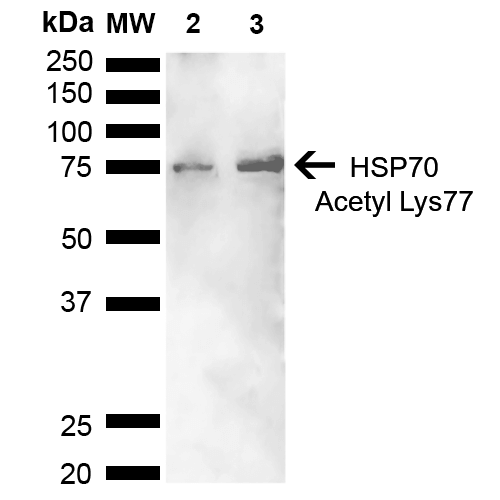
(Western blot analysis of Human Cervical cancer cell line (HeLa) lysate showing detection of ~70 kDa HSP70 Acetyl Lys77 protein using Rabbit Anti-HSP70 Acetyl Lys77 Polyclonal Antibody (SPC-743). Lane 1: Molecular Weight Ladder (MW). Lane 2: Cervical Cancer cell line (HeLa) lysate. Lane 3: H2O2 Cervical Cancer cell line (HeLa) lysate. Load: 10 ug. Block: 5% Skim Milk in 1X TBST. Primary Antibody: Rabbit Anti-HSP70 Acetyl Lys77 Polyclonal Antibody (SPC-743) at 1:1000 for 2 hours at RT. Secondary Antibody: Goat Anti-Rabbit HRP:IgG at 1:3000 for 1 hour at RT. Color Development: ECL solution for 5 min at RT. Predicted/Observed Size: ~70 kDa.)
WB (Western Blot)
(Western blot analysis of Human Cervical cancer cell line (HeLa) lysate showing detection of ~70 kDa HSP70 Acetyl Lys77 protein using Rabbit Anti-HSP70 Acetyl Lys77 Polyclonal Antibody (SPC-743). Lane 1: Molecular Weight Ladder (MW). Lane 2: Cervical Cancer cell line (HeLa) lysate. Lane 3: H2O2 Cervical Cancer cell line (HeLa) lysate. Load: 10 ug. Block: 5% Skim Milk in 1X TBST. Primary Antibody: Rabbit Anti-HSP70 Acetyl Lys77 Polyclonal Antibody (SPC-743) at 1:1000 for 2 hours at RT. Secondary Antibody: Goat Anti-Rabbit HRP:IgG at 1:3000 for 1 hour at RT. Color Development: ECL solution for 5 min at RT. Predicted/Observed Size: ~70 kDa.)
Rabbit HSP70 Polyclonal Antibody | anti-HSP70 antibody
HSP70 Antibody (Acetyl Lys77): RPE
WB (Western Blot)
(Western blot analysis of Human Cervical cancer cell line (HeLa) lysate showing detection of ~70 kDa HSP70 Acetyl Lys77 protein using Rabbit Anti-HSP70 Acetyl Lys77 Polyclonal Antibody (SPC-743). Lane 1: Molecular Weight Ladder (MW). Lane 2: Cervical Cancer cell line (HeLa) lysate. Lane 3: H2O2 Cervical Cancer cell line (HeLa) lysate. Load: 10 ug. Block: 5% Skim Milk in 1X TBST. Primary Antibody: Rabbit Anti-HSP70 Acetyl Lys77 Polyclonal Antibody (SPC-743) at 1:1000 for 2 hours at RT. Secondary Antibody: Goat Anti-Rabbit HRP:IgG at 1:3000 for 1 hour at RT. Color Development: ECL solution for 5 min at RT. Predicted/Observed Size: ~70 kDa.)
WB (Western Blot)
(Western blot analysis of Human Cervical cancer cell line (HeLa) lysate showing detection of ~70 kDa HSP70 Acetyl Lys77 protein using Rabbit Anti-HSP70 Acetyl Lys77 Polyclonal Antibody (SPC-743). Lane 1: Molecular Weight Ladder (MW). Lane 2: Cervical Cancer cell line (HeLa) lysate. Lane 3: H2O2 Cervical Cancer cell line (HeLa) lysate. Load: 10 ug. Block: 5% Skim Milk in 1X TBST. Primary Antibody: Rabbit Anti-HSP70 Acetyl Lys77 Polyclonal Antibody (SPC-743) at 1:1000 for 2 hours at RT. Secondary Antibody: Goat Anti-Rabbit HRP:IgG at 1:3000 for 1 hour at RT. Color Development: ECL solution for 5 min at RT. Predicted/Observed Size: ~70 kDa.)
ICC (Immunocytochemistry)
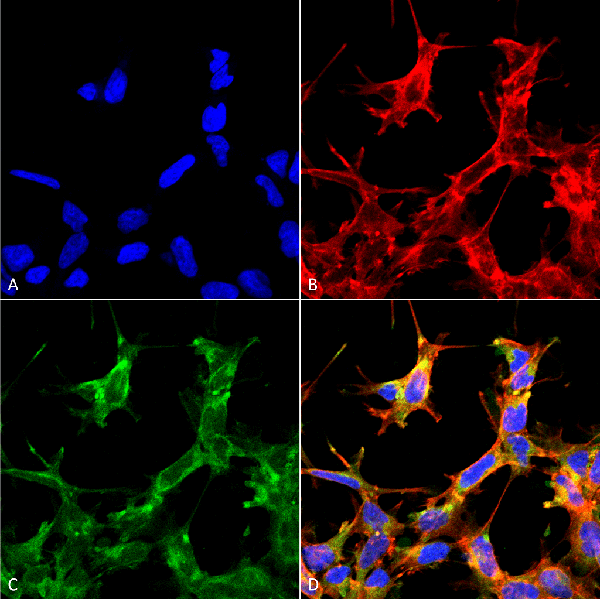
(Immunocytochemistry/Immunofluorescence analysis using Rabbit Anti-HSP70 Acetyl Lys77 Polyclonal Antibody (SPC-743). Tissue: Embryonic kidney cells (HEK293) cultured overnight with 50 uM H2O2. Species: Human. Fixation: 5% Formaldehyde for 5 min. Primary Antibody: Rabbit Anti-HSP70 Acetyl Lys77 Polyclonal Antibody (SPC-743) at 1:60 for 30-60 min at RT. Secondary Antibody: Goat Anti-Mouse Alexa Fluor 488 at 1:1500 for 30-60 min at RT. Counterstain: Phalloidin Alexa Fluor 633 F-Actin stain; DAPI (blue) nuclear stain at 1:250, 1:50000 for 30-60 min at RT. Localization: Cytoplasmic. Magnification: 20X (2X Zoom). (A) DAPI (blue) nuclear stain. (B) Phalloidin Alex Fluor 633 F-Actin stain. (C) HSP70 Antibody (Acetyl Lys77). (D) Composite. Courtesy of: Dr. Robert Burke, University of Victoria.)
ICC (Immunocytochemistry)
(Immunocytochemistry/Immunofluorescence analysis using Rabbit Anti-HSP70 Acetyl Lys77 Polyclonal Antibody (SPC-743). Tissue: Embryonic kidney cells (HEK293) cultured overnight with 50 uM H2O2. Species: Human. Fixation: 5% Formaldehyde for 5 min. Primary Antibody: Rabbit Anti-HSP70 Acetyl Lys77 Polyclonal Antibody (SPC-743) at 1:60 for 30-60 min at RT. Secondary Antibody: Goat Anti-Mouse Alexa Fluor 488 at 1:1500 for 30-60 min at RT. Counterstain: Phalloidin Alexa Fluor 633 F-Actin stain; DAPI (blue) nuclear stain at 1:250, 1:50000 for 30-60 min at RT. Localization: Cytoplasmic. Magnification: 20X (2X Zoom). (A) DAPI (blue) nuclear stain. (B) Phalloidin Alex Fluor 633 F-Actin stain. (C) HSP70 Antibody (Acetyl Lys77). (D) Composite. Courtesy of: Dr. Robert Burke, University of Victoria.)
All HSP70s, regardless of location, bind proteins, particularly unfolded ones. The molecular chaperones of the HSP70 family recognize and bind to nascent polypeptide chains as well as partially folded intermediates of proteins preventing their aggregation and misfolding. The binding of ATP triggers a critical conformational change leading to the release of the bound substrate protein (6). The universal ability of HSP70s to undergo cycles of binding to and release from hydrophobic stretches of partially unfolded proteins determines their role in a great variety of vital intracellular functions such as protein synthesis, protein folding and oligomerization and protein transport.
NCBI and Uniprot Product Information
Customer Reviews
Loading reviews...
Share Your Experience
Similar Products



Product Notes
The HSP70 hspa1a (Catalog #AAA253876) is an Antibody produced from Rabbit and is intended for research purposes only. The product is available for immediate purchase. The HSP70 Antibody (Acetyl Lys77): RPE reacts with Human; Mouse; Rat and may cross-react with other species as described in the data sheet. AAA Biotech's HSP70 can be used in a range of immunoassay formats including, but not limited to, IF (Immunofluorescence), ICC (Immunocytochemistry), ELISA, WB (Western Blot). Researchers should empirically determine the suitability of the HSP70 hspa1a for an application not listed in the data sheet. Researchers commonly develop new applications and it is an integral, important part of the investigative research process. It is sometimes possible for the material contained within the vial of "HSP70, Polyclonal Antibody" to become dispersed throughout the inside of the vial, particularly around the seal of said vial, during shipment and storage. We always suggest centrifuging these vials to consolidate all of the liquid away from the lid and to the bottom of the vial prior to opening. Please be advised that certain products may require dry ice for shipping and that, if this is the case, an additional dry ice fee may also be required.Precautions
All products in the AAA Biotech catalog are strictly for research-use only, and are absolutely not suitable for use in any sort of medical, therapeutic, prophylactic, in-vivo, or diagnostic capacity. By purchasing a product from AAA Biotech, you are explicitly certifying that said products will be properly tested and used in line with industry standard. AAA Biotech and its authorized distribution partners reserve the right to refuse to fulfill any order if we have any indication that a purchaser may be intending to use a product outside of our accepted criteria.Disclaimer
Though we do strive to guarantee the information represented in this datasheet, AAA Biotech cannot be held responsible for any oversights or imprecisions. AAA Biotech reserves the right to adjust any aspect of this datasheet at any time and without notice. It is the responsibility of the customer to inform AAA Biotech of any product performance issues observed or experienced within 30 days of receipt of said product. To see additional details on this or any of our other policies, please see our Terms & Conditions page.Item has been added to Shopping Cart
If you are ready to order, navigate to Shopping Cart and get ready to checkout.