
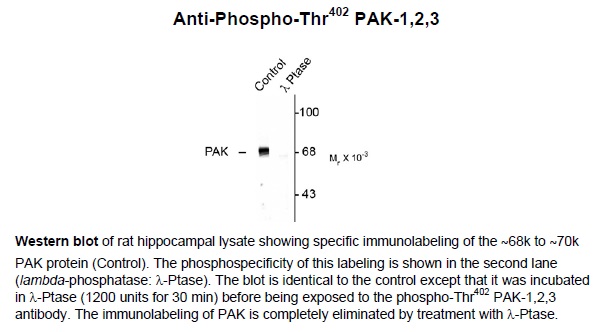
 Application Data
Rabbit anti-Rat PAK-1,2,3 (Thr402) Polyclonal Antibody | anti-PAK1-3 antibody
Anti-Phospho-Thr402 PAK-1,2,3
Reactivity
Rat
Applications
Western Blot
Purity
Affinity Purified (Prepared from rabbit serum by affinity purification via sequential chromatography on phospho- and dephosphopeptide affinity columns.)
Synonyms
PAK-1,2,3 (Thr402), Antibody; Anti-Phospho-Thr402 PAK-1,2,3; anti-PAK1-3 antibody
Host
Rabbit
Reactivity
Rat
Clonality
Polyclonal
Specificity
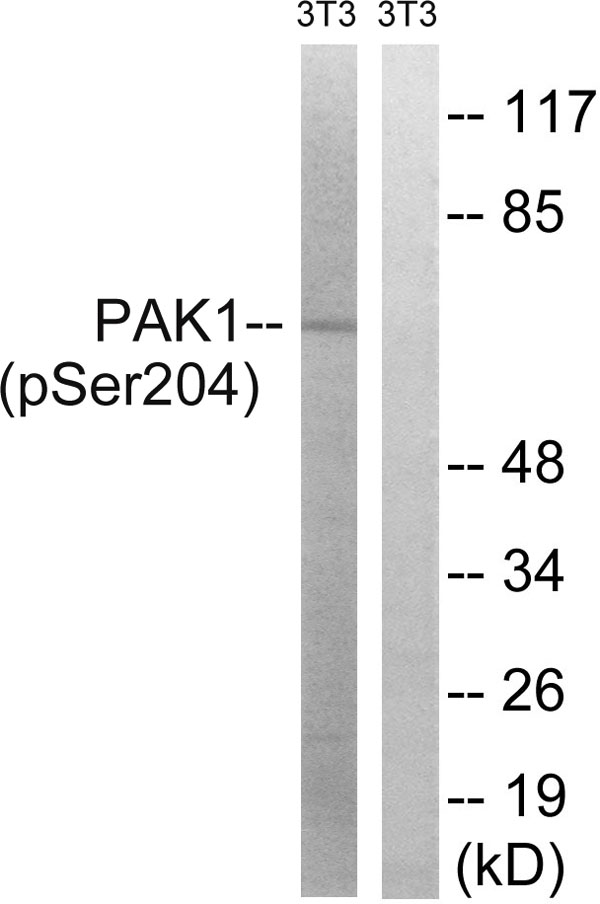
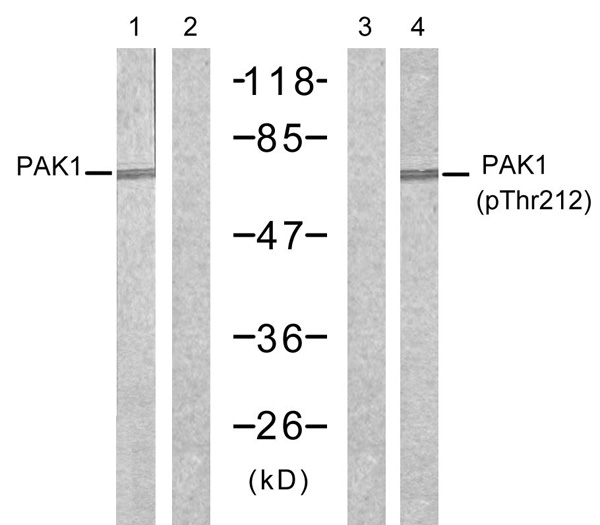
Specific for the ~68k to ~70k PAK protein phosphorylated at Thr402. The immunolabeling of PAK is completely eliminated by lambda-phosphatase treatment.
Purity/Purification
Affinity Purified (Prepared from rabbit serum by affinity purification via sequential chromatography on phospho- and dephosphopeptide affinity columns.)
Form/Format
100 ul in 10 mM HEPES (pH 7.5), 150 mM NaCl, 100 ug per ml BSA and 50% glycerol. Adequate amount of material to conduct 10-mini Western Blots.
Sequence Length
544
Applicable Applications for anti-PAK1-3 antibody
WB (Western Blot)
Antigen
Phosphopeptide corresponding to amino acid residues surrounding the phospho-Thr402 of rat p21 activated kinase 2 (PAK-2). The peptide sequence used is identical in PAK-1, 2 and 3. Note: Thr402 in PAK-2 corresponds to Thr423 in human PAK-1.
Immunogen Information
Synthetic phospho-peptide corresponding to amino acid residues surrounding Thr402 conjugated to KLH
Immunogen Species
Rat
Reactivity Assumed Based on 100% Sequence Homology
Bovine, canine, human and mouse
Species Reactivity Note
The antibody has been directly tested for reactivity in Western blots with rat tissue. It is anticipated that the antibody will react with bovine, canine, human and mouse based on the fact that these species have 100% homology with the amino acid sequence used as antigen.
Biological Significance
In mammals, there are several identified isoforms of p21-activated protein kinases or PAKs: alpha-PAK (also known as PAK-1) and beta-PAK (also known as PAK-3) are mostly brain-specific, while -PAK (also known as PAK-2) is expressed ubiquitously (Jakobi et al., 2003). Mutations of the gene coding for PAK-3 are associated with X-linked mental retardation and recent work indicates that PAK-3 is a key regulator of synapse formation and plasticity in the hippocampus (Boda et al., 2004). PAK-3 is thought to play a key role in regulation of cell shape and motility as well as cell death (Jakobi et al., 2003; Walter et al., 1998). Autophosphorylation of Thr402 in the protein has been found to be essential for activation of PAK (Jakobi et al., 2000).
Preparation and Storage
Store at -20 degree C; stable for at least one year.
Application Data
Application Data
Related Product Information for anti-PAK1-3 antibody
Affinity purified rabbit polyclonal antibody
References
• Boda B, Alberi S, Nikonenko I, Node-Langlois R, Jourdain P, Moosmayer M, Parisi-Jourdain L, Muller D (2004) The mental retardation protein PAK-3 contributes to synapse formation and plasticity in hippocampus. J Neurosci 24:10816-10825.
• Jakobi R, Huang Z, Walter BN, Tuazon PT, Traugh JA (2000) Substrates enhance autophosphorylation and activation of p21-activated protein kinase gamma-PAK in the absence of activation loop phosphorylation. Eur J Biochem 267:4414-4421.
• Jakobi R, McCarthy CC, Koeppel MA, Stringer DK (2003) Caspase-activated PAK-2 is regulated by subcellular targeting and proteasomal degradation. J Biol Chem 278:38675-38685.
• Walter BN, Huang Z, Jakobi R, Tuazon PT, Alnemri ES, Litwack G, Traugh JA (1998) Cleavage and activation of p21-activated protein kinase gamma-PAK by CPP32 (caspase 3). Effects of autophosphorylation on activity. J Biol Chem 273:28733-28739.
• Jia Nie, Chao Sun, Omar Faruque, Guangming Ye, Jia Li, Qiangrong Liang, Zhijie Chang, Wannian Yang, Xiao Han, and Yuguang Shi (2012) Synapses of Amphids Defective (SAD-A) Kinase Promotes Glucose-stimulated Insulin Secretion through Activation of p21-activated Kinase (PAK1) in Pancreatic beta-Cells. J. Biol. Chem. 287:26435- 26444.
• Jakobi R, Huang Z, Walter BN, Tuazon PT, Traugh JA (2000) Substrates enhance autophosphorylation and activation of p21-activated protein kinase gamma-PAK in the absence of activation loop phosphorylation. Eur J Biochem 267:4414-4421.
• Jakobi R, McCarthy CC, Koeppel MA, Stringer DK (2003) Caspase-activated PAK-2 is regulated by subcellular targeting and proteasomal degradation. J Biol Chem 278:38675-38685.
• Walter BN, Huang Z, Jakobi R, Tuazon PT, Alnemri ES, Litwack G, Traugh JA (1998) Cleavage and activation of p21-activated protein kinase gamma-PAK by CPP32 (caspase 3). Effects of autophosphorylation on activity. J Biol Chem 273:28733-28739.
• Jia Nie, Chao Sun, Omar Faruque, Guangming Ye, Jia Li, Qiangrong Liang, Zhijie Chang, Wannian Yang, Xiao Han, and Yuguang Shi (2012) Synapses of Amphids Defective (SAD-A) Kinase Promotes Glucose-stimulated Insulin Secretion through Activation of p21-activated Kinase (PAK1) in Pancreatic beta-Cells. J. Biol. Chem. 287:26435- 26444.
NCBI and Uniprot Product Information
NCBI GI #
NCBI GeneID
NCBI Accession #
NCBI GenBank Nucleotide #
Molecular Weight
68/70
NCBI Official Full Name
serine/threonine-protein kinase PAK 1
NCBI Official Synonym Full Names
p21 protein (Cdc42/Rac)-activated kinase 1
NCBI Official Symbol
Pak1
NCBI Protein Information
serine/threonine-protein kinase PAK 1; PAK-1; p68-PAK; alpha-PAK; protein kinase MUK2; p21-activated kinase 1; p21 (CDKN1A)-activated kinase 1; p21/Cdc42/Rac1-activated kinase 1 (yeast Ste20-related)
UniProt Protein Name
Serine/threonine-protein kinase PAK 1
UniProt Gene Name
Pak1
UniProt Synonym Gene Names
PAK-1
UniProt Entry Name
PAK1_RAT
Customer Reviews
Loading reviews...
Share Your Experience
Similar Products


Product Notes
The PAK1-3 pak1 (Catalog #AAA72801) is an Antibody produced from Rabbit and is intended for research purposes only. The product is available for immediate purchase. The Anti-Phospho-Thr402 PAK-1,2,3 reacts with Rat and may cross-react with other species as described in the data sheet. AAA Biotech's PAK-1,2,3 (Thr402) can be used in a range of immunoassay formats including, but not limited to, WB (Western Blot). Researchers should empirically determine the suitability of the PAK1-3 pak1 for an application not listed in the data sheet. Researchers commonly develop new applications and it is an integral, important part of the investigative research process. It is sometimes possible for the material contained within the vial of "PAK-1,2,3 (Thr402), Polyclonal Antibody" to become dispersed throughout the inside of the vial, particularly around the seal of said vial, during shipment and storage. We always suggest centrifuging these vials to consolidate all of the liquid away from the lid and to the bottom of the vial prior to opening. Please be advised that certain products may require dry ice for shipping and that, if this is the case, an additional dry ice fee may also be required.Precautions
All products in the AAA Biotech catalog are strictly for research-use only, and are absolutely not suitable for use in any sort of medical, therapeutic, prophylactic, in-vivo, or diagnostic capacity. By purchasing a product from AAA Biotech, you are explicitly certifying that said products will be properly tested and used in line with industry standard. AAA Biotech and its authorized distribution partners reserve the right to refuse to fulfill any order if we have any indication that a purchaser may be intending to use a product outside of our accepted criteria.Disclaimer
Though we do strive to guarantee the information represented in this datasheet, AAA Biotech cannot be held responsible for any oversights or imprecisions. AAA Biotech reserves the right to adjust any aspect of this datasheet at any time and without notice. It is the responsibility of the customer to inform AAA Biotech of any product performance issues observed or experienced within 30 days of receipt of said product. To see additional details on this or any of our other policies, please see our Terms & Conditions page.Item has been added to Shopping Cart
If you are ready to order, navigate to Shopping Cart and get ready to checkout.