Loading...

Skip to main content
Call us at +1-800-604-9114 for more information about our products or contact us online Need help? +1-800-604-9114 or contact us
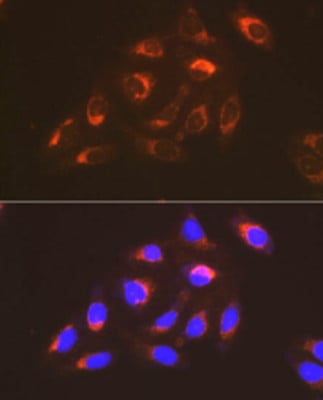
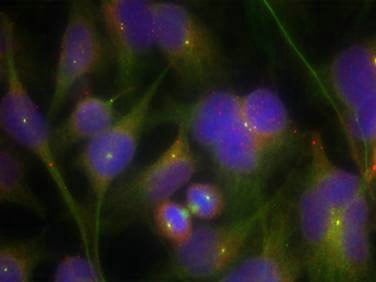
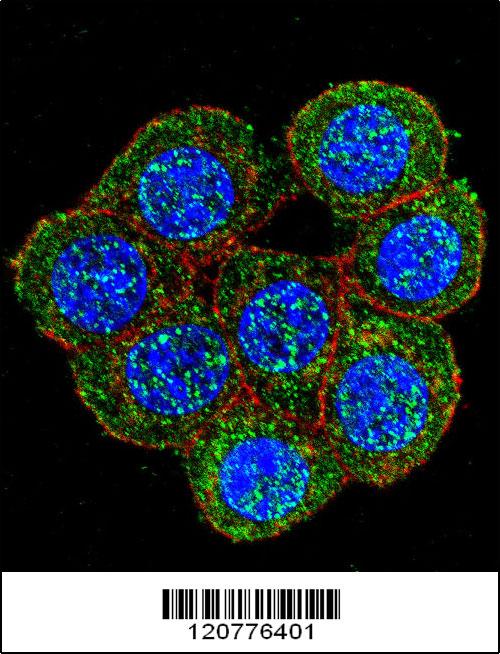
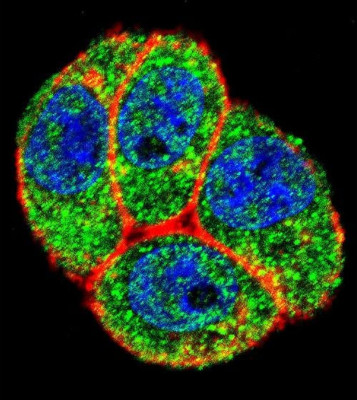
product-image-AAA288401_IF8.jpg IF (Immunofluorescence) (Confocal immunofluorescent analysis of PTK2 Antibody (Center) with Hela cell followed by Alexa Fluor 488-conjugated goat anti-rabbit lgG (green). Actin filaments have been labeled with Alexa Fluor 555 phalloidin (red).DAPI was used to stain the cell nuclear (blue).)

Rabbit PTK2 Polyclonal Antibody | anti-PTK2 antibody

PTK2 Antibody (Center)

Gene Names
PTK2; FAK; FADK; FAK1; FRNK; PPP1R71; p125FAK; pp125FAK
Reactivity
Human
Predicted: Chicken, Mouse, Rat
Applications
Immunofluorescence, Flow Cytometry, Functional Assay, Immunohistochemistry, ELISA, Western Blot
Purity
This antibody is prepared by Saturated Ammonium Sulfate (SAS) precipitation followed by dialysis against PBS.
Synonyms
PTK2, Antibody; PTK2 Antibody (Center); Focal adhesion kinase 1; FADK 1; Focal adhesion kinase-related nonkinase; FRNK; Protein phosphatase 1 regulatory subunit 71; PPP1R71; Protein-tyrosine kinase 2; p125FAK; pp125FAK; PTK2; FAK; FAK1; anti-PTK2 antibody
Ordering
Host
Rabbit
Reactivity
Human
Predicted: Chicken, Mouse, Rat
Clonality
Polyclonal
Isotype
Rabbit IgG
Specificity
This PTK2 antibody is generated from rabbits immunized with a KLH conjugated synthetic peptide between 396-423 amino acids from the Central region of human PTK2.
Purity/Purification
This antibody is prepared by Saturated Ammonium Sulfate (SAS) precipitation followed by dialysis against PBS.
Form/Format
Purified polyclonal antibody supplied in PBS with 0.09% (W/V) sodium azide.
Sequence Positions
396-423
Sequence Length
1,006
Applicable Applications for anti-PTK2 antibody
IF (Immunofluorescence), FCM/FACS (Flow Cytometry), IHC (Immunohistochemistry), ELISA, WB (Western Blot)
Function
Non-receptor protein-tyrosine kinase that plays an essential role in regulating cell migration, adhesion, spreading, reorganization of the actin cytoskeleton, formation and disassembly of focal adhesions and cell protrusions, cell cycle progression, cell proliferation and apoptosis. Required for early embryonic development and placenta development. Required for embryonic angiogenesis, normal cardiomyocyte migration and proliferation, and normal heart development. Regulates axon growth and neuronal cell migration, axon branching and synapse formation; required for normal development of the nervous system. Plays a role in osteogenesis and differentiation of osteoblasts. Functions in integrin signal transduction, but also in signaling downstream of numerous growth factor receptors, G-protein coupled receptors (GPCR), EPHA2, netrin receptors and LDL receptors. Forms multisubunit signaling complexes with SRC and SRC family members upon activation; this leads to the phosphorylation of additional tyrosine residues, creating binding sites for scaffold proteins, effectors and substrates. Regulates numerous signaling pathways. Promotes activation of phosphatidylinositol 3-kinase and the AKT1 signaling cascade. Promotes activation of MAPK1/ERK2, MAPK3/ERK1 and the MAP kinase signaling cascade. Promotes localized and transient activation of guanine nucleotide exchange factors (GEFs) and GTPase-activating proteins (GAPs), and thereby modulates the activity of Rho family GTPases. Signaling via CAS family members mediates activation of RAC1. Phosphorylates NEDD9 following integrin stimulation (PubMed:9360983). Recruits the ubiquitin ligase MDM2 to P53/TP53 in the nucleus, and thereby regulates P53/TP53 activity, P53/TP53 ubiquitination and proteasomal degradation. Phosphorylates SRC; this increases SRC kinase activity. Phosphorylates ACTN1, ARHGEF7, GRB7, RET and WASL. Promotes phosphorylation of PXN and STAT1; most likely PXN and STAT1 are phosphorylated by a SRC family kinase that is recruited to autophosphorylated PTK2/FAK1, rather than by PTK2/FAK1 itself. Promotes phosphorylation of BCAR1; GIT2 and SHC1; this requires both SRC and PTK2/FAK1. Promotes phosphorylation of BMX and PIK3R1. Isoform 6 (FRNK) does not contain a kinase domain and inhibits PTK2/FAK1 phosphorylation and signaling. Its enhanced expression can attenuate the nuclear accumulation of LPXN and limit its ability to enhance serum response factor (SRF)-dependent gene transcription.
Cellular Location
Cell junction, focal adhesion. Cell membrane {ECO:0000250|UniProtKB:Q00944}; Peripheral membrane protein {ECO:0000250|UniProtKB:Q00944}; Cytoplasmic side {ECO:0000250|UniProtKB:Q00944}. Cytoplasm, perinuclear region. Cytoplasm, cell cortex. Cytoplasm, cytoskeleton {ECO:0000250|UniProtKB:O35346}. Cytoplasm, cytoskeleton, microtubule organizing center, centrosome. Nucleus. Cytoplasm, cytoskeleton, cilium basal body Cytoplasm Note=Constituent of focal adhesions. Detected at microtubules {ECO:0000250|UniProtKB:P34152}
Tissue Location
Detected in B and T-lymphocytes. Isoform 1 and isoform 6 are detected in lung fibroblasts (at protein level) Ubiquitous. Expressed in epithelial cells (at protein level) (PubMed:31630787).
Preparation and Storage
Maintain refrigerated at 2-8°C for up to 2 weeks. For long term storage store at -20°C in small aliquots to prevent freeze-thaw cycles.

IF (Immunofluorescence)

(Confocal immunofluorescent analysis of PTK2 Antibody (Center) with Hela cell followed by Alexa Fluor 488-conjugated goat anti-rabbit lgG (green). Actin filaments have been labeled with Alexa Fluor 555 phalloidin (red).DAPI was used to stain the cell nuclear (blue).)

product-image-AAA288401_IF8.jpg IF (Immunofluorescence) (Confocal immunofluorescent analysis of PTK2 Antibody (Center) with Hela cell followed by Alexa Fluor 488-conjugated goat anti-rabbit lgG (green). Actin filaments have been labeled with Alexa Fluor 555 phalloidin (red).DAPI was used to stain the cell nuclear (blue).)

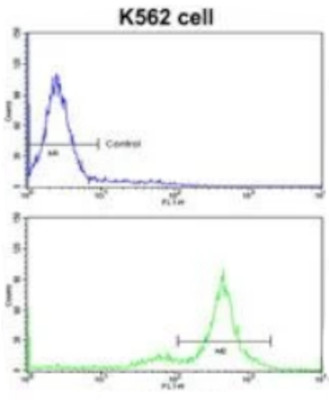
FCM/FACS (Flow Cytometry)

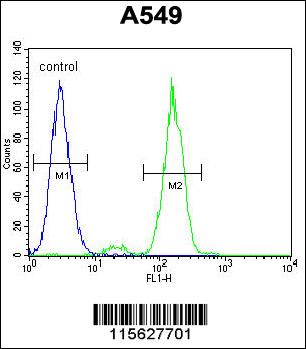
(Flow cytometric analysis of K562 cells using PTK2 Antibody (Center)(bottom histogram) compared to a negative control cell (top histogram)FITC-conjugated goat-anti-rabbit secondary antibodies were used for the analysis.)

product-image-AAA288401_FCM10.jpg FCM/FACS (Flow Cytometry) (Flow cytometric analysis of K562 cells using PTK2 Antibody (Center)(bottom histogram) compared to a negative control cell (top histogram)FITC-conjugated goat-anti-rabbit secondary antibodies were used for the analysis.)

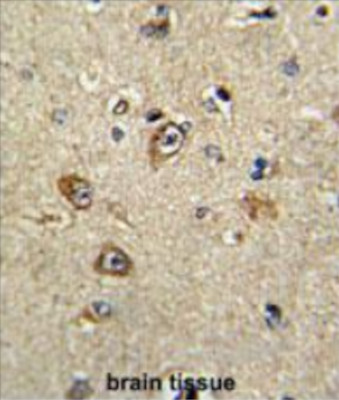
IHC (Immunohistochemisry)

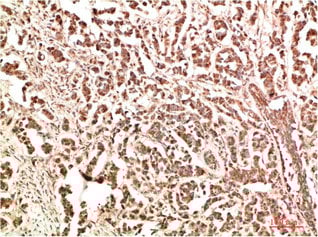
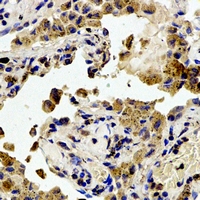
(Formalin-fixed and paraffin-embedded human brain tissue reacted with PTK2 Antibody (Center), which was peroxidase-conjugated to the secondary antibody, followed by DAB staining. This data demonstrates the use of this antibody for immunohistochemistry; clinical relevance has not been evaluated.)

product-image-AAA288401_IHC11.jpg IHC (Immunohistochemisry) (Formalin-fixed and paraffin-embedded human brain tissue reacted with PTK2 Antibody (Center), which was peroxidase-conjugated to the secondary antibody, followed by DAB staining. This data demonstrates the use of this antibody for immunohistochemistry; clinical relevance has not been evaluated.)

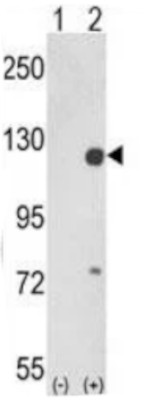
WB (Western Blot)

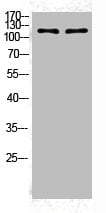
(Western blot analysis of PTK2 (arrow) using rabbit polyclonal PTK2 Antibody (Center). 293 cell lysates (2 ug/lane) either nontransfected (Lane 1) or transiently transfected with the PTK2 gene (Lane 2).)

product-image-AAA288401_WB13.jpg WB (Western Blot) (Western blot analysis of PTK2 (arrow) using rabbit polyclonal PTK2 Antibody (Center). 293 cell lysates (2 ug/lane) either nontransfected (Lane 1) or transiently transfected with the PTK2 gene (Lane 2).)

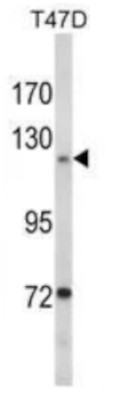
WB (Western Blot)

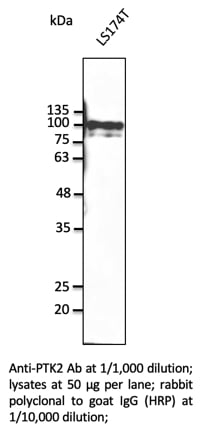
(Western blot analysis of PTK2 Antibody (Center) in T47D cell line lysates (35ug/lane). PTK2 (arrow) was detected using the purified Pab.)

product-image-AAA288401_WB15.jpg WB (Western Blot) (Western blot analysis of PTK2 Antibody (Center) in T47D cell line lysates (35ug/lane). PTK2 (arrow) was detected using the purified Pab.)
Related Product Information for anti-PTK2 antibody
PTK2 is a cytoplasmic protein tyrosine kinase which is found concentrated in the focal adhesions that form between cells growing in the presence of extracellular matrix constituents. This protein is a member of the FAK subfamily of protein tyrosine kinases but lacks significant sequence similarity to kinases from other subfamilies.
Product Categories/Family for anti-PTK2 antibody
References
Calalb,M.B., et.al., Mol. Cell. Biol. 15 (2), 954-963 (1995)
Polte,T.R. et.al., Proc. Natl. Acad. Sci. U.S.A. 92 (23), 10678-10682 (1995)
Gervais,F.G., et.al., J. Biol. Chem. 273 (27), 17102-17108 (1998)

NCBI and Uniprot Product Information

NCBI GI #
NCBI GeneID
NCBI Accession #
NCBI GenBank Nucleotide #
UniProt Accession #
NCBI Official Full Name
focal adhesion kinase 1 isoform c
NCBI Official Synonym Full Names
protein tyrosine kinase 2
NCBI Official Symbol
PTK2
NCBI Official Synonym Symbols
FAK; FADK; FAK1; FRNK; PPP1R71; p125FAK; pp125FAK
NCBI Protein Information
focal adhesion kinase 1
UniProt Protein Name
Focal adhesion kinase 1
UniProt Gene Name
PTK2
UniProt Synonym Gene Names
FAK; FAK1; FADK 1; FRNK; PPP1R71
UniProt Entry Name
FAK1_HUMAN

Similar Products

Product Notes

The PTK2 ptk2 (Catalog #AAA288401) is an Antibody produced from Rabbit and is intended for research purposes only. The product is available for immediate purchase. The immunogen sequence is 396-423. The PTK2 Antibody (Center) reacts with Human Predicted: Chicken, Mouse, Rat and may cross-react with other species as described in the data sheet. AAA Biotech's PTK2 can be used in a range of immunoassay formats including, but not limited to, IF (Immunofluorescence), FCM/FACS (Flow Cytometry), IHC (Immunohistochemistry), ELISA, WB (Western Blot). Researchers should empirically determine the suitability of the PTK2 ptk2 for an application not listed in the data sheet. Researchers commonly develop new applications and it is an integral, important part of the investigative research process. It is sometimes possible for the material contained within the vial of "PTK2, Polyclonal Antibody" to become dispersed throughout the inside of the vial, particularly around the seal of said vial, during shipment and storage. We always suggest centrifuging these vials to consolidate all of the liquid away from the lid and to the bottom of the vial prior to opening. Please be advised that certain products may require dry ice for shipping and that, if this is the case, an additional dry ice fee may also be required.

Precautions

All products in the AAA Biotech catalog are strictly for research-use only, and are absolutely not suitable for use in any sort of medical, therapeutic, prophylactic, in-vivo, or diagnostic capacity. By purchasing a product from AAA Biotech, you are explicitly certifying that said products will be properly tested and used in line with industry standard. AAA Biotech and its authorized distribution partners reserve the right to refuse to fulfill any order if we have any indication that a purchaser may be intending to use a product outside of our accepted criteria.

Disclaimer

Though we do strive to guarantee the information represented in this datasheet, AAA Biotech cannot be held responsible for any oversights or imprecisions. AAA Biotech reserves the right to adjust any aspect of this datasheet at any time and without notice. It is the responsibility of the customer to inform AAA Biotech of any product performance issues observed or experienced within 30 days of receipt of said product. To see additional details on this or any of our other policies, please see our Terms & Conditions page.

Item has been added to Shopping Cart

If you are ready to order, navigate to Shopping Cart and get ready to checkout.

Submit a Question

Please complete the form below and a representative will contact you as soon as possible.

Request more Information

Please complete the form below and a representative will contact you as soon as possible.

Request a Manual

Please complete the form below and a representative will contact you as soon as possible.

Request a Quote

Please complete the form below and a representative will contact you as soon as possible.