
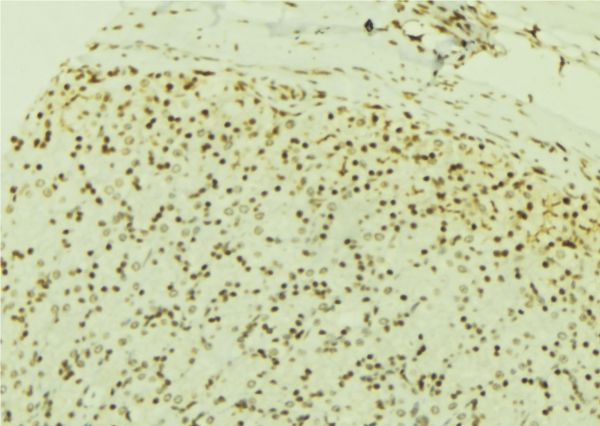
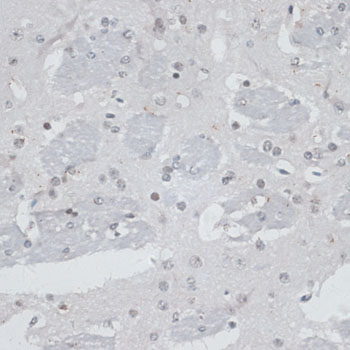
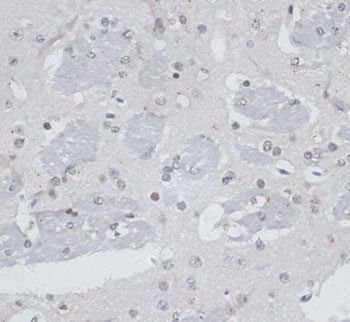
 IHC (Immunohistochemisry)
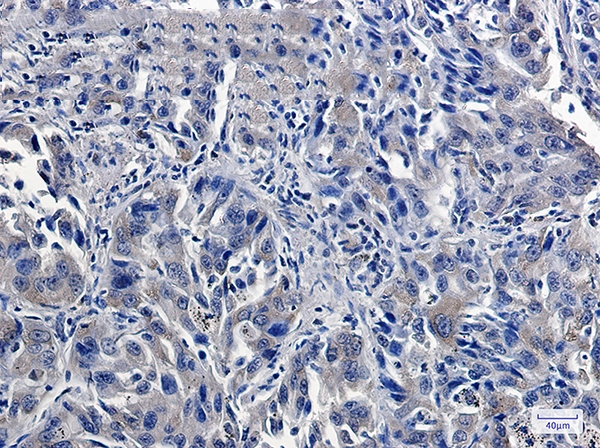
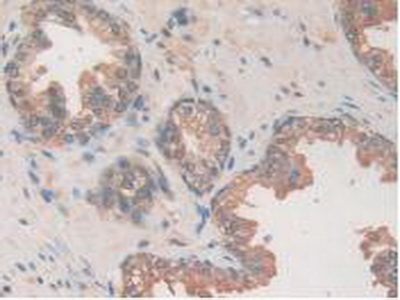
(AAA326686 at 1/100 staining Human gastric tissue by IHC-P. The sample was formaldehyde fixed and a heat mediated antigen retrieval step in citrate buffer was performed. The sample was then blocked and incubated with the antibody for 1.5 hours at 22 degree C. An HRP conjugated goat anti-rabbit antibody was used as the secondary.)
IHC (Immunohistochemisry)
(AAA326686 at 1/100 staining Human gastric tissue by IHC-P. The sample was formaldehyde fixed and a heat mediated antigen retrieval step in citrate buffer was performed. The sample was then blocked and incubated with the antibody for 1.5 hours at 22 degree C. An HRP conjugated goat anti-rabbit antibody was used as the secondary.)
Rabbit USP7 Polyclonal Antibody | anti-USP7 antibody
USP7 Antibody
Phosphate buffered saline, pH 7.4, 150mM NaCl, 0.02% sodium azide and 50% glycerol.
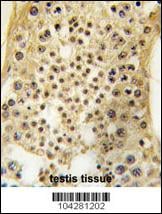
IHC (Immunohistochemisry)
(AAA326686 at 1/100 staining Human gastric tissue by IHC-P. The sample was formaldehyde fixed and a heat mediated antigen retrieval step in citrate buffer was performed. The sample was then blocked and incubated with the antibody for 1.5 hours at 22 degree C. An HRP conjugated goat anti-rabbit antibody was used as the secondary.)
IHC (Immunohistochemisry)
(AAA326686 at 1/100 staining Human gastric tissue by IHC-P. The sample was formaldehyde fixed and a heat mediated antigen retrieval step in citrate buffer was performed. The sample was then blocked and incubated with the antibody for 1.5 hours at 22 degree C. An HRP conjugated goat anti-rabbit antibody was used as the secondary.)
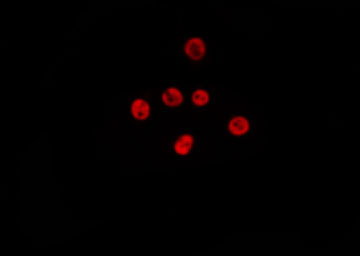
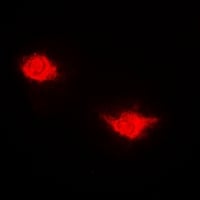
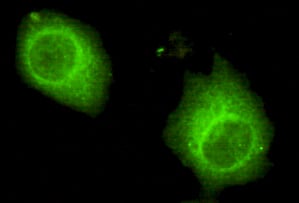
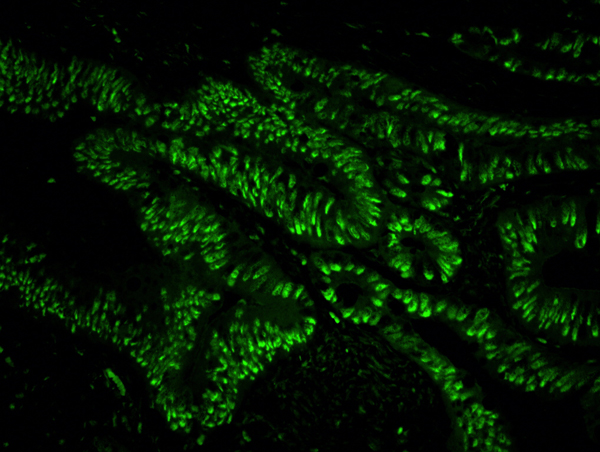
IF (Immunofluorescence)
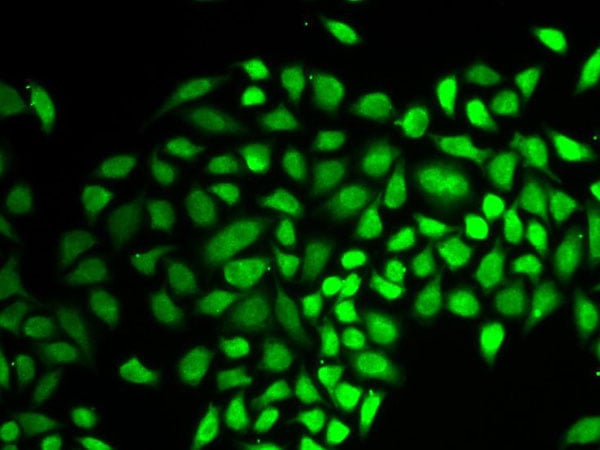
(AAA326686 staining HepG2 by IF/ICC. The sample were fixed with PFA and permeabilized in 0.1% Triton X-100, then blocked in 10% serum for 45 minutes at 25 degree C. The primary antibody was diluted at 1/200 and incubated with the sample for 1 hour at 37 degree C. An Alexa Fluor 594 conjugated goat anti-rabbit IgG (H+L) Ab, diluted at 1/600, was used as the secondary antibody.)
IF (Immunofluorescence)
(AAA326686 staining HepG2 by IF/ICC. The sample were fixed with PFA and permeabilized in 0.1% Triton X-100, then blocked in 10% serum for 45 minutes at 25 degree C. The primary antibody was diluted at 1/200 and incubated with the sample for 1 hour at 37 degree C. An Alexa Fluor 594 conjugated goat anti-rabbit IgG (H+L) Ab, diluted at 1/600, was used as the secondary antibody.)
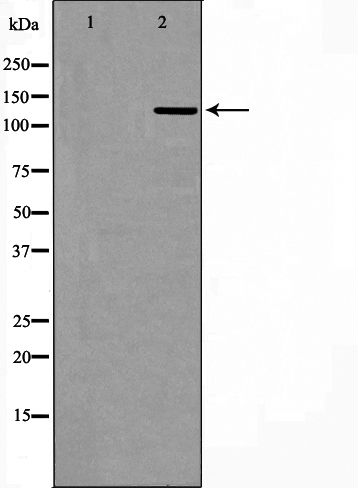
WB (Western Blot)
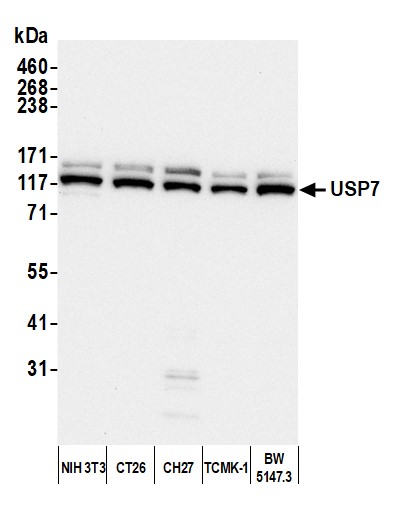
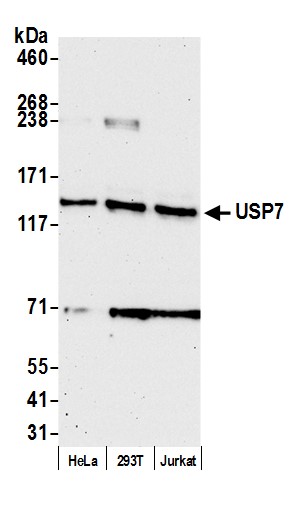
(Western blot analysis of HepG2, using USP7 Antibody. The lane on the left is treated with the antigen-specific peptide.)
WB (Western Blot)
(Western blot analysis of HepG2, using USP7 Antibody. The lane on the left is treated with the antigen-specific peptide.)
Function: Hydrolase that deubiquitinates target proteins such as FOXO4, p53/TP53, MDM2, ERCC6, DNMT1, UHRF1, PTEN, KMT2E/MLL5 and DAXX (PubMed:11923872, PubMed:15053880, PubMed:16964248, PubMed:18716620, PubMed:25283148, PubMed:26678539). Together with DAXX, prevents MDM2 self-ubiquitination and enhances the E3 ligase activity of MDM2 towards p53/TP53, thereby promoting p53/TP53 ubiquitination and proteasomal degradation (PubMed:15053880, PubMed:16845383, PubMed:18566590, PubMed:20153724). Deubiquitinates p53/TP53, preventing degradation of p53/TP53, and enhances p53/TP53-dependent transcription regulation, cell growth repression and apoptosis (PubMed:25283148). Deubiquitinates p53/TP53 and MDM2 and strongly stabilizes p53/TP53 even in the presence of excess MDM2, and also induces p53/TP53-dependent cell growth repression and apoptosis (PubMed:11923872). Deubiquitination of FOXO4 in presence of hydrogen peroxide is not dependent on p53/TP53 and inhibits FOXO4-induced transcriptional activity (PubMed:16964248). In association with DAXX, is involved in the deubiquitination and translocation of PTEN from the nucleus to the cytoplasm, both processes that are counteracted by PML (PubMed:18716620). Deubiquitinates KMT2E/MLL5 preventing KMT2E/MLL5 proteasomal-mediated degradation (PubMed:26678539). Involved in cell proliferation during early embryonic development. Involved in transcription-coupled nucleotide excision repair (TC-NER) in response to UV damage: recruited to DNA damage sites following interaction with KIAA1530/UVSSA and promotes deubiquitination of ERCC6, preventing UV-induced degradation of ERCC6 (PubMed:22466611, PubMed:22466612). Involved in maintenance of DNA methylation via its interaction with UHRF1 and DNMT1: acts by mediating deubiquitination of UHRF1 and DNMT1, preventing their degradation and promoting DNA methylation by DNMT1 (PubMed:21745816, PubMed:22411829). Deubiquitinates alkylation repair enzyme ALKBH3. OTUD4 recruits USP7 and USP9X to stabilize ALKBH3, thereby promoting the repair of alkylated DNA lesions (PubMed:25944111). Acts as a chromatin regulator via its association with the Polycomb group (PcG) multiprotein PRC1-like complex; may act by deubiquitinating components of the PRC1-like complex (PubMed:20601937). Able to mediate deubiquitination of histone H2B; it is however unsure whether this activity takes place in vivo (PubMed:20601937). Exhibits a preference towards 'Lys-48'-linked ubiquitin chains (PubMed:22689415). Increases regulatory T-cells (Treg) suppressive capacity by deubiquitinating and stabilizing the transcription factor FOXP3 which is crucial for Treg cell function (PubMed:23973222).
Subunit Structure: Monomer. Homodimer. Part of a complex with DAXX, MDM2, RASSF1 and USP7 (PubMed:18566590). Part of a complex with DAXX, MDM2 and USP7 (PubMed:16845383). Interacts with MDM2; the interaction is independent of p53/TP53. Interacts with DAXX; the interaction is direct and independent of MDM2 and p53/TP53 (PubMed:16845383). Component of a complex composed of KMT2E/MLL5 (isoform 3), OGT (isoform 1) and USP7; the complex stabilizes KMT2E/MLL5, preventing KMT2E/MLL5 ubiquitination and proteosomal-mediated degradation (PubMed:26678539). Interacts (via MATH domain) with KMT2E/MLL5 isoform 3 (PubMed:26678539). Interacts with OGT isoform 1 (PubMed:26678539). Interacts with FOXO4; the interaction is enhanced in presence of hydrogen peroxide and occurs independently of p53/TP53 (PubMed:16964248). Interacts with p53/TP53; the interaction is enhanced in response to DNA damage (PubMed:25283148). Interacts with TSPYL5; this impairs interaction with p53/TP53 (PubMed:21170034). Interacts with PTEN; the interaction is direct (PubMed:18716620). Interacts with ATXN1 and the strength of interaction is influenced by the length of the poly-Gln region in ATXN1 (PubMed:12093161). A weaker interaction seen with mutants having longer poly-Gln regions (PubMed:12093161). Interacts with KIAA1530/UVSSA (PubMed:22466611, PubMed:22466612). Interacts with ABRAXAS2; the interaction is direct (PubMed:25283148). Identified in a complex with TP53/p53 and ABRAXAS2 (PubMed:25283148). Interacts with MEX3C and antagonizes its ability to degrade mRNA (PubMed:22863774). Interacts with DNMT1 and UHRF1 (PubMed:21745816, PubMed:22411829). Interacts with FOXP3 (PubMed:23973222). Interacts (via MATH domain) with RNF220. Associated component of the Polycomb group (PcG) multiprotein PRC1-like complex (PubMed:20601937). Interacts with EPOP (By similarity). Interacts with OTUD4 and USP9X; the interaction is direct (PubMed:25944111).
Post-translational Modifications: Isoform 1: Phosphorylated. Isoform 1 is phosphorylated at positions Ser-18 and Ser-963. Isoform 2: Not phosphorylated. Isoform 1: Polyneddylated. Isoform 2: Not Polyneddylated. Isoform 1 and isoform 2: Not sumoylated. Isoform 1 and isoform 2: Polyubiquitinated by herpesvirus 1 trans-acting transcriptional protein ICP0/VMW110; leading to its subsequent proteasomal degradation. Isoform 1: Ubiquitinated at Lys-869.
Similarity: The C-terminus plays a role in its oligomerization. Belongs to the peptidase C19 family.
NCBI and Uniprot Product Information
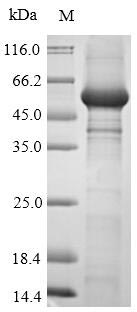
Predicted: 129 kDa
Customer Reviews
Loading reviews...
Share Your Experience
Similar Products

Product Notes
The USP7 usp7 (Catalog #AAA326686) is an Antibody produced from Rabbit and is intended for research purposes only. The product is available for immediate purchase. The USP7 Antibody reacts with Human, Mouse, Rat and may cross-react with other species as described in the data sheet. AAA Biotech's USP7 can be used in a range of immunoassay formats including, but not limited to, ELISA, ICC (Immunocytochemistry), IF (Immunofluorescence), IHC (Immunohistochemistry), WB (Western Blot). Researchers should empirically determine the suitability of the USP7 usp7 for an application not listed in the data sheet. Researchers commonly develop new applications and it is an integral, important part of the investigative research process. It is sometimes possible for the material contained within the vial of "USP7, Polyclonal Antibody" to become dispersed throughout the inside of the vial, particularly around the seal of said vial, during shipment and storage. We always suggest centrifuging these vials to consolidate all of the liquid away from the lid and to the bottom of the vial prior to opening. Please be advised that certain products may require dry ice for shipping and that, if this is the case, an additional dry ice fee may also be required.Precautions
All products in the AAA Biotech catalog are strictly for research-use only, and are absolutely not suitable for use in any sort of medical, therapeutic, prophylactic, in-vivo, or diagnostic capacity. By purchasing a product from AAA Biotech, you are explicitly certifying that said products will be properly tested and used in line with industry standard. AAA Biotech and its authorized distribution partners reserve the right to refuse to fulfill any order if we have any indication that a purchaser may be intending to use a product outside of our accepted criteria.Disclaimer
Though we do strive to guarantee the information represented in this datasheet, AAA Biotech cannot be held responsible for any oversights or imprecisions. AAA Biotech reserves the right to adjust any aspect of this datasheet at any time and without notice. It is the responsibility of the customer to inform AAA Biotech of any product performance issues observed or experienced within 30 days of receipt of said product. To see additional details on this or any of our other policies, please see our Terms & Conditions page.Item has been added to Shopping Cart
If you are ready to order, navigate to Shopping Cart and get ready to checkout.