

 Application Data
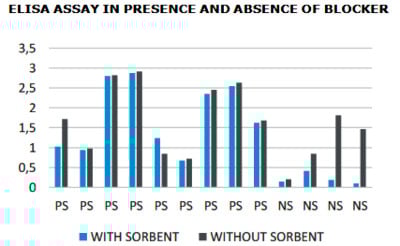
(Indirect IgG ELISA assay was performed with SAG1 of T. gondii (Please inquire) produced in P. pastoris. The coating was carried out with 1 ug/ml of protein. The assays were performed with (blue) and without (grey) blocker incubation. PS means positive serum and NS means negative serum.)
Application Data
(Indirect IgG ELISA assay was performed with SAG1 of T. gondii (Please inquire) produced in P. pastoris. The coating was carried out with 1 ug/ml of protein. The assays were performed with (blue) and without (grey) blocker incubation. PS means positive serum and NS means negative serum.)
Sorbent for anti-cross-reactive carbohydrate determinants (CCD) Reagent
Sorbent for anti-cross-reactive carbohydrate determinants (CCD) antibodies
Application Data
(Indirect IgG ELISA assay was performed with SAG1 of T. gondii (Please inquire) produced in P. pastoris. The coating was carried out with 1 ug/ml of protein. The assays were performed with (blue) and without (grey) blocker incubation. PS means positive serum and NS means negative serum.)
Application Data
(Indirect IgG ELISA assay was performed with SAG1 of T. gondii (Please inquire) produced in P. pastoris. The coating was carried out with 1 ug/ml of protein. The assays were performed with (blue) and without (grey) blocker incubation. PS means positive serum and NS means negative serum.)
Application Data
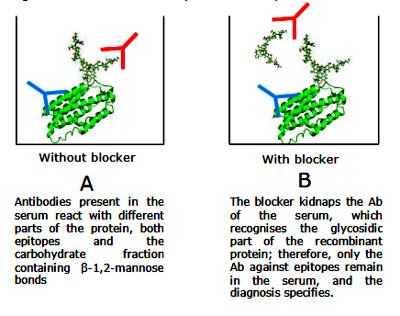
(As some human normal sera contains IgG antibodies against mannan, they can interact with the CCD structures of the proteins produced in Pichia (A). With addition of the blocker, the anti-CCD antibodies will be kidnapped, and the specificity of the assay will increase.)
Application Data
(As some human normal sera contains IgG antibodies against mannan, they can interact with the CCD structures of the proteins produced in Pichia (A). With addition of the blocker, the anti-CCD antibodies will be kidnapped, and the specificity of the assay will increase.)
Application Data
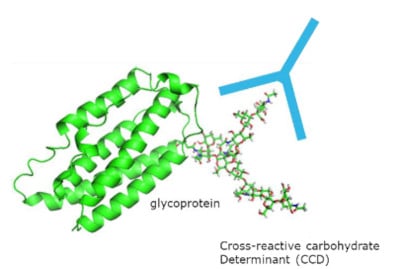
(The glycoprotein contains a carbohydrate structure which can act as a cross-reactive carbohydrate determinant (CCD), interacting with IgG antibodies anti-mannan present in some normal human sera. The β-1,2-linked Man residues have been established to be potent antigens for the adaptive immune response and to elicit specific infection protective antibodies. These IgG antibodies present in the normal human sera can cross-react to glycoproteins which contain these ?-1,2-linked Man residues in their glycan structure as the glycoproteins produced in Pichia pastoris (Mille et al., 2008). The methylotrophic yeast Pichia pastoris, currently reclassified as Komagataella pastoris, has become a substantial workhorse for biotechnology, especially for heterologous protein production. One of the main benefits of this system compared with bacterial systems lies in the fact that glycosylated proteins can be produced, which help to a correct folding of the secreted protein. Successful expression of many industrial enzymes as well as pharmaceutically relevant proteins has rendered the methylotrophic yeast P. pastoris one of the most suitable and powerful protein production host systems, and without doubt, the currently most inexpensive eukaryotic expression system in market. The blocker eliminates anti-CCD IgG antibodies from patient serum, which increases the specificity of the result. The use of the anti-CCD-blocker IgG only is indicated when antibodies against CCD structures are present in the patient serum.)
Application Data
(The glycoprotein contains a carbohydrate structure which can act as a cross-reactive carbohydrate determinant (CCD), interacting with IgG antibodies anti-mannan present in some normal human sera. The β-1,2-linked Man residues have been established to be potent antigens for the adaptive immune response and to elicit specific infection protective antibodies. These IgG antibodies present in the normal human sera can cross-react to glycoproteins which contain these ?-1,2-linked Man residues in their glycan structure as the glycoproteins produced in Pichia pastoris (Mille et al., 2008). The methylotrophic yeast Pichia pastoris, currently reclassified as Komagataella pastoris, has become a substantial workhorse for biotechnology, especially for heterologous protein production. One of the main benefits of this system compared with bacterial systems lies in the fact that glycosylated proteins can be produced, which help to a correct folding of the secreted protein. Successful expression of many industrial enzymes as well as pharmaceutically relevant proteins has rendered the methylotrophic yeast P. pastoris one of the most suitable and powerful protein production host systems, and without doubt, the currently most inexpensive eukaryotic expression system in market. The blocker eliminates anti-CCD IgG antibodies from patient serum, which increases the specificity of the result. The use of the anti-CCD-blocker IgG only is indicated when antibodies against CCD structures are present in the patient serum.)
Blocker Addition
(Add the needed quantity to the sample diluent to reach the final blocker concentration between 0.125 and 5 mg/ml. A larger blocker quantity will be required when the serum dilution is minor. Incubate at RT for 10 min. Afterwards, the assay can be proceeded as usual.)
Blocker Addition
(Add the needed quantity to the sample diluent to reach the final blocker concentration between 0.125 and 5 mg/ml. A larger blocker quantity will be required when the serum dilution is minor. Incubate at RT for 10 min. Afterwards, the assay can be proceeded as usual.)
Blocker Addition
(The procedure wil be as follows:Reconstitute with 0.94 ml of water, shake at RT for 5 min to obtain a homogeneous solution, considering that part of the cake can be on the container's glass walls. If the complete content is not immediately used, it can be aliquoted and stored at -20°C.)
Blocker Addition
(The procedure wil be as follows:Reconstitute with 0.94 ml of water, shake at RT for 5 min to obtain a homogeneous solution, considering that part of the cake can be on the container's glass walls. If the complete content is not immediately used, it can be aliquoted and stored at -20°C.)
Cross-reactive carbohydrate determinants (CCD) are glycan structures attached to proteins during post-translational modifications. In addition to the CCD structures of glycosylated proteins from plants or invertebrates, which are immunogenic (as they differ from those of human glycoproteins), there are also glycoproteins from several yeast species which have adapted to colonize human tissue. One example is the endo-saprophytic yeast Candida albicans, which can invade human tissues in immunosuppressed patients, leading to frequent nosocomial systemic infections. Among these virulence attributes critical for survival under changing environmental conditions, is the yeast cell wall containing large amounts of carbohydrates and carbohydrates covalently linked to a noncarbohydrate moiety classified as glycoconjugates, either glycoproteins or glycolipids. Despite similarities in the early steps of processing, the mature structure of glycans differs substantially between yeasts and mammals. Depending on the species, fungal high mannose glycans contain distinctive modifications, such as the addition of mannosyl phosphate and beta-linked mannose. These IgG antibodies against the ?-linked mannose are frequently present among healthy individuals without regard to age, race, or gender.
Bradford, MM. A rapid and sensitive method for the quantitation of microgram quantities of protein utilizing the principle of protein dye binding. Anal Biochem. 1976, 131:499-503.
Customer Reviews
Loading reviews...
Share Your Experience
Similar Products



Product Notes
The Sorbent for anti-cross-reactive carbohydrate determinants (CCD) (Catalog #AAA72875) is a Reagent and is intended for research purposes only. The product is available for immediate purchase. It is sometimes possible for the material contained within the vial of "Sorbent for anti-cross-reactive carbohydrate determinants (CCD), Reagent" to become dispersed throughout the inside of the vial, particularly around the seal of said vial, during shipment and storage. We always suggest centrifuging these vials to consolidate all of the liquid away from the lid and to the bottom of the vial prior to opening. Please be advised that certain products may require dry ice for shipping and that, if this is the case, an additional dry ice fee may also be required.Precautions
All products in the AAA Biotech catalog are strictly for research-use only, and are absolutely not suitable for use in any sort of medical, therapeutic, prophylactic, in-vivo, or diagnostic capacity. By purchasing a product from AAA Biotech, you are explicitly certifying that said products will be properly tested and used in line with industry standard. AAA Biotech and its authorized distribution partners reserve the right to refuse to fulfill any order if we have any indication that a purchaser may be intending to use a product outside of our accepted criteria.Disclaimer
Though we do strive to guarantee the information represented in this datasheet, AAA Biotech cannot be held responsible for any oversights or imprecisions. AAA Biotech reserves the right to adjust any aspect of this datasheet at any time and without notice. It is the responsibility of the customer to inform AAA Biotech of any product performance issues observed or experienced within 30 days of receipt of said product. To see additional details on this or any of our other policies, please see our Terms & Conditions page.Item has been added to Shopping Cart
If you are ready to order, navigate to Shopping Cart and get ready to checkout.