
 Application Data
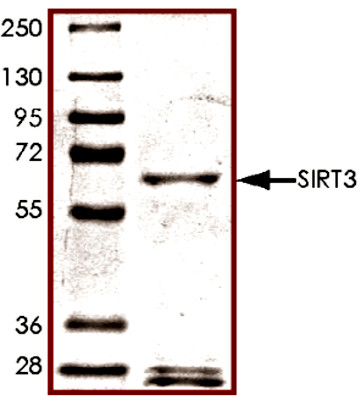
(The purity of SIRT3 was determined to be >70% by densitometry, approx. MW 66kDa.)
Application Data
(The purity of SIRT3 was determined to be >70% by densitometry, approx. MW 66kDa.)
SIRT3 recombinant protein
SIRT3, Active
Gene Names
SIRT3; SIR2L3
Applications
SIRT Assay
Purity
>70%
Synonyms
SIRT3; N/A; SIRT3, Active; SIRT3 recombinant protein
Host
Sf9 insect cells using baculovirus
Purity/Purification
>70%
Form/Format
50mM Tris-HCl, pH 7.5, 150mM NaCl, 10mM glutathione, 0.1mM EDTA, 0.25mM DTT, 0.1mM PMSF, 25% glycerol.
Concentration
0.1 ug/uL (varies by lot)
Sequence Positions
47-end
Sequence Length
2919
Applicable Applications for SIRT3 recombinant protein
SIRT Assay
Species
Human
Tag
GST tag
Dry Ice Note
The product may be shipped with dry ice, and an additional fee may be added to your shipping cost.
Preparation and Storage
Store product at -70 degree C.
For optimal storage, aliquot target into smaller quantities after centrifugation and store at recommended temperature.
For most favorable performance, avoid repeated handling and multiple freeze/thaw cycles.
For optimal storage, aliquot target into smaller quantities after centrifugation and store at recommended temperature.
For most favorable performance, avoid repeated handling and multiple freeze/thaw cycles.
Application Data
(The purity of SIRT3 was determined to be >70% by densitometry, approx. MW 66kDa.)
Application Data
(The purity of SIRT3 was determined to be >70% by densitometry, approx. MW 66kDa.)
Application Data
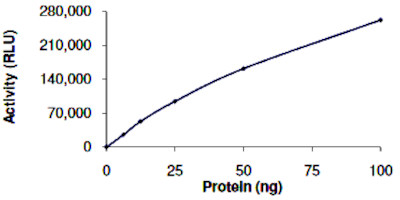
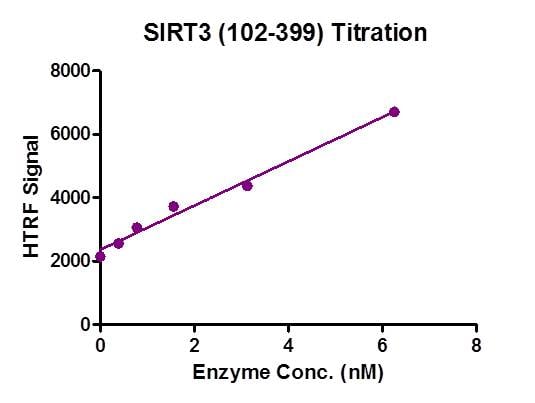
(The specific activity of SIRT3 was determined to be 170 RLU/min/mg as per activity assay protocol.)
Application Data
(The specific activity of SIRT3 was determined to be 170 RLU/min/mg as per activity assay protocol.)
Related Product Information for SIRT3 recombinant protein
Description: Recombinant human SIRT3 (47-end) was expressed by baculovirus in Sf9 insect cells using a C-terminal GST tag.
Scientific Background: SIRT3 is a member of the class I of the Sirtuin family that is characterized by a Sirtuin core domain. Sirtuin are grouped into four classes and are homologs to the Sir2 protein. SIRT3 is known to regulate the epigenetic gene silencing and suppresses recombination of rDNA (1). SIRT3 may function as an intracellular regulatory protein with mono-ADP-ribosyltransferase activity that is essential for its silencing function. SIRT3 regulates and maintains basal ATP levels in the cell (2). SIRT3 also modulates mitochondrial intermediary metabolism and fatty acid use during fasting (3).
Scientific Background: SIRT3 is a member of the class I of the Sirtuin family that is characterized by a Sirtuin core domain. Sirtuin are grouped into four classes and are homologs to the Sir2 protein. SIRT3 is known to regulate the epigenetic gene silencing and suppresses recombination of rDNA (1). SIRT3 may function as an intracellular regulatory protein with mono-ADP-ribosyltransferase activity that is essential for its silencing function. SIRT3 regulates and maintains basal ATP levels in the cell (2). SIRT3 also modulates mitochondrial intermediary metabolism and fatty acid use during fasting (3).
Product Categories/Family for SIRT3 recombinant protein
References
1. Tanny, J. C. et.al: An enzymatic activity in the yeast Sir2 protein that is essential for gene silencing. Cell 99: 735-745, 1999. 2. Ahn, B.-H. et.al: A role for the mitochondrial deacetylase Sirt3 in regulating energy homeostasis. Proc. Nat. Acad. Sci. 105: 14447-14452, 2008. 3. Hirschey, M. D. et.al: SIRT3 regulates mitochondrial fatty-acid oxidation by reversible enzyme deacetylation. Nature 464: 121-125, 2010.
NCBI and Uniprot Product Information
NCBI GI #
NCBI GeneID
NCBI Accession #
NCBI GenBank Nucleotide #
Molecular Weight
66 kDa
NCBI Official Full Name
Homo sapiens sirtuin 3 (SIRT3), transcript variant 1, mRNA
NCBI Official Synonym Full Names
sirtuin 3
NCBI Official Symbol
SIRT3
NCBI Official Synonym Symbols
SIR2L3
NCBI Protein Information
NAD-dependent protein deacetylase sirtuin-3, mitochondrial
UniProt Protein Name
NAD-dependent protein deacetylase sirtuin-3, mitochondrial
UniProt Gene Name
SIRT3
UniProt Synonym Gene Names
SIR2L3; hSIRT3
Customer Reviews
Loading reviews...
Share Your Experience
Similar Products



Product Notes
The SIRT3 sirt3 (Catalog #AAA73140) is a Recombinant Protein produced from Sf9 insect cells using baculovirus and is intended for research purposes only. The product is available for immediate purchase. The immunogen sequence is 47-end. AAA Biotech's SIRT3 can be used in a range of immunoassay formats including, but not limited to, SIRT Assay. Researchers should empirically determine the suitability of the SIRT3 sirt3 for an application not listed in the data sheet. Researchers commonly develop new applications and it is an integral, important part of the investigative research process. It is sometimes possible for the material contained within the vial of "SIRT3, Recombinant Protein" to become dispersed throughout the inside of the vial, particularly around the seal of said vial, during shipment and storage. We always suggest centrifuging these vials to consolidate all of the liquid away from the lid and to the bottom of the vial prior to opening. Please be advised that certain products may require dry ice for shipping and that, if this is the case, an additional dry ice fee may also be required.Precautions
All products in the AAA Biotech catalog are strictly for research-use only, and are absolutely not suitable for use in any sort of medical, therapeutic, prophylactic, in-vivo, or diagnostic capacity. By purchasing a product from AAA Biotech, you are explicitly certifying that said products will be properly tested and used in line with industry standard. AAA Biotech and its authorized distribution partners reserve the right to refuse to fulfill any order if we have any indication that a purchaser may be intending to use a product outside of our accepted criteria.Disclaimer
Though we do strive to guarantee the information represented in this datasheet, AAA Biotech cannot be held responsible for any oversights or imprecisions. AAA Biotech reserves the right to adjust any aspect of this datasheet at any time and without notice. It is the responsibility of the customer to inform AAA Biotech of any product performance issues observed or experienced within 30 days of receipt of said product. To see additional details on this or any of our other policies, please see our Terms & Conditions page.Item has been added to Shopping Cart
If you are ready to order, navigate to Shopping Cart and get ready to checkout.